The biggest mistake faculty make about promotion is this: they think “educational scholarship” means “I must publish randomized controlled trials on teaching.” Wrong.
If you’re in a medical school, educational scholarship is broader, more practical, and frankly more attainable than that.
Let me lay it out clearly.
What actually counts as educational scholarship?
Use this filter:
It’s educational scholarship if:
- It’s about teaching, learning, assessment, curriculum, or faculty development and
- It’s systematic, documented, shared beyond your immediate setting, and reviewable by peers.
If those four boxes are checked, you’ve probably got something you can put in the “Educational Scholarship” section of your CV or promotion dossier.
Here’s what typically counts at most medical schools:
- Peer‑reviewed educational research articles
- Peer‑reviewed curriculum or assessment innovations
- Invited workshops or courses (with materials) on teaching/education
- Educational review articles, guides, or book chapters
- Nationally distributed teaching tools (OSCE cases, question banks, videos, e-modules)
- Leadership of major educational programs with evidence of outcomes
- Digital scholarship (blogs, podcasts, FOAMed, YouTube) that’s structured and citable
- Funded education grants and resulting products
And here’s what often does not count as scholarship by itself (but can be converted):
- “I give great lectures.”
- “Residents like my teaching.”
- “I run our clerkship.”
- “I made some slides and handouts.”
Teaching excellence is essential, but teaching ≠ scholarship. Scholarship requires evidence, structure, and dissemination.
The four-part test: How to know if your work is scholarship
If you remember nothing else, use this four-part test. Any educational activity can become scholarship if you intentionally build these in.

| Step | Description |
|---|---|
| Step 1 | Educational activity |
| Step 2 | Improve local teaching only |
| Step 3 | Educational scholarship |
| Step 4 | Systematic? |
| Step 5 | Documented? |
| Step 6 | Shared beyond local? |
| Step 7 | Peer review or citable? |
1. Systematic
You didn’t just wing it.
You:
- Used educational theory or prior literature to design the thing
- Defined goals (knowledge, skills, attitudes, performance)
- Chose methods on purpose, not by habit (“I like PowerPoint” is not a method)
- Collected some form of evaluation or outcomes data (learners, faculty, patients, systems, etc.)
Example: You redesign your IM morning report using case-based learning, set clear objectives, plan a 6‑month rollout, and measure learner engagement and diagnostic reasoning using pre/post tests.
That’s systematic. Not just “we changed it and people seemed to like it.”
2. Documented
You can hand someone a “packet” (physical or digital).
That packet might include:
- Description of the setting and learners
- Objectives
- Methods and materials
- Assessment tools
- Outcomes data (survey, scores, performance, usage analytics)
- Reflection on what worked / didn’t
If all your work lives in your head or scattered emails, it’s not scholarship yet. Documentation is what converts “stuff I do” into “stuff I can show.”
3. Shared beyond your immediate setting
Local-only = good for learners.
Beyond-local = good for your CV.
Ways to share:
- Peer-reviewed journal publication (research, innovations, briefs)
- MedEdPORTAL or similar repositories
- National, regional, or major institutional presentations (oral, poster, or workshop)
- Invited curriculum consultations at other institutions
- Widely used online resources (podcast series, blog, video channel) with real reach
Key point: A grand rounds at your own institution is weak scholarship.
A workshop at a national meeting with peer review and posted materials online is strong scholarship.
4. Peer-reviewable / citable
Someone outside your own department could, in theory, review, critique, and cite your work.
This usually means:
- It has a stable place to “live” (journal, repository, conference proceedings, citable webpage)
- It’s not just a talk that evaporated once people left the room
- There’s enough detail that someone else could repeat or adapt it
Handing out slides at noon conference? Not scholarship.
Having your curriculum published in MedEdPORTAL with methods, tools, and results? Scholarship.
Common categories of educational scholarship (with examples)
Here’s how promotion committees actually classify things, even if the language varies slightly.
| Category | Typical Evidence |
|---|---|
| Ed research articles | Peer-reviewed papers |
| Curriculum/assessment innovations | MedEdPORTAL, journals |
| Program leadership with outcomes | Reports, publications |
| Faculty development | Workshops, toolkits |
| Digital scholarship (FOAMed, etc.) | Metrics, citations |
| Books/chapters/guides | Publisher, impact |
1. Educational research
This is the classic stuff:
- Quantitative or qualitative studies of teaching methods, curricula, assessments, remediation, feedback, simulation, etc.
- Examples: Clerkship grading equity studies, OSCE validity evidence, impact of a new bootcamp on intern performance.
What committees look for:
- Peer-reviewed articles in recognizable journals (Acad Med, Med Educ, JGME, etc.)
- Evidence that you’re first or senior author on multiple works
- Some methodological rigor (not just bad pre/post surveys with no thought behind them)
2. Curriculum and assessment innovations
This is where many clinician‑educators leave promotion money on the table.
Countable examples:
- You design a new longitudinal primary care curriculum and publish the design, materials, and outcomes
- You create an OSCE station set with standardized rubrics and submit to MedEdPORTAL
- You build a new EPAs‑based assessment system and present it at a national meeting + publish a program description
The key: You move from “we made a cool thing” to “we described the cool thing and its impact so others can use it.”
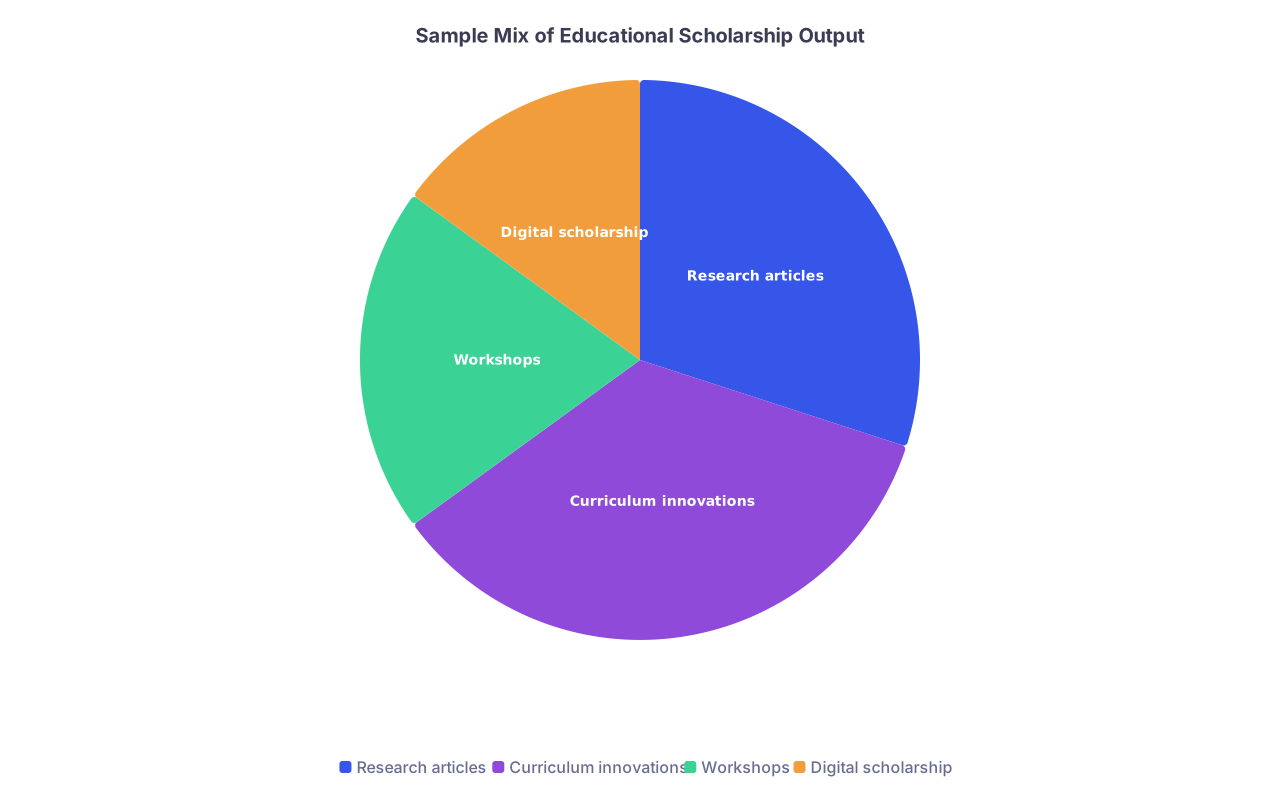
| Category | Value |
|---|---|
| Research articles | 30 |
| Curriculum innovations | 35 |
| Workshops | 20 |
| Digital scholarship | 15 |
3. Faculty development and leadership in education
Your job title can itself generate scholarship—if you do it right.
Things that can count:
- Directing a residency program, clerkship, or course and publishing about your innovations, outcomes, or models
- Building a faculty development program (e.g., residents-as-teachers curriculum) and disseminating it
- Leading competency committee redesign and presenting your approach nationally
Directorship alone is service.
Directorship + systematic innovation + data + dissemination = scholarship.
4. Reviews, guides, and book chapters in medical education
Not as strong as original research but absolutely part of the portfolio:
- Review articles on feedback methods, simulation, assessment, wellness curricula
- How‑to pieces: “Practical guide to designing a bootcamp,” “Ten tips for effective OSCE stations”
- Book chapters in recognized MedEd texts
Again: the topic must be education, not clinical content.
5. Digital and open educational resources (FOAMed, podcasts, blogs, videos)
This is where a lot of younger faculty generate massive impact and then undersell it.
This can count, but you must treat it like scholarship:
- Clear educational objectives
- Defined target audience
- Regular cadence and evidence of reach (downloads, views, followers, citations, mentions)
- Ideally, peer review (editorial boards, open reviews, or external reviewers)
- Ability to be cited (DOI, stable URL, indexing)
Examples:
- Co‑running a widely used EM education podcast with documented learner use in programs nationwide
- Writing a high‑quality medical education blog that’s been cited in the literature or integrated into curricula
- Creating a video series on OSCE skills adopted by multiple schools and embedded in formal courses
How many and what kind of scholarship do you actually need?
This depends heavily on your promotion track: clinician‑educator vs. tenure/research vs. clinical.
General reality for clinician‑educator tracks (ballpark, not gospel):
Assistant to Associate Professor
- 5–15 peer‑reviewed educational products total
- Mix of: a few solid papers, some MedEdPORTAL or equivalent, several peer‑reviewed workshops or national presentations
- Evidence of growing regional or national reputation in education
Associate to Full Professor
- 15+ items, with increasing depth and impact
- Clear educational focus/brand (e.g., assessment, simulation, professionalism, remediation)
- Reputation is national and often international; invited talks, external reviews, leadership roles in societies
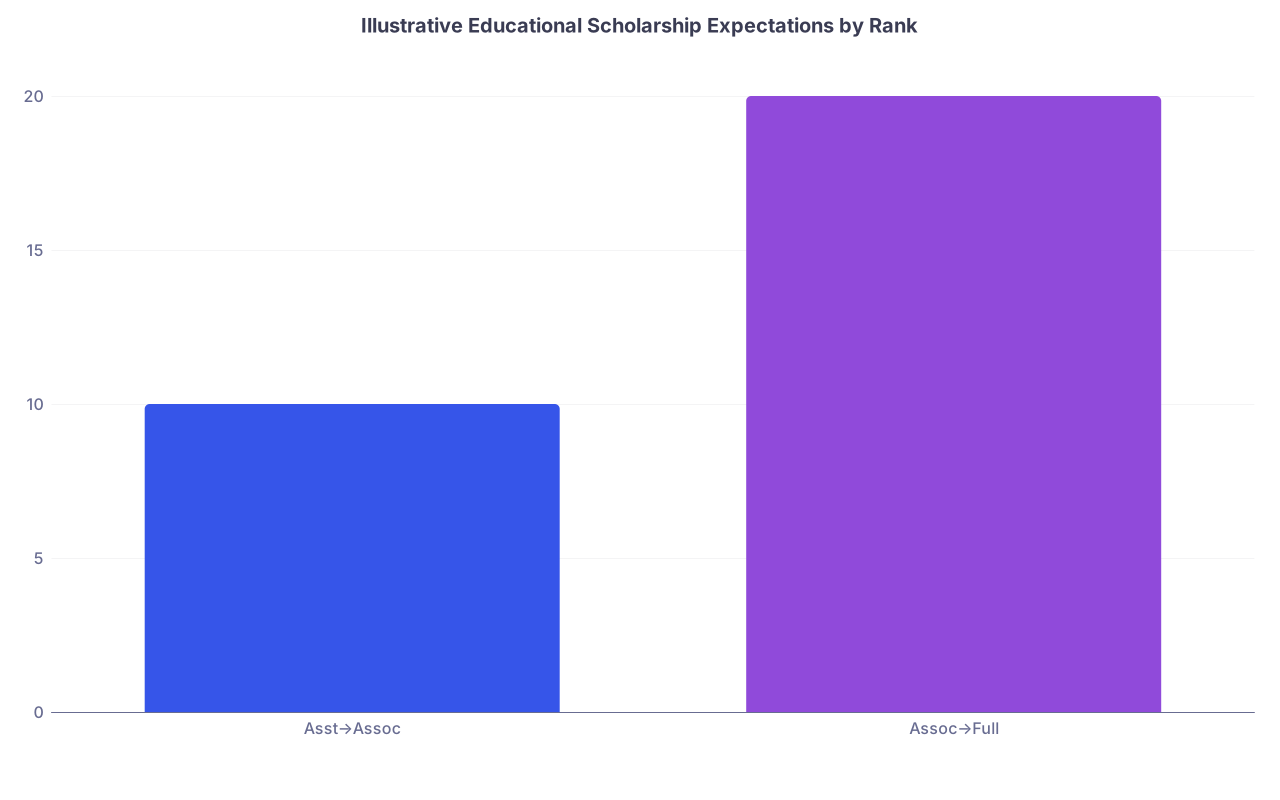
| Category | Value |
|---|---|
| Asst→Assoc | 10 |
| Assoc→Full | 20 |
On research‑heavy or tenure tracks, expectations may be:
- More publications
- More rigorous methods
- External grant funding for educational research
Bottom line: Ask your promotions committee for the actual criteria document and read the section on “Educational Contributions” or “Teaching and Mentoring.” Don’t guess.
How to turn what you’re already doing into scholarship
You’re probably sitting on scholarship opportunities right now. Here’s the conversion playbook.
Step 1: Inventory your work
List:
- Courses, clerkships, conferences you lead or heavily contribute to
- New or redesigned curricula
- Assessment tools you’ve built (rubrics, OSCEs, EPA tools, progress tests)
- Faculty development series you run
- Any educational content you’ve shared outside your department
Then ask: “What did I do here that’s new, intentional, and measurable?”

| Step | Description |
|---|---|
| Step 1 | List current teaching work |
| Step 2 | Identify innovations |
| Step 3 | Collect data and outcomes |
| Step 4 | Write up or package materials |
| Step 5 | Submit to journal or repository |
| Step 6 | Submit to conference or workshop |
Step 2: Add data and structure
Take one project and:
- Write clear objectives
- Collect baseline and follow‑up data (surveys, scores, performance, usage metrics)
- Add a short literature review to frame what you’re doing
- Reflect on what worked, what didn’t, and what you’d change
Now you’re in scholarship territory.
Step 3: Choose a dissemination target early
Decide: Is this a paper, a MedEdPORTAL submission, a workshop, or all three?
Why it matters:
- A MedEdPORTAL paper needs detailed materials and implementation guides
- A research article needs a more formal methods and results section
- A workshop needs interactive design and handouts
Plan the endgame at the start. It changes how you design the project.
The “gray zone”: What people argue about
Some things are controversial across institutions. Expect variability.
Local workshops and talks
- At small institutions, some internal workshops are counted as scholarship if they go through peer review and have broad institutional impact.
- At larger ones, they’re usually “service” unless clearly innovative and documented.
Invited talks
- National invited talks about your educational work usually help your reputation more than your publication count.
- Still, they’re evidence of impact.
Quality improvement vs education research
- If the main outcome is patient care metrics or workflow, it’s QI.
- If the main outcome is trainee/faculty knowledge, skills, behaviors, or assessment methods, it’s education.
- A good project can be both, but be explicit.
Non–peer reviewed stuff
- Blog posts, internal reports, white papers, unreviewed toolkits.
- These help your narrative and can show leadership, but they rarely carry the same weight as peer-reviewed products.
- Still include them—just don’t overclaim.

Quick reality check: Are you on track?
Ask yourself:
- Do I have at least one identifiable area of educational focus? (e.g., assessment, simulation, curriculum design, feedback)
- Can I point to 3–5 products in that area that show progression and increasing sophistication?
- Has anything I’ve created been used or cited outside my home institution?
- Could someone reasonably say, “You’re the ‘X’ person” in our region? (X = remediation, OSCE design, tech-enhanced learning, etc.)
If the answer to most of those is no, you don’t need to panic. You just need to start converting your daily education work into documentable, disseminated scholarship.
FAQs
1. Do teaching evaluations and teaching awards count as educational scholarship?
They count as evidence of teaching excellence, which matters a lot—but they are usually not classified as scholarship. Put them in the “Teaching” or “Honors/Awards” sections. You still need actual scholarly products (publications, presentations, curricular materials) for the scholarship part of your dossier.
2. Does MedEdPORTAL “count” as much as a traditional journal article?
At most places, yes—for educational innovation and curriculum work, MedEdPORTAL is often treated as equivalent to a peer-reviewed publication. It’s indexed, peer-reviewed, and focused exactly on curriculum and assessment tools. For tenure‑track research roles, pure research journals may be valued more, but MedEdPORTAL is still a strong signal of scholarship.
3. Do posters and workshops at conferences really matter, or is it all about papers?
They matter. Peer‑reviewed posters and workshops show that others find your work worth reviewing and sharing. For early‑career clinician‑educators, a mix of posters, workshops, and a few solid publications is perfectly reasonable. As you move toward full professor, written, citable products (articles, MedEdPORTAL) become relatively more important, but talks and workshops still strengthen your national reputation.
4. Can digital scholarship like blogs and podcasts be my primary form of educational scholarship?
Yes—but only if you treat it like scholarship. That means clear educational intent, audience, structure, and metrics. You should also document peer review or editorial oversight if possible. Many promotion committees still think in terms of “papers,” so you’ll need to make a strong, explicit case for rigor and impact and often supplement digital work with more traditional outputs.
5. I direct a major clerkship. Isn’t that enough for promotion as an educator?
No. Directing a clerkship is essential and valued, but by itself it’s administrative/educational service, not scholarship. For promotion, you need to show you improved or innovated in that role and then studied and disseminated what you did—via publications, MedEdPORTAL, or national presentations.
6. What’s the fastest way to get my first piece of educational scholarship on my CV?
Pick one existing teaching project (a new session, curriculum tweak, or assessment tool), clean up the documentation, collect some outcomes data, and submit it as a brief innovation or a MedEdPORTAL resource. In parallel, submit a poster or short oral presentation of the same work to a medical education conference (e.g., AAMC, APDIM, AMEE, local GME day). One project, two peer‑reviewed products. That’s how you start building momentum.
Three things to remember:
- Teaching is your base; scholarship is teaching plus intentional design, data, and dissemination.
- Almost any meaningful educational work you’re already doing can be converted into scholarship if you plan for it.
- Promotion committees want to say yes—make it easy for them by giving your best educational work a paper trail and a public home.