
You’re midway through residency or fellowship, stuck on a night shift, and you open your CV for the first time in months. The “Teaching” section is embarrassingly short. A few noon conferences. Some informal med student teaching on rounds. Maybe a simulation session if your program is organized.
You’re aiming for an academic job. But you’re wondering: is this enough teaching to be taken seriously? Or are programs quietly filtering for people with a legit teaching portfolio while you’re hoping that “I like to teach” in your cover letter will carry you?
Let me be blunt: “I enjoy teaching” with no receipts is useless. But you also do not need to be a mini–program director with a 10‑page teaching dossier to get hired.
Here’s the real answer, broken down by career stage and specialty.
The Core Principle: It’s Not Hours, It’s Pattern
Programs almost never have a magic number like “X hours of teaching.” What they look for is a clear pattern of engagement with teaching that fits your career stage and your specialty.
They’re asking three questions:
- Have you consistently participated in teaching where it was available?
- Have you taken some initiative beyond what was mandatory?
- Does your story match the job you’re applying for?
So “How much is enough?” changes depending on whether you’re applying for:
- A standard clinical faculty job with some expected teaching.
- A clinician‑educator track.
- A research‑heavy track with minimal teaching expectations.
Let’s sort out what “enough” looks like in real numbers.
What Counts as Teaching? (More Than You Think, Less Than You’d Like)
First, you need to stop under‑calling what you already do.
Things that absolutely count as teaching:
- Bedside teaching on rounds with students and residents.
- Leading small groups (case‑based discussions, problem‑based learning).
- Giving didactics: noon conference, morning report, M&M, grand rounds (if you’ve done it).
- Skills teaching: procedures, ultrasound, OSCE coaching.
- Simulation teaching (codes, trauma, crisis resource management).
- Precepting in clinic (once you’re senior enough).
- Mentoring a student or junior resident through a project, QI, or cases.
- Teaching in non‑clinical settings: anatomy lab, standardized patient sessions, physical exam courses.
Things that are nice, but weaker as “teaching,” on their own:
- “I helped explain things to my co‑residents on nights.”
- “I like to walk patients through their conditions” (patient education ≠ academic teaching).
- One‑off guest talk with no follow‑up, no evaluations, no documentation.
You want tangible, nameable, documentable items. “Led weekly resident noon conferences on ICU topics (10 sessions, 2024–2025).” That sort of thing.
Specialty‑Specific Baselines: What’s “Enough” in Your Field?
Different specialties have different teaching cultures. EM is not Pathology. Radiology is not OB/GYN. Here’s a realistic baseline for someone finishing residency or fellowship and applying for a typical academic clinical job in that specialty.
| Specialty Group | Typical "Enough" Teaching for Entry-Level Academic Job |
|---|---|
| IM, FM, Peds | Regular ward/clinic teaching, 5–10+ formal sessions |
| EM, OB/GYN, Surg | Regular clinical teaching, 3–8 formal sessions |
| Psych, Neuro | Ongoing clinical teaching, 3–6+ formal sessions |
| Radiology, Path | Case-based teaching, 2–5+ formal sessions |
| Anesthesia, ICU | Daily OR/ICU teaching, 3–6+ sim/lectures |
Read that carefully: this is for a general clinical academic job, not a clinician‑educator track.
Now let’s break this down more concretely.
Minimum Teaching Track Record by Career Stage
Think of this as the “you should really hit at least this” guide.
As a Senior Resident (PGY-3+ or equivalent)
If you’re applying for an academic job straight from residency (common in IM, FM, Peds, Psych), I’d want to see:
- Consistent clinical teaching:
You can truthfully say you:- Routinely taught med students / juniors on wards or in clinic.
- Led portions of rounds, presentations, or case discussions.
- At least 3–6 formal teaching sessions, documented:
- Noon conferences / morning reports.
- Small group teaching for med students.
- OSCE or physical exam sessions.
- One or two “above and beyond” items, like:
- Helping organize a teaching curriculum or block.
- Serving as a chief resident, teaching resident, or clinic lead.
- Getting resident teaching awards or nominations.
If you cannot list even 3–4 concrete teaching sessions by PGY‑3 or PGY‑4, that’s a red flag for academic programs. They’ll assume you either don’t prioritize teaching or you’re not proactive.
As a Fellow (Subspecialty)
Fellowship is where academic programs really start looking for direction. By the end of fellowship, if you want an academic job in that subspecialty, you should have:
- Regular involvement in teaching:
- Teaching on rounds or consults.
- Helping run subspecialty conferences or journal clubs.
- 5–10+ named teaching activities over the whole fellowship, such as:
- Didactic lectures to residents or fellows.
- Teaching med students in clinics or electives.
- Simulation or procedural teaching.
- Evidence of progression, like:
- Creating or revamping a lecture, module, or workshop.
- Being asked to repeat or expand a session.
- Invited teaching at another department or site.
For a clinician‑educator fellowship (e.g., medical education tracks), double that. Volume matters more, and you should have some curriculum design and education scholarship on your CV.
How Expectations Change With Job Type
You cannot talk about “enough” without talking about the type of academic job you’re aiming for.
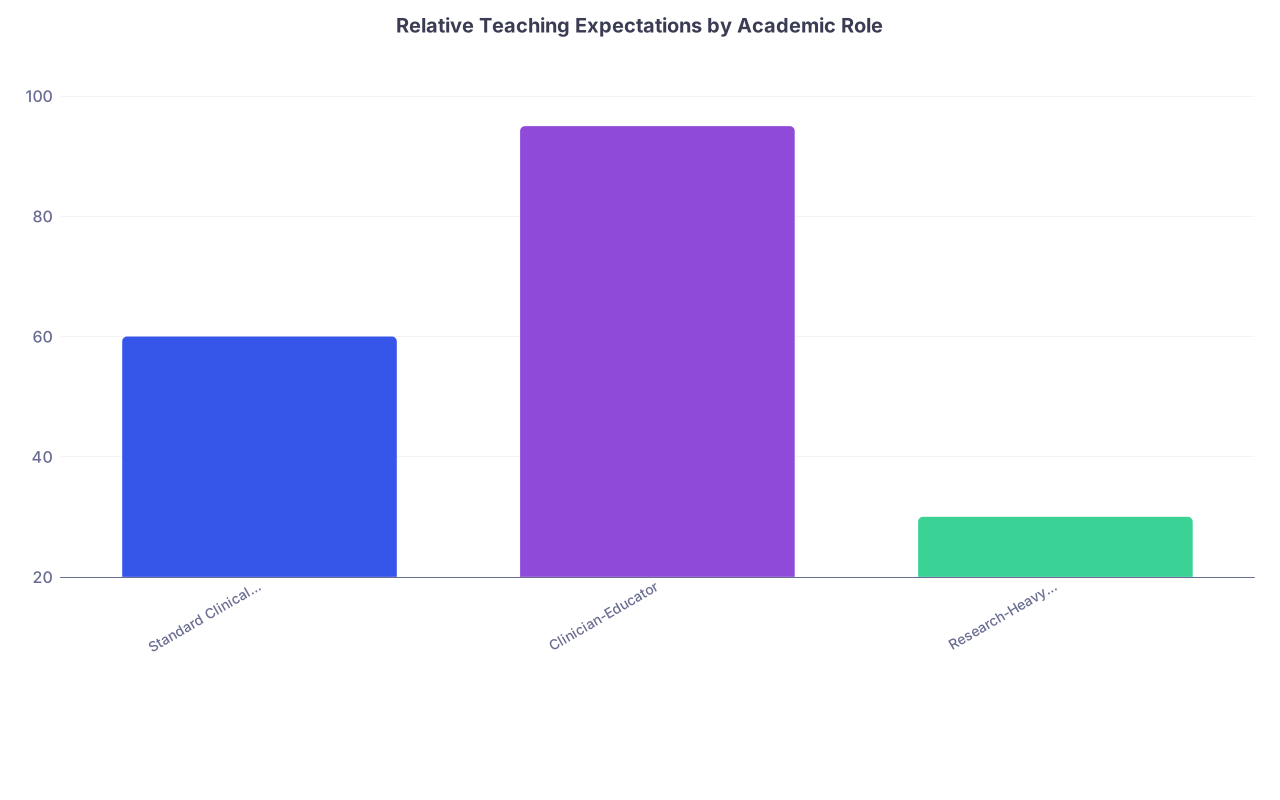
| Category | Value |
|---|---|
| Standard Clinical Faculty | 60 |
| Clinician-Educator | 95 |
| Research-Heavy Faculty | 30 |
Interpretation: higher number = more teaching expected.
1. Standard Clinical Faculty (Teaching-Focused but Not Education Track)
What chairs expect:
- You show up to:
- Teach on rounds or in clinic.
- Give some conferences.
- Work with learners in your practice.
- You have:
- A history of consistent, not extreme, involvement.
- Maybe a teaching award, but it’s not mandatory.
“Enough” here is:
- Strong clinical teaching references (“the residents fought to be on her team”).
- A CV showing several teaching roles each year in residency/fellowship.
- A credible answer in interviews when asked: “What kind of teaching do you enjoy, and how do you approach it?”
2. Clinician-Educator Track
Different world. If you say “I want a clinician‑educator path,” people expect proof:
- Volume: 10–20+ discrete teaching activities by end of fellowship.
- Variety: small groups, large groups, bedside, simulation, maybe online content.
- Development: something more than “I showed up and talked,” such as:
- Designed a new session or curriculum.
- Led an orientation, boot camp, or skills course.
- Helped with evaluation or assessment tools.
- Bonus but very helpful:
- Med Ed certificate, fellowship, or courses.
- One or two education abstracts, posters, or papers.
If your CV shows the same teaching volume as a standard clinical hire, but you’re claiming “education is my main scholarly interest,” that mismatch hurts you.
3. Research-Heavy or Basic Science Faculty
Here, teaching is not the main currency, but you still can’t ignore it.
You want at least:
- A track record of being able to interact with trainees:
- Taught a few didactics or small groups relevant to your research area.
- Mentored a student on a project.
- Enough documentation to show:
- You won’t be a disaster in front of a classroom.
- You’re not hostile to learners.
They won’t require a giant teaching portfolio, but zero teaching is still a bad look in most departments.
By Specialty: What You Should Aim For
Let’s hit some big groups with clear targets.
Internal Medicine, Family Medicine, Pediatrics
These are teaching‑heavy fields.
By end of residency:
- Routine involvement in inpatient and/or outpatient teaching.
- At least:
- 4–8 noon conferences / morning reports.
- 3–5 small group or med student sessions.
- Bonus:
- Chief resident role or equivalent.
- Teaching awards or high evaluations.
By end of fellowship (subspecialty IM/Peds):
- 5–10+ fellow‑level lectures.
- Evidence you can:
- Teach residents and students in a subspecialty clinic.
- Run or co‑lead a conference series or journal club.
Emergency Medicine
EM is chaotic but very teaching-rich.
Realistic target:
- Regular direct teaching on shifts (everyone does that, but still mention it).
- 3–6 formal sessions:
- Conference talks.
- Simulation teaching.
- Procedures workshops.
- Some evidence of:
- Curriculum involvement (e.g., sim course, ultrasound teaching).
- Interest in feedback/coaching.
Surgery (General and Subspecialties), OB/GYN
Surgical fields care about operative teaching plus some didactics.
By end of residency/fellowship:
- Constant in‑OR and peri‑op teaching (again, name it clearly on your CV).
- 3–6 didactic/small group sessions:
- Morbidity & Mortality presentations.
- Grand rounds talk (even as junior presenter).
- Skills labs for junior residents/med students.
- Any role in:
- Boot camps.
- Simulation (e.g., laparoscopy, hysteroscopy).
- Anatomy or procedural courses.
Radiology, Pathology
Teaching is often built into daily work:
- Case conferences.
- Unknowns.
- Slide reviews.
You still need:
- Explicitly listed:
- 2–5 didactic or case‑based sessions.
- Involvement in resident/med student teaching rotations.
- A clear statement of:
- How you teach at the workstation or microscope.
- Any curricula or recurring conference you ran or co‑ran.
How to Build “Enough” Teaching Fast (If You’re Behind)
If you’re close to graduation and feel light on teaching, you need to manufacture structured opportunities. No, not by faking anything. By asking for real teaching jobs now.
Here’s the move:
Tell your PD or APD:
“I’m aiming for an academic job and want more formal teaching experience. Can I take on more structured teaching sessions this year?”Concrete things to ask for:
- A recurring noon conference or case conference slot (monthly or quarterly).
- A small‑group series with med students (exam skills, EKGs, imaging, etc.).
- Participation as faculty in simulations or OSCEs.
- Helping onboard new interns or students (orientation teaching).
Lock it in writing:
- Get it on your schedule.
- Save emails scheduling you. This is your documentation.
After doing the session:
- Ask if there are evaluations you can see or use.
- Log it immediately in a teaching portfolio or CV draft.
A few months of intentional, structured teaching can convert a weak portfolio into a strong one.
Common Mistakes That Make Good Teaching Look Weak
I see these constantly on CVs:
Burying all teaching under “Other” or “Service.”
Create a dedicated “Teaching Experience” section.Vague entries like “Taught medical students on wards, 2022–2024.”
Better: “Bedside teaching for 3rd‑year students on inpatient cardiology rotation, average 2–3 students per block, 2022–2024.”Listing only big talks but ignoring routine roles:
Morning report, skills labs, OSCEs, PBL sessions all count.No indication of frequency:
- Once versus monthly looks the same if you do not specify. Add “Weekly,” “Monthly,” or “One‑time invited lecture” as appropriate.
How To Tell If You Personally Have “Enough”
Here’s a simple mental checklist. If you’re applying for a standard academic clinical job and you can say “yes” to most of these, you’re in good shape:

| Step | Description |
|---|---|
| Step 1 | Start |
| Step 2 | Ask PD for more roles |
| Step 3 | Teaching likely enough |
| Step 4 | Add 1-2 extra roles this year |
| Step 5 | Clinical teaching most rotations? |
| Step 6 | 3 or more formal sessions? |
| Step 7 | Any initiative beyond required? |
If you’re targeting a clinician‑educator role, upgrade the thresholds:
- 10–20+ sessions over training.
- Some curriculum work and/or education scholarship.
If you’re nowhere close, your next move is not panic. It’s to fill the gaps quickly and deliberately.
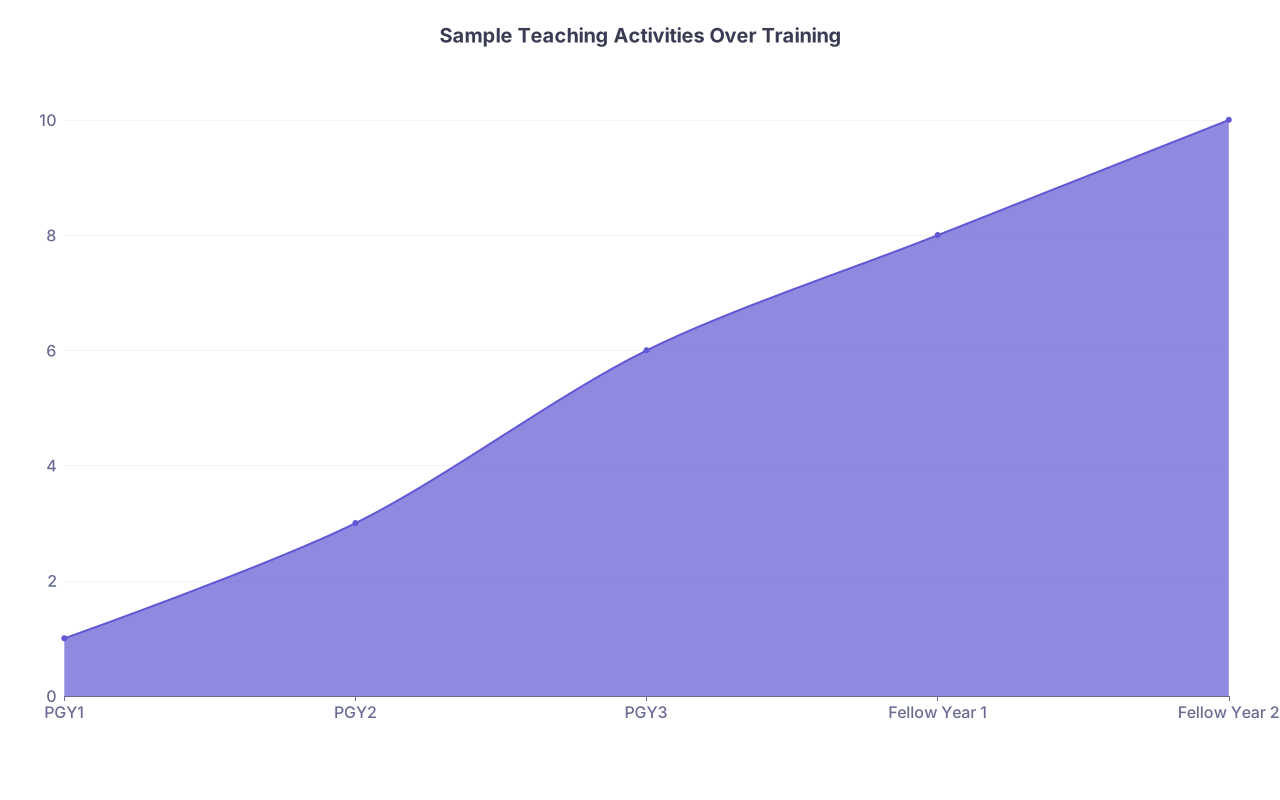
| Category | Value |
|---|---|
| PGY1 | 1 |
| PGY2 | 3 |
| PGY3 | 6 |
| Fellow Year 1 | 8 |
| Fellow Year 2 | 10 |
This is roughly the curve you’re aiming for: a clear upward trajectory.

Quick Reality Check: What Chairs Actually Care About
Most department chairs and division chiefs do not sit with a spreadsheet counting your lectures. They want to know:
- Do learners like working with you?
- Will you reliably show up for teaching commitments?
- Are you growing as a teacher, or are you static?
- Does your stated interest in teaching match the job you’re asking for?
If your references describe you as:
- “One of our best teachers among the senior residents.”
- “Frequently sought out by students.”
- “Took initiative to improve or create sessions.”
…then you’re fine, even if the raw numbers aren’t massive.
If your references are lukewarm (“solid clinician, no concerns, did the required teaching”), you need volume and structure to compensate.
FAQ (Exactly 6 Questions)
1. Do I need formal teaching evaluations or awards to get an academic job?
No, they’re helpful but not mandatory. Evaluations and awards function as “evidence,” but they are not prerequisites. What you must have is a believable track record of consistent teaching, plus references who can directly comment on your teaching. If your program has evals, skim them and be ready to summarize strengths and one or two things you worked on. Do not manufacture drama; just show growth.
2. How should I list teaching on my CV so academic programs take it seriously?
Create a dedicated “Teaching Experience” section. For each item, include: role, audience, topic, format, and frequency. Example: “Lecturer, Resident Noon Conference, Department of Internal Medicine, ‘Approach to Hyponatremia,’ Monthly, 2023–2024.” Group similar activities (e.g., “Morning Report Facilitator, 8 sessions, 2024”) rather than listing each individually. Specific, structured entries look far more impressive than vague statements like “various lectures.”
3. Is informal bedside teaching enough if I have no formal lectures?
For a truly academic‑leaning job, no. Informal bedside teaching is expected of every resident; it is not a differentiator. You need at least a few formal, scheduled, named teaching roles—noon conferences, small groups, skills sessions, simulations. If you’re close to graduation and have done none of these, ask now to be plugged into upcoming sessions. You can repair this gap in a few months if you’re deliberate.
4. What if my specialty is very procedural and not “classic” academic, like ortho or IR?
The bar shifts slightly, but it doesn’t disappear. In procedural fields, programs are happy if you can: teach in the OR/procedure suite, run or help run skills labs, and deliver a handful of structured talks (indications, complications, imaging review, etc.). Case‑based teaching conferences count heavily here. You do not need 20 lectures; you do need consistent involvement in trainee education that matches procedural practice.
5. How do I build a clinician-educator portfolio if I’m starting late (PGY-4/late fellow)?
You compress the timeline. Tell your leadership clearly you’re aiming for an education‑focused role and ask for concentrated teaching: recurring conferences, small‑group series, participation in OSCEs/simulation, help with curriculum blocks. Try to create one new or revamped session you can call your own. If possible, turn that into a brief abstract or education poster. In 6–12 months you can go from thin to solid if you’re aggressive and organized.
6. What’s the biggest sign I do NOT have enough teaching for an academic career yet?
Two things: 1) You cannot list more than 3–4 distinct, scheduled teaching activities over your entire training, and 2) you struggle to answer, specifically, “What kind of teaching do you enjoy, and what have you done to develop that?” If your answers stay generic—“I like teaching on rounds, I explain things a lot”—you need more structure and documentation. Fix it by intentionally seeking recurring, named teaching roles this year and logging them accurately.
Key takeaways:
First, there is no magic number of lectures; programs are looking for a clear pattern of consistent, structured teaching that fits your specialty and your claimed career path. Second, bedside teaching alone is not enough—by the end of training you should have several documented, recurring teaching roles, especially if you want a clinician‑educator track. Build that now, on purpose, and your “Teaching” section will stop being an anxiety trigger and start being a strength.