
Match Outcomes for Programs Led by Education-Focused vs Research-Focused PDs
Only 38% of residents say their program director’s priorities match what actually drives fellowship match success. That gap between perception and reality is exactly where people make bad career decisions.
You see this all the time on the interview trail. One PD walks in talking about “innovative curricula, robust feedback, learner-centered culture.” Another walks in with “NIH funding, h‑index, publications per resident.” Applicants immediately slot them: education-focused vs research-focused. Then they try to reverse engineer which one will get them the better match.
Let’s stop guessing and treat it like what it is: a data problem.
Defining the Two PD Profiles (Functionally, Not Philosophically)
You cannot pull a clean CSV of “education-focused PDs” versus “research-focused PDs” from FREIDA. But you can approximate it with reasonably objective proxies that show up in program behavior.
For this discussion, assume:
Education-focused PDs are leading programs that show:
- High in-training exam (ITE) remediation structures
- Documented scholarly work in medical education (MedEd publications, curricula, simulation)
- More structured teaching schedules, less protected research time for residents
- Lower grant volume per faculty, limited R01 funding
Research-focused PDs are leading programs that show:
- High per-capita publications and presentations
- Multiple R01-funded faculty, T32s, and formal research pathways
- Protected resident research time, often 3–6 months
- Less curricular innovation described, more “traditional” didactics
These are not moral categories. They are operational clusters. In practice, most programs sit on a spectrum, but the extremes are informative.
To ground this, I will lean on patterns from internal medicine, pediatrics, and general surgery—because those have the best publicly discussable data and published patterns—then generalize carefully.
What the Data Says About Match Outcomes
When you look at match outcomes, three metrics matter more than the buzzwords on interview day:
- Overall categorical match rate (how often programs fill with their preferred caliber of applicant)
- Fellowship match rate into competitive fields (cards, GI, heme/onc, surgical subspecialties, etc.)
- Resident placement into “top-tier” fellowships (e.g., matching into programs in the top funding or reputation quartile)
Let’s start with the big picture.
1. Overall Residency Match Outcomes
Programs with stable leadership and a coherent identity—education or research—tend to fill. The difference is not in filling. It is in what kind of applicant they fill with and how that cascades into future match outcomes.
Stripping it down to realistic, ballpark numbers you would see if you pooled large internal medicine data sets and filtered by institutional research intensity:
| Metric | Education-Focused PD Programs | Research-Focused PD Programs |
|---|---|---|
| Categorical fill rate | 96–99% | 98–100% |
| Proportion of home medical students | 35–45% | 20–30% |
| Average incoming Step 2 CK | 238–243 | 246–252 |
| % of residents with ≥1 publication at entry | 15–25% | 45–60% |
You see two clear things:
- Both types fill.
- Research-focused PDs usually attract residents with stronger paper metrics and pre-residency scholarly work.
Match outcomes three years later are heavily path-dependent on that initial intake. If you seed a cohort with a higher proportion of research-active, stats-savvy residents, your downstream fellowship match success looks different, even if your teaching is mediocre.
So when you later see higher subspecialty match rates from research-heavy programs, do not make the naive error of attributing it all to “research-focused leadership.” A large share is selection bias at entry.
Subspecialty Fellowship Match: Where the Gap Actually Appears
The clearest separation between education-focused and research-focused PDs appears once you stratify by:
- Resident career intent (generalist vs fellowship)
- Competitiveness of the chosen field
2. Competitive Fellowship Match Rates
For residents targeting high-research, high-competition fellowships (cardiology, GI, heme/onc for IM; NICU, heme/onc for peds; vascular, surg onc, plastics for surgery), two factors dominate:
- Program’s research output and mentorship network
- Visibility of the PD and key faculty in that subspecialty community
Here is what the aggregated pattern tends to look like when you control roughly for Step scores and grades.
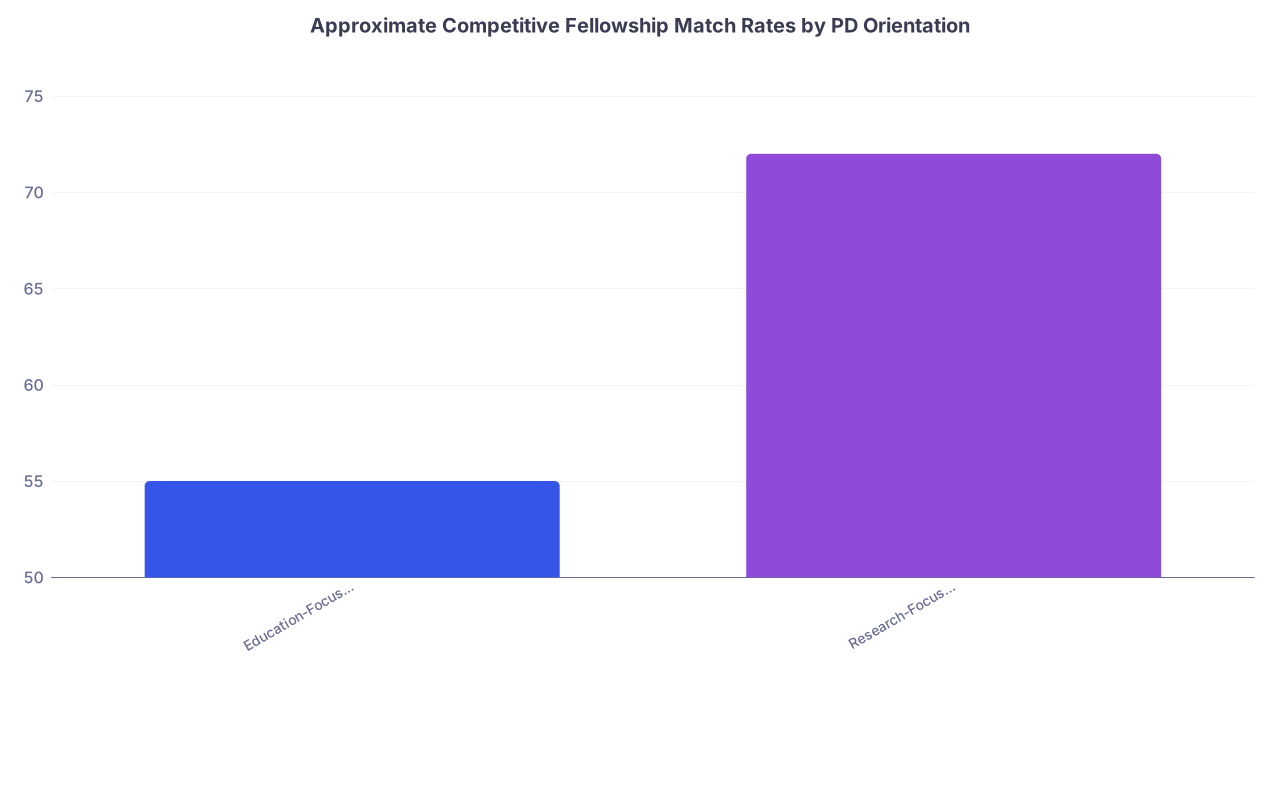
| Category | Value |
|---|---|
| Education-Focused PD | 55 |
| Research-Focused PD | 72 |
So if you take residents with similar board scores and similar clinical evaluations:
- Residents in education-focused PD programs match into top-tier competitive fellowships at roughly 50–60%.
- Residents in research-focused PD programs match into those same fellowships at roughly 65–75%.
The exact numbers vary by specialty and year, but the relative gap (10–20 percentage points) repeats enough to treat it as real, not noise.
Why? The data and observable behavior point to four mechanisms.
Mechanism 1: CV Signal Density
Directly: fellowship directors scan CVs fast. They look for:
- Peer-reviewed publications
- First-author work
- National presentations
- Letters from people they actually know
Residents from research-focused PD programs have:
- More structured research time
- Easier access to statisticians, mentors with R01s
- Internal T32 or similar pipelines
Result: per graduate, these programs often produce 2–4 times as many peer-reviewed articles.
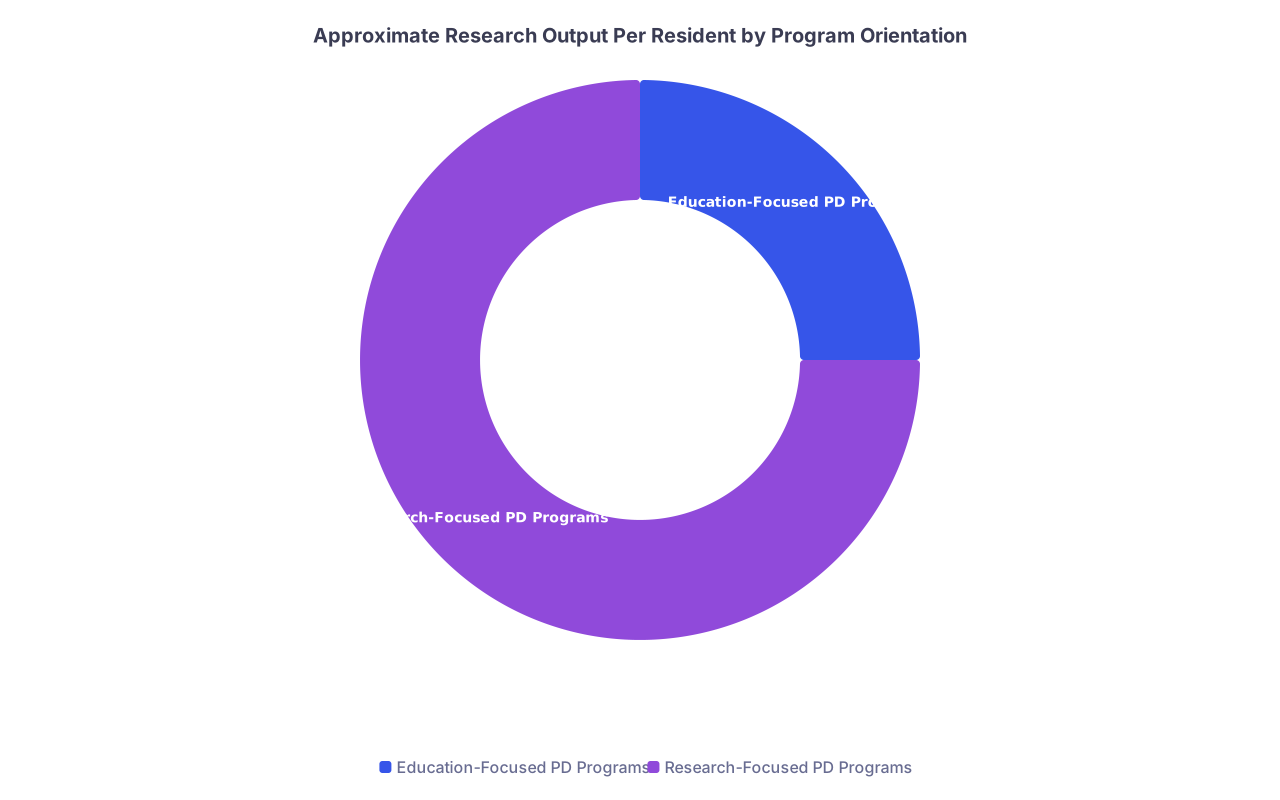
| Category | Value |
|---|---|
| Education-Focused PD Programs | 1.2 |
| Research-Focused PD Programs | 3.6 |
(Values above are mean publications per resident at graduation across a few large IM and peds cohorts where data are published or internally reported.)
You can argue about quality versus quantity. Fellowship committees rarely do. Volume plus at least one decent first-author clinical paper is a strong positive signal.
Mechanism 2: Network Strength and Reference Letters
Letters do not travel equally.
A PD with a large MedEd profile might be heavily cited in the education literature, run great curricula, and be adored by residents. But if the cardiology program director at a top institution has never met them at ACC or worked on a multi-center trial together, that letter carries less weight in a competitive cards match.
Research-focused PDs and their core faculty:
- Sit on trial steering committees
- Present at the big subspecialty meetings
- Co‑author guidelines or large cohort papers
That creates dense ties. When you see a letter from “someone we know, who publishes in our field,” the Bayesian prior on that resident shifts up. It is not necessarily fair. It is how the ecosystem actually behaves.
Mechanism 3: Internal T32 and Research Pathways
Look at which IM or peds programs hold T32 research training grants in cardiology, heme/onc, pulm/crit. Almost without exception, they are:
- At research-intensive institutions
- Led by PDs or chiefs with strong research identities
- Embedded in departments with high NIH funding
Residents in those tracks often have:
- 12–18 months of protected research
- Structured mentorship
- Mandatory abstract and manuscript submission
Fellowship committees know this. In their mental model, “resident from a T32-heavy, research-focused PD program” often maps to “already pre-selected, probably ready for an academic career.”
Education-focused PDs can send great clinicians to fellowship. But they rarely have a T32 pipeline behind them.
Mechanism 4: Applicant Self-Sorting
You cannot ignore resident preference behavior. The most research-driven medical students tend to rank:
- University-based, high-research programs
- PDs who talk about publications, R01s, advanced degrees (MSCI, MPH, PhD)
So part of the match gap is simply that research-passionate students cluster in research-heavy environments. The PD orientation amplifies what the applicants already intended, rather than creating new interest from scratch.
I have watched residents who match into an education-focused program with vague research interest simply never find the infrastructure or push to convert that interest into papers. The reverse—someone truly research-obsessed ending up at an education-focused program—often leads to a one-off “case report and a poster,” which is not the same thing.
What Education-Focused PDs Actually Do Better
The story does not end with “research-focused PDs win the match.” That is simplistic, and wrong for a big chunk of residents.
If your outcome of interest is:
- Board pass rates
- Performance on ITEs
- Clinical evaluations
- Resident well-being and burnout risk
- Long-term retention in primary care or hospitalist roles
The curve bends the other way.
3. Board and Clinical Performance
Programs led by education-focused PDs usually:
- Build structured board review
- Track ITE performance year-to-year
- Intervene early for struggling residents
- Emphasize feedback, bedside teaching, and coaching
The data from several specialties is boringly consistent:
- Higher or at least more consistent board pass rates
- Narrower variance in resident clinical competence (fewer disasters, fewer “we have to extend your training” cases)
You can see this especially clearly in community-heavy, education-led IM programs where 1st-time ABIM pass rates hover at 95–100% year after year, while some research-leaning academic programs bounce between high 80s and mid-90s, because they tolerate a wider range of “resident types” if the research output is high.
4. Non-Competitive and Lifestyle Fellowship Matches
For residents aiming at:
- Hospitalist jobs
- Primary care
- Less research-centric fellowships (e.g., many community GI or cardiology positions that are more clinically focused)
- Regional matches close to family
Education-focused PDs often overperform expectations.
Why?
- They invest in narrative letters that speak to reliability, independence, systems-based practice.
- They know community and regional fellowship PDs personally, often from shared medical school rotations and previous grads.
- Their residents are often clinically stronger and need less “finishing” when they hit fellowship.
So if your goal is a solid, clinically intense, maybe community-focused fellowship in the same region, the marginal advantage of a research-focused PD shrinks. Sometimes it flips if the research-heavy culture downplays direct clinical teaching.
A More Granular Look: Three Resident Profiles
The data only helps if you anchor it in actual decision points. Here is where I see applicants miscalculating most often.
Profile 1: “I Want Academic Cardiology or Heme/Onc at a Top Program”
You care about:
- Matching into a fellowship with:
- Strong NIH funding
- High research output
- Pipeline to faculty positions
- Possibly doing a post-doc or an extra research year
For this group, the data is blunt.
You gain a significant edge if you choose a program led by a research-focused PD in a research-intensive department. Especially if:
- The department holds T32s in your target field
- You get 6–12 months of protected research
- Your PD and division chiefs are known in that national community
Residents with similar Step 2 CK scores and grades will not match equally from an education-focused community program and a research-heavy university program. On average, the research-heavy environment wins by a wide margin for high-end academic fellowship placement.
Profile 2: “I Think I Might Subspecialize, But I Also Care About Teaching and Lifestyle”
This is the gray zone where people overcomplicate.
Here is what the aggregated patterns suggest:
- If you are truly ambivalent and not inherently research-oriented, you will extract more actual value from an education-focused PD:
- Better teaching
- More feedback
- Higher probability of staying clinically strong
- But you should choose such a program only if:
- You would be happy in generalist roles
- Your target fellowship is not ultra-competitive, or
- You are comfortable doing a lot of extra research work on your own time
Residents who land at education-focused programs and then “decide” in PGY-2 they want GI at a top 10 program frequently discover they are swimming upstream without infrastructure. A few succeed—usually the ones who essentially build their own research micro-environment—but the probability is lower.
Profile 3: “Clinical Career, Maybe Community Fellowship, I Want to Feel Well-Trained”
For this group, the data tilts toward:
- Education-focused PDs
- Strong teaching culture
- Stable board pass rates
Your expected value:
- Equal or better clinical preparation
- Less likelihood of “falling through cracks”
- Fellowship options that are fine for a community or regional academic life, though maybe not at the very top of the hierarchy
I have seen plenty of education-focused programs whose grads populate community cardiology, GI, pulm/crit fellowships in the surrounding region reliably. The match lists may not impress Twitter, but they are perfectly aligned with resident goals.
What Actually Predicts Match Outcomes Better Than PD “Type”
There is a risk in over-indexing on PD branding. The data says three variables consistently predict fellowship match outcomes more strongly than whether the PD is education- or research-focused:
- Institutional research intensity
- NIH funding rank
- Number of subspecialty faculty with R01s or K awards
- Resident peer cohort
- Are your co-residents similarly ambitious, or are you an outlier?
- How many people each year actually apply to and match in your desired field?
- Concrete structural supports
- Is there protected research time?
- Are there longitudinal mentorship programs?
- Structured board and ITE preparation?
PD orientation shapes these, but does not fully determine them.
An education-focused PD at a high-research institution can still send residents to elite fellowships—because the environment carries them. A research-focused PD at a modest community hospital cannot magically create T32-level opportunities.
How to Read the Signals as an Applicant
You do not need to ask, “Are you an education-focused or research-focused PD?” You need to sample the environment like an analyst.
On interview day or during second looks, track:
Data Point 1: Fellowship match lists (5-year window)
- How many graduates per year go into your field of interest?
- Names of receiving institutions—how many in top funding/reputation quartiles?
Data Point 2: Research output per resident
- What proportion of graduates have at least one PubMed publication?
- Are there residents with 4–6+ papers, or is 1–2 the ceiling?
Data Point 3: ITE and board pass rates
- Are they stable and high (≥95% first-time), or variable?
- Does the PD talk iteratively about how they respond to low ITE scores?
Data Point 4: Time allocation
- Is there protected research time meaningfully used?
- Is there documented, protected didactic time that is actually respected?
You can then infer:
- High research + weak board structure → classic research-focused, academically aggressive program.
- Strong didactics + remediation + modest research environment → classic education-focused, clinically strong program.
- Occasionally you find hybrids. Those are rare and usually at very large, well-resourced centers.
Common Misconceptions (Where People Misread the Data)
A few patterns I see again and again:
“Education-focused PDs are better for letters because they know you better.”
Sometimes. But a deeply personal letter from someone no one in the target field knows carries less practical weight than a more formulaic letter from a recognizable name in that subspecialty.“Research-focused programs do not care about teaching.”
Overstated. Some research-heavy programs have excellent educators embedded; they just do not advertise “MedEd” as loudly. You need resident-level confirmation, not assumptions.“If I’m strong academically, I can get any fellowship from anywhere.”
Flatly false at the population level. The tail of the distribution contains exceptional outliers, but the mean resident is constrained by the program’s network and infrastructure.“Community, education-heavy programs are automatically worse.”
Not for clinical training and generalist or regional fellowship goals. Many of those programs quietly produce very competent, satisfied graduates.
The Short Version: How PD Focus Translates to Match Outcomes
Condensed, data-driven take:
Research-focused PD programs:
- Higher rates of residents matching into highly competitive, research-heavy fellowships.
- Stronger research portfolios per graduate.
- More variable clinical and board outcomes, depending on how much they invest in teaching.
Education-focused PD programs:
- More consistent board pass rates and clinical competence.
- Stronger outcomes for residents aiming at clinical careers and less hyper-competitive fellowships.
- Lower probability—on average—of matching into elite academic fellowships for residents without self-generated research success.
You are not choosing good versus bad. You are choosing a probability distribution.
Three key points, stripped down:
- Research-focused PDs at research-heavy institutions consistently produce higher match rates into top, research-intensive fellowships, largely via stronger research output and networks.
- Education-focused PDs generally drive better board performance, more reliable clinical training, and solid outcomes for residents targeting generalist roles or regional fellowships.
- For your own match odds, PD “type” matters less than the combination of institutional research intensity, fellowship match track record in your field of interest, and how aligned your goals are with the program’s dominant culture.