
The dirty secret about “protected teaching time” is simple: it’s not about how good a teacher you are. It’s about power, funding, and how useful you are to the system that pays for those empty clinic slots.
You already know the mythology. Programs “value education,” “support teaching,” and “protect time for learners.” Then you watch one colleague blocked off for a half‑day every week to run teaching, while you’re triple‑booked in clinic and told to “just teach on the fly.”
Let me tell you what actually decides who gets protected time and who never will.
The Real Currency Behind Protected Teaching Time
Protected time is not primarily an educational decision. It’s a budgeting decision disguised as an academic value.
Behind closed doors, when program directors and division chiefs hash this out, the conversation sounds like:
“Who’s going to eat the RVU loss if we block their clinic?”
“Will this help us with accreditation?”
“Whose FTE can we carve, and who’s ‘too productive’ to pull from?”
Nobody says, “Who is the most passionate teacher?” That’s a nice bonus. Not the driver.
What matters more:
- Where your salary comes from
- How much billing you generate
- Whether your role is seen as “mission critical” to accreditation or recruitment
- How much political capital your champions have at the table
Teaching itself is cheap. The time is not.
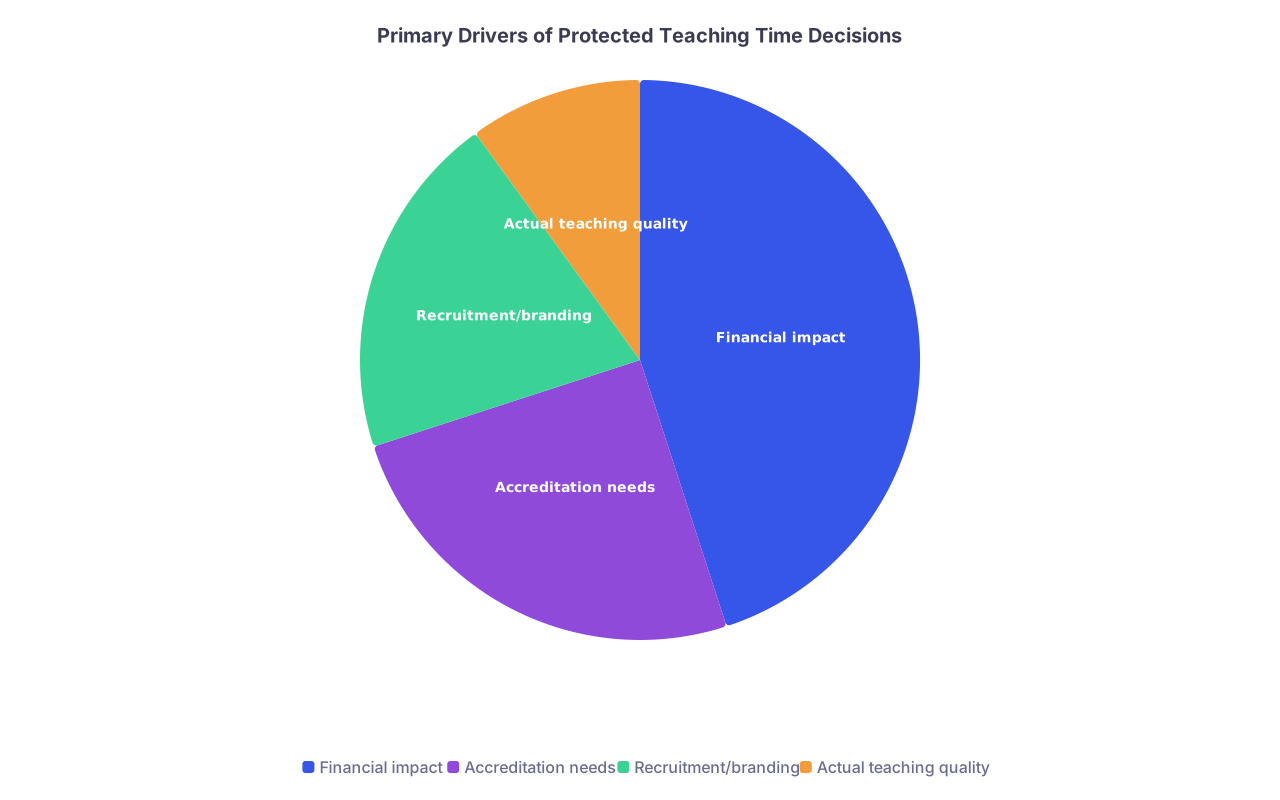
| Category | Value |
|---|---|
| Financial impact | 45 |
| Accreditation needs | 25 |
| Recruitment/branding | 20 |
| Actual teaching quality | 10 |
When you see some clinicians bathed in scheduled, guaranteed teaching blocks while you’re squeezing teaching between discharge summaries, you’re seeing this calculus play out in real time.
Let’s break down who gets chosen and why.
Who Almost Always Gets Protected Teaching Time
You want to understand this quickly? Look at titles and job descriptions, not teaching awards.
The people who reliably get real, protected educational time fall into a few predictable buckets.
1. The “Funded Educator” FTE Crowd
These are the people whose job descriptions literally say 0.2–0.5 FTE “education.” Their salary is justified partly or entirely by teaching, not just clinical work.
You’ll see titles like:
- Director of Medical Student Education
- Residency Associate Program Director
- Simulation Center Director
- Clerkship Director
At a place like UCSF, a medicine APD might have 0.3 FTE funded from GME and departmental dollars. That means 30% of their paid time is supposed to be education. Which means someone has already agreed: “We will pay for this person not to see patients 30% of the time.”
Protected time shows up because the money came first. Not the other way around.
If your contract says 1.0 FTE clinical and “teaching expected,” you’re not in this group. You are a clinician who teaches, not an educator whose work is funded.
2. The Accreditation Shield Bearers
Residency and medical school accreditation are non‑negotiable. Leadership gets twitchy about anything that even smells like an ACGME or LCME issue.
So whoever can plausibly be called “essential” to accreditation suddenly becomes very safe to protect.
Classic examples:
- Program Director – legally required. Has to have protected time. They’ll fight hard here.
- Core Faculty who fulfill specific ACGME requirements – if losing your teaching time risks their “protected faculty” narrative, you’re golden.
- Required clerkship leadership – LCME often asks, “Do you have support for clerkship directors?” Programs show them your blocked academic half day as proof.
I’ve sat in meetings where someone said, “We can’t cut her clinic. She’s the face of the med school for [specialty] rotation, and LCME always asks who runs it.” That person? Safe.
Your problem if you’re not in that circle: “nice to have” teachers don’t trigger fear. Accreditation triggers fear. And fear buys protected time.
3. The People Who Help With Recruitment and Branding
Nobody admits this directly, but everyone knows it.
Some faculty get blocked time because they’re a marketing asset:
- The charismatic teacher who sells the program to applicants on interview day
- The “education name” who gets invited to national meetings and makes the program look good
- The person with a shiny title and a reputation for being “resident‑friendly”
If the chair believes, “If we pull their teaching time, our recruitment tanks,” then you, magically, become “protected.” Not because they’re altruistic. Because residency spots are revenue, prestige, and future workforce.
I’ve heard this exact line from a PD:
“If we kill her teaching block, she stops running the morning conference that all the applicants rave about. That’s not happening.”
If you quietly run solid workrooms and nobody outside notices, you don’t get that argument made for you.
Why Some Excellent Teachers Never Get a Minute Protected
Here’s the ugly part. Some of the best teachers I’ve ever seen never got a single hour of truly protected time. Not one.
They got “expected teaching.” They got “thanks for supporting education.” They did not get “clinic blocked and RVUs forgiven.”
Why?
1. You’re Funded Like a Pure Workhorse
If your contract is 1.0 clinical FTE and your salary is justified entirely by RVUs or service coverage, you are structurally disadvantaged.
Hospitalist groups, EM groups, proceduralists paid on productivity – these folks are often set up so any teaching is on top of what they “owe.” When leadership looks at your schedule, they see revenue. Not flexibility.
Private hospitalist group at a community site that hosts a university’s residents:
- Group paid based on shifts and productivity
- University wants more teaching time
- Group says: “Fine, but who’s paying for it?”
Answer: usually no one. So the teaching happens in between admissions, not formally blocked.
If your financial line item lives under “clinical revenue,” nobody feels authorized to “take money off your line” to pay for teaching.
2. You Don’t Belong to Anyone Powerful
There’s a phrase I’ve heard faculty use quietly: “Who owns you?”
They mean: which pot of money pays your salary, and which leader will go to war for your time?
If you’re:
- Half paid by the hospitalist group, half by the department
- Technically under one division, but teaching for another program
- A “shared” faculty member rotating at multiple sites
You become everyone’s favorite to exploit and no one’s favorite to protect. Too easy to say, “Well, we can’t cut Dr. X’s clinic, but maybe we can squeeze yours…”
The faculty who get protected time? Someone owns them. The clerkship director reports to the vice chair for education. The APD reports to the PD. Their boss has skin in the game if their teaching time disappears.
3. You Never Got It Written Into Your Job Description
This is the silent career‑killer.
You start as “interested in teaching.” You agree to give a few noon conferences, then run small groups. You precept more. You help with orientation. You’re “the education person” but on paper? Nothing.
Five years later, you’re doing 0.3–0.4 FTE of teaching with 1.0 FTE of clinical expectations.
I’ve watched this happen at multiple mid‑tier academic centers. The people who got protected time had one thing in common: they insisted, early, that their educational work be explicitly named and percent‑efforted in their contract or annual letter.
The people who “just helped out” got buried.
No one retroactively gifts you protected time because you’ve been doing the job unofficially. That’s not how budgeting works. There has to be a moment where someone says, “We’ll move 0.2 FTE from clinical to education and cover the clinical gap.”
If that never happens formally, you will be “the great teacher” with no protection until burnout forces you to cut back or leave.
How Protected Time Actually Gets Negotiated Behind the Scenes
Let me walk you through what happens when someone ends up with a shiny new teaching block on their schedule.
You see:
“Dr. Lee – Wednesday afternoon: Resident Clinic Teaching – Protected”
What happened behind closed doors was closer to this:
- Dr. Lee built a visible portfolio: recurring teaching, maybe a course lead role, maybe some curriculum work.
- A leader decided, “We need to keep Lee. And we can leverage this for accreditation/recruitment/branding.”
- That leader went to the chair or division chief and said, “We need 0.2 FTE protected for Lee’s educational work.”
- Chair asked: “Where is that 0.2 coming from? Who covers that clinic? Who pays for it?”
- Money was shifted. Either:
- GME dollars partly support salary
- Department reallocated funds from a vacated FTE
- Clinical group agreed to a lower RVU target to retain Lee
Only after that do you see your colleague’s clinic blocked and labeled “protected.”

| Step | Description |
|---|---|
| Step 1 | Clinician teaches a lot |
| Step 2 | Leader sees strategic value |
| Step 3 | Leader requests FTE for education |
| Step 4 | Education-supported FTE |
| Step 5 | Schedule blocked as protected |
| Step 6 | Who pays for the loss |
You thinking “I teach a lot and people like me” is not enough. Someone has to convert that goodwill into funded FTE.
And that rarely happens by accident.
If You Want Protected Time, Build Leverage the Right Way
Here’s the part that nobody mentors you on. You can influence this. Not perfectly. But more than you think.
Step 1: Stop Being Generic “Teaching Help”
Scattered, one‑off teaching rarely convinces anyone to give you protected time. It’s too amorphous.
Leaders fund roles, not vibes.
Which means you want to tie yourself to a discrete, named piece of educational infrastructure:
- “I run the M3 inpatient medicine rotation at the VA.”
- “I’m the simulation lead for the intern boot camp.”
- “I coordinate and deliver the weekly evidence‑based medicine seminar for PGY‑1s.”
Those can be described in FTE terms. If you stay in the land of “gives excellent teaching on rounds,” nothing gets carved out.

Step 2: Attach Yourself to Someone With Power in Education
Protected time follows champions.
If you align with:
- The residency PD who is actually listened to by the chair
- The vice chair for education who controls some budgets
- The clerkship director who’s indispensable to the med school
You increase your odds that when they go to bat for protected FTE, your name is on the list.
If you stay on an island, doing “nice” teaching unconnected to any major program, there’s nobody with authority whose metrics depend on your survival.
And here’s the twist: those leaders need you too. They’re overextended. They know they should be building a bench of educators. If you show up not just eager but organized—with a concrete proposal, clear deliverables, and an understanding of time involved—you make their job easier.
Step 3: Start Speaking the Language of FTE and RVUs
This is where clinicians lose every negotiation. They show up with feelings; administration shows up with numbers.
You need to be able to say something like:
- “This role takes about 0.1 FTE consistently—4 hours/week of teaching plus 1–2 hours/week of prep and admin, year‑round.”
- “Currently I’m at full clinical FTE. To sustain this without burnout, we need to formally allocate that 0.1 toward education and adjust my RVU target accordingly.”
Then shut up and let them respond.
If you walk in saying, “I’m overwhelmed, I feel burned out, I love teaching,” they’ll commiserate and change nothing. If you walk in with concrete FTE language, they have to respond in the framework they use internally.
I sat in a VP meeting where a chair literally said, “He’s asking for 0.2 FTE. We could probably do 0.1 from GME and 0.1 from department. It’ll cost us X in lost RVUs, but it shores up the residency.” That only happened because the clinician framed it that way.
| Role | Approx FTE | Hours/Week |
|---|---|---|
| Inpatient rotation director | 0.1 | 4 |
| Simulation curriculum lead | 0.15 | 6 |
| Associate Program Director | 0.2–0.3 | 8–12 |
| Clerkship director (core) | 0.2–0.3 | 8–12 |
Numbers like this are what chairs and CFOs understand.
Step 4: Tie Your Work to Their Pain Points
Protected time shows up when your absence creates pain for them, not just for you.
Translate your teaching into those terms:
- Accreditation: “If this curriculum fails, we can’t credibly say we meet X ACGME requirement.”
- Recruitment: “This monthly teaching conference is what applicants keep mentioning in their feedback.”
- Retention: “Residents have cited this structured teaching as a reason to stay for fellowship or faculty.”
When you can connect your protected time request to metrics they report up the chain, it stops being a personal favor and becomes a risk‑management decision.
I’ve literally seen a PD turn to a chair and say:
“If we stop this simulation series, we’re going to have a hard time answering ACGME about our procedural training.”
Clinic got cut. Sim time survived.
Why Some Clinicians Truly Will Never Get It (And What to Do Then)
I’m going to be blunt. There are positions where protected time is almost impossible without you changing jobs or institutions.
Here are the red flags:
- You’re in a pure RVU shop, no academic department, no GME funding.
- The “education” happening is sporadic, unstructured, and no one is formally responsible.
- Leadership openly says, “We like having learners; they help with the work,” and that’s the whole narrative.
- There’s no history of anyone ever getting FTE for teaching.
If you’re in that environment, I don’t care how beloved you are by students and residents—you are not getting genuine, recurring, blocked “protected time.” They might toss you a “teaching half‑day” once a month and then quietly expect you to catch up RVUs later.
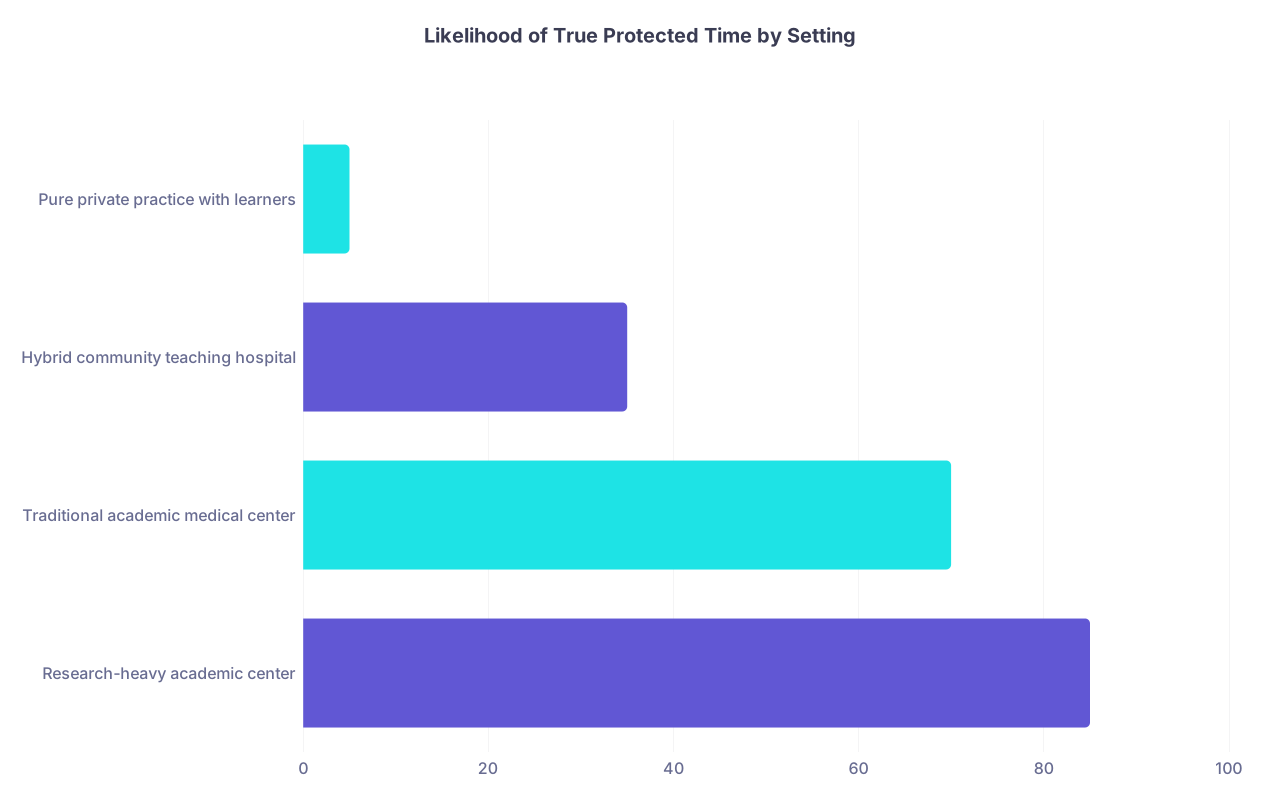
| Category | Value |
|---|---|
| Research-heavy academic center | 85 |
| Traditional academic medical center | 70 |
| Hybrid community teaching hospital | 35 |
| Pure private practice with learners | 5 |
If you care about having teaching as a protected, stable part of your career, you may need to move to:
- A residency‑heavy academic medical center
- A VA affiliated with a strong med school
- A hospital system with a formal “clinician‑educator” track and published FTE guidelines
You can’t will a non‑academic system into funding time for teaching. Their business model doesn’t require it.
And yes, sometimes the answer isn’t “negotiate better.” It’s “stop trying to get blood from a stone and go where what you want actually exists.”
The Hard Truth About “Protected” Time Once You Get It
Even when you win this game, it’s not as clean as they make it sound.
Three realities you should walk in knowing:
- “Protected” rarely means sacred. Your block will be chipped at from the edges: “Just this one urgent patient,” “Can you cover this meeting,” “The call schedule is tight this month.” If you don’t defend it, it erodes.
- You will owe visible deliverables. They will want curricula, evaluations, learner feedback, accreditation documentation. If you thought you were just getting paid to “be a great teacher,” you’ll be surprised.
- Your colleagues may resent you. They’re drowning in RVUs while you’re “off teaching.” That’s their perception, even if you’re working just as hard in a different way.
So if you’re going to fight for protected time, you need to be ready to:
- Use it exactly as promised
- Track what you produce
- Publicize successes (yes, you have to market your educational work)

I’ve seen clinicians lose protected time after a few years because leadership looked and said, “We’re not sure what we’re getting from this 0.2 FTE.” The work was happening. It just wasn’t visible.
Don’t make that mistake.