
The fastest way to stall your academic career is to submit a promotion dossier full of red flags you did not even know existed.
Promotion committees in medical schools are not looking for perfection. They are looking for patterns. And they notice those patterns within minutes of opening your file. If you build the wrong pattern—sloppy documentation, inflated claims, incoherent teaching narrative—you will quietly sabotage yourself, even if you are actually a good educator.
I have sat in those rooms. I have heard the phrases you never want associated with your name: “This reads like a CV dump.” “Where is the evidence?” “I cannot tell what they actually do.” The dossier is your one chance to control the story. Most people surrender that chance without realizing it.
Here are the mistakes that get noticed immediately—and how to avoid them.
1. The “CV with a Cover Letter” Dossier
Most unsuccessful education dossiers die in the first 5 minutes for one reason: there is no coherent story. Just piles of bullets.
Committee members flip between your CV, your educator’s statement, and your teaching portfolio. If all three look like variations of the same unfocused, laundry-list document, you have a problem.
Red flags they see right away
A generic educator’s statement
“I am passionate about medical education and strive to create a supportive learning environment.” I have seen that sentence or a close cousin in at least 40 dossiers. Nobody believes it anymore. If your narrative could be copy-pasted into any other faculty member’s file, it is a red flag.Zero alignment between claims and evidence
You say you redesigned the clerkship. The CV has a bullet that says “Clerkship co-director.” The portfolio has no syllabus, no evaluation data, no before/after metrics, no letters from learners. That gap is obvious on page 1.No clear career focus
You list every talk, every small group, every committee, every workshop since residency. But there is no through-line: are you an assessment expert? A simulation educator? A curriculum leader in professionalism? If the committee has to guess, you have already lost ground.
How not to make this mistake
Treat the dossier as an argument, not a scrapbook. You are answering one question: “Why should we believe this person is an established (or emerging) leader in medical education?”
Build from that:
- Your educator’s statement should name 1–2 clear areas of focus and show a progression: early interest → developing skill → leadership/contribution → dissemination.
- Your CV should support that narrative by clustering roles and accomplishments in those focus areas, not by chronological brain-dump alone.
- Your teaching portfolio should provide evidence (syllabi, evaluation summaries, letters, outcomes) that match the story you are telling.
If you cannot explain your educational niche in one sentence, committee members will not do it for you.
2. Inflated Teaching Claims with Thin Evidence
Nothing erodes credibility faster than big claims paired with weak proof. Committees have seen every version of this.
Common offenders:
- “I completely restructured the residency curriculum” followed by… one noon conference series.
- “I am the primary mentor for numerous trainees” with no mentee list, no outcomes, no letters.
- “I am recognized nationally as an educator” and a single invited talk at a friend’s program.
The pattern is obvious. Over-claiming, under-documenting.
How committees spot this in minutes
They go straight to:
- Your educator’s statement claims
- The teaching activity summary
- Evaluation data and letters
- Educational scholarship section
Then they cross-check.
- You say you are “heavily involved in small group teaching.” EVU or teaching load shows 10 hours/year.
- You claim “consistently outstanding feedback.” Scores are average; comments are generic.
- You list “curriculum development” in multiple places but have no outline, no needs assessment, no evaluation of its impact.
The mismatch is the red flag. Not the actual volume of work.
How to avoid this trap
Use modest, precise language
Replace “I completely transformed the clerkship” with “I led the redesign of the inpatient curriculum, including X and Y, which resulted in [specific outcome].”Show, do not boast
- If you restructured something, include before/after schedules or objectives.
- If you mentored many trainees, provide a table of mentees and their outcomes (abstracts, positions, awards).
- If you improved evaluations, include trends over time.
Never outrun your evidence
If you have done solid work but do not have five years of outcome data, say that. “Preliminary data from the first two cohorts show…” reads as honest and credible.
When a committee member says, “This person is actually under-selling what they do,” you win. That only happens if you anchor claims tightly to evidence.
3. Missing or Embarrassing Teaching Evaluations
Do not kid yourself: people on promotion committees look at your teaching evaluations. Quickly. Critically. Especially if you are going up on an education track.
Two serious red-flag patterns show up over and over.
Red flag 1: Missing or cherry-picked data
The committee opens the portfolio and sees:
- Only your best evaluations from one course
- No raw data, only a self-curated selection
- Whole teaching roles with no evaluations at all
This triggers one silent question: “What are they hiding?”
Red flag 2: Unaddressed negative comments or trends
Even worse: the dossier includes obviously concerning evals, and you pretend they do not exist.
Comments like:
- “Disorganized and often late.”
- “Made belittling comments during rounds.”
- “Slides were unreadable and content outdated.”
And your dossier? Complete silence. No reflection. No change in approach. No faculty development.
That combination is a major warning sign.
How to handle evaluations without shooting yourself in the foot
You need to balance transparency with professionalism.
Provide complete, structured data
Do not cherry-pick. Summarize by course/role and year. If your institution provides official summaries, use those. If you must pull your own numbers, be honest and consistent.A simple table like this is far better than scattered printouts:
| Role | Years Included | Mean Rating (1–5) | Department Mean | N of Evaluations |
|---|---|---|---|---|
| Inpatient Attending | 2019–2024 | 4.5 | 4.2 | 180 |
| Clerkship Small Groups | 2020–2024 | 4.3 | 4.1 | 95 |
| Morning Report Facilitator | 2021–2024 | 4.0 | 4.2 | 60 |
Address real problems head-on
If your scores dipped during a certain time or you had concerning comments:- Name it briefly in your narrative.
- Note what you did in response (workshops, observation, changed methods).
- If there has been improvement, show it with data.
Committees are surprisingly forgiving of past problems when you show insight and response. They are not forgiving of denial.
Do not over-interpret small differences
You are not doing a meta-analysis of your own evals. A 0.1 shift year to year is noise. Do not attempt to spin every curve. Focus on clear patterns over several years: consistently strong, improving, or concerning.
If your immediate instinct is to hide or omit evaluations, stop. Fix the teaching, not the paperwork. Then present the full, honest picture.
4. “Busy but Not Impactful” CVs
Some dossiers scream one message: this person says yes to everything and advances nothing.
Committee members recognize this pattern fast. Pages and pages of roles:
- Member, Curriculum Committee
- Member, Assessment Committee
- Member, Wellness Committee
- Member, Some Task Force That Met Twice
All with overlapping dates. All listed without description or outcomes.
How this damages you
To a committee, this looks like:
- Lack of focus
- Lack of depth
- Lack of impact
They are trying to decide if you are a leader in education. Leaders make things happen and can point to what changed because of their involvement. If your dossier reads like “professional meeting attendee,” you get passed over.
What they look for instead
They scan for:
- Progressive responsibility (from member → vice chair → chair → director)
- Concrete outputs (new course, new assessment system, policy, published work)
- Evidence that your presence mattered
Fixing the “activity hoarder” problem
Ruthlessly prioritize what you highlight
It is acceptable for your full CV to list everything. But your promotion-focused materials (educator’s statement, portfolio narrative) should only feature educational roles where you had real responsibility and impact.Translate roles into outcomes
“Member, Assessment Committee” is meaningless alone.
“Assessment Committee member (2019–2022): co-led implementation of workplace-based assessment tool now used across all clinical rotations” tells a very different story.Show depth over breadth
A few major roles sustained over time with clear results will always impress more than fifteen forgettable committee memberships.
If your CV reads like someone allergic to the word “no,” clean it up before the committee does it for you—in their heads, against you.
5. Sloppy, Inconsistent, or Unprofessional Presentation
Yes, people absolutely judge you for typos and formatting. Especially in academic medicine. And especially in promotion contexts.
The committee has a stack of dossiers. When yours opens with:
- Different fonts on every page
- Misspelled course titles
- Incorrect dates that conflict with other sections
- Random bolding and underlining
You send a clear message: you do not respect the process enough to take care with the details.
Presentation red flags committees notice
Inconsistent dates and roles
Your CV says you became Clerkship Director in 2021. Your narrative says 2022. The school’s official list says 2020. You might think that is minor. It is not. It undermines trust in everything else.Sloppy citation of educational scholarship
Half of your teaching-related projects are listed as “in progress” since 2019. Abstracts are formatted differently throughout. Some “publications” are actually internal documents.Obvious copy-paste errors
I once read an educator’s statement that referred to “our engineering students” all the way through. MD faculty. Internal medicine. They had used someone else’s personal statement as a template and never cleaned it. That application was dead before page 2.
How to avoid looking careless
- Use your institution’s template if it exists. They usually align with committee expectations.
- Do a line-by-line consistency check of timeline-sensitive items: degrees, promotions, major roles, program leadership.
- Have one trusted colleague read only for form, not content. Tell them explicitly: “I need you to find errors, inconsistencies, and confusing sections. Be brutal.”
You are asking for a long-term institutional commitment. If your written materials look like they were thrown together in a weekend, everyone in the room will assume that is how you treat your work too.
6. Weak or Misaligned Letters of Evaluation
Letters can kill an education-focused promotion faster than anything else. Not because they are harsh. Because they are vague or mismatched with your claimed strengths.
Here is what raises red flags immediately:
Generic, unfocused letters
“Dr. X is a pleasant colleague and effective clinician.” Nice. Irrelevant. If your main strength is education and your letters barely mention teaching, mentoring, or curriculum, the committee notices.Letter writers who do not know your educational work
You pick a famous name from another institution, but they clearly only know you from clinical conferences. They write glowing praise about your bedside manner and responsiveness. They say nothing concrete about your teaching or scholarship.Overly cautious or lukewarm tone
It is astonishing how many letters for borderline candidates use tells like “solid,” “reliable,” “conscientious,” and never “outstanding,” “leader,” “innovative.” Committee members have learned that code.
How to avoid letter problems
You cannot script letters, but you can avoid predictable mistakes.
- Choose writers who have direct knowledge of your educational work, not just your clinical skill or personal traits.
- Give them a focused packet: your CV, educator’s statement, and a one-page summary of your key educational accomplishments with specific examples they might comment on.
- Make sure your chosen referees understand the track and level you are going up for, and what “success” looks like there.
If you are on an education track and your letters do not foreground your educational impact, the committee will assume there was nothing better to say.
7. Nonexistent or Token Educational Scholarship
Here is a harsh truth: in many academic medical centers, education track does not mean “no scholarship required.” It means “educational scholarship, appropriately scaled.”
The red flag is not “only two education papers.” It is having zero demonstrable effort to turn your educational work into something that can be shared, studied, or adopted elsewhere.
What committees see as problematic
- Years of curriculum work with no abstracts, workshops, or publications associated.
- “Posters in preparation” and “Manuscripts planned” that have been “planned” since your last review.
- Lists of internal talks framed as “national educational impact.”
What minimal, credible educational scholarship looks like
It does not have to be a randomized trial of a new curriculum. But there should be some combination of:
- Peer-reviewed educational publications (even small studies or innovation reports)
- Peer-reviewed workshops at regional/national meetings
- Accepted posters or platform presentations focused on education
- Contributions to consensus guidelines, national curricula, or collaborative education projects
Even a straightforward before/after curriculum evaluation, written up and submitted to a journal like MedEdPORTAL or Academic Medicine’s “RIME” section, signals the right mindset: you are trying to systematically improve and share your work.
Quick visual: weak vs. credible education scholarship patterns
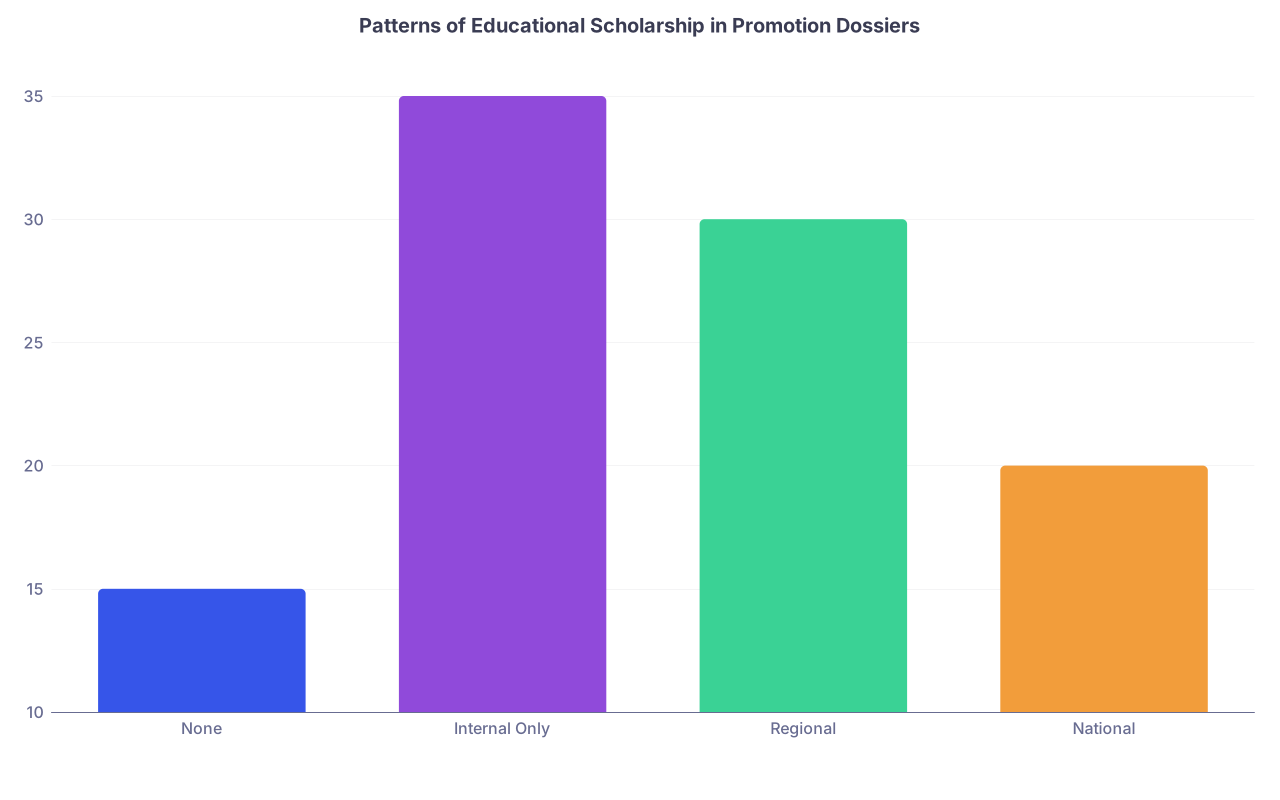
| Category | Value |
|---|---|
| None | 15 |
| Internal Only | 35 |
| Regional | 30 |
| National | 20 |
The “internal only” group is where many stalled educators live. They work hard but never convert effort into scholarly products. Committees notice.
If your dossier shows years of curriculum work with no external dissemination, fix that before you go up, not after your first failed attempt.
8. No Evidence of Progression or Future Direction
Promotion is not a lifetime achievement award for being busy. Committees are looking for trajectory.
Two questions they quietly ask:
- Has this person clearly grown from junior to mid-career educator?
- Do we see a realistic future where they continue to contribute at a higher level?
The red flags:
- Your teaching roles look exactly the same as five years ago.
- You list no new responsibilities, no leadership, no innovations, just “more of the same.”
- Your educator’s statement is entirely backward-looking, with no articulated future plans.
Why this matters
Academic institutions are investing in potential, not just history. If your dossier suggests you have plateaued, even generous committee members hesitate.
What progression should look like on paper
Think of it roughly in stages (these are examples, not rigid rules):
| Stage | Example Roles | Example Outputs |
|---|---|---|
| Early Career | Small group teaching, precepting | Strong evaluations, first workshop |
| Mid Career | Course or clerkship leadership | Curriculum redesign, local awards |
| Senior | Program or institutional leadership | National talks, publications |
Your dossier should show movement along that continuum consistent with your time in rank and institutional norms.
Do not forget the future
A brief, concrete section in your educator’s statement about where you are going next—specific projects, roles, or scholarly goals—signals continued momentum. Vague aspirations do not.
“I hope to continue improving medical education” is meaningless.
“I am developing a longitudinal assessment program for our residency, with plans to study its impact on milestone progression over the next three years” is not.
9. Ignoring Institutional Expectations and Templates
One last red flag that drives committees crazy: dossiers that simply ignore the rules.
If your institution provides:
- A promotion guideline document
- Track-specific criteria
- Required dossier sections and templates
…and you treat those as suggestions rather than requirements, you signal either arrogance or inattention. Neither helps you.
What this looks like in practice
- Submitting a narrative that does not match the requested headings
- Failing to label sections the way the committee expects
- Omitting required data (like contact hours, learner levels, or percent effort)
- Using an idiosyncratic CV format that omits key categories
Remember: committees are often reading 10–30 dossiers in a cycle. When yours does not fit the mental template they are using, it feels harder to review. Harder to defend. Easier to say no.
Use the system to your advantage
- Map your accomplishments explicitly onto the institution’s stated promotion criteria. If there is a bullet that says “evidence of regional or national impact,” show it, label it, and make it easy to find.
- Use headings and subheadings that mirror the criteria language. You are helping the committee write the case for you.
- If your portfolio or track is non-standard, include a short cover note or framing paragraph that explains how your work fits the criteria.
Do not make the committee hunt for reasons to promote you. They do not have time, and they will not.

| Step | Description |
|---|---|
| Step 1 | Open Dossier |
| Step 2 | Red flag - unfocused |
| Step 3 | Check Evidence |
| Step 4 | Red flag - inflated claims |
| Step 5 | Review Evaluations |
| Step 6 | Red flag - eval issues |
| Step 7 | Assess Scholarship |
| Step 8 | Red flag - weak scholarship |
| Step 9 | Check Trajectory and Fit |
| Step 10 | Support Promotion |
| Step 11 | Clear Education Story |
| Step 12 | Claims match data |
| Step 13 | Consistent and addressed |
| Step 14 | Adequate for track |

The Bottom Line: What You Must Not Get Wrong
Three things committees notice immediately, every time:
- Does your dossier tell a focused, evidence-backed story of who you are as an educator, or is it a chaotic pile of activities and vague claims?
- Do your words, data, letters, and roles actually match, or are you inflating your impact and hoping no one cross-checks?
- Does your trajectory show growth, scholarship, and future potential within the rules and expectations of your institution?
If you avoid those core mistakes, you are already ahead of most applicants. The content of your career still matters, of course. But how you present it can either amplify or quietly destroy what you have built. Do not let preventable red flags be the reason your dossier dies in the first 5 minutes.