
You are at your desk at 10:47 p.m. The promotion packet is due in 48 hours. Your chair has “strongly encouraged” you to submit for associate professor this cycle. You open your teaching portfolio—the one you have been “updating” for years—and your stomach drops.
It is long. It is busy. And the more you skim, the more you realize: it does not actually prove you are a strong educator. It looks like activity. It does not look like impact.
This is where solid candidates quietly lose promotions they should have earned.
Let me walk you through the mistakes that derail teaching portfolios all the time—and how to avoid becoming the cautionary example people whisper about in the hallway after the P&T meeting.
1. Confusing “Teaching Activity List” with “Teaching Portfolio”
The first big mistake is conceptual.
Most faculty throw together a glorified logbook:
- Dates
- Course titles
- Number of hours taught
- Maybe a few student comments
Then they call it a “portfolio” and assume it will speak for itself.
It will. It will say: “I showed up and talked.”
A teaching portfolio should answer two questions for reviewers:
- What is your role as an educator?
- What is your impact on learners and the educational mission?
A bare activity list answers neither.
Red flags you are making this mistake
- Your portfolio starts with a giant chronological table of “Teaching Activities” spanning 8–10 pages.
- There is no explicit teaching philosophy or narrative statement.
- There is no structure beyond date/course/role.
- You rely on volume “I taught 200+ lectures” instead of evidence “Here is what changed as a result.”
| Feature | Activity List Only | Real Portfolio |
|---|---|---|
| Teaching philosophy statement | No | Yes |
| Evidence of outcomes/impact | Minimal | Clear |
| Organized around themes/roles | No | Yes |
| Reflective commentary | No | Yes |
| Assessments beyond student evals | Rare | Included |
How to avoid it
Rebuild your structure around impact, not chronology. A simple, promotion-friendly outline:
- Teaching Philosophy and Approach (1–2 pages)
- Teaching Roles and Responsibilities
- Evidence of Teaching Effectiveness
- Educational Leadership and Innovation
- Scholarly Contributions in Education
- Mentoring and Advising
Then the teaching activity list becomes an appendix, not the main event.
If a reviewer can read the first 4–5 pages and walk into the committee saying, “This person is a serious educator with clear impact,” you are doing it right.
2. Burying Reviewers in Unfiltered Evaluations
Here is the fastest way to irritate a promotions committee: upload a 150-page PDF of raw student evaluations with no context.
I have seen this more than once:
- Every evaluation from every rotation.
- Tiny font.
- No summary.
- Scores scattered across forms with different scales.
The reaction in the room is predictable: “I am not reading this.”
Why this quietly kills you
Reviewers are busy. Many are clinicians with packed schedules. They might give your entire packet 15–20 minutes, not an hour. If you force them to excavate evidence from a data dump, they will default to impressions instead of data.
And impressions, in a room of senior faculty, are often biased toward:
- Well-known “star teachers”
- People from their own department
- Colleagues they have seen teach
If your evaluations are good but unreadable, you have wasted your best evidence.
How to do it correctly
You must curate and summarize.
- Create a one-page table summarizing your evaluations for the last 3–5 years:
- Courses/rotations
- Number of learners per year
- Average rating (with scale clearly labeled)
- Department or school mean for comparison
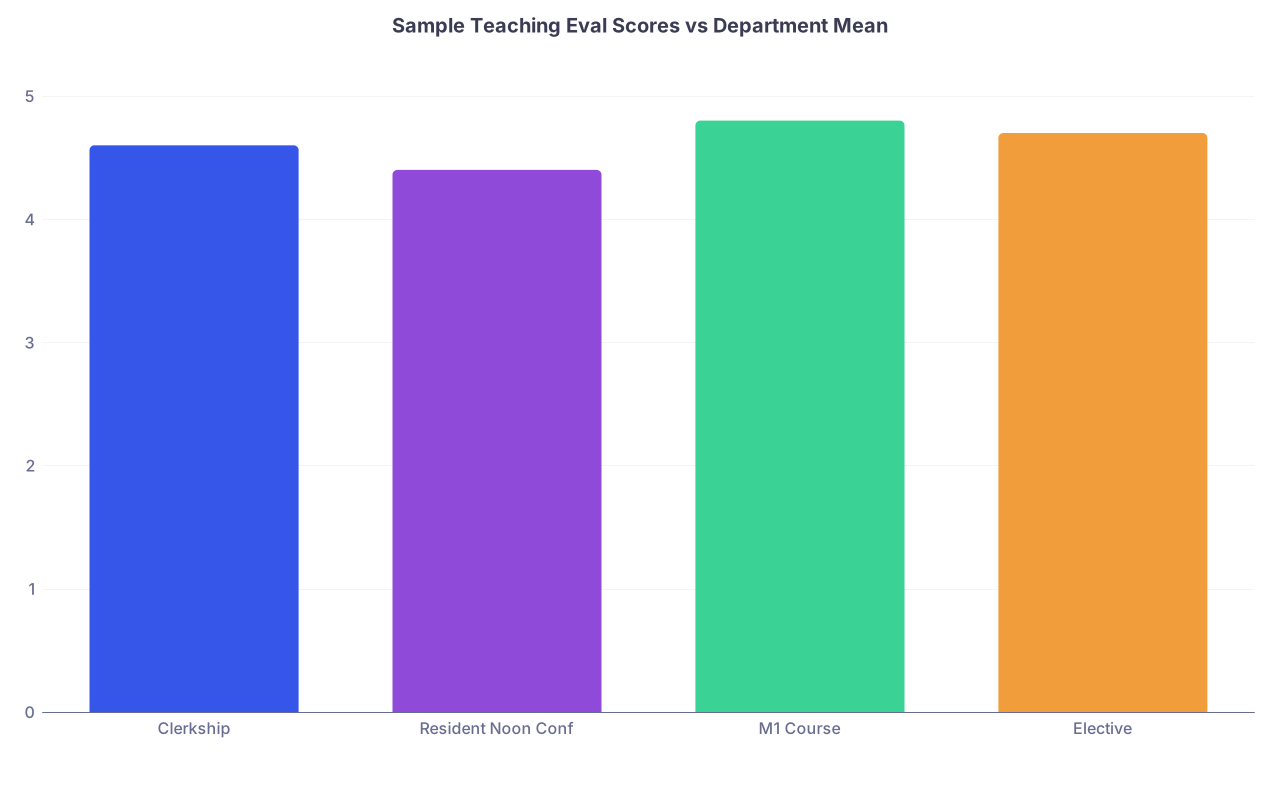
| Category | Value |
|---|---|
| Clerkship | 4.6 |
| Resident Noon Conf | 4.4 |
| M1 Course | 4.8 |
| Elective | 4.7 |
Then add the department mean in the caption:
- Department mean on 5-point scale: 4.2
Provide a short narrative:
- How your scores compare to means
- Trends (improving, stable)
- Any changes you made in response to feedback
Put selected evaluations in an appendix:
- A few full evaluation forms from different settings
- Only if they are legible and representative
Do not make reviewers dig. Hand them the conclusion up front: “Over 5 years, my teaching ratings are consistently above departmental averages in all settings.”
3. No Coherent Teaching Identity
Another subtle killer: being “all over the map.”
You have:
- Lectured in three different pre-clinical courses
- Precepted in clinic
- Given a few noon conferences
- Maybe led a workshop at grand rounds once
All fine. But your portfolio reads like random gigs, not a coherent career.
Promotion committees look for:
- A trajectory as an educator
- Depth in at least one or two areas
- Evidence you are more than a warm body filling slots
Signs you lack a teaching identity
- Your portfolio is organized only by date.
- Your teaching narrative is generic: “I enjoy teaching and try to engage learners.”
- Every listed activity is at the “I was invited to give a lecture” level, with no sustained role.
- You cannot answer “What kind of educator are you?” in one sentence.
Better answers:
- “I am a clinical educator focused on bedside teaching and feedback skills in internal medicine.”
- “I am an education leader in simulation-based training for emergency medicine residents.”
- “I develop and direct longitudinal communication skills curricula for medical students.”
How to fix this
Reframe your portfolio around 2–3 core identities:
- Clinical teacher
- Course/clerkship director
- Curriculum designer
- Simulation educator
- Assessment and feedback specialist
- Mentorship/Advising leader
Then group activities and evidence under those roles. Show progression:
- Started as small-group facilitator → became course co-director → then course director → then led curriculum redesign and evaluation.
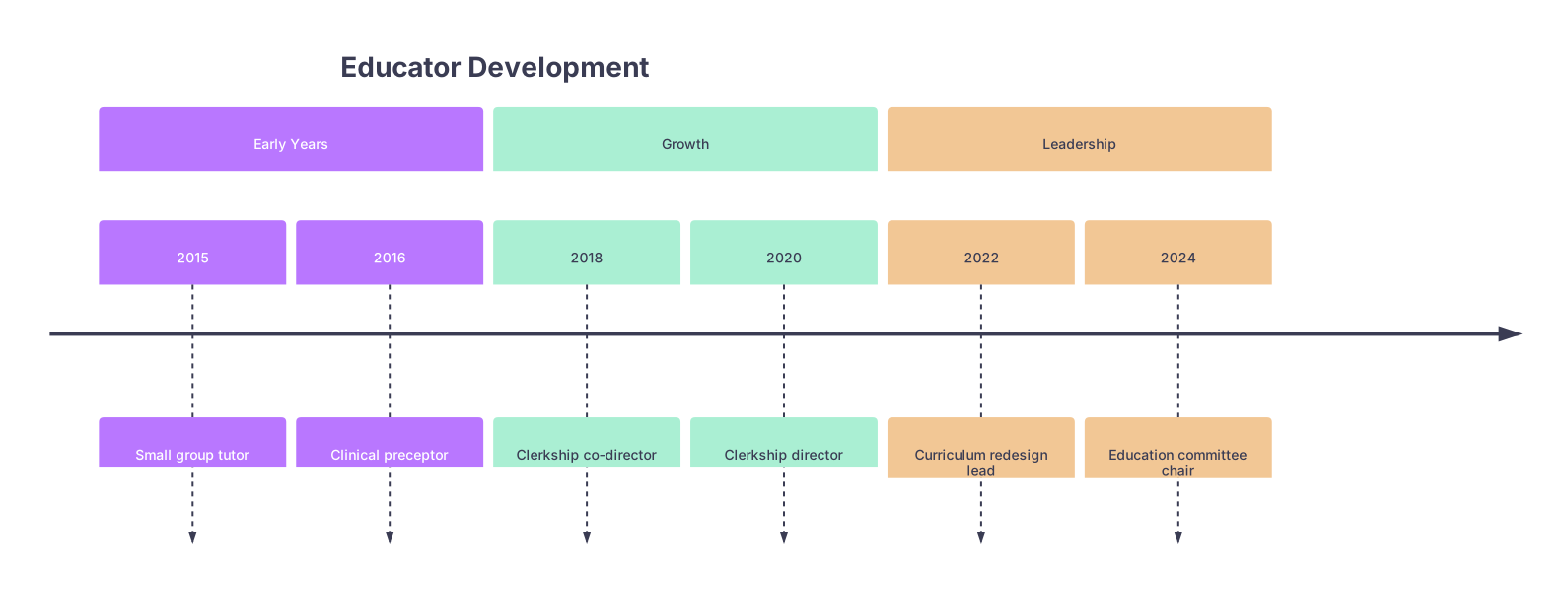
| Period | Event |
|---|---|
| Early Years - 2015 | Small group tutor |
| Early Years - 2016 | Clinical preceptor |
| Growth - 2018 | Clerkship co-director |
| Growth - 2020 | Clerkship director |
| Leadership - 2022 | Curriculum redesign lead |
| Leadership - 2024 | Education committee chair |
Do not let your packet suggest you are just a perpetual volunteer lecturer.
4. Overweighting Quantity and Underweighting Impact
This mistake is everywhere. People proudly list:
- “Gave 28 lectures in 2022–2023”
- “Precepted 3 half-days per week”
- “Supervised X students on rounds”
Numbers of hours are fine. But promotions committees care more about:
- Outcomes
- Innovation
- Recognition
- Dissemination
If you taught a ton and nobody can see what changed as a result, your argument is weak.
Weak evidence vs strong evidence
Weak:
- “Taught weekly lectures to M3 students.”
- “Precepted residents in continuity clinic.”
- “Gave noon conference 10 times.”
Stronger:
- “Redesigned the resident continuity clinic curriculum to include standardized feedback templates and mini-CEX tools; resident comfort with giving feedback improved from 2.8 to 4.1 on a 5-point scale over 2 years.”
- “Led implementation of case-based learning in M2 course; NBME subject exam performance increased from 65th to 78th percentile nationally.”
- “Developed and evaluated a simulation-based central line curriculum; complication rates decreased 30% over 18 months.”
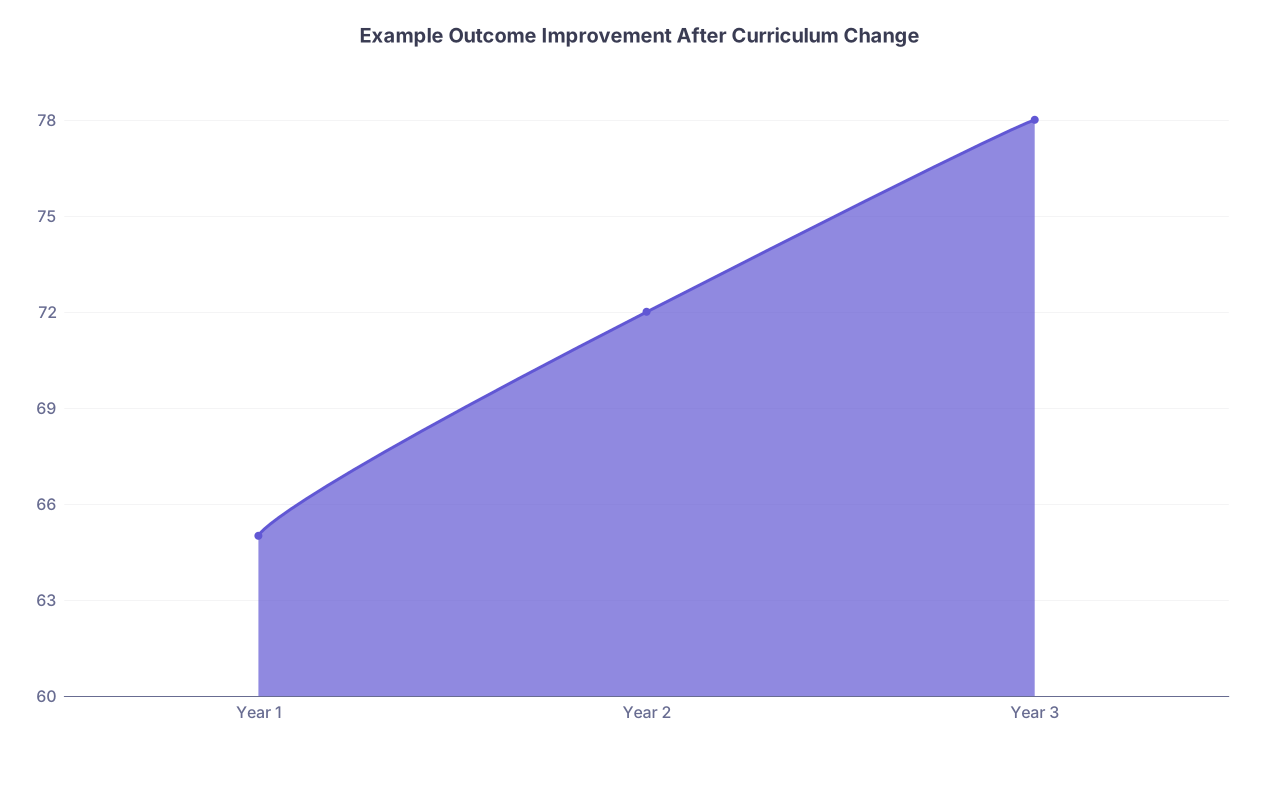
| Category | Value |
|---|---|
| Year 1 | 65 |
| Year 2 | 72 |
| Year 3 | 78 |
**Your portfolio must show that your teaching:
- Changes learner behavior
- Improves assessment outcomes
- Improves patient care or systems
- Is recognized as high quality by peers
Do not stop at “I did it.” Push to “Here is what happened because I did it.”
5. Ignoring Educational Scholarship
Here is a cruel reality: at many academic centers, being an excellent teacher is not enough. You also need scholarship in education, particularly beyond assistant professor.
I routinely see strong teachers stalled at promotion because they made this mistake:
- They spent a decade doing creative educational work.
- They never turned any of it into peer-reviewed output.
The committee comment is depressingly predictable: “High-quality teaching, but limited scholarly productivity in the educational domain.”
What counts as educational scholarship?
Not everything you call “curriculum development” is scholarship. Scholarship generally requires:
- Intentional design
- Systematic evaluation
- Dissemination beyond your local setting
Examples that help your case:
- Peer-reviewed education research in journals (Academic Medicine, MedEdPORTAL, JGME, etc.)
- Published curricula with evaluation data
- Invited workshops at national meetings where you present your educational methods and outcomes
- Education-focused book chapters or review articles (less weight than original studies, but still something)
| Activity | Scholarship Weight |
|---|---|
| Giving a local lecture | Low |
| Creating a new local rotation | Medium |
| Publishing MedEdPORTAL module | High |
| Prospective study of your curriculum with peer-reviewed article | Very High |
| National invited workshop with evaluation data | High |
How to stop making this mistake
If you are mid-career and have zero educational publications, stop pretending this is fine. Pick one ongoing teaching project and:
- Clarify the educational question.
- Design simple evaluation (pre/post surveys, performance data).
- Collect and analyze systematically.
- Submit to a real venue (conference abstract, journal, MedEdPORTAL).
Then feature this work in a “Scholarly Contributions to Education” section, not buried in the CV.
6. Sloppy Documentation: Dates, Roles, and Scope
Promotions committees are allergic to ambiguity. If they cannot tell:
- When you did something
- How long
- In what role
- With how many learners
They will mentally downgrade its importance.
Common sloppy patterns:
- “Course: Physical Diagnosis. Role: faculty.”
- “Clerkship: Internal Medicine. 2018–present.”
- “Mentor: many students.”
Unhelpful. Vague roles look inflated.
Document like someone will audit you
For every major activity, you should state:
- Role (with clarity on leadership vs participant)
- Setting/level of learners
- Time frame (start–end year)
- Frequency (e.g., 12 sessions/year)
- Number of learners
Example of clean documentation:
- “Clerkship Director, Internal Medicine (2019–present). Responsible for overall design and implementation of 8-week M3 clerkship for ~120 students/year; oversee 6 site directors; led major assessment and feedback redesign in 2021.”
Compare that to:
- “Internal Medicine Clerkship – involved in teaching.”
One sounds promotable. The other sounds like an afterthought.

Also, avoid padding:
- Do not list one-time guest lectures as if they are ongoing major roles.
- Do not call yourself “co-director” of something if you were really an occasional guest speaker. Committees absolutely notice this.
7. Weak or Generic Teaching Philosophy
Many institutions explicitly require a teaching philosophy statement. And many faculty submit something that reads like it was generated by a random “teaching philosophy” boilerplate.
You know the type:
- “I believe in learner-centered education.”
- “I strive to create a safe and inclusive environment.”
- “I use various teaching modalities to engage learners.”
None of this differentiates you. More importantly, none of it connects to your actual evidence.
Mistakes here that undermine you
- Vague, buzzword-heavy statements that do not match your activities.
- No examples of how your philosophy shows up in real teaching.
- No mention of how you adapt for different learner levels (students vs residents vs fellows).
- No reflection on changes over time—no sense of growth.
Do it better
Your teaching philosophy should:
- Be grounded in your actual practice.
- Reference specific behaviors or strategies.
- Connect directly to evidence in the rest of the portfolio.
Example snippet (stronger):
“My core teaching goal is to make clinical reasoning visible. On inpatient rounds, I force myself to ‘think out loud’ and then ask residents to do the same, using a structured one-minute summary format. The effect has been measurable: after we introduced this structure, resident ratings of ‘clarity of attending reasoning’ increased from 3.6 to 4.5 on our rotation evaluations over two years.”
Now your philosophy is not just words. It is tied to data. That is what reviewers remember.
8. Neglecting Mentoring and Advising
Many faculty underestimate how much mentoring counts as teaching. They also fail to document it.
Common scenario:
- You have informally mentored dozens of students and residents.
- You helped them through specialty choice, projects, letters, and personal crises.
- None of this appears in your portfolio except maybe a vague line: “Mentored multiple learners.”
Promotion committees cannot give you credit for what you do not document.
What you should avoid
- Listing “Mentoring” as a single bullet with no specifics.
- Counting every brief conversation as “mentorship”—that dilutes your real work.
- Failing to highlight mentees who achieved tangible outcomes (presentations, publications, successful matches).
How to present mentoring effectively
Create a mentoring section that:
- Lists sustained mentees (those you worked with >6 months).
- Specifies their level (M2, M4, PGY-2, fellow).
- States your role (research mentor, career advisor, primary scholarly mentor).
- Notes outcomes where relevant (presentations, projects, match results).
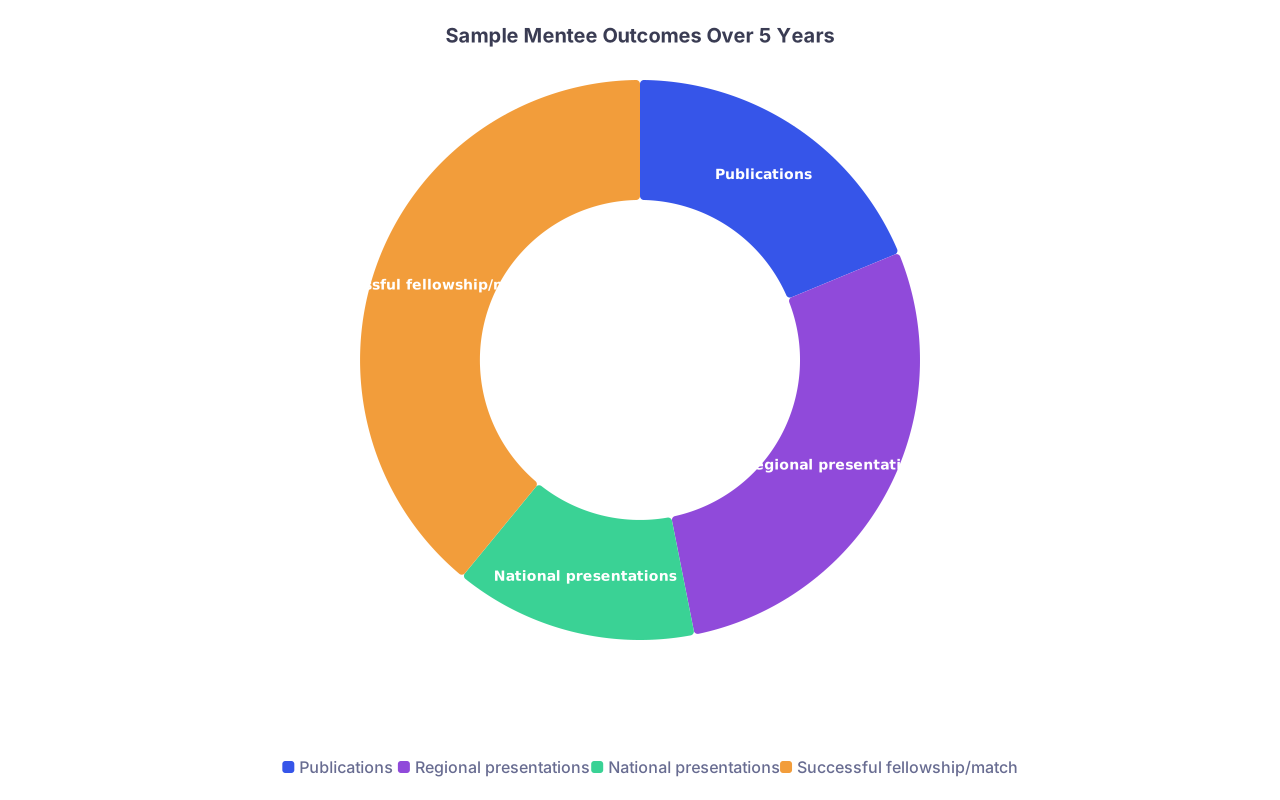
| Category | Value |
|---|---|
| Publications | 12 |
| Regional presentations | 18 |
| National presentations | 9 |
| Successful fellowship/match | 25 |
Avoid overclaiming credit. If you were one of five mentors, say so. But do not hide this work. Reviewers know mentoring is time-consuming and high-impact. Let them see it.
9. No Clear Story of Growth
Promotion is not only about where you are. It is about where you came from and where you are going.
A lot of teaching portfolios read flat:
- 2016: teaching.
- 2018: more teaching.
- 2020: still teaching.
No sense of development. No “arc.”
That kills excitement. Committees like to promote people who are on a trajectory, not just standing still.
What is missing when there is no trajectory
- Reflection on early teaching struggles and how you addressed them.
- Evidence of seeking training (faculty development courses, certificate programs, MEds).
- Increasing levels of responsibility.
- Shift from consumer of curricula to producer/leader.

| Step | Description |
|---|---|
| Step 1 | Individual Teacher |
| Step 2 | Course Contributor |
| Step 3 | Course or Clerkship Director |
| Step 4 | Curriculum Leader |
| Step 5 | Institutional or National Education Leader |
Make your growth obvious
In your narrative, explicitly connect:
- “In my early years, I focused on mastering bedside teaching.”
- “After completing the Teaching Scholars program in 2019, I shifted toward curriculum design and evaluation.”
- “In the last three years, my focus has expanded to institutional leadership and national dissemination.”
Then make your evidence match that story.
10. Poor Formatting and Organization That Signal “Afterthought”
This should not matter. But it does. The way your portfolio looks affects how seriously people take it.
Red flags:
- Tiny fonts, single spacing, walls of text.
- Inconsistent headings and numbering.
- Random order of sections that does not align with institutional guidelines.
- Typos in course names, dates, or titles.
- PDFs that are upside down or rotated (yes, this still happens).
These things give reviewers the impression that:
- You assembled this in a rush.
- You are not detail-oriented.
- You do not respect their time.

Simple fixes
- Use your institution’s template if it exists. Many do. Ask around.
- Keep a consistent heading hierarchy.
- Put a clear table of contents at the front, with page numbers.
- Reserve appendices for supporting documents only.
- Use legible font and reasonable spacing; reviewers should not have to zoom to 150%.
Do not make form overshadow substance.
FAQ (Exactly 4 Questions)
1. How long should my teaching portfolio be for promotion?
Too short looks weak, too long looks bloated. For most mid-career academic physicians, 15–30 pages of core content is reasonable, plus appendices. Core sections (philosophy, roles, evidence of effectiveness, leadership, scholarship, mentoring) should be concise and readable. Appendices can include selected evaluations, sample syllabi, representative teaching materials, and evaluation tools. If your main narrative is 60 pages, you are not curating. If it is 5 pages with no evidence, you are under-documenting.
2. Do I really need educational publications to be promoted on a teaching track?
In many places: yes, at least some. The exact requirement varies by institution and track, but almost all promotion committees look for some scholarship in your area of emphasis. That does not mean you must become a full-time education researcher. It does mean that high-quality, innovative educational work should eventually lead to some form of peer-reviewed dissemination. If you are on a designated clinician-educator or teaching track, you get more leeway on volume, but zero educational scholarship is a common reason for delay.
3. What if my student evaluations are mixed or dipped during certain years?
Do not hide them. Hiding dips looks worse than explaining them. Instead, present them transparently with context. For example, if there was a major curriculum change, COVID disruption, or switch to virtual learning, say so. More importantly, show how you responded: sought feedback, changed methods, attended faculty development, or revised your sessions. A narrative of “I saw a problem, did something, and things improved” actually strengthens your case. Committees respect growth far more than artificially perfect numbers.
4. When should I start building a serious teaching portfolio?
Yesterday. The most dangerous mistake is waiting until you are 6–12 months from promotion to assemble everything. You will forget activities, lose data, and scramble for evidence. Start a living document early in your career. After each course, rotation, or major teaching project, log:
- Dates and roles
- Number and level of learners
- Key evaluation metrics
- Any outcomes or changes you made Then, when promotion time comes, you are organizing and polishing—not reconstructing your career from memory at midnight.
Open your current teaching portfolio file right now. Look at the first three pages only. Ask yourself: “Could a skeptical senior faculty member, who has never met me, read just this and confidently argue that I am a high-impact educator worthy of promotion?” If the answer is anything short of “yes,” pick one section—teaching evaluations, mentoring, or philosophy—and fix that piece this week.