
The most dangerous career mistake in medical education is picking the wrong person to open doors for you—and not realizing it for five years.
You can recover from a mediocre talk. You can recover from a weak publication. You do not easily recover from being tied to the wrong “sponsor” in your teaching career.
Let me be blunt: in academic medicine, mentors help you grow. Sponsors decide whether you get in the room where decisions are made. Choosing that sponsor casually, based on who seems “nice,” is how promising teaching careers stall out before they even start.
This is your warning label.
Mentorship vs Sponsorship: The First Big Misunderstanding
Most early educators confuse mentorship and sponsorship. That confusion is not harmless.
- A mentor advises you.
- A sponsor uses their reputation and political capital to push you forward: committee nominations, talk invitations, job offers, leadership roles.
You need both. But the wrong sponsor can:
- Attach your name to their rivalries.
- Pigeonhole you into low-value teaching roles.
- Block you from opportunities they see as “theirs.”
I have watched junior faculty chase “big names” who never once spoke their name in a promotions meeting. Meanwhile, a quieter mid-career educator down the hall was actively nominating their own mentees for teaching awards, curriculum committees, and national workshops.
Do not confuse coffee chats with power.
Here is the common mistake pattern:
- You like someone’s lectures or vibe.
- They seem supportive and offer to “keep you in mind.”
- You assume this equals active sponsorship.
- Three years later, you are still doing the same low-level teaching while their true protégés move into leadership roles.
The first step is admitting this: sponsorship is about what they actually do for your trajectory, not how they make you feel in meetings.
Red Flag #1: The “Mentor Collector” Who Never Delivers
Early educators often think more mentors = more safety. That is wrong. Especially when you “collect” big names who enjoy the optics of mentoring without doing any real work on your behalf.
Watch for these behaviors:
- They agree to be your mentor but:
- Rarely respond to emails.
- Cancel half of your meetings.
- Never bring concrete opportunities (“There is a new workshop slot I want you for”).
- They brag about “all the people I mentor.”
- They talk about themselves 80% of every meeting.
- They give generic advice but do not:
- Edit your teaching portfolio.
- Introduce you to anyone.
- Put your name forward for anything.
That person may be respected. They may be kind. They are not your sponsor.
You make a major career mistake when you:
- List them prominently on your CV or teaching portfolio as your main mentor.
- Tell promotion committees they “guide your career.”
- Wait for them to advocate for you when they never agreed (internally) to do that.
Fix: Look at evidence of action, not titles or promises.
Ask yourself:
- In the past 12 months, what have they tangibly done for my teaching career?
- Introduced me to a course director?
- Gave me a role in a curriculum project?
- Nominated me for a teaching award or course directorship?
- Have they ever said my name in a room where I was not present? And can I point to the outcome?
If the answer is “no” across the board, you are treating a casual advisor as a sponsor. That mismatch will cost you years.
Red Flag #2: The Self-Promoter Who Uses You as Labor, Not a Protégé
Some senior educators are extraordinarily good at turning junior faculty into invisible workforce. They are less good at sharing credit.
You will know you picked this wrong sponsor when:
- You do massive work on:
- A course redesign
- A simulation program
- A new assessment tool
- They present it at national meetings under their name.
- Your contribution appears as:
- “Thanks to the residents and fellows who helped.”
- Your name is buried as the fourth or fifth co-author, if at all.
I have seen junior faculty run entire OSCE programs, draft all the station content, coordinate all the graders—then watch the senior “sponsor” accept the institutional teaching award with a two-sentence acknowledgment.
This is not just unfair. It is dangerous for your trajectory:
- You appear to have less output.
- Your teaching portfolio looks anemic.
- Your national footprint is delayed by 3–5 years.
You must distinguish between:
- Healthy apprenticeship: You do real work, they teach you systems, you both get visible credit.
- Exploitative sponsorship: You do real work, they build their brand, your visibility stays flat.
Before you sign on deeply with anyone as a sponsor, ask:
- “How have you helped past mentees gain independent recognition?”
- “Can you show me people who worked with you and are now course directors or national-level educators?”
If all their “mentees” are still stacked beneath them on every project, you have your answer.
Red Flag #3: The Narrow-Gate Sponsor Who Pigeonholes Your Career
Another subtle but devastating mistake: choosing a sponsor whose vision for you is much smaller than your own.
Common scenario:
- You love teaching and curriculum design.
- A senior clinician-educator sees you as:
- The perfect small-group teacher.
- The reliable OSCE facilitator.
- That is all they ever offer you.
So you spend five years:
- Running sessions.
- Grading exams.
- “Helping out” on other people’s projects.
Meanwhile, you are invisible in:
- Institutional curriculum committees.
- National education organizations.
- Any conversation about leadership or promotion based on educational scholarship.
Here is the quiet trap: they might even be kind and appreciative. “We could not run this course without you.” That feels good. But functionally, they have turned you into indispensable support staff, not a growing academic educator.
You chose the wrong sponsor if:
- They rely on you heavily.
- They are happy for you to be the backbone of operations.
- They do not strategically move you into:
- First-author education papers.
- Visible speaking roles.
- Leadership positions in your area of interest.
Good sponsors ask: “Where are you trying to go?” and then push you beyond what is convenient for them.
Bad sponsors ask silently: “How can I keep this person making my life easier?”
How to Evaluate a Potential Sponsor Before You Commit
You should be as picky about sponsors as you are about fellowship programs. Maybe more.
Here is a quick lens: look at their trail, not their talk.
| Criterion | Healthy Sponsor | Risky Sponsor |
|---|---|---|
| Past mentees | Now in visible roles | Still in support roles |
| Credit-sharing | You see mentees first-author, first-presenter | Senior name dominates everything |
| Availability | Meets reliably, follows through | Cancels, forgets, vague promises |
| Political capital | Sits in real decision rooms | Respected, but no actual pull |
| Attitude toward your goals | Stretches you, challenges you | Keeps you where you are “useful” |
Concrete steps to vet them:
Talk to their former mentees, not just current ones. Current mentees may still be in the honeymoon phase. Ask the ones 5–10 years out:
- “What did they actually do that moved your career forward?”
- “Would you choose them again as a primary sponsor?”
Check where their mentees end up:
- Are they course directors? Clerkship leaders? Program directors? National committee members?
- Or are they still “helping with teaching”?
Ask about their philosophy of sponsorship explicitly:
- “How do you think about using your position to advance junior educators?”
- If they look uncomfortable or give fluff answers, believe that.
Notice how they talk about others:
- Do they proudly mention mentees by name and accomplishments?
- Or is everything “my program,” “my course,” “my idea”?
If you are getting strong “me” energy with no visible track record of lifting others, that is a flashing red light.
The Politics You Ignore at Your Own Risk
Many emerging educators pretend politics do not matter in medical education. That is naïve.
Your sponsor is not just a person. They are a political alignment.
Here is where people hurt themselves:
- They align closely with a senior educator who:
- Is quietly in conflict with department leadership.
- Has burned bridges with key committees.
- Is respected but no longer trusted.
- They then discover:
- Their name triggers quiet skepticism in promotions meetings.
- Their initiatives are viewed as “coming from X’s camp.”
- Opportunities mysteriously go to people aligned with other leaders.
This is rarely explicit, but it is real.
You need to understand:
- Where your potential sponsor sits in the institutional ecosystem:
- Are they seen as collaborative or combative?
- Are they on or near key decision-making bodies?
- Are they viewed as “yesterday’s leadership” or rising/current power?
No, you should not play cynical games. But you also should not walk blindly into factional battles that predate you.
Discreet questions to ask trusted, politically aware colleagues:
- “If I work closely with Dr X, does that limit me anywhere?”
- “How is Dr X perceived by the dean’s office / GME leadership?”
- “When promotions are discussed, whose voice carries weight?”
If the consistent answer is, “Everyone respects them, but…”—listen hard to what comes after the “but.”
Mistake: Treating Any Senior Teacher as Automatically Safe
Another common misstep: assuming that anyone who is “into education” must be a good sponsor.
Wrong.
Some deeply committed teachers:
- Hate politics and avoid all committees.
- Are burned out and checked out of institutional life.
- Have zero interest in navigating promotions criteria.
You absolutely want such people as mentors. They can teach you:
- How to run an outstanding small group.
- How to give formative feedback.
- How to design assessment that is fair.
But if they:
- Do not attend curriculum committee meetings.
- Do not sit on promotions panels.
- Are never at national organizations’ leadership tables.
Then they cannot sponsor you effectively. Their influence is limited to the classroom.
Again: mentor ≠ sponsor. You need both. Confusing them is your mistake, not theirs.
Balance your mentorship “portfolio”:
- 1–2 high-integrity, high-skill teaching mentors who refine your craft.
- 1–2 politically aware, well-positioned sponsors who move you into bigger roles.
- Maybe 1 outside-of-institution mentor for perspective and honesty.
Do not hand your whole career to the kindest person you meet.
The Hidden Cost of Staying Too Long with the Wrong Sponsor
The harm here is mostly delayed. That is why so many people miss it until it is ugly.
Here’s what it looks like over time:
- Years 1–2: You feel grateful. You are getting chances to teach. You are “busy” and people know your name locally. You think, “This is working.”
- Years 3–4: Your peers start:
- Leading sessions, not just staffing them.
- Presenting at national meetings.
- Joining national education committees.
- Years 5+: You realize:
- You are not first-author on much.
- Your teaching portfolio is filled with operational tasks, not leadership.
- Promotion committees struggle to see your “impact.”
At that point, switching sponsors feels disloyal or risky. So you stay. And dig the hole deeper.
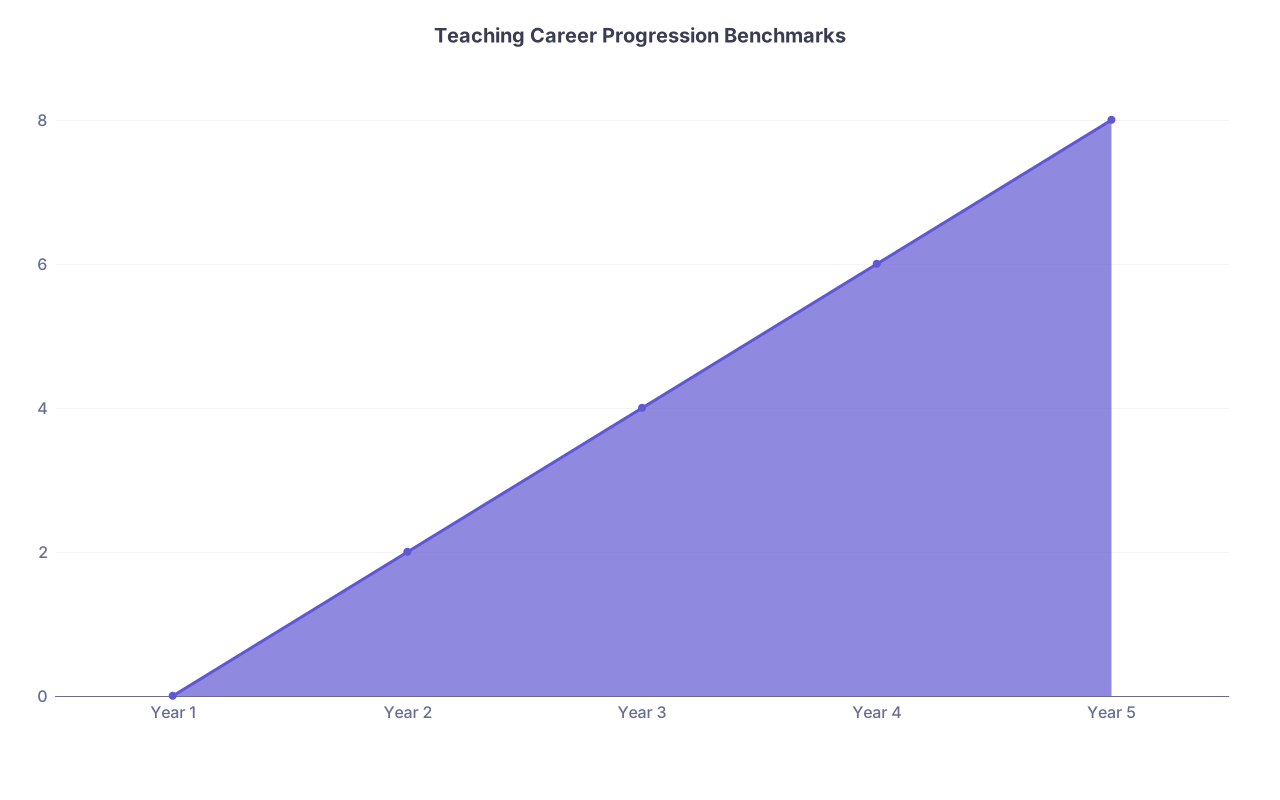
Protect yourself by tracking outcomes, not feelings:
| Category | Value |
|---|---|
| Year 1 | 0 |
| Year 2 | 2 |
| Year 3 | 4 |
| Year 4 | 6 |
| Year 5 | 8 |
Use a simple benchmark mindset:
- By Year 2 in a stable job:
- You should have at least one visible, named role (e.g., module lead, small-group lead, clear piece of a course).
- By Year 3–4:
- You should have your name attached to:
- 1–2 education abstracts or workshops.
- 1 or more education scholarship products (paper, curriculum product, national workshop).
- You should have your name attached to:
- By Year 5:
- You should be in the conversation for:
- Formal educator titles (e.g., Associate Program Director for Education, Course Director).
- Institutional or regional teaching awards.
- You should be in the conversation for:
If none of this is happening and you are still “helping with X course,” you waited too long to re-evaluate your sponsor choice.
How to Course-Correct When You Realize You Chose Wrong
Realizing you picked the wrong sponsor is painful. Staying stuck out of guilt or fear is worse.
You do not need to stage a dramatic breakup. You do need to quietly rebalance your support system.
Steps that work:
- Stop calling them your “primary mentor” on every form and conversation.
- Add new people to your support circle:
- Seek out someone who:
- Has a track record of lifting others.
- Sits in real decision rooms.
- Has complementary strengths.
- Seek out someone who:
- Clarify your goals with new sponsors:
- “In the next 3 years, I want to become X (e.g., course director, key simulation lead, national workshop faculty).”
- Ask explicitly, “How could you help me move toward that?”
- Shift your time toward projects that give you visibility and ownership, not just service:
- Lead a discrete component you can clearly claim.
- Take first-author roles where possible.
- Stay civil but boundaried with your previous sponsor:
- You can still teach for them.
- But you do not owe them your entire career trajectory.
Do not announce: “You were a bad sponsor.” Simply behave as someone who now sees their career as their own responsibility.
Building a Smarter Sponsorship Strategy
The safest educators I know do not rely on a single sponsor. They build a small, intentional network.
Think in three layers:
Institutional sponsor
- Someone who sits in local power structures:
- Course/clerkship leadership.
- GME / UME committees.
- Promotions or appointment committees.
- Their job for you: get you into visible, valued roles within your home institution.
- Someone who sits in local power structures:
External sponsor
- Someone active in:
- A national specialty organization.
- A national education society (e.g., AAMC, IAMSE, STFM, APDIM, etc.).
- Their job for you: put your name on:
- National workshops.
- Committee roles.
- Multi-institutional education projects.
- Someone active in:
Craft mentor (non-political)
- The person who:
- Will rip apart your slide deck so it is actually good.
- Teaches you how to run a room.
- Helps you think deeply about assessment, feedback, and learning design.
- Their job: make sure you are excellent enough that sponsorship is justified.
- The person who:

When these three are aligned, your career moves quickly and safely. When you confuse them, or hand all three roles to one misaligned person, you create unnecessary risk.
Common Myths That Will Quietly Sabotage You
Let me kill a few myths that keep people stuck with bad sponsors.
“They are famous, so they must be good for me.”
Being a known lecturer or textbook author does not mean they invest in junior people. Many famous educators are terrible sponsors. They are too busy protecting their own brand.“They are nice to me, so they are safe.”
Niceness is not a career strategy. You need integrity, alignment, and follow-through. Plenty of very polite people are organizationally useless.“I owe them loyalty; they gave me my first chance.”
You owe them gratitude and professionalism. You do not owe them your stagnation. Mature sponsors understand that mentees grow beyond them.“If I work hard enough for them, they will eventually reward me.”
This is how you become free labor. If sponsorship has not appeared after 2–3 years of heavy work, it probably is not coming.
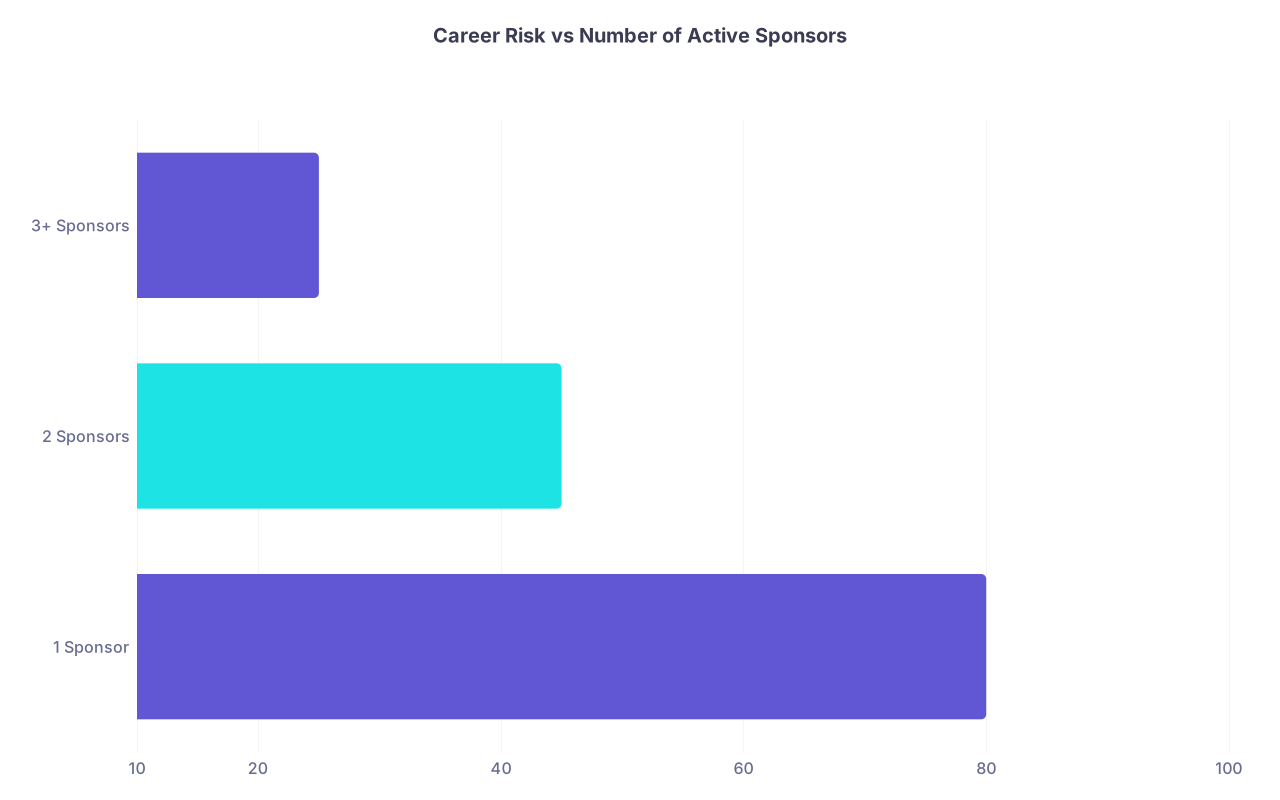
Visualizing Risk: Over-Reliance on a Single Sponsor
To make this less abstract, here is what typically happens when you put all your eggs in one sponsorship basket versus distributing your bets.
| Category | Value |
|---|---|
| 1 Sponsor | 80 |
| 2 Sponsors | 45 |
| 3+ Sponsors | 25 |
The fewer people invested in your success, the higher your vulnerability:
- A single sponsor retires, leaves, or loses political capital → your opportunities vanish.
- Two or three aligned sponsors → if one weakens, the others still carry you.
Your goal is not to collect people. Your goal is to ensure that your trajectory does not depend on any one person’s mood, job security, or internal politics.
FAQ (Exactly 4 Questions)
1. How early should I start looking for a real sponsor in my teaching career?
Earlier than you think. By the end of your first serious teaching year (as faculty, fellow, or senior resident with formal teaching roles), you should have at least one person you can identify who:
- Has institutional power.
- Knows your work specifically.
- Can imagine you in a bigger role.
Do not wait until promotion time to panic about sponsorship. By then you are 3–5 years behind.
2. What if the only senior educators available in my department are poor sponsors?
Then you look sideways and outside. You can:
- Identify sponsors in neighboring departments (medicine, surgery, pediatrics often share educational structures).
- Connect with leaders in the Office of Medical Education or GME.
- Use national organizations to find external sponsors.
You still maintain cordial relationships locally, but you do not let “local scarcity” trap you into bad bargains.
3. How do I avoid looking disloyal when I diversify my sponsors?
You do not need to frame it as leaving someone. You frame it as expanding your scope:
- “I am getting more involved in assessment, so I am also working with Dr Y who leads that area.”
- “I am exploring national work in simulation, and Dr Z has strong connections there.”
Most reasonable people accept that no one mentor can cover everything. If someone reacts possessively, that is a warning about their maturity—another sign you were right to diversify.
4. What is one concrete sign that my sponsor is actually working for me?
You should be able to point to at least one specific opportunity in the last 12–18 months that:
- You would not have known about or accessed alone.
- Came directly because they:
- Suggested you.
- Introduced you.
- Advocated for you in a selection meeting.
If all the good things in your career are self-initiated and your sponsor mostly gives validation and “great job” emails, you have a mentor, not a sponsor.
Key points to walk away with:
- Do not confuse “nice senior teacher” with “effective sponsor.” Look for a track record of lifting others into visible roles.
- Avoid over-reliance on a single sponsor, especially one who uses you for labor without visible credit or advancement.
- Audit your progress every 1–2 years; if your teaching career is not clearly moving, assume your sponsorship structure is part of the problem and adjust deliberately.