
You just signed the contract for your first faculty job. Your email now ends with “Assistant Professor.” You’ve got a shared office, a hospital badge that says “Teaching Faculty,” and an inbox full of invites: clerkship orientation, curriculum committee, resident teaching noon conference.
And then it hits you: no one actually taught you how to be a medical educator.
If you’re not careful, your first year can quietly wreck your teaching reputation, your workload, and your future promotion — long before you realize what went wrong. I’ve watched new faculty walk straight into the same traps, over and over, and spend years digging themselves out.
Let’s walk through ten career‑killing mistakes new medical educators make in year one — and how to avoid stepping on those landmines.
1. Saying “Yes” to Everything (and Getting Typecast Immediately)
This is the classic first‑year disaster.
You’re eager. You want to be “a team player.” Every email looks like an opportunity:
- “Can you give a noon conference next week?”
- “We need someone to sit on the assessment subcommittee.”
- “Could you be the faculty advisor for the simulation interest group?”
You say yes. To almost all of it.
By November, you’re drowning. You’re writing lectures at 11 p.m., missing your own deadlines, and your supposedly “50% clinical, 50% education” job has turned into 120% total.
Worse: you’ve branded yourself as the person who will always pick up unclaimed work. Not as the person with a clear niche.
Here’s the mistake: confusing volume with value. Promotion committees and future chairs do not reward “said yes to a ton of small random tasks.” They reward sustained, coherent contributions with evidence of impact.
You avoid this by forcing every new request through three filters before you agree:
- Does this align with the educator identity I want (e.g., assessment expert, simulation, UME curriculum, resident education)?
- Can I do it well without sabotaging my existing core responsibilities?
- Does it come with something concrete: title, time, or resources?
If the answer is “no” to all three, you politely decline. And yes — you must actually decline. Early.
| Type of Commitment | Healthy in Year One | Career-Harming Trap |
|---|---|---|
| One core course/rotation role | Yes | No |
| Single committee aligned with your interests | Yes | No |
| Multiple unrelated committees | No | Yes |
| Recurring lectures without title/time | No | Yes |
| Protected role (clerkship co-director, etc.) | Yes | Sometimes (if unsupported) |
If you do not learn to say no in year one, you will be buried by year three.
2. Treating Teaching Like “Extra” Instead of Core Work
New educators often keep behaving like residents: patient care is “real work,” and teaching is something you squeeze in between notes.
Huge mistake.
Faculty who treat teaching as a side activity:
- Show up unprepared.
- Wing lectures with old slides they barely understand.
- Give feedback as an afterthought, if at all.
- Cancel teaching when the clinical day gets busy.
Learners notice. So do your colleagues. You quickly get labeled as unreliable or mediocre, and that reputation spreads faster than you think.
If your contract says you’re an educator, then teaching is your core work. You schedule around it. You block your calendar before other meetings. You prepare as seriously as you would for a complex case.
Put every recurring teaching duty in your calendar with prep time baked in — not just the session itself. If grand rounds is at 12, your calendar should show a blocked hour days before for slide review and an immediate 15–30 minutes afterward for documentation, follow‑up emails, or updating materials.
When you treat education as “optional,” the institution does too. And that is poison for your career.
3. Ignoring the Politics of Evaluation and Feedback
You will underestimate how dangerous evaluation politics are. Almost everyone does.
You’re excited to “be honest” in evaluations. You write:
- “This resident is unsafe to practice independently.”
- “Student lacks insight, very poor performance overall.”
- Or the opposite: “Outstanding” for someone who was actually average.
Two problems:
- You don’t align with the program’s language and standards.
- You don’t document critical concerns with any structure.
Then:
- A resident you flagged “unsafe” graduates with no remediation because your eval looked like you were out on a limb.
- Or you’re known as “the harsh grader” and your evaluations get discounted.
- Or you pass everyone and become the “inflater” no one trusts.
You need to learn the local evaluation culture fast. That means:
- Asking your program director or clerkship director: “What does ‘meets expectations’ actually look like for this level?”
- Reviewing sample evaluations that led to remediation vs. honors.
- Calibrating with other faculty — ask, “How do you rate a solid but not outstanding resident?”
And for negative feedback, you never drop a bomb in the evaluation system that you have not already discussed with the learner face‑to‑face, with concrete examples.
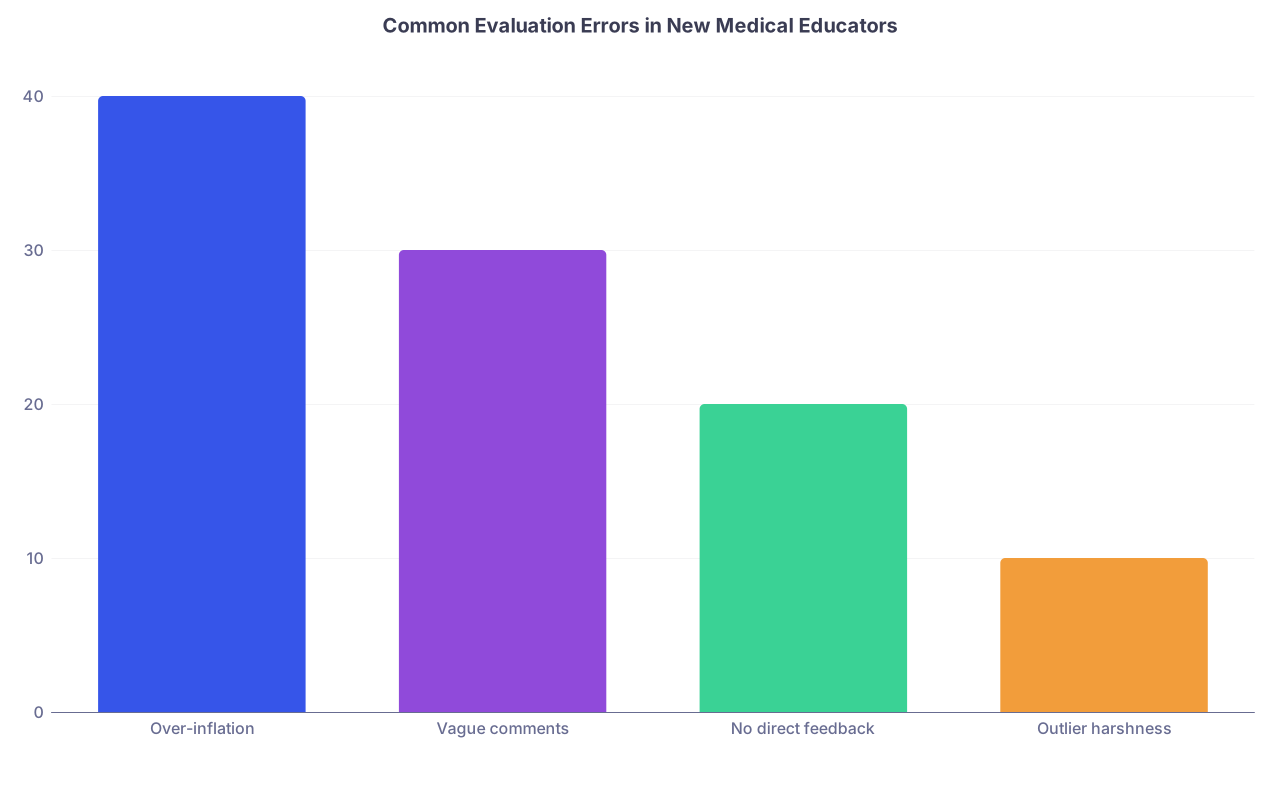
| Category | Value |
|---|---|
| Over-inflation | 40 |
| Vague comments | 30 |
| No direct feedback | 20 |
| Outlier harshness | 10 |
If your written words don’t match your in‑person feedback, you will hurt trainees and your own credibility.
4. Over‑Lecturing and Under‑Coaching
New educators often copy the worst teaching they experienced: 60‑minute monologues with too many slides, tiny fonts, and zero interaction.
You talk the entire time. Learners say “good talk, thanks” out of politeness, then forget 90% of it.
The real career‑killer here? You become known as “a content dumper” instead of a skilled educator. When leadership looks for people to run curricula or lead education innovation, they do not pick the person who reads off slides.
Do not make your first year about how much information you can push. Make it about how well you can help learners think.
That means:
- Asking questions before giving answers.
- Using short, focused mini‑lectures (10–15 minutes) with active application immediately afterward.
- Dropping half your slides. Then probably another quarter.
- Using real cases from your service, not abstract lists.
On rounds, this means asking: “What’s your assessment and plan?” then guiding. Not delivering a half‑hour talk at the bedside while the team’s pager explodes.
If learners are mostly silent during your sessions, that is not a sign of your brilliance. It’s a warning sign.
5. Failing to Set Expectations on Day One
You show up to a new rotation or session. You assume:
- Learners know what you want.
- They’ll read before clinic.
- They’ll present the way you like.
They don’t. Because they can’t read your mind. So you spend weeks irritated at them for failing rules you never explained. Meanwhile, they’re frustrated because your expectations are invisible and ever‑shifting.
This is how you quietly destroy your evaluations and your teaching climate.
On day one of any substantial teaching relationship — clerkship week, inpatient block, longitudinal clinic — you must explicitly state:
- What you care about most (professionalism? communication? clinical reasoning?).
- How you want presentations structured.
- How you’ll handle feedback (when, how often, and how blunt).
- What’s non‑negotiable (lateness, disrespect, safety shortcuts).
Do it out loud and in writing. A one‑page expectations handout is not overkill. It protects you when conflicts arise.

If you skip this step, you will end up having “big conversations” at the end of the block about issues that should have been addressed on day one.
6. Being Afraid to Give Real‑Time, Specific Feedback
New educators often either:
- Avoid negative feedback because they want to be liked, or
- Dump criticism at the very end, when it’s too late to help.
Both are career‑limiting. Students and residents will rate you as “didn’t give feedback” or “unhelpful,” and program leadership notices those patterns.
The mistake is thinking feedback needs to be a dramatic, sit‑down event.
The best educators use short, specific, emotionally neutral feedback throughout the day:
- “Your oral presentation was organized, but your assessment was too vague. Let’s rephrase it together.”
- “You interrupted the patient several times. On the next visit, I want you to ask the opening question and then stay silent for 30 seconds.”
Tiny, focused, immediate.
If you wait until the final day and then unload a list of problems they never heard before, you damage trust and your own ratings. You also look cowardly — like you avoided the hard conversation until you could hide behind the written eval.
Build a simple habit: one specific reinforcing comment and one specific refinement point per learner per day. It takes less than two minutes.
7. Neglecting Documentation of Your Educational Work
This one will not hurt you in month two. It will destroy you in year five at promotion time.
In year one, you’re just “happy to teach.” You don’t track:
- How many lectures you gave.
- How many learners you supervised.
- Curriculum materials you developed.
- Committee work you did.
- Teaching awards you were nominated for (even if you didn’t win).
Then, when it’s time for promotion or a raise, your CV looks vague. Your educator portfolio is thin. You remember “doing a lot,” but you have no proof.
Promotion committees do not care about your memory. They care about documented output and impact.
Start now:
- Keep an “education log” file (spreadsheet or simple doc).
- Every time you teach, update it: date, audience, topic, setting, hours.
- Save emails that show leadership roles, invitations, or good feedback.
- Keep versions of curricula, syllabi, evaluation tools you helped design.

| Category | Value |
|---|---|
| Informal bedside teaching | 25 |
| Curriculum development | 25 |
| Committee work | 20 |
| Mentorship | 20 |
| Formal lectures | 10 |
If you don’t build this habit in year one, reconstructing your educational life later will be a nightmare.
8. Letting Clinical Demands Completely Crush Your Teaching Role
Here’s a common pattern: the department is understaffed. Your clinical sites are drowning. “We just need you to pick up a few more clinics,” they say. “Just for now.”
You agree. You like patients. You’re a team player. Suddenly your “0.4 FTE educator” job is 0.1 education in practice — but your title and expectations haven’t changed.
So you:
- Rush through teaching.
- Cancel sessions because of call or overflow clinics.
- Stop attending education meetings.
- Let your curriculum projects stall.
Then, evaluations show you’re not delivering on the education side, and guess who gets blamed? You, not the system.
The career‑killing mistake is not the extra clinical work. It’s quietly absorbing it without any renegotiation of your educational role.
You must do something most new faculty are terrified to do: document and escalate misalignment.
If your clinical load creeps up, send a factual, non‑emotional email to your division chief or vice chair for education:
- Outline your original FTE split.
- Document the actual clinical hours and responsibilities.
- Show the educational tasks that are at risk.
Then ask a direct question: “How would you like me to prioritize these responsibilities given the current load? I want to make sure I’m meeting expectations.”
This is not whining. This is boundary protection and expectation management. If you never do it, your education career will erode under the weight of “just a few extra shifts.”
9. Working in Isolation and Skipping the Educator Community
New educators often think, “I’ll just focus on my teaching. I don’t need all those educator meetings and retreats.”
So they skip:
- Faculty development workshops.
- Education journal clubs.
- Department teaching academies.
- Local medical education conferences.
They hide in their clinic or on the wards, teaching in a vacuum.
Short term: you save a few hours. Long term: you pay for it.
You miss:
- Mentors who could steer you away from bad projects.
- Collaborators who share authorship on education scholarship.
- Early invites to leadership roles that actually come with time/support.
- The informal intel on what the promotion committee really values.
You also keep repeating the same rookie teaching mistakes because no one is watching you and giving feedback.
Find your educator tribe early. At least:
- Join your institution’s Academy of Medical Educators (or equivalent) if it exists.
- Attend the core faculty development series — yes, even if you think you’re “already a good teacher.”
- Identify 1–2 senior educators whose careers look like what you want and ask them explicitly for guidance.
If you try to build a medical education career solo, you will stall out.
10. Confusing “Busy” with “Building a Track”
This is the subtle but deadly one.
Many new educators spend their first few years doing a random mix of:
- Lectures on whatever topics need coverage.
- Ad hoc committee work.
- Occasional workshops.
- Small admin tasks (“Can you manage the sign‑in sheets?”).
They are constantly busy. Their calendars are full. They feel indispensable.
Then they try to apply for an education leadership role or promotion and realize something ugly: their work is scattered. There’s no coherent story.
Promotion committees want to see a track:
- Assessment and program evaluation
- Simulation and procedural training
- Interprofessional education
- Clerkship/UME leadership
- GME/Residency curriculum leadership
- Faculty development
Something. Not everything. Not nothing.
Your first year should not be about collecting random tasks. It should be about sampling enough to decide on a direction — then slowly pruning.
By the end of year one, you should be able to answer, in one sentence: “I’m building a career as a ________ educator.” Fill in that blank with something more specific than “medical.”
Then, every new major commitment gets measured against that direction. If you’re heading toward simulation, why are you spending your nights rewriting the geriatrics didactic slide deck for the third time? You can say no — or negotiate to make it fit your track (e.g., “I’ll do this if we can build a simulation component and call it a curricular innovation project”).
If you don’t get intentional, you will wake up five years in, with 12 disconnected minor roles and no clear identity.
FAQ (Exactly 4 Questions)
1. How much should I say “no” in my first year without looking uncooperative?
You don’t reflexively say no; you say conditional yes or redirect. Accept 1–2 core roles that align with your desired educator identity and come with some recognition (title, time, or mentorship). For everything else, try: “I’m at full capacity with X and Y this year. If this can replace one of those, I’m happy to discuss. Otherwise I’d recommend Dr. Z who has an interest in this area.” That signals you’re thoughtful about commitments, not lazy.
2. What’s the fastest way to get better at bedside or ward teaching?
Ask one trusted colleague with a reputation for great teaching to watch you once. Tell them: “I want unfiltered feedback on how I run rounds.” Then actually change something based on what they say. Combine that with one small structure — for example, always doing a 3‑minute “one teaching point” per patient, or assigning a learner to be “reasoning explainer” on each case. You don’t need fancy tools; you need structure and honest observation.
3. Do I really need an educator portfolio if I’m mostly clinical with ‘some’ teaching?
If you plan to stay in academic medicine longer than two years, yes. “Mostly clinical” faculty still get evaluated on teaching. Your future self will be furious at you if you don’t track this from the start. The portfolio doesn’t have to be formal at first — a simple file with dates, topics, audiences, and sample materials is enough to build on.
4. How do I pick an education niche without boxing myself in too early?
You’re not signing a lifetime contract with one niche; you’re choosing a direction. In year one, sample 2–3 areas that genuinely interest you (e.g., simulation, assessment, wellness curriculum). Pay attention to where you get invited back, where senior people are excited to work with you, and what energizes you instead of draining you. By the end of the year, deliberately drop one area and keep 1–2. You can pivot later, but drifting everywhere is worse than committing somewhere.
Key things to remember:
- Do not confuse “saying yes a lot” with building a real education career.
- Protect your time, your boundaries, and your documentation from day one.
- Pick a direction, find mentors, and treat teaching as core work — not a hobby stapled onto clinical care.