What if you want to keep your rural practice… but you also want a real role in medical education that’s more than the occasional random student rotation?
You are not the only rural doc thinking that. A lot of you are quietly doing heroic clinical work and feeling completely cut off from academic medicine. Maybe a student shows up once a year. Maybe never. You want to teach, shape the pipeline, and maybe even build something local and lasting—a true “regional site” for a med school.
Let me walk you through how to actually do that. Not fantasy. The playbook.
Step 1: Get Clear on What You Actually Want to Build
“Regional site” sounds grand, but in practice it usually starts small.
Do you want:
- One student at a time for 4–6 week clerkships?
- A longitudinal integrated clerkship (LIC) where 4–8 students stay in your town for 6–12 months?
- A recurring 2–4 week rural elective?
- A mix—core clerkships plus some electives?
If you don’t answer that, administrators will answer for you. And they often default to “occasional elective,” which is the least powerful model for your community and for you.
Here’s the spectrum, simplified:
| Model | Students | Duration | Complexity |
|---|---|---|---|
| Short Elective | 1–2 at a time | 2–4 weeks | Low |
| Core Block Rotation | 1–3 at a time | 4–8 weeks | Moderate |
| Longitudinal Integrated Clerkship | 4–10 at a time | 6–12 months | High |
| Hybrid (Core + Electives) | 2–6 at a time | Variable | High |
My blunt advice:
- If you’re solo or in a 2–3 physician group: start with elective or core block rotations.
- If you have 5+ attendings in town across sites (clinic, hospital, ED, OB, maybe a specialist or two): LIC becomes feasible. It’s heavy lift but transformational.
Write down, in 1 page, your “ideal”:
- How many students at once
- For how long
- What they’d do (clinic, ED, OB, procedures, community health, etc.)
- What YOU get (CME, academic title, call coverage adjustment, protected time, maybe recruitment pipeline)
You’ll use this page repeatedly when you start talking to schools and hospital leadership.
Step 2: Map Your Local Assets (and Weak Spots) Honestly
Before you pitch anyone, you need a realistic picture of what your town can offer.
Think in four buckets:
- Clinical settings
- Preceptors
- Housing and logistics
- Education infrastructure
Walk through this like you’re doing a consult on your own town.
Clinical settings
Can students see:
- Outpatient primary care (FM/IM/peds)
- Inpatient medicine
- Emergency care
- OB (prenatal + deliveries)
- Surgery/anesthesia
- Behavioral health
- Community medicine/public health projects
You don’t need all of these to start, but the more you cover, the more attractive you are as a “site” rather than “just a clinic.”
I’ve seen successful sites that were literally:
- 2 FM docs + 1 PA clinic
- 15–25 bed critical access hospital
- A 24/7 ED covered by local docs
- 1 visiting general surgeon
That’s enough for a 6–8 week core family medicine or rural medicine block, sometimes a mini-LIC.
Preceptors
Do you have:
- At least 2–3 physicians who actually like teaching, not just tolerate it?
- One person willing to be “Site Director” (yes, that might be you)?
- Any DOs or MDs with academic titles previously?
- APPs (NP/PA) who enjoy teaching and can take partial responsibility for some skill sessions?
Be honest about who’s burned out and who’s energized. One toxic preceptor can tank a new site quickly.
Housing and logistics
Big one. Students care more about this than schools admit.
- Is there safe, walkable housing within 10–15 minutes of clinic/hospital?
- Is hospital housing or a discounted motel option available?
- Reliable internet? (If your internet goes out when it rains, fix that first.)
- Transportation—do students need a car, or can you arrange shuttles/bikes?
If your town is 90 miles from an airport and 40 miles from a Walmart, that does not kill your chances. But you need a clear, honest logistics plan so schools aren’t blindsided.
Education infrastructure
Right now you probably have none. That’s fine. But schools will ask:
- Where will students chart? Do they get their own logins?
- Where can they sit to write notes?
- Is there a room for teaching / case discussions?
- Can they join Zoom lectures from your site?
Make a basic list of what you can offer and what you’d need support to build.
Step 3: Identify Which School(s) to Approach (and How)
Do not email every med school within 500 miles with a generic “we’d love students” message. That gets ignored.
Instead, find:
- The nearest allopathic and osteopathic schools
- Their existing rural programs (Rural Track, LIC, regional campuses)
- The Associate Dean for Clinical Education, Regional Campuses, or Rural Programs
- Any alum of your town on their faculty
You want to look like a solution to an existing problem, not a brand-new project they need to invent.
Look at their website and you’ll see things like:
- “We are expanding our rural clerkship footprint.”
- “Our LIC sites include X, Y, Z.”
- “Students must complete a rural rotation.”
That’s your opening.
Draft a very specific, 1–2 page proposal email + attachment. Not a novel. Something like:
- Who you are (rural FM/IM/OB, years out, practice description)
- Your town’s basics (distance from med school, population, hospital size)
- What you’re offering (e.g., “We can host 1–2 third-year students every 6 weeks for Family Medicine / Rural Medicine rotation”)
- What you need (credentials, orientation support, maybe a small stipend or GME support if this grows)
Step 4: Build the Pitch That Actually Works
Schools and hospital suits are all asking one thing: “Is this going to be a headache?”
Your pitch has to answer:
- This is educationally solid.
- This is logistically realistic.
- This won’t blow up in six months.
Here’s the rough skeleton:
- Educational design
- What clerkship(s) are you offering? FM, IM, rural rotation, elective?
- What will students do in an average week—clinic %, hospital %, ED %, call?
- How will core objectives be met (e.g., “We can provide continuity, chronic disease management, acute visits, procedures such as…”)
- Faculty and supervision
- List your preceptors, credentials, and roles.
- Confirm they’re willing to complete faculty development modules and evals.
- Student experience
- Housing details.
- Expected hours and call.
- Access to Wi-Fi, food, gym, etc.
- Administrative/logistical plan
- Who handles schedules?
- Who signs paperwork / evaluations?
- How orientation will work (Day 1 checklist: badges, EMR, tour).
- Benefits for the school and health system
- Rural pipeline for residency/employment.
- Community engagement.
- Potential future GME site for FM/IM.
Once you’ve got this written, schedule a Zoom with:
- The clerkship director for the discipline you’re targeting, and
- Someone with decision power—Associate Dean or Director of Clinical Education.
Do not just send documents. Talk live. People say yes to humans, not PDFs.
Step 5: Negotiate the Non-Negotiables (For You and For Them)
If you just say yes to everything, you’ll burn out and the site will die. I’ve watched that movie enough times.
Your must-haves:
- Protected teaching time built into your schedule.
- Example: half-day per week with decreased clinic volume when students are present.
- Reasonable workload:
- No, students should not be “extra staff.” They slow you down at first.
- If your RVU targets don’t budge despite teaching load, that’s a red flag.
- Basic support:
- Reliable student housing.
- Credentialing help.
- Malpractice coverage clearly spelled out for supervision/teaching.
The school’s must-haves:
- Accreditation compliance:
- Students need access to certain types of patients and procedures.
- Evaluations returned on time.
- Clear supervision and documentation rules.
- A named site director:
- Someone responsible for quality and student issues.
- Some level of faculty development:
- Short online modules or occasional in-person/virtual workshops.
Do not be shy about asking:
- For a small site director stipend.
- For help funding student housing (even partial).
- For EMR training and admin support.
Many schools will say, “We don’t have a huge budget, but…” and then find money for the sites they actually value. Be one of those.
Step 6: Set Up the Day-to-Day Reality So This Doesn’t Implode
This is where most rural teaching projects fail. The vision is fine. Life in clinic kills it.
You need systems. Boring, repeatable, idiot-proof systems.
Orientation checklist
Day 1 is predictable. Make it scripted:
- ID badge
- EMR access with appropriate student role
- HIPAA/OSHA review (school may do this; you confirm)
- Tour: clinic, hospital, call rooms, cafeteria
- Meet staff: nurses, front desk, lab, x-ray
- Review expectations:
- Start/stop times
- Dress code
- Where to park
- How notes are written and labeled as student notes
- How to ask for help in ED/hospital
Write this out as a 1–2 page “Rural Site Welcome Packet.” Send it to students before arrival.
Weekly schedule template
Don’t reinvent the wheel for every student.
Make a default weekly template, something like:
- Mon: AM clinic, PM clinic + teaching case
- Tue: AM hospital rounds/ED, PM clinic
- Wed: Procedure half-day + clinic
- Thu: OB/prenatal + L&D call
- Fri: Clinic + community project time / reading
You can flex it, but having a skeleton reduces chaos.
Teaching structure
You are not going to deliver a two-hour chalk talk every day. No one in real practice does.
What works in rural teaching:
- “Case of the day”:
- End of morning or afternoon, 10–15 minutes.
- Student presents one case; you walk through reasoning and teaching points.
- Micro-teaching in the room:
- “Pause. Before we go back in, tell me your top 2 diagnoses and what you’d do first.”
- Weekly formal session (30–60 min):
- Quick topic review tied to real patients (COPD, prenatal care, chest pain, back pain, etc.).
- Use whatever resources the school provides (online modules, etc.) as scaffolding.
Feedback and evaluation
Students take this deadly seriously; schools track it; you’ll be judged on it whether you like it or not.
Set a rule with yourself:
- Mid-rotation feedback: schedule it. 15–20 minutes, private, explicit.
- End-of-rotation feedback: also scheduled, with written eval submitted within 48 hours.
Use simple language:
- “You’re strong in X. Where I want to see growth before residency is Y. Here’s one concrete thing to work on next month.”
If you consistently return fair, detailed evals on time, schools trust you and send more students.
Step 7: Decide Whether to Build Toward an LIC or Stay with Short Rotations
At some point, if your site does well, someone will say, “Could we turn this into a longitudinal clerkship site?”
That’s not a small ask.
An LIC (6–12 months, multiple disciplines in parallel) needs:
- Multiple preceptors (FM, IM, surgery, OB, peds, psych, ED)
- Strong coordination so students hit all required encounters
- Serious housing arrangements (year-long leases, often)
- A Site Director who basically has a second part-time job
Upside:
- Massive continuity for patients and learners.
- Extremely strong recruitment to rural practice; many LIC grads come back to similar communities.
- The school often invests more money and infrastructure in LIC sites.
Downside:
- If you’re already stretched clinically, it can break you.
- If one key preceptor leaves, the whole LIC structure can wobble.
My take: start with 2–3 years of shorter block rotations. Build your teaching culture, your local credibility, and your processes. Then negotiate LIC from a position of strength if it still makes sense.
Step 8: Protect Yourself From the Three Common Failure Modes
I’ve seen rural sites fail for the same reasons again and again:
- One-person hero model
- No backup when crisis hits
- Nobody watching the “student experience”
Let’s be candid.
Failure mode 1: The hero burns out
You design the program, teach every student, return every email, do every evaluation, handle all the logistics.
It works. For… 18 months. Then you’re fried.
Solution:
- From day one, identify at least one co-preceptor and one admin ally.
- Build redundancy:
- “If I’m out or swamped, Dr. X can take the student.”
- “If I’m on vacation, our clinic manager handles orientation paperwork.”
Failure mode 2: Something bad happens and no one has a plan
Student sees something traumatic. Or there’s a patient care complaint. Or they struggle with performance.
In small towns, things get personal and weird fast if you don’t have structure.
Before you launch, clarify with the school:
- Who handles:
- Student wellness issues
- Allegations of mistreatment
- Clinical performance concerns
- What to do today if:
- You need to remove a student from patient care immediately.
- A student discloses mental health crisis or harassment.
You want a written algorithm, even if it’s simple.
Failure mode 3: Students feel isolated and unsupported
Rural rotations can be the best or worst of med school.
If students feel:
- Socially isolated
- Out of the academic loop
- Overused as “extra hands” and under-taught
…word spreads. Your site gets a reputation, and not the good kind.
Countermeasures:
- Explicit weekly check-in with you:
- “How’s it going? What do you need more of or less of next week?”
- Connection to main campus:
- Protected time to join required lectures by Zoom.
- Possible virtual small groups with peers at other sites.
- Some social structures:
- Give them tips on local events, hiking trails, coffee shops.
- If appropriate, occasional faculty-student meal or community activity (once a rotation is enough).
Step 9: Think About Your Own Career: Titles, CME, and the Next Step
You are not just doing charity work for the school. This should advance your career too.
Things to push for:
- Faculty appointment:
- “Clinical Instructor,” “Assistant Clinical Professor,” or similar.
- This matters when you later want to move, apply for promotions, or get CME discounts.
- CME and development:
- Access to the med school library, online CME, teaching workshops.
- Leadership possibilities:
- Regional site director
- Clerkship co-director for the rural track
- Participation in admissions or curriculum committees (especially rural-focused ones)
If you want to eventually move into more formal medical education leadership, this rural site work is legitimate, high-value experience. Treat it like that. Keep a running CV section of:
- Number of students precepted
- Courses/rotations directed
- Innovations (new curriculum, community project, etc.)
- Teaching awards or positive program reviews
Step 10: Measure, Adjust, and Grow (Or Deliberately Stay Small)
After the first year, sit down with:
- Yourself
- Your key preceptors
- The clerkship director or Associate Dean
Ask three blunt questions:
- Is this sustainable?
- Are students getting what they need?
- Is this still good for our community and our physicians?
Look at:
- Student evaluations of the site and preceptors
- Any patient care or professionalism incidents
- Your own sense of workload and burnout
Then decide:
- Grow a bit:
- Add another student or another rotation.
- Stabilize:
- Keep numbers the same, refine logistics and teaching.
- Scale back:
- Drop from 2 students at a time to 1.
- Offer only certain blocks of the year.
Growth for its own sake is dumb. The goal is a stable, high-quality, long-term rural teaching presence, not a balloon that looks great until it pops.
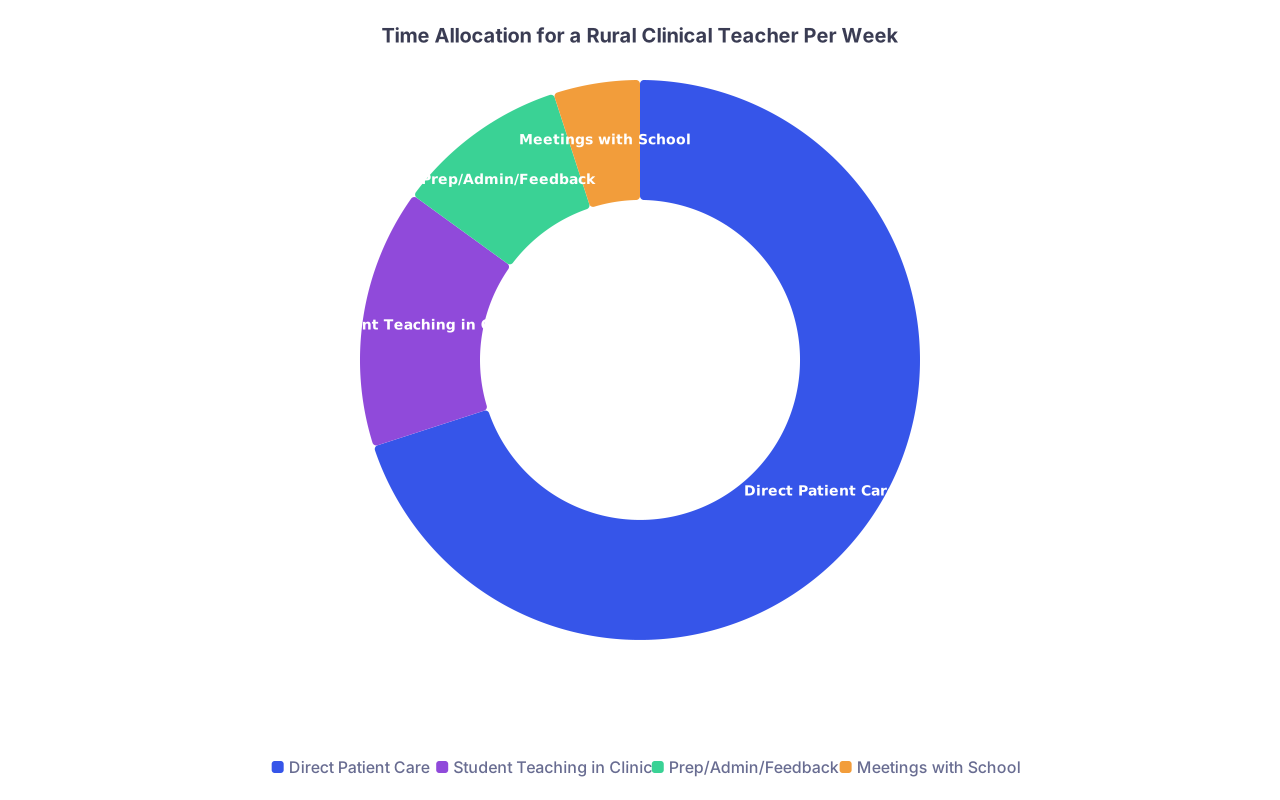
| Category | Value |
|---|---|
| Direct Patient Care | 70 |
| Student Teaching in Clinic | 15 |
| Prep/Admin/Feedback | 10 |
| Meetings with School | 5 |
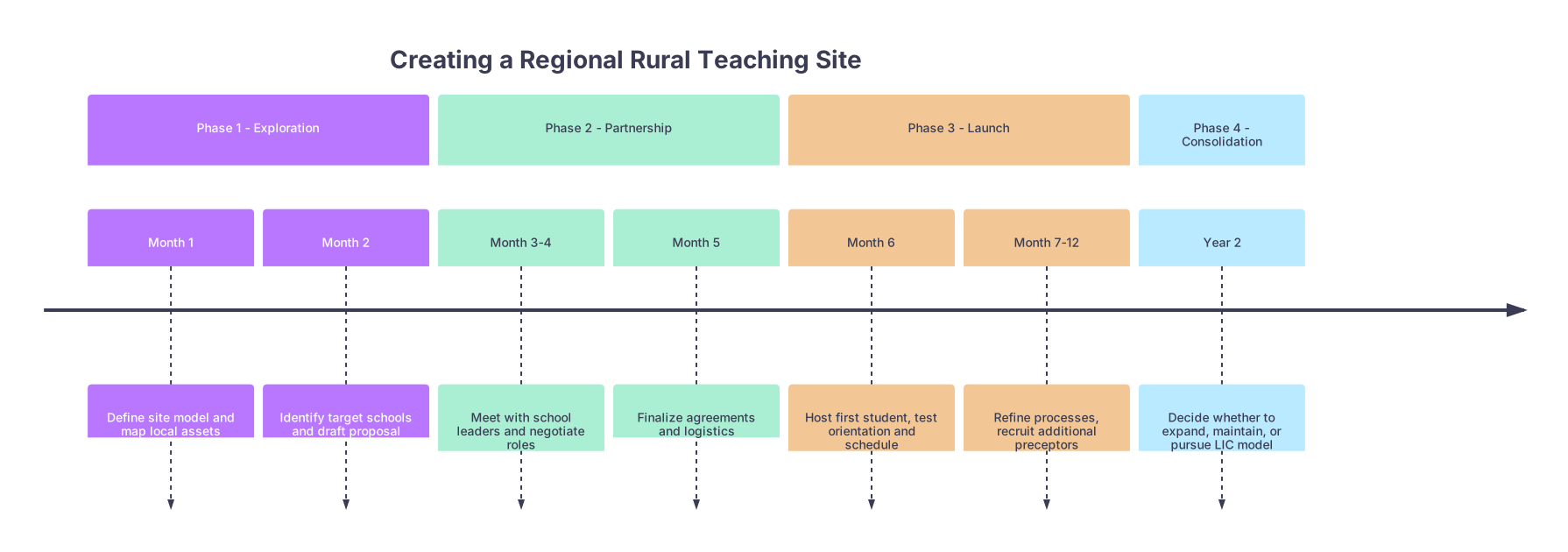
| Period | Event |
|---|---|
| Phase 1 - Exploration - Month 1 | Define site model and map local assets |
| Phase 1 - Exploration - Month 2 | Identify target schools and draft proposal |
| Phase 2 - Partnership - Month 3-4 | Meet with school leaders and negotiate roles |
| Phase 2 - Partnership - Month 5 | Finalize agreements and logistics |
| Phase 3 - Launch - Month 6 | Host first student, test orientation and schedule |
| Phase 3 - Launch - Month 7-12 | Refine processes, recruit additional preceptors |
| Phase 4 - Consolidation - Year 2 | Decide whether to expand, maintain, or pursue LIC model |
Two or Three Things to Keep Front and Center
First: You can absolutely do real medical education from a rural clinic. But it only works if you’re ruthless about structure—clear roles, simple systems, real support.
Second: Do not play the hero. Build a small team, negotiate for what you need, and be willing to stay modest in scale rather than saying yes to everything and burning out.
Third: Treat this like a real career step for yourself. Get the title, the development, and the influence you’ve earned by turning your town into the place where future physicians learn what real medicine looks like.