
What do you do when the work you spent a decade training for starts to drain you instead of fuel you—but you still actually like medicine and can’t imagine leaving completely?
If that’s where you are, you’re exactly who I’m talking to.
You’re not “done with medicine.” You’re done with the way you’re currently practicing it. The pager. The RVUs. The inbox. The patient satisfaction comments that read like Yelp reviews for a restaurant you don’t even own.
Medicine itself? The ideas, the problem‑solving, the teaching moments with students and residents—those might still light you up.
That gap—between hating your current day‑to‑day and still caring about the field—is where medical education becomes a very real, very practical pivot.
Let’s walk through how to do this like an adult with bills, responsibilities, and limited energy, not like a fantasy “one day I’ll teach” idea.
Step 1: Get Honest About Your Burnout Profile
Not all burnout is the same. Before you leap toward “med ed will fix this,” you need to understand what’s actually wrong.
Ask yourself, very concretely:
- What parts of my current job do I dread most?
- What parts give me any energy at all?
- If I had a week with no clinical work, what kind of work would I choose to do?
Write this down. Not in your head. On paper or in a note.
Common patterns I see:
You hate:
- Endless documentation, inbox, prior auths
- 15‑minute visits stacked back‑to‑back
- Night shifts/weekends
- Being evaluated on RVUs or patient “satisfaction” scores
You still like (or at least tolerate):
- Explaining things to patients or families
- Walking a student through how to interpret a lab or image
- Giving noon conference when you actually have time to prepare
- Journal club or case discussions
If your eyes light up more for the second list than the first, good. That’s your first sign that medical education isn’t just escapism—it actually matches how you’re wired.
Now, reality check: clinical work does not disappear in most med ed jobs. But the ratio and the daily rhythm change. Your goal is not to run away from all clinical work; it’s to structurally shift what you spend most of your working hours on.
Step 2: Know What “Medical Education Career” Actually Means
“Medical education” isn’t one job. It’s a cluster of roles with different levels of clinical time, academic expectations, and pay.
Here’s a snapshot so you’re not chasing a fuzzy dream.
| Role | Typical Clinical Time | Formal Education Training Required? |
|---|---|---|
| Clerkship/Block Director | 20–50% | Preferred, often not required |
| Residency/APD/PD Leadership | 20–60% | Increasingly expected |
| Simulation Director/Faculty | 10–40% | Helpful but not always required |
| Skills Lab / Preclinical Lead | 0–30% | Often yes or strongly preferred |
| Full-time Med Ed Scholar | 0–20% | Usually yes (Master’s, fellowship) |
If you want:
- Less nights/weekends, more predictable schedule → Clerkship leadership, simulation, preclinical education
- To stay integrated with residents/fellows but change focus → Associate program director (APD), residency leadership
- To go deep into curriculum design, assessment, and scholarship → Med ed fellowship or Master’s leading to more education‑heavy roles
None of these are purely “teaching” jobs where you just give lectures and go home at 3 pm. The higher you go (program director, vice‑chair for education, dean‑level roles), the more admin and politics you’ll get. Know that going in.
Step 3: Start Where You Are – Low-Risk Experimentation
You do not start by quitting your job and applying to med ed fellowships blindly. You start by running small, low‑risk experiments inside your current context.
You’re testing two things:
- Do you actually enjoy the work of teaching and education administration?
- Can you show enough impact that someone would credibly hire you for it?
Here’s a practical sequence that works for most people:
Say yes strategically, not desperately.
Don’t just say “I’ll help with teaching” and wait for scraps. Target what gives you some energy:- Precept an extra half-day in clinic with clear teaching goals
- Volunteer to give or revamp one recurring talk (e.g., M&M, noon conference)
- Join an existing committee that touches education (clerkship committee, CCC, PEC)
Take ownership of one small project.
Examples I’ve seen that turned into CV bullets:- Build a structured feedback form for residents and actually use it
- Create a pocket guide or checklist for a common rotation (e.g., “ICU Survival Guide for Interns”)
- Standardize the way your team does bedside rounds teaching
Measure and document what you do. Even basic data:
- Lecture feedback ratings before vs after you revamped it
- Number of learners you worked with and their level
- Comments like “best session of the block” or “this made night float survivable” saved in a folder
That portfolio becomes the spine of your med ed story later. Without it, you’re just another burned‑out clinician saying “I like teaching.”
Step 4: Get Seen by the Right People (Without Being Annoying)
No one is going to tap you for a med ed role if they have no idea who you are in that space.
You’re not trying to become a social climber. You’re trying to make sure the people who control education jobs know you exist and can deliver.
Targeted moves:
Know your local med ed power players.
These are often:- Clerkship directors
- Residency/fellowship program directors
- Vice chair for education
- Director of undergraduate medical education
- Simulation center director
Ask for a 20-minute conversation, not a job.
Reach out with something like:“I’ve realized that the teaching parts of my work are what keep me going, and I’m seriously considering developing a more education-focused career path. Could I get 20 minutes of your perspective on how people here have done that successfully?”
Then actually keep it to ~20 minutes.
Walk in prepared. Have:
- A short list of what you’ve already done in education
- One or two specific directions you’re curious about (“I think I like curriculum design more than research,” etc.)
- One clear ask: “If you were me, what’s the next concrete step you’d take in the next 6–12 months?”
This does two things. It marks you as someone serious about education. And it gives you inside intel on how your institution really functions—not the fantasy version.
Step 5: Decide Whether You Need Formal Training
Here’s the part people overcomplicate. “Do I need a Master’s in Medical Education?” “Do I need an education fellowship?”
Short answer: not always. But more and more, serious education leadership roles expect something formal.
Use this decision logic:

| Step | Description |
|---|---|
| Step 1 | Want more education work |
| Step 2 | Start with local teaching and small projects |
| Step 3 | Consider med ed fellowship or Masters |
| Step 4 | Start with certificate courses and local roles |
| Step 5 | Build scholarship and network |
| Step 6 | Target role is leadership or scholarship heavy |
| Step 7 | Can you reduce clinical time for 1-2 years |
Options, realistically:
Certificate programs / faculty development series
Usually shorter (a few days to months, part‑time). Good for:- Clinicians wanting more tools without taking a pay cut
- People testing if med ed “depth” actually interests them
Master’s in Health Professions Education / Med Ed / Curriculum & Instruction
Examples: MHPE, MMEd, MEd. Some are online or part‑time. Good for:- Folks aiming for long‑term leadership (PD, clerkship director, dean roles)
- People who want to publish in med ed and be taken seriously in that space
Medical education fellowships (1–2 years)
Strong if:- You can afford a pay cut for a year or two
- You’re fine relocating if needed
- You want structured mentorship, a project, and built‑in network
Don’t sign up for a Master’s just because you’re miserable clinically. Only do it if the work of designing studies, writing curricula, and reading education literature actually sounds interesting to you.
Step 6: Crunch the Numbers (Yes, Including Money)
Burnout makes people do impulsive things. Like quitting to “figure it out” later. Don’t.
You need a basic financial and time reality check.
Look at:
- Current salary vs likely med ed‑heavy roles at your institution
- How much protected time those roles actually have vs what’s promised
- Whether there’s an internal compensation structure for education roles (some places have formal “education tracks” with salary ladders, many don’t)
Here’s a typical pattern I see:
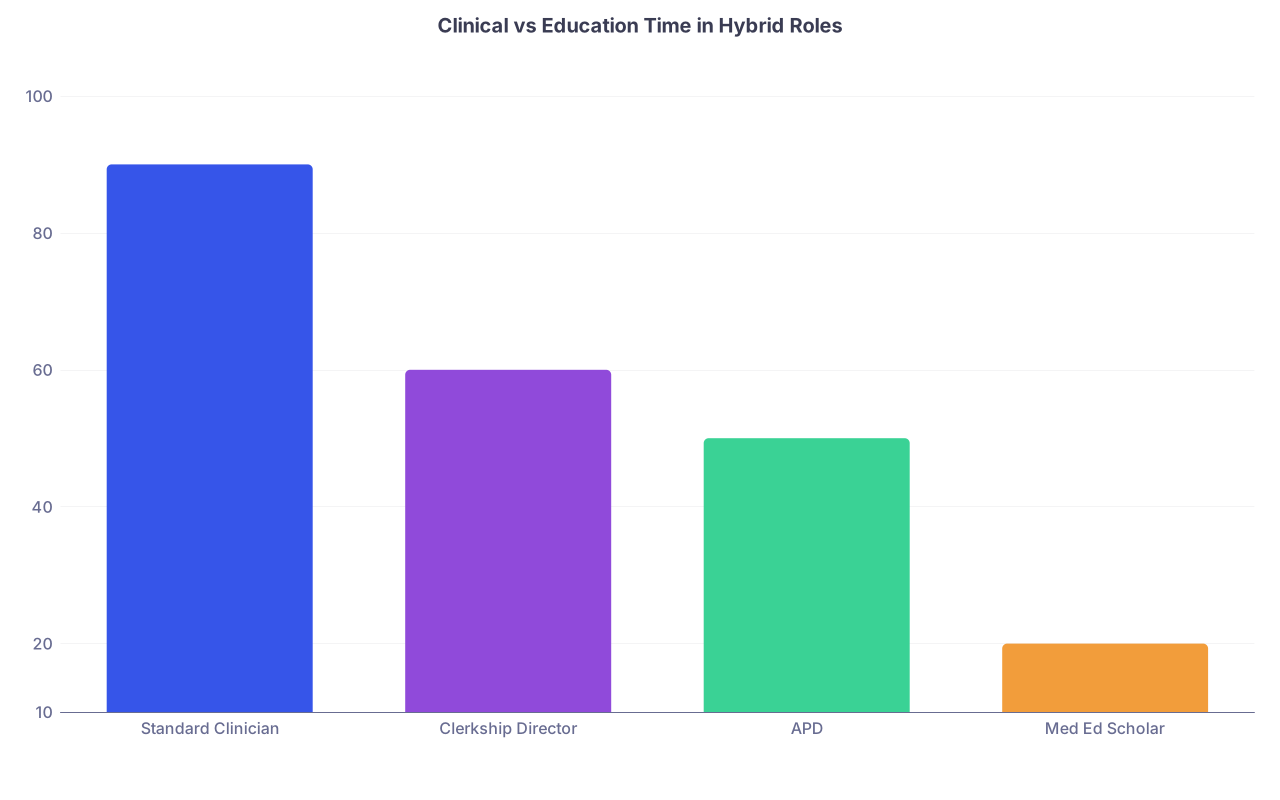
| Category | Value |
|---|---|
| Standard Clinician | 90 |
| Clerkship Director | 60 |
| APD | 50 |
| Med Ed Scholar | 20 |
Those numbers are rough, but the trend holds: the more education and admin you do, the less clinical you do. That often means:
- Slightly or moderately lower total comp than your full‑tilt clinical peers
- Better schedule control, fewer nights/weekends
- Different kind of stress (meetings, deadlines, politics vs codes and overnight admits)
Decide explicitly:
- What’s your minimum acceptable yearly income?
- Are you willing to trade, say, 10–30% of income for a sustainable career?
- What schedule or lifestyle changes do you need (not just want)?
If your current institution cannot or will not offer realistic med ed‑heavy roles that meet those needs, you expand your search. Which leads to…
Step 7: Build a Med Ed CV and Go on the Market (Without Burning Bridges)
When you’re ready to pivot, you need to package your story properly. This is where most clinicians sabotage themselves—they send a generic clinical CV and say “interested in teaching.”
You need a med ed–focused CV that foregrounds:
- Teaching roles (formal and informal)
- Curriculum or program development
- Educational leadership (even small-scale stuff—clinic lead, rotation revamp)
- Education scholarship (posters, workshops, QI with teaching components)
Then you actively look for roles that match your target ratio of clinical vs education work.
Common job postings to search for:
- “Clerkship Director – [Specialty]”
- “Associate Program Director – [Residency]”
- “Director of Simulation”
- “Director of Undergraduate Medical Education – [Discipline/Block]”
- “Health Professions Education Faculty”
Your pitch in cover letters and interviews should not be “I’m burned out and need a change.” It should sound like:
- You already function as an educator where you are
- You’ve done concrete projects with impact
- You now want a role where that’s central, not peripheral
Example framing:
“Over the last five years I’ve gradually shifted more of my time into education—developing a structured intern orientation for our inpatient service, leading M&M conferences, and co‑chairing the residency CCC. Those experiences made it clear that curriculum design and learner development are the most meaningful parts of my work. I’m looking for a role where that’s not just a side project, but a core responsibility.”
That sounds like someone moving toward something, not just running away.
Step 8: Protect Yourself from a “Same Misery, New Label” Trap
You can absolutely end up burned out in medical education too. Just differently.
Classic trap patterns:
- You take on a clerkship director job with “30% protected time” that magically evaporates into meetings, accreditation paperwork, and endless emails…
- …while your actual clinical load never decreases proportionally.
Or:
- You become APD, but the culture is toxic, nobody respects your admin time, and your “education work” is basically schedule triage and duty hour policing.
You avoid that by being ruthlessly specific before you sign anything.
Questions to ask (out loud, in writing if possible):
- How many half‑days per week of clinical work are expected?
- What does “0.4 FTE for education” actually mean in hours and responsibilities?
- Who controls your schedule? Can someone unilaterally add more clinics because “we’re short”?
- How is educational work recognized for promotion and salary? Is there a documented path?
- What happened to the last person in this role? (If they left after 18 months “to pursue other opportunities,” dig harder.)
If those questions make them uncomfortable or irritated, that’s your answer.
Step 9: If You Can’t Pivot Internally, Use Med Ed to Change Environments
Sometimes the problem isn’t just that you’re doing too much clinical work. It’s that you’re in a bad system—corporate clinic mill, RVU sweatshop hospital, or an academic place that talks about education but treats educators like cheap labor.
In that case, med ed can be your ticket out, not just your “new job.”
You might:
- Move from a heavy‑volume community job into a teaching‑focused safety‑net or VA system
- Leave a toxic academic department for a different university that actually funds education
- Go from inpatient‑heavy job to mostly outpatient + teaching, or vice versa, depending on your burnout triggers
- Shift into a health system or med school that has a mission you actually believe in (rural training, underserved communities, etc.)
The key is to treat your education experience and training as portable capital. You’re not just “one more hospitalist” or “one more EM doc.” You’re:
- “The person who built our simulation bootcamp”
- “The one who revamped the sub‑I curriculum and improved evaluations”
- “The APD who turned CCC feedback into something residents found useful instead of terrifying”
That’s the stuff that travels well when you apply elsewhere.
Step 10: Make a 12–24 Month Pivot Plan, Not a Vague “Someday”
The difference between people who talk about doing this and people who actually pivot is a simple thing: a real timeline.
You don’t need a five‑year plan. You need a one‑ to two‑year roadmap with specific moves.
Something like:
Next 3 months:
- Take on one concrete small med ed project where you are
- Meet with your local education leader for advice
- Start documenting teaching activities and feedback
Months 4–9:
- Apply to or complete a short faculty development course or certificate
- Present one education‑related project locally (grand rounds, resident conference)
- Decide whether you want/need a Master’s or fellowship and research options
Months 10–18:
- Either:
- Apply for formal med ed training (if that’s your route)
- Or actively apply for education‑heavy roles locally or externally
- Update CV into a proper med ed CV
- Have at least two mentors who know your goals and can advocate for you
You’re not waiting to “feel ready.” You’re moving in stages, with each stage giving you more data about whether this path genuinely fits you.
Before You Jump: Two Hard Questions
Ask yourself, and answer honestly:
- If I stripped away my anger at my current job, do I actually like the work of teaching, curriculum, and mentoring enough to make it 30–70% of my job?
- Am I willing to trade some income and some clinical identity points for a career that’s intellectually and emotionally more sustainable?
If yes, you’re a good candidate for a med ed pivot.
If the real answer is “I just want my current job to suck less,” then your first move might be reducing FTE, changing specialty focus, or even leaving clinical medicine entirely—and that’s a different conversation.
Key Takeaways
- Don’t treat “medical education” as a fantasy escape. Test it where you are with small, concrete teaching and curriculum projects, then decide if you want more.
- Build a visible education profile—projects, feedback, mentors—before you go hunting for med ed–heavy roles or additional training.
- Protect yourself on the way out: clarify clinical time, compensation, and real responsibilities so you don’t just recreate your burnout with a different job title.
If you handle it deliberately, medical education isn’t a consolation prize for burned‑out clinicians. It’s a legitimate, sustainable second arc in your career.