
What if the career path you pick in your first faculty offer quietly decides your next 20 years of freedom, stress level, and how much you actually get to teach?
Let’s answer the real question: Should you choose the clinician-educator track or the traditional tenure track?
I’ll walk you through how these tracks actually play out in real life—not just what’s on the HR slide deck.
Big Picture: What’s the Core Difference?
Here’s the cleanest way to say it:
- Traditional tenure track = research is king, grants and publications drive your promotion and job security. Teaching and clinical work matter, but they’re not the main metric.
- Clinician-educator (CE) track = clinical care and teaching are king, with research and scholarship as secondary or optional, depending on the institution.
If you’re miserable writing grants but come alive on rounds or in the sim lab, you’re probably a CE-track person. If you love designing studies, chasing R01s, and get a weird high from being “last author” on five papers in a year, that’s tenure-track energy.
The problem is most people pick a track based on prestige or what their mentors did—not on how they actually want to spend their day from 8 am to 6 pm for the next decade.
Let’s get specific.
How Your Day Actually Looks on Each Track
Forget titles for a second. Look at time.
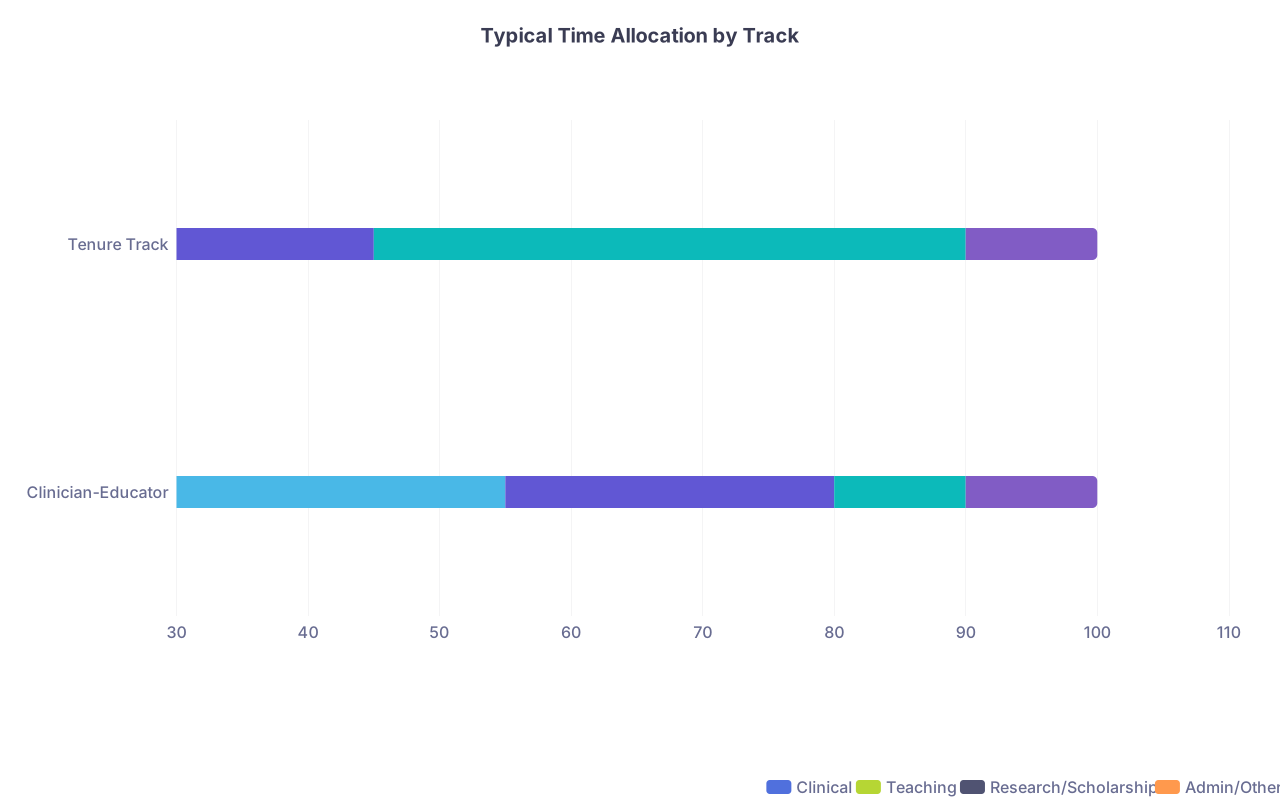
| Category | Clinical | Teaching | Research/Scholarship | Admin/Other |
|---|---|---|---|---|
| Clinician-Educator | 55 | 25 | 10 | 10 |
| Tenure Track | 30 | 15 | 45 | 10 |
These are ballpark numbers I’ve seen at places like large academic medical centers (think: UCSF, Michigan, Duke). It varies, but the pattern is consistent:
Clinician-Educator Track
Your life is built around:
- Clinical sessions (clinic, OR, wards, consults)
- Teaching learners in those settings
- Some structured teaching (lectures, small groups, courses)
- Optional or modest scholarly activity (curriculum design, QI projects, education research)
You’re the person people call when a resident is struggling and needs a good teacher. You’re probably the attending who actually sits down and explains the differential instead of speed-walking out of the room.
Traditional Tenure Track
Your life is built around:
- Protected research time (ideally 50–75% early on)
- Grants, publications, mentoring trainees on projects
- Some teaching (often less than you’d think, but it’s scored)
- Minimal clinical load, optimized to protect research time
You’re judged by your CV metrics: first/last author papers, external funding, national reputation in a niche.
If the idea of spending 2–3 days a week writing, analyzing data, and revising manuscripts sounds like a good week—not a punishment—then tenure track may fit.
Promotions, Security, and How “Safe” Each Track Is
Here’s where people get confused and sometimes burned.
| Feature | Clinician-Educator Track | Traditional Tenure Track |
|---|---|---|
| Primary focus | Clinical care + teaching | Research + grants |
| Job security model | Contract-based, renewable | Tenure clock → potential tenure |
| Promotion emphasis | Teaching evals, service, some scholarship | Publications, grants, national reputation |
| Typical clinical load | Higher | Lower |
| Research expectation | Low–moderate | High |
| Flexibility to shift later | Limited at many places | Sometimes to CE, rarely opposite |
Tenure Track
You’re on a clock (often 6–9 years) to prove:
- You can bring in external funding (K award, R01, foundation grants, etc.)
- You can produce consistent peer-reviewed publications
- People outside your institution know who you are and respect your work
If you hit those marks, you can get tenure—long-term job security plus status. Sounds great.
Reality check:
In many departments, a big chunk of junior tenure-track faculty never actually get tenure. They either:
- Slide to a non-tenure/CE track before their tenure decision, or
- Quietly don’t get renewed and disappear to another institution or private practice
If you’re not comfortable with that risk—and don’t love research enough to fight for it—think hard.
Clinician-Educator Track
There’s usually:
- No traditional “tenure,” but
- More realistic promotion expectations
- A focus on teaching excellence, clinical excellence, and some form of scholarship (educational projects, QI, guidelines, etc.)
You’re often on renewable contracts (e.g., 3–5 years), and if you’re productive clinically and not a problem, your job is usually reasonably secure. Not guaranteed—but less “up or out” culture.
One big catch: Some places treat CE-track as second-class citizens. Less voting power, fewer leadership slots, less protected time, lower pay. At other places, CE is the backbone of the department and very respected.
You need to find out which culture you’re stepping into.
Money, Prestige, and Real-World Tradeoffs
Let’s talk about what people actually care about but rarely say out loud.
Salary
- Early career:
CE track and tenure track can be similar or CE slightly higher (because you’re doing more RVU-generating work). - Long term:
Tenure-track high performers with big grants can end up making more, especially with endowed chairs, leadership roles, and percent salary from grants.
But the variance is big. A strong CE faculty member who takes on leadership (clerkship director, program director, vice chair of education) can also do very well.
If your main driver is maximizing income with less admin, neither track wins. Private practice or hybrid community-academic setups usually pay more.
Prestige and Identity
Here’s the ugly truth:
In many old-school academic cultures, tenure-track basic scientists and physician-scientists sit at the top of the prestige pyramid.
But the culture is shifting, especially in:
- Education-focused departments
- Hospitals where clinical revenue drives everything
- Fields heavily dependent on clinician-educators (IM, pediatrics, EM, FM)
If you need the validation of being “Professor X, R01-funded investigator,” you know which way you’re leaning.
If you’d rather be known as “the attending everyone wants to work with and the person who built our residency curriculum,” that’s CE territory.
How to Decide: A Brutally Honest Framework
Walk through these questions and don’t lie to yourself.
1. What do you actually enjoy on a random Tuesday?
Imagine:
- 8 am: You can either
A) Pre-round, teach on the wards, staff clinic, handle real patient issues with learners, or
B) Sit in your office, write, analyze, build a manuscript, revise a grant.
Which day leaves you more energized at 5 pm?
If it’s mostly A → Clinician-Educator probably fits you.
If it’s mostly B → Tenure Track deserves serious consideration.
2. How much do you hate (or tolerate) grant writing?
Not “could I push through it if I had to?” but: would you willingly build a career where grants are:
- Always hanging over your head
- Directly tied to your job security and protected time
- Needing constant maintenance (renewals, resubmissions, new aims)
If your stomach drops reading that, tenure track is going to feel like a never-ending treadmill.
3. Are you already producing scholarship—and do you want to double down?
Look at your current record:
- First-author papers?
- Ongoing projects with clear, fundable directions?
- Mentors offering you a realistic path to significant external funding?
If you’re already functioning like a junior investigator and enjoy it: tenure track could be right.
If your CV is mostly:
- Teaching awards
- Descriptions of “participated in curriculum X”
- Maybe a couple of case reports and a QI poster
You’re a better fit for clinician-educator, unless you do a serious pivot and training in research.
4. How risk-tolerant are you?
Tenure track:
- Higher risk, higher reward
- Clearer “win or lose” moments (tenure decision)
Clinician-educator:
- More stable day-to-day
- Often less existential anxiety (as long as you’re clinically solid and not burned out)
If you’re already anxious and stretched thin as a fellow or resident, betting your whole future on a tenure clock may be a bad move.
Red Flags and Questions to Ask Before You Sign
Don’t just accept whatever HR calls the track. Ask targeted questions when you interview or negotiate.

| Step | Description |
|---|---|
| Step 1 | Clarify Your Priorities |
| Step 2 | Ask About Tenure Track Expectations |
| Step 3 | Ask About CE Track Expectations |
| Step 4 | Consider Tenure Track Offer |
| Step 5 | Clinician Educator Is Good Fit |
| Step 6 | Consider Other Institutions |
| Step 7 | Prefer Research or Teaching |
| Step 8 | Comfort With Grants and Pressure |
| Step 9 | Institution Values CE Track |
Key questions (ask multiple people, not just the chair):
For CE track:
- How are promotions evaluated for clinician-educators here?
- Do CE faculty have protected time for education work, or is it all “on top” of clinical?
- What percentage of your department leadership is on the CE track?
For tenure track:
- What’s the actual tenure rate in the last 10 years?
- How much truly protected research time do junior faculty get, and who controls it?
- What kind of internal support exists for grant writing and pilot funding?
For both:
- How easy is it to switch tracks later? (And get a real, honest answer.)
- What happens to faculty who don’t meet promotion expectations?
- Are there formal educator tracks with promotion criteria built around education scholarship?
If people dodge, handwave, or “rah-rah” you without specifics, be careful.
Where Each Track Shines (Concrete Scenarios)
Strong Clinician-Educator Fit
You:
- Love teaching on rounds and in clinic
- Have ideas for improving clerkships, residency curricula, or assessments
- Enjoy QI projects, clinical guidelines, or building teaching tools more than sitting with SPSS or R
- Are okay with higher clinical load and less research pressure
This is the person who becomes:
- Clerkship director
- Program director
- Vice chair for education
- Simulation director
- Director of faculty development
Those jobs are almost always filled by clinician-educators.
Strong Tenure-Track Fit
You:
- Genuinely like reading the literature, thinking about unanswered questions, and designing studies
- Don’t mind long, quiet stretches of writing and analysis
- Already have or want advanced research training (MPH, MSCE, PhD, or serious methods training)
- Get more satisfaction from a new JAMA paper than from a standing ovation after Grand Rounds
You’re the one who becomes:
- Section head of research
- PI on big multicenter trials
- Chair of a study section
- Holder of an endowed chair
If that sounds like the life you want, tenure track is absolutely worth the risk.
Quick Self-Check: 5-Question Gut Test
Answer these fast, no overthinking:
- I’d rather design a new curriculum than a new clinical trial.
- I’d rather be known institutionally as “the best teacher” than “the most funded researcher.”
- I’d be okay if I never wrote another R01-style grant in my life.
- I get more joy from watching a resident finally “get it” than from seeing my name in PubMed.
- I can accept that my job security is tied more to my clinical and educational output than to my H-index.
If you said “yes” to 4–5 of these → Clinician-Educator.
If you said “yes” to 0–2 of these → Tenure Track deserves serious thought.
If you’re in the 3-zone, you’re in the gray area; your local environment and mentors will probably tip the scale.
FAQ: Clinician-Educator vs Traditional Tenure Track
1. Can I switch from clinician-educator to tenure track later?
Sometimes, but it’s usually hard. Most institutions treat tenure-track entry as front-loaded—you’re expected to start on that path with a research agenda already forming. Moving from CE to tenure track later often requires a clear research portfolio, methods training, and strong departmental support. Plan as if switching will be difficult.
2. Does clinician-educator track mean I can’t do any research?
No. You can absolutely publish, do education research, QI studies, or collaborate on clinical research. The difference is that your promotion doesn’t depend primarily on big grants and high-volume publications. But you still need some scholarship at many places—often education-focused.
3. Is tenure track always more prestigious?
Not anymore, and not everywhere. In some old-guard departments, yes, tenure is still the gold standard. But lots of modern academic centers are very clear that clinical and educational missions are just as critical. Look at who gets leadership roles, awards, and prime committee seats—that tells you what’s really valued.
4. What if I love teaching but also want serious research time?
Then you might aim for a hybrid: tenure track with an education-research focus, or a CE track at a place that heavily values education scholarship. But you can’t avoid the basic tradeoff: if you want serious research time, you’ll need to accept research-type metrics and pressure.
5. How should I build my CV in residency or fellowship to keep both options open?
Do both teaching and research, but be intentional. At a minimum: get involved in at least one substantial research project (preferably leading to a first-author publication), and one education or teaching project (curriculum, evaluation tool, simulation course, etc.). This gives you credibility no matter which way you lean when offers come.
6. If I’m already burned out clinically, is clinician-educator a bad idea?
Potentially, yes. CE usually means more clinical time than tenure track. If clinic or inpatient work is what’s frying you, doubling down on a clinical-heavy track might backfire. In that case, either fix the burnout (different setting, better team, better schedule) or rethink whether an academic clinical career at all is the right move.
Key takeaways:
- Choose the track that matches how you actually want to spend most weekdays—teaching and seeing patients vs designing studies and chasing grants.
- Be honest about your tolerance for risk, grant pressure, and the tenure clock; don’t pick tenure track for prestige alone.
- Before you sign, interrogate the local culture—how each track is truly valued and supported at that institution matters more than any generic description.