
It’s 10:30 p.m. You’ve finally finished charting, your inbox is still a mess, and you’re staring at your CV trying to decide if this is the year you actually go up for promotion. You’ve done lectures, precepting, maybe a curriculum or two. But the question that keeps looping in your head is:
“Do I have enough teaching projects, or am I going to get laughed out of the promotions committee?”
Let me answer that directly.
You do not need a magic number of teaching projects. You need the right mix of teaching work, with visible impact and evidence that it’s more than just “I showed up and talked.”
But numbers do matter in context, so I’ll give you ranges and concrete targets.
The Short Answer: Target Ranges by Level
Here’s the straight talk based on how many educators I’ve watched go through promotions at academic medical centers.
| Rank Target | Solid Range of Distinct Teaching Projects | What That Usually Looks Like |
|---|---|---|
| Instructor → Asst Prof | ~3–5 | Mostly local, small scope, some evaluation data |
| Asst Prof → Assoc Prof | ~5–10 | Several larger efforts, clear leadership and outcomes |
| Assoc Prof → Full Prof | 10+ (with depth & leadership) | Program-level impact, regional/national recognition |
Define “teaching project” properly:
A teaching project is a distinct, structured educational activity that goes beyond “I gave a lecture.” It usually has at least some of these:
- Clear goals or objectives
- Defined audience and setting
- Design or redesign work you led or co-led
- Evaluation or outcome data
- Evidence of dissemination (locally or beyond)
Examples that usually count as a project:
- Designing and running a new simulation-based code blue curriculum
- Creating a longitudinal QI teaching track for residents
- Building a standardized patient OSCE for clerkship students
- Leading a faculty development workshop series with evaluation data
- Developing an online module that gets adopted by multiple sites
A single noon lecture, even if repeated, is teaching activity, not a “teaching project.”
What Promotion Committees Actually Look For
Committees don’t sit around counting projects like they’re Step scores. They look for patterns:
- Breadth – Do you teach in multiple formats and levels (students, residents, CME, etc.)?
- Depth – Have you led or built anything, or are you always the “guest lecturer”?
- Impact – Can you show that learners or programs changed because of your work?
- Trajectory – Does your teaching portfolio look better and more focused over time?
That’s why the person with 4 strong, well-documented projects can look better than someone with 18 scattered, unassessed activities.
To give you a more concrete sense, here’s what a credible teaching portfolio might look like at different promotion stages.
For Promotion to Assistant Professor: The Early Portfolio
You’re probably:
- 0–3 years out of training
- Mostly clinically focused with some teaching squeezed in
- With relatively little formal educational scholarship
Rough target: 3–5 distinct teaching projects, plus routine teaching activity.
Typical components that play well:
Baseline teaching activity
- Precepting in clinic or wards
- Giving a recurring lecture (core topic)
- Small-group teaching (case-based, problem-based sessions)
2–3 structured, documented projects, for example:
- Designed and delivered a small-group skills workshop (e.g., EKG boot camp) with pre/post confidence ratings
- Took responsibility for a block of the clerkship curriculum and updated session design with evaluation data
- Created a standardized teaching handout or pocket guide used across your program
Basic evidence
- Learner evaluations (numbers and key comments)
- A simple summary: “What was the goal, what did you do, what happened?”
At this stage, committees mainly want to see that you’re not just showing up. You’re thinking about how you teach and can demonstrate some impact.
For Promotion to Associate Professor: Solidifying an Educator Identity
This is where the question “how many teaching projects?” really starts to matter more.
You’re usually:
- 5–8+ years out of training
- Established in your department
- Starting to shape curricula or programs, not just plug in as a lecturer
Rough target: 5–10 distinct teaching projects, with at least 3–5 where you’re clearly leading and with documented impact.
What I like to see in someone at this level:
Clear teaching narrative
- You have a focus: communication skills, ultrasound education, QI teaching, assessment, simulation, etc.
- Your projects mostly line up with that theme, showing growth over time.
A mix of project types, for example:
- One or two curriculum builds or major redesigns
- Example: Led redesign of the internal medicine morning report curriculum with structured cases, faculty guides, and learner evaluations.
- One simulation or skills-based program
- Example: Co-created a simulation series for procedural skills with checklists and faculty training.
- One faculty development or peer education effort
- Example: Designed and ran a workshop on giving feedback, delivered annually, disseminated across departments.
- One assessment or evaluation initiative
- Example: Implemented a new direct observation tool for residents and collected data on use.
- One or two curriculum builds or major redesigns
Evidence and scholarship
- Aggregated evaluation summaries, not just raw score sheets.
- At least some form of dissemination:
- Poster or workshop at a regional/national meeting (AAMC, SGIM, APDIM, STFM, etc.)
- A MedEdPortal publication, or
- A paper on education outcomes, even if small.
At this level, quantity and coherence matter. Six random one-off projects don’t look as good as four deep, growing efforts in a clear niche.
For Promotion to Full Professor: Depth, Leadership, Reach
If you’re eyeing full professor, no one is asking if you “have enough projects.” They’re asking if you have educational impact at scale.
You’re usually:
- 10–15+ years into your career
- Already recognized locally as “the person for X” in education
- Holding leadership roles (clerkship director, program director, vice chair for education, etc.)
Rough target: 10+ distinct projects over your career, with at least 5–7 substantial, longitudinal, and clearly led by you, plus regional/national visibility tied to those projects.
What that looks like in real terms:
You’ve built and sustained one or more major programs:
- Longitudinal curriculum (e.g., 4-year clinical reasoning thread in the med school)
- Major residency track or scholarly concentration
- A high-stakes assessment program (OSCEs, milestone assessments)
Your work has spread:
- Invited workshops at other institutions
- National committees related to your area
- Multi-site education collaborations
- Widely used tool, guide, or module
Your scholarship tracks your projects:
- Papers, MedEdPortal resources, book chapters, or significant national presentations directly derived from your teaching projects.
At this stage, raw count is almost irrelevant unless it’s weirdly low. The issue is influence and recognition.
How to Decide if You Have “Enough” Right Now
You can do a self-audit in under an hour. Lay it out bluntly.
Step 1: List your teaching projects only (not all teaching)
On a blank page or spreadsheet, create columns:
- Project name
- Role (lead, co-lead, faculty, contributor)
- Start–end dates
- Level (UGME, GME, CME, faculty)
- Evidence of impact (evals, outcomes, changes)
- Dissemination (none/local/regional/national)
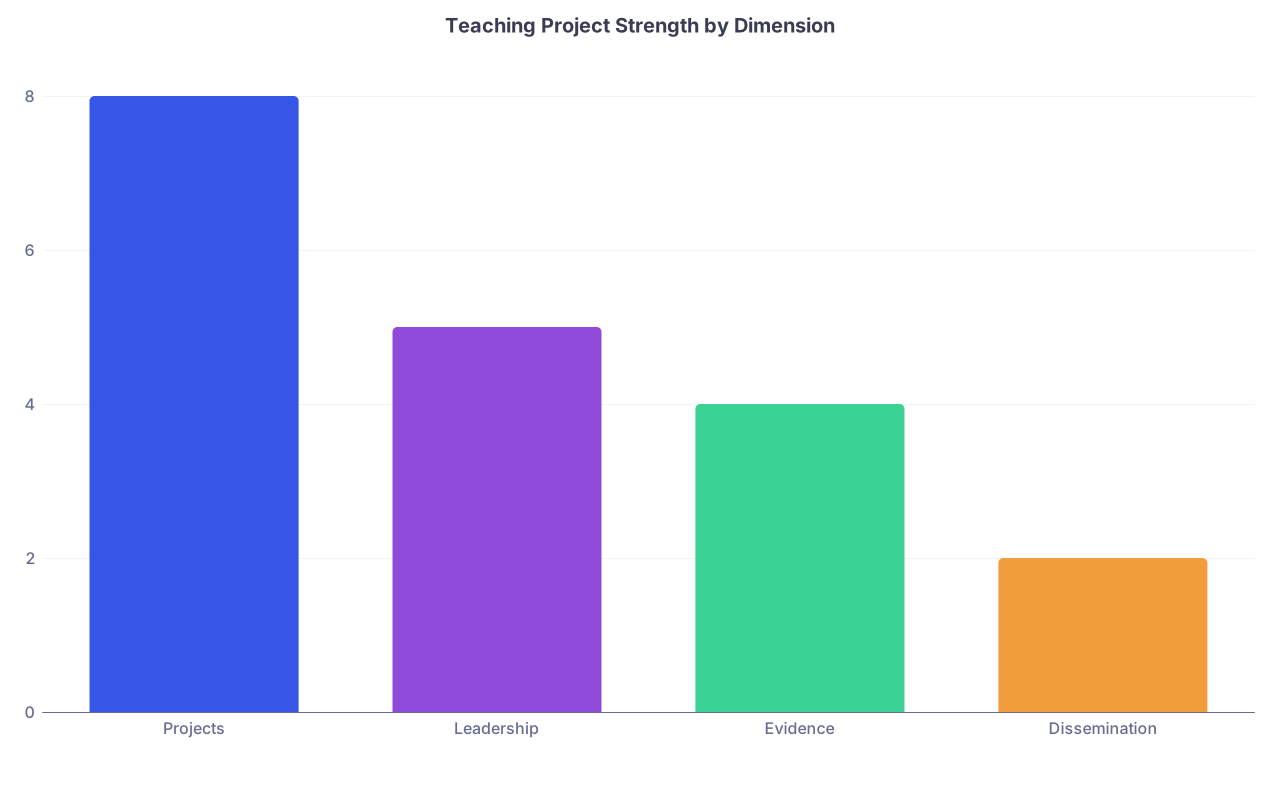
| Category | Value |
|---|---|
| Projects | 8 |
| Leadership | 5 |
| Evidence | 4 |
| Dissemination | 2 |
That might look like: “8 projects total, but only 5 where I’m the lead, 4 with good evidence, 2 actually disseminated.”
That’s common. And fixable.
Step 2: Identify obvious gaps
Patterns I see all the time:
- Lots of lectures, almost no designed curricula
- Good local work, no dissemination
- Many small projects, nothing longitudinal
- Everything is “co-” nothing is clearly led by you
Step 3: Match your count and quality to your target rank
Use this as a basic cross-check:
| Question | Assistant Prof Target | Associate Prof Target | Full Prof Target |
|---|---|---|---|
| Distinct projects overall | 3–5 | 5–10 | 10+ |
| Projects you clearly *led* | ≥1 | ≥3–5 | ≥5–7 |
| Projects with real evaluation/outcomes data | ≥1–2 | ≥3–4 | Most |
| Projects with dissemination beyond your site | Helpful, not required | At least 1–2 | Several, ongoing |
If you’re clearly below in multiple boxes, you’re probably early. If you’re at or above all of them, your issue is more likely documentation, not quantity.
Common Mistakes That Hurt You More Than “Too Few Projects”
Fragmenting one program into ten “projects” on your CV
Committees see through this. One curriculum with three minor tweaks is still one main project with iterations.No evaluation data
“Learners liked it” with no data is weak, especially for promotion beyond assistant professor. Even a simple pre/post confidence scale and a couple of representative comments are better than nothing.No alignment with your personal “educator brand”
If your teaching CV looks like a yard sale—one of everything tossed in—it’s hard to argue you’ve developed in a specific area.No narrative
Same list, no story. Your educator’s statement (teaching portfolio narrative) should connect the dots: what you focused on, how your projects evolved, what you changed based on outcomes.
How to Strengthen a Thin Portfolio in 12–18 Months
If your count or depth feels light, you don’t need ten more projects. You need 2–3 high-yield moves.
Move 1: Elevate one existing activity into a real project
Example: You give an annual communication skills session.
Turn it into a project by:
- Clarifying objectives
- Creating a structured plan and materials
- Adding pre/post survey questions
- Summarizing results and iterating the session next year
- Submitting it to MedEdPortal or as a workshop at a regional conference
Same time footprint. Much higher promotion value.
Move 2: Lead one new curriculum or program change
Pick something tightly scoped but meaningful:
- A new orientation/boot camp for interns
- A brief, focused QI teaching series during rotation
- A structured feedback training for faculty with follow-up
Make sure you:
- Are clearly named in a lead role
- Get evaluation data
- Present outcomes locally and, if reasonable, regionally/nationally
Move 3: Package and disseminate what you already do
You probably have at least one thing that could be turned into:
- A local grand rounds or education conference talk
- A poster or oral presentation
- A workshop at a specialty meeting
- A MedEdPortal submission
That one step often shifts a project from “local effort” to “promotion-level educational scholarship.”
Visualizing Your Trajectory
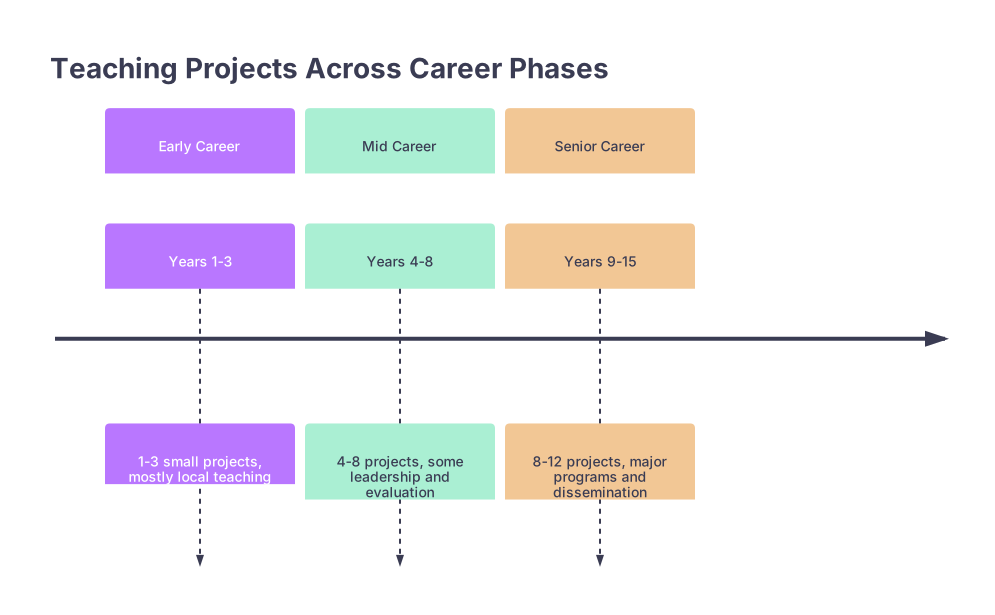
Sometimes it helps to see whether your teaching work is actually growing over time, or if you’ve been flat for years.
| Period | Event |
|---|---|
| Early Career - Years 1-3 | 1-3 small projects, mostly local teaching |
| Mid Career - Years 4-8 | 4-8 projects, some leadership and evaluation |
| Senior Career - Years 9-15 | 8-12 projects, major programs and dissemination |
If your personal “timeline” doesn’t look like this—if it’s flat or actually declines—you either need to:
- Rebalance your clinical vs. education commitments, or
- Get formal support/role definition (APD, clerkship director, etc.) that legitimizes your education work and gives you protected time.
FAQ: Teaching Projects and Promotion (5 Questions)
1. Does each year of a curriculum count as a separate teaching project?
No. Running the same curriculum yearly is one project with duration. You can describe major revisions or expansions as “phases” of the same project, but don’t list “M3 clerkship didactics 2019, 2020, 2021” as three different projects.
2. Do bedside or clinic precepting sessions count as teaching projects?
Routine precepting is essential teaching activity, but it’s not a “project” unless you’ve systematically structured and studied it—for example, implementing a new feedback model in your clinic with measured outcomes. You still list precepting under teaching roles, but don’t over-sell it as a project.
3. How many publications do I need from my teaching projects?
For pure educator tracks, many committees are satisfied if your major teaching projects generate some scholarship: a handful of peer-reviewed papers, MedEdPortal resources, or national workshops tied to your work. There’s no universal number, but if you have multiple big projects and zero dissemination, that’s a problem at the associate/full level.
4. Will a single “big” education project make up for having very few others?
It helps, but rarely enough by itself. A massive single project with strong outcomes and national impact is impressive, but committees still want to see a pattern of engagement and sustained contribution. Better to have one flagship project plus several smaller, coherent ones than just one moonshot.
5. What should I do this month if I’m planning to apply for promotion next year?
Pick one existing teaching activity and upgrade it into a formal project:
- Define clear objectives
- Add a simple evaluation component
- Collect data for the next few sessions
- Start a one-page summary of the project (goals, methods, results, next steps)
- Identify one venue (local or regional) where you can present it
That single move both improves your portfolio and gives you concrete material to talk about in your educator’s statement.
Open your CV and teaching portfolio file right now. Make a separate section titled “Teaching Projects” and list only activities that qualify by the criteria above. Count them. Then mark which ones have leadership, evaluation, and dissemination. Your next step is obvious once you see that list in front of you.