
The harsh truth: whether you get invited back to give grand rounds has very little to do with how smart you are and everything to do with how you make the room feel.
You’ve heard all the public advice: be evidence-based, speak clearly, disclose conflicts. Fine. That’s the baseline. What actually decides if your name quietly goes on the “have back again” list happens in side comments in the hallway, in an email you never see, in a debrief between the CME coordinator and the department chair.
Let me walk you through how it really works.
How Grand Rounds Invitations Actually Get Decided
There’s a myth that grand rounds invitations are controlled by some formal, objective process. A CME committee. A structured vetting of expertise. A rational evaluation of educational value.
Sometimes. On paper.
Behind the scenes, it’s much messier and much more human.
Here’s the usual pipeline I’ve watched for years at multiple institutions:
- Names come from three places: previous speakers, faculty word-of-mouth, and industry suggestions. Very rarely from cold outreach.
- A program coordinator or education chief keeps an informal mental list: “engaging,” “never again,” “fine but dull,” “fantastic—bring back for fellows.”
- The department chair or vice chair of education weighs in based on politics: collaborations, recruitment, institutional relationships.
- After your talk, there’s a five-minute informal postmortem: “Was that good?” “Did people stay?” “Did anyone complain?”
That last piece decides if you get invited back.
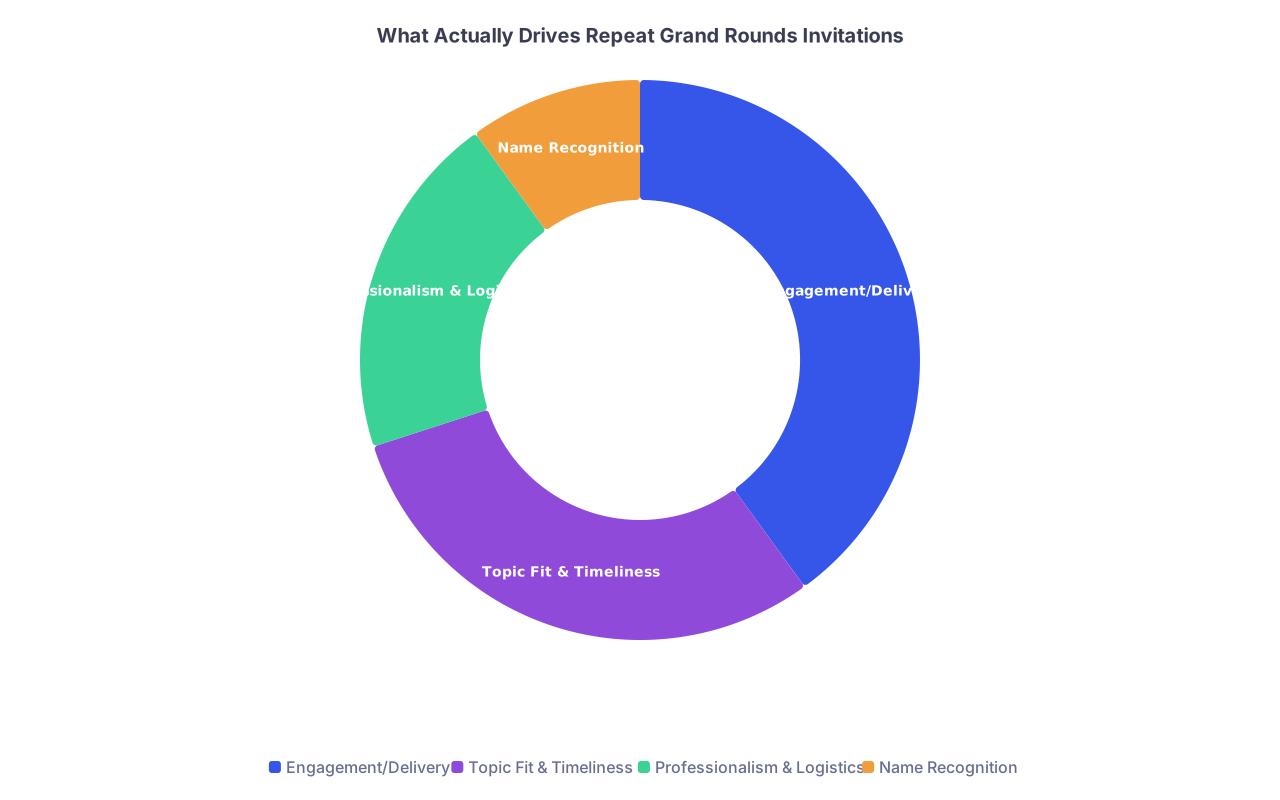
| Category | Value |
|---|---|
| Engagement/Delivery | 40 |
| Topic Fit & Timeliness | 30 |
| Professionalism & Logistics | 20 |
| Name Recognition | 10 |
Notice what’s missing from that chart? “Number of publications,” “H-index,” “Famous trial PI.” Those get you in the door. They don’t get you back.
The unspoken rule: you’re being judged more as a live performer than as a scholar.
And most academics never figure that out.
The Shadow Criteria: What People Really Judge
No one will send you this rubric, but I’ve literally sat in conference rooms and heard versions of these lines.
1. “Did they respect our time?”
This is the first and biggest filter.
Respecting time isn’t just ending on time. It’s showing you understand what it feels like to be in that room on a Tuesday at 8:00 am:
- Residents post-call and half-awake
- Outpatient attendings watching their schedule collapse
- Hospitalists glancing at their phones for codes and pages
Disrespect looks like this:
- Starting late because you’re “just waiting for a few more folks to join”
- Going 5–10 minutes over and saying, “I’ll just take one or two quick questions” while people are visibly packing up
- Spending the first 15 minutes on your CV disguised as “how I got into this work”
- Overstuffed slides you speed-read, then saying, “I know this is a lot”
The people who get invited back do something very different. You’ll see them:
- Start on time even if the room’s half empty
- End 3–5 minutes early on purpose
- Edit ruthlessly to a few key takeaways
- Say openly, “I know you’re all busy; I’m going to make this worth your hour”
That last line? I’ve heard it twice from phenomenal speakers—both of them got re-invited within a year.
2. “Could I actually use this on rounds or in clinic?”
No one articulates this, but it’s the implicit standard.
A beautifully polished talk that doesn’t change behavior is not a success. It’s a performance art piece. Which is fine, but that’s not what the department needs from its limited grand rounds slots.
In the post-talk hallway conversations, here’s what matters:
- “I’m going to change how I counsel patients about this.”
- “I didn’t realize the risk was that high; I’ll start screening more.”
- “That algorithm for workup was actually useful.”
If your talk ends and people say, “That was interesting,” you’re in the middle tier. If they say, “That was so depressing,” you’re dead. If they say, “I need to try that with my next patient,” you’re on the list to bring back.
Translate your trial data. Turn your guideline into 3 concrete changes they can make this week. If you don’t, they won’t remember you once they hit the stairwell.
Anatomy of a “Repeat Invite” Talk
Let’s be concrete. The talks that turn into recurring invites tend to share the same spine. I keep seeing it.
Hook fast, and with something clinical
The mistake most academics make: they open with epidemiology graphs, pathophysiology diagrams, or their lab’s story.
The people who get invited back open with a case that hurts.
- “The sickest patient I’ve ever discharged home.”
- “The 32-year-old who coded in our waiting room.”
- “The consult I got at 2 am that changed how I practice.”
Not a mystery case for medical students. A real case that makes every attending in the room think, “I’ve had that patient.”
You have 2–3 minutes to earn attention. If you waste it on your training history or disclosures slide you read aloud, you’ve already lost half the room.
One big question, three practical answers
Grand rounds is not a place for you to show you know everything. It’s a place to make one major clinical point stick.
The pattern that works:
- One driving question: “How do we prevent missing X?”
- Three practice-changing answers:
- Change how we recognize it
- Change how we diagnose it
- Change how we treat or follow it
If you try to “cover the whole field,” you won’t be remembered. The speakers who get invited back are ruthless about focus.

| Step | Description |
|---|---|
| Step 1 | Clinical Hook Case |
| Step 2 | Big Question |
| Step 3 | Key Point 1 - Recognition |
| Step 4 | Key Point 2 - Diagnosis |
| Step 5 | Key Point 3 - Management |
| Step 6 | 1 Clear Takeaway |
| Step 7 | 1 Clear Takeaway |
| Step 8 | 1 Clear Takeaway |
| Step 9 | Summary and Call to Action |
You’ll notice what’s not on that diagram: a 20-slide literature review. You can weave in data, but if your structure is “history, then pathophys, then trials,” you’re giving a board review talk, not a grand rounds that anyone will talk about in a week.
Design for hybrid attention
Most grand rounds are now some flavor of hybrid: a few people in seats, a lot on Zoom with black boxes and muted mics. That changes the rules.
The “invite them back” folks know how to handle this reality:
- They check in with the room: “For those online, feel free to drop questions in the chat; [name] will keep an eye on it.”
- They don’t get flustered by tech glitches. Audio hiccup? They pause, reset, move on. No theatrics.
- They design slides readable on a phone. If your font requires a 60-inch screen, you’ve already disrespected remote attendees.
Here’s the unspoken standard from CME staff: if your talk triggered five tech support emails, they’re not going to be excited to bring you back, no matter how brilliant the content was.
The Political Layer No One Talks About
You can give a phenomenal talk and still never get invited back. Why? Politics.
No one writes this in policy documents, but I’ll tell you how it sounds in real meetings.
Protecting internal people
Most departments see grand rounds as a limited internal currency. They want to:
- Showcase their own faculty
- Support rising stars
- Cover recruitment and promotion needs
Every external speaker edges out an internal one. So for you, an outsider, to become a repeat invite, your talk has to clear a higher bar: it must be seen as something no one inside can do as well.
That usually means one of three things:
- You’re the clear national expert on a narrow topic relevant to them.
- Your talk filled the room and sparked ongoing projects, QI efforts, or collaborations.
- Someone powerful in the department really wants you back.
Fail to hit one of those, and you might have given an excellent “one and done” talk.
Industry and conflict whispers
Let me be blunt: if you look like an industry plant, you will not be invited back.
Even if you disclose properly. Even if no rule is technically broken. The moment people in the back row murmur “this feels like a drug talk,” you’re done at that institution for a while.
I’ve watched this exact sequence:
- Speaker gives a slick, data-rich presentation centered around one new drug.
- Officially, it’s fair-balanced. Unofficially, everyone feels the angle.
- Day after: “We’re not doing that again. Felt too sponsored.”
You want to be invited back? Spread your risk:
- Talk about a problem, not a product
- Include management strategies not tied to a single device, drug, or company
- If you must discuss industry work, be visibly the one critiquing, not cheerleading
How you treat staff gets remembered
You think your future invitations ride on the chair’s opinion. To a point. But here’s the part they don’t tell you:
The education coordinator’s private verdict can kill you.
If you:
- Send your slides late and make them chase you
- Ignore their instructions about format or CME requirements
- Act annoyed about parking, honoraria, travel, or hybrid logistics
- Are dismissive or rude in emails
You’ll still probably give your talk. But when someone later says, “Should we bring them back next year?” there will be a tiny pause and a quiet, “They were a bit…high maintenance.”
And that’s it. You’re replaced by someone easier.
The Q&A That Makes or Breaks You
Most speakers underestimate how much Q&A drives the “have them back” decision. Faculty and trainees judge you much more on your unscripted answers than on your polished slides.
Two minutes that change the whole impression
Here’s what absolutely tanks your chances:
- Being defensive when questioned: “Well, that’s not really what the data show.”
- Dodging beyond your evidence: making up confident-sounding answers instead of admitting uncertainty
- Going on tangents with private controversies that half the room can’t follow
On the other hand, I’ve seen mediocre talks rescued by fantastic Q&A.
The pattern of people who get brought back:
- They welcome challenges: “That’s a fantastic point; let’s talk about where evidence stops and opinion starts.”
- They admit limits: “We do not have strong data here; here’s how I think about it in practice.”
- They pivot back to clinical reality: “For you on wards tomorrow, the safe move is X.”
Faculty watching think, “We can trust this person with our residents.” That’s the subconscious bar.
Timing, Follow-up, and the Long Game
People treat grand rounds like a one-night performance. The ones who turn it into a recurring gig understand it’s a relationship.
The quiet moves after you leave
A few behaviors I’ve seen consistently in speakers who become annual or every-other-year guests:
- They send slides or key references promptly when requested, in a usable format.
- They offer a follow-up: “If folks want, I’m happy to do a focused session with your fellows next time.”
- They reply to the thank-you email with something specific: “I’d be glad to come back in a year or two with updated data on X.”
Does this guarantee anything? No. But a year later, when the education chief is staring at an empty spring schedule, your name is right there in their inbox being helpful and low-maintenance.
The hidden attendance metric
One more unspoken reality: someone, somewhere, is looking at attendance data.
Not always formally. Sometimes it’s just, “We had to move this to a larger room,” or “Half the audience left at 8:40.”
If your topic and title attracted a crowd and they stayed, you become “safe.” Safety is gold. It means they can put you on the calendar without worrying they’ll be embarrassed by an empty auditorium.
So yes, your title and email blurb matter. If your invitation description reads like a journal article subtitle, you’re handicapping yourself. The effective ones are framed around a clinical tension or problem clinicians actually care about.
Common Ways Strong Speakers Quietly Get Blacklisted
Let me spell out a few landmines I’ve actually watched people step on. These are rarely communicated back to the speaker.
The arrogance problem
Confidence is good. Arrogance is not. Some red flags that get discussed after you leave:
- Trashing local practice patterns from the podium
- Mocking “community hospitals” or “non-academic settings”
- Overstating your own results, “We solved this…”
Even if some faculty agree with you, the overall impression sours. No one wants to invite back someone who made their colleagues feel small.
Ignoring learners
If you talk at the senior attendings and forget the residents and fellows, you’ve missed the mission of most academic grand rounds.
Signs you’ve ignored learners:
- No explanation of jargon
- Never acknowledging training-level challenges
- Blaming “noncompliant patients” instead of acknowledging systems and hierarchy
The programs that care about education will quietly blacklist you. They won’t say it. They’ll just “never find a spot” for you again.
Being “that person” about money
Let me be blunt. Ask about honoraria and travel up front. That’s professional. Negotiate politely if needed.
But if you:
- Send multiple pointed emails about payment timing
- Complain publicly about the honorarium amount
- Compare them unfavorably to “other places that pay more”
You’ve told them exactly what you value. And it’s not their learners. Don’t expect a repeat invitation.
| Behavior Type | Effect on Future Invitations |
|---|---|
| Ends 5 minutes early | Strongly positive |
| Focused, actionable talk | Strongly positive |
| Respectful Q&A handling | Strongly positive |
| Slides sent late | Negative |
| Over time, dense review | Negative |
| Industry-tilted content | Strongly negative |
How to Become “One of Their Regulars”
Here’s the part no one tells you explicitly: most departments have a short list of “safe” outside speakers they rotate through every few years.
You want on that list.
Step 1: Choose your topic like an insider
Don’t pitch “Updates in [your field].” Everyone does that. Instead, think like a division chief:
- What are they getting sued for?
- What are their residents constantly messing up?
- What did guidelines just flip on them?
Offer talks that solve their headaches:
- “The 5 highest-risk decisions we make with anticoagulation”
- “What your documentation about sepsis is telling the lawyers”
- “Why your heart failure readmissions won’t budge—and what might actually help”
Even if you’re basic science–heavy, translate it: “What our lab’s work on X means for your next consult on Y.”
Step 2: Be unbelievably easy to work with
This is the unglamorous part, but it’s the glue.
- Respond quickly.
- Send slides when asked.
- Show up early enough to test tech.
- Stick to the promised content and timing.
You think this is obvious. It’s not. A shocking number of big-name speakers act like the hospital should be grateful they showed up at all. Those people burn bridges quietly.
Step 3: Leave them wanting more, not exhausted
End with energy. Not with “And here are 20 more Kaplan-Meier curves.”
Summarize three things. Literally:
- “If you remember nothing else, remember these three points…”
- One slide. Big font. Short phrases.
I’ve watched this in real time: a talk ends with a clean summary, a strong last line, and then, “Thank you.” Room claps. No one runs for the door. The education chief smiles.
Then the same week, another talk dribbles out with, “I think I’ll stop there because we’re out of time,” while hurriedly flipping past 8 “backup” slides.
Guess which name ends up on the “bring back” list.
FAQ: Unspoken Rules of Medical Grand Rounds
1. Do I really need to end early, or is ending on time enough?
End slightly early. Consistently. Ending 3–5 minutes early signals control, respect, and professionalism. Ending “right on time” usually means you actually went over and crushed Q&A, or you rushed your last few slides. Faculty and CME staff notice the difference, even if no one comments out loud.
2. How much self-promotion is acceptable in a grand rounds talk?
Very little. One slide with where you work, your role, maybe one quick sentence about your research focus is enough. If your first 10 minutes are your trajectory, your trials, your lab, people tune out and label you as self-centered. Showcase your work through its impact on patient care, not through your CV.
3. Are controversial topics risky for getting invited back?
The topic itself isn’t the problem. The way you handle it is. If you present balanced evidence, acknowledge uncertainty, and respect opposing views, controversy can make you memorable—in a good way. If you come off as dogmatic, dismiss local practice, or use the platform to push an ideological agenda, you’ll absolutely get discussed afterward, and not in a way that leads to repeat invitations.
4. What if my field is very niche—can I still become a regular invited speaker?
Yes, but you must frame your niche in terms of common problems. Instead of “Advanced molecular markers in rare lung disease,” talk about “When your ‘asthma’ patient is not getting better: what you’re missing.” Same content, different framing. Departments will repeatedly bring back someone who can reliably turn esoteric expertise into broadly relevant, practice-changing insights.
Key points to keep in your head:
- You’re being judged as a live clinician-educator, not as a CV. Make it practical, focused, and respectful of time.
- The shadow critics—education staff, learners, and the hallway conversations—decide if you’re invited back more than any official evaluation ever will.