
Last Tuesday, a new assistant professor waited outside our conference room, clutching her printed slides, rehearsing her pitch for a new longitudinal curriculum. She thought the decision would be made when she walked in. What she did not know is that her fate was essentially sealed 48 hours earlier, in an informal pre-meeting involving three people whose names were not even on the agenda.
Let me walk you through what actually happens in faculty meetings—especially in medical education—before you ever sit down at the table.
The Real Meeting Happens Before the Meeting
Here’s the first thing you need to understand: by the time a “major” item hits the official faculty meeting agenda in a medical school or teaching hospital, there’s a high chance the outcome is already 70–90% decided.
Nobody will say this openly. They’ll talk about “robust discussion” and “shared governance.” But behind closed doors, the real sequence looks more like this:

| Step | Description |
|---|---|
| Step 1 | Idea owner |
| Step 2 | Quiet hallway chats |
| Step 3 | Small pre-meeting |
| Step 4 | Agenda shaping |
| Step 5 | Faculty meeting performance |
| Step 6 | Rubber stamp or token edits |
You see “Item 4: Proposed change to clerkship grading policy.” You think: this is where we’ll decide. The people running the place think: this is where we’ll record the decision.
Where did the real decision get made?
In three places:
- Informal one-on-ones weeks prior
- A small “pre-meeting” among key players
- Agenda construction and wording
Miss those, and you’re playing theater, not governance.
Who Actually Decides What Before You Walk In
Let’s decode the usual players in a medical education setting: med school, residency, CME office, whatever. Different labels, same power dynamics.
1. The Quiet Triad: Chair, Vice Chair/PD, Administrator
In most academic departments there’s a small core who shape almost everything:
- Department Chair (or equivalent, e.g., Associate Dean)
- Program Director / Vice Chair for Education
- Department Administrator / Education Manager
They will rarely call it a “pre-meeting,” but it is exactly that. It might be:
- Calendar-blocked as “check-in”
- A standing weekly operations meeting
- A “quick touch base” on Zoom before a larger education committee session
In that space, your proposal or “discussion item” gets sorted into one of three piles:
| Triage Category | What It Really Means |
|---|---|
| Done Deal | We’re passing this. Meeting = formality. |
| Kill Quietly | We’ll ‘run out of time’ or send to subcommittee to die. |
| Let Them Vent | We’ll allow discussion but keep control of final shape. |
If you’ve sensed that some items sail through while others mysteriously stall, that’s not random. It’s category assignment.
2. The Real Gatekeeper: Agenda Control
The biggest hidden lever in faculty meetings is not who talks the most. It’s who controls:
- What gets on the agenda
- How it’s worded
- How much time is allocated
Here’s the part people do not tell junior faculty: “Agenda review” is usually where the Chair/PD and administrator decide how much oxygen each topic will get.
If the item is written as:
- “Vote: adopt new evaluation form for residents” – that’s a signal the outcome is expected.
- “Discussion: challenges with resident evaluation forms” – that’s an airing-of-grievances session with low probability of immediate change.
- “Update: evaluation form pilot” – that’s “we’ve already decided and started; you’re being informed.”
The wording is a tell. Look at a few agendas from the past six months and decode the verbs. You’ll start seeing the pattern.
3. The Side Convos: Power Brokers and Whispers
Every department has 3–5 people who do not hold formal executive titles, but everyone checks with them anyway:
- Long-standing clerkship director who knows where all the bodies are buried
- Senior researcher who brings in the big grants
- Beloved clinician-educator who has moral authority with the faculty
- Old-guard attending who “speaks for” a large specialty division
Here’s what happens in real life:
Someone proposes changing call schedules. Before it ever hits the formal committee, the PD (if they’re smart) walks down the hall and says:
“If we went from Q4 to night float, what’s your reaction going to be?”
Those five minutes matter more than anything that happens in the recorded minutes. If that person shrugs and says, “Makes sense,” your proposal’s risk just dropped dramatically. If they say, “Over my dead body,” the brakes get quietly applied.
You rarely know these conversations happened. You only feel the outcome as “mysterious resistance” or “surprisingly easy consensus.”
What’s Typically Pre-Decided: The Categories You Don’t See
Let’s be precise about what is usually decided before the room fills. Not everything is locked, but more than you think.
1. Budget-Linked Decisions
Curriculum changes that affect:
- FTEs
- Faculty salary support
- Simulation center time
- New software or platforms
- Extra admin support
Those do not get decided in open faculty meetings. By the time they show up, central finance and departmental leadership have already signaled green, yellow, or red.
You may think the faculty “voted down” your new OSCE initiative. What actually happened is that finance said “no new FTE,” the Chair decided “no,” and the meeting was used to wrap that “no” in language about “competing priorities” and “resource limitations.”
You’re watching the public sentencing, not the trial.
2. Policy and Compliance Issues
Anything involving:
- ACGME requirements
- LCME standards
- Institutional policies (duty hours, evaluation timelines, mistreatment reporting)
- Legal risk
These are rarely genuinely open questions. By the time they hit the agenda, the answer is:
“We’re going to do this. How much do you want to complain first?”
I’ve seen entire 30-minute “discussions” where the decision—say, mandatory completion of an online module—was non-negotiable, but leadership still let everyone feel like they’d “weighed in.” The actual constraint came from the GME office or legal, five levels above.
3. Promotions & Titles
The official “faculty vote” on promotions? Ninety percent theater. The real work is:
- CV review in the promotions committee
- Quiet back-channel calls: “Is this person solid?”
- Dean’s office guidelines about how many promotions can go through in a cycle
By the time the list is brought to “faculty meeting for approval,” it’s basically final. You can object, but you’re swimming upstream against a process that’s already chewed through the details.
If they’re asking you to vote on titles at the meeting, what they’re really asking is: “Will anyone object so loudly we have to pause this?”
4. Leadership Appointments
Ninety-nine times out of a hundred, the phrase “We’re excited to announce our new clerkship director…” in a meeting is not the start of a decision. It’s the conclusion of a search process that already involved:
- Shortlists drawn up in small circles
- Off-the-record reference checks
- One-on-one persuasion of the top candidate
If someone tells you they’re “opening it up for nominations” in the faculty meeting, they already have a preferred candidate in mind. The open call is to make it look fair.
What Faculty Meetings Are Actually For
So if decisions are mostly made beforehand, why have these meetings at all? Because they serve other purposes.
I’ll be blunt: faculty meetings in medical education are primarily about:
- Social signaling
- Legitimacy
- Information broadcasting
- Controlled venting
And, secondarily, about shaping details of pre-decided directions.
Social Signaling and Legitimacy
When the Dean comes to your monthly education meeting to “share the new strategic vision,” you are not being consulted. You are being brought into the fold.
Same with curriculum overhauls. The work was done in smaller design committees. The faculty meeting is where:
- Leadership demonstrates that “everyone was included”
- Opposition is sized up—is it noisy but small, or truly dangerous?
- Minutes are created that show “decision by consensus” for accreditation bodies
Accreditation loves evidence of “shared governance.” Minutes from faculty meetings are Exhibit A. So leadership makes sure there’s some discussion, some recorded comments, and then a “motion carried.”
Information Broadcasting and Narrative Control
Large emails get ignored. Meetings don’t—at least not entirely. So big changes are rolled out in person.
The meeting is where they:
- Frame the change (“this is about patient safety” vs “this is about cost control”)
- Choose what data to show (selected survey results, cherry-picked benchmarks)
- Shape the story faculty will repeat to trainees
I’ve literally been in the pre-meeting where someone says: “We’re not going to show them the full report; it will just distract from the direction we need to go.”
That’s code for: the narrative is already decided.
Controlled Venting
Here’s a secret: part of why controversial things are brought to faculty meetings is precisely to let people blow off steam publicly.
Leadership calculation goes like this:
- “If we don’t talk about this, the anger will move to the hallway and email gossip.”
- “If we let them vent for 20 minutes, most will accept it and move on.”
So they schedule a 20-minute slot on “New evaluation requirements,” fully expecting the first 10 minutes to be complaints. They build in enough time to let people feel heard, then move to, “Given our constraints, we do need to move forward,” and call the question.
You think you are hijacking the meeting with your criticism. Often you’re doing exactly what they anticipated you’d do.
The Hidden Timelines: When the Real Decision Window Is Open
This is where smart faculty separate themselves.
If you walk into a large faculty meeting and this is the first time you’re pushing back on something, you’re late. The window was earlier.
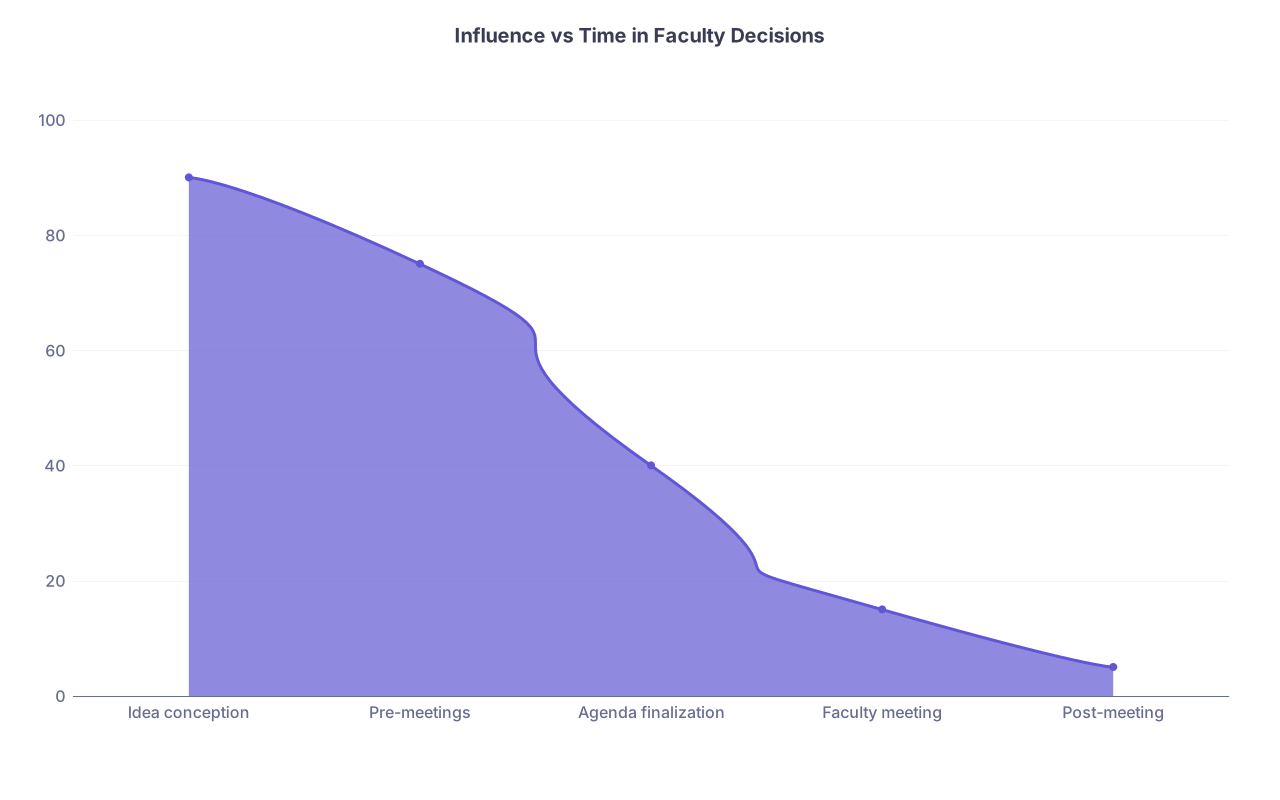
| Category | Value |
|---|---|
| Idea conception | 90 |
| Pre-meetings | 75 |
| Agenda finalization | 40 |
| Faculty meeting | 15 |
| Post-meeting | 5 |
Influence is highest at “idea conception” and “pre-meetings.” It collapses once the agenda is published and the room fills.
So what do insiders do?
They:
- Ask for draft agendas before they’re final
- Grab 10 minutes with the PD or clerkship director the week before a big item
- Send a short, precise email: “I have serious reservations about X—worth a brief chat before Monday?”
- Offer a solution, not just a complaint, during those quiet conversations
By the time the public meeting happens, they are either aligned with the majority direction or have already negotiated concessions off-stage.
The people who try to “win the argument” at the microphone? They’re usually playing a losing game.
How to Read the Room and See What’s Pre-Determined
There are tells. Once you know where to look, you’ll see them.
Look at Time Allocation
If a mandatory structural change (say, revamping the entire clerkship grading schema) is given 10 minutes at the end of a packed agenda, your ability to change its direction is near zero. They’re informing, not asking.
If something has a 45-minute block with no other big items around it, there is more genuine openness—or the leadership is nervous and wants to be seen as fully transparent.
Watch Who Introduces the Topic
Three patterns:
- Chair/PD opens and frames it personally → high-importance, mostly decided.
- Mid-level director introduces, clearly nervous → decision might still be flexible.
- Admin reads it from a slide → it’s already done, they’re just documenting it.
I was once that mid-level director. Asked to introduce a new evaluation form I did not fully believe in. The Chair sat three seats away and watched. That’s a test: can you sell it without creating open revolt?
Listen for Phrases
Certain phrases are code. For example:
- “Given our regulatory requirements…” → Translation: non-negotiable.
- “We are piloting this approach…” → Some leeway exists, but direction is chosen.
- “We’re really open to your input on how this looks in practice…” → Big picture is set; small operational details are up for grabs.
- “We’ll take this back to the committee…” → Decision will be made in a smaller group later; meeting is for input only.
Once you tune your ear to those, you stop wasting energy on battles you cannot win and focus on the aspects you can still shape.
Playing the Game Without Selling Your Soul
You’re probably wondering: So what do I actually do with this? Am I supposed to just accept that it’s all rigged?
No. But you do need to stop being naive about where the levers are.
Here’s how seasoned educators operate without becoming part of the problem.
1. Get Closer to Agenda-Setting
You don’t need a big title to influence agendas. But you do need relationships.
- Volunteer for an education committee that actually drafts proposals, not just receives them.
- Build a working relationship with the program’s education coordinator—they see everything early.
- Offer to help “prepare background materials” for meeting items. That’s where you learn how the sausage is made.
Once you’re close to that process, you see ideas in the raw state, not just as polished motions.
2. Move Your Advocacy Upstream
Stop saving your best arguments for the public meeting.
If you strongly support or oppose something, hit these three steps:
- Quiet one-on-one with the person owning the proposal
- Brief email summarizing your concern, with 1–2 concrete alternatives
- Only then a measured comment in the full meeting, framed as “I’ve already discussed this with X…”
That sequence makes you someone who engages constructively rather than someone who grandstands.
3. Know Which Hills to Die On
Everything feels urgent when you’re junior. It is not.
You need to distinguish:
- Cosmetic issues: slide templates, minor wording, small scheduling annoyances
- Directional issues: grading schema, promotion criteria, workload expectations
- Ethical/non-negotiable issues: fairness in evaluation, harassment, patient safety
Save your political capital for the last two. Nod along for the cosmetic ones. You’ll be taken far more seriously when you do dig in.
4. Protect Trainees Without Burning Out
Medical education faculty often feel trapped between trainees and institution. You see how decisions affect residents, but you also see how little is truly decided in the big room.
Your job is to:
- Use your insider understanding of what’s already fixed to be honest with trainees about where change is possible
- Fight hardest on the hidden but impactful stuff: who gets opportunities, who’s at the table, how remediation is handled
- Avoid promising trainees that “we’ll fix this in the next faculty meeting” when you know that’s not where the fix is
Sometimes the right move is not “I’ll bring this up at the meeting,” but “Let me talk to the PD and the chief residents this week; that’s where this can actually shift.”
A Quick Reality Check: Not Every Place Is Broken
One more truth from someone who’s sat in these rooms at multiple institutions: they’re not all toxic or deceitful.
In some departments:
- Pre-meetings exist simply to avoid chaos, not to rig the game
- Leadership truly wants input, but within real constraints (ACGME, budget, FTE caps)
- Faculty meetings are clumsy but sincere attempts to bring everyone along
But even in the healthiest places, the structure is the same:
- Real constraints are worked out in small groups
- Proposals are shaped before they are publicly aired
- The big room is as much performance and communication as it is decision-making
Once you understand that, you stop taking the performance personally and start looking for the real levers.
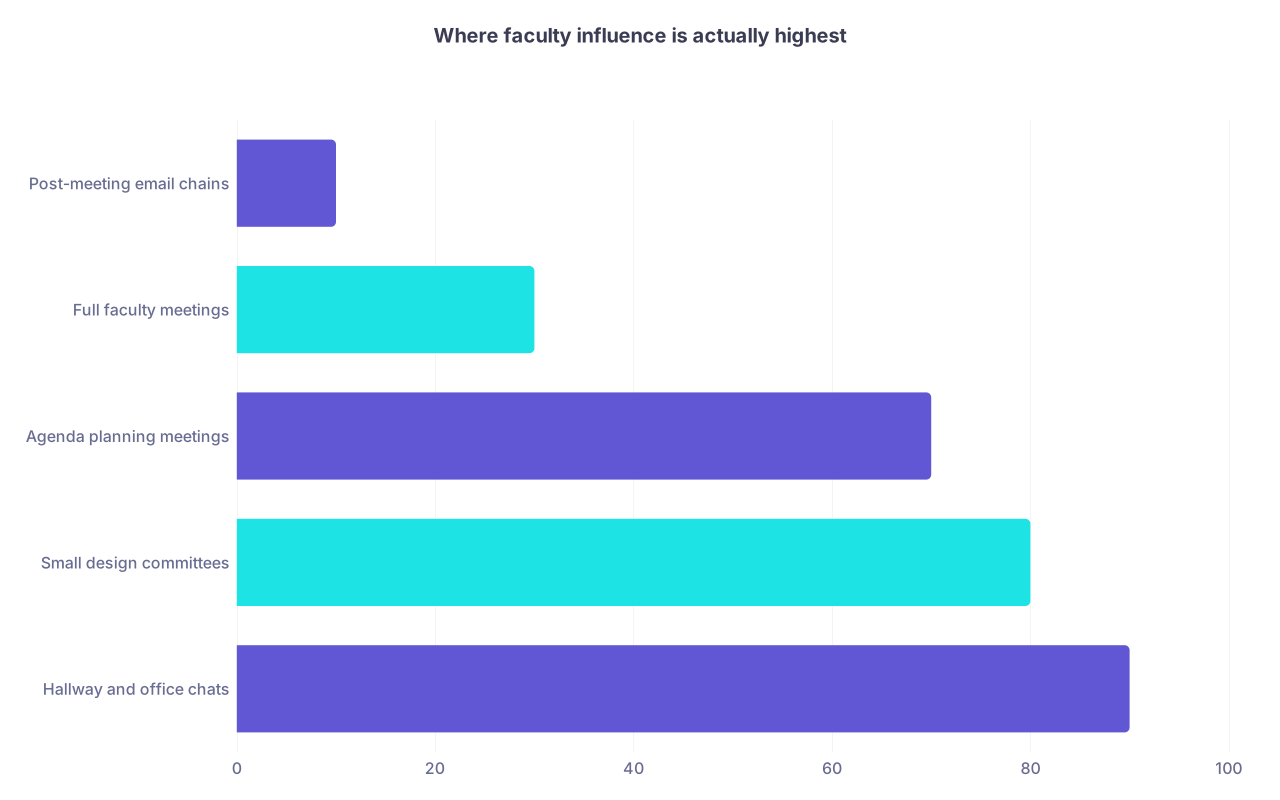
| Category | Value |
|---|---|
| Hallway and office chats | 90 |
| Small design committees | 80 |
| Agenda planning meetings | 70 |
| Full faculty meetings | 30 |
| Post-meeting email chains | 10 |

FAQs
How can I tell if a “vote” in a faculty meeting is real or just for show?
Look at three things: timing, stakes, and who’s pushing it. If it’s a high-stakes, budget-linked decision crammed into a late agenda slot, introduced by a senior leader with little background provided, it’s almost certainly a formality. If there’s extensive pre-reading, a generous time block, and the person introducing it genuinely seems uncertain and invites alternative paths, you might actually be in a real decision window. Over time, compare what’s “voted on” with what was already happening in practice; that pattern tells you a lot.
I’m junior faculty. Is it worth speaking up in big meetings, or should I stay quiet?
You should not be silent forever, but you should be strategic. As junior faculty, your influence is far higher in one-on-one conversations and small working groups than at a microphone in a crowded room. Early on, ask questions more than you make speeches: “Can you clarify how this will affect resident call schedules?” shows engagement without posturing. When you do speak against something, make sure you’ve already floated your concerns privately to at least one decision-maker; then your comment reinforces an existing conversation instead of surprising everyone.
How do I get invited into the “real” pre-meetings without being political?
You earn your way in by being useful and predictable, not by being a sycophant. Take on unglamorous work in education committees and do it well. Offer to draft policies, summarize feedback, or pilot new tools. Leaders quickly learn who can shape ideas without derailing them. Those are the people they start looping into early discussions. You do not need to flatter anyone; you need to demonstrate that you understand constraints, care about trainees, and can turn messy complaints into concrete, implementable options. Once you do that consistently, the pre-meeting invites come. Sometimes without even being labeled as such.
Two things to remember.
First, most of the real decisions in medical education are made before the big room fills, in smaller, quieter spaces where agendas, narratives, and constraints are worked out. Second, your influence grows dramatically once you stop treating faculty meetings as the battlefield and start treating them as the stage—one part of a much longer, mostly invisible process that you can actually learn to shape.