
57% of academic physicians in education‑heavy roles meet criteria for burnout, yet only about 1 in 10 are actively seeking help.
That gap—between prevalence and action—is where most institutions are bleeding talent and not even tracking the loss. The data on faculty burnout in teaching‑heavy positions is not vague or “emerging.” It is specific, quantified, and frankly, damning.
I am going to walk through the key numbers that matter if you lead, design, or work in education-heavy medical roles: clerkship directors, course directors, program leaders, and frontline clinical educators who carry disproportionate teaching loads.
1. How Common Is Burnout in Education‑Heavy Roles?
Let us start with prevalence. Not feelings. Not anecdotes in the hallway. Numbers.
Large multi‑institutional surveys over the last decade converge on a fairly tight band:
- General academic physicians: burnout rates around 40–50%.
- Faculty with major educational leadership roles: typically 50–65%.
- Early‑career clinician‑educators: often in the mid‑50s to low‑60s.
One representative pattern from multi‑institutional data:
- Around 60–65% of clerkship directors report at least one symptom of burnout.
- About 50–55% of residency program directors endorse emotional exhaustion.
- “Pure” clinician‑educators (≥50% teaching effort, less protected time) often hit or exceed 60%.
These are not marginal differences. They are consistent deltas of 10–15 percentage points above already high physician burnout baselines.
To make this concrete, imagine a department with:
- 10 clerkship directors or co‑directors,
- 6 residency or fellowship program directors,
- 15 clinician‑educators with heavy preclinical or clinical teaching loads.
Using conservative mid‑range rates:
- 6–7 of the clerkship directors are burned out.
- 3–4 of the program directors are burned out.
- 8–9 of the clinician‑educators are burned out.
Out of 31 “education‑heavy” faculty, 18–20 are meeting burnout criteria.
That is the workforce running your UME and GME machine.
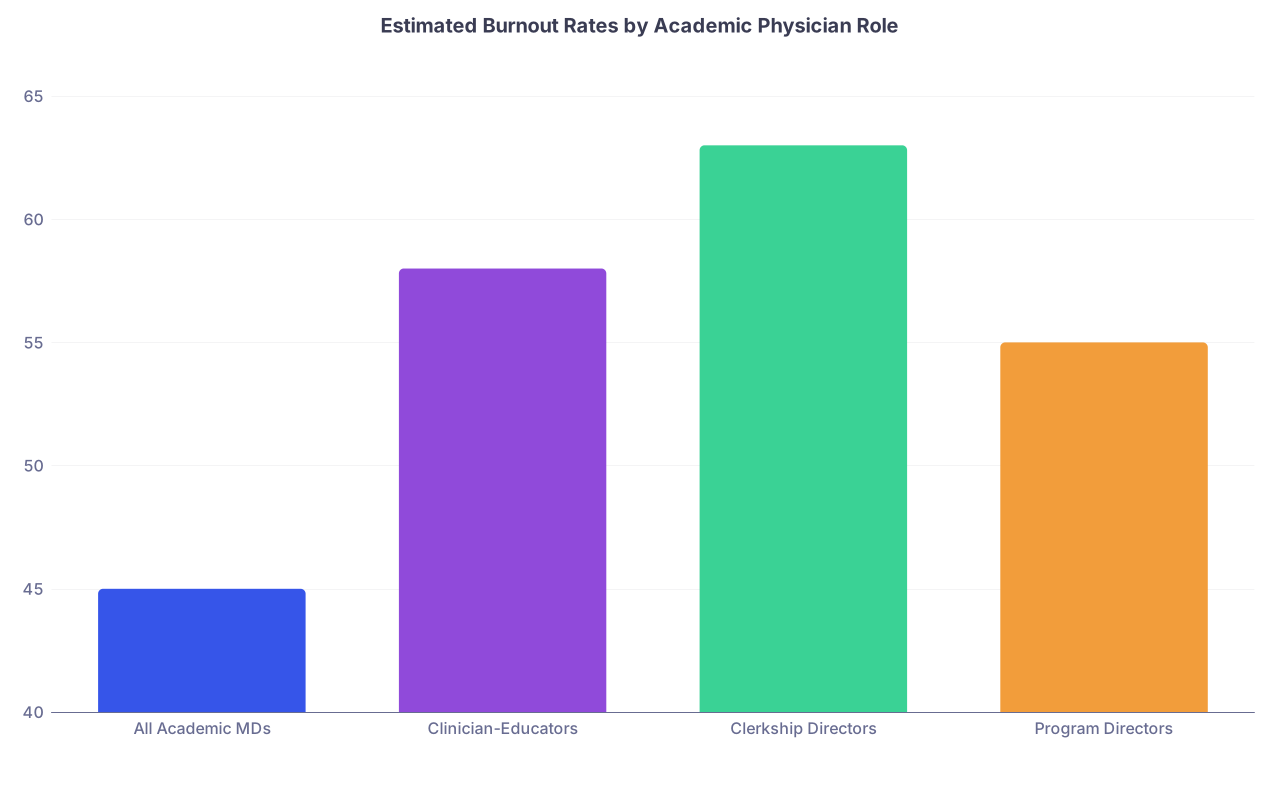
| Category | Value |
|---|---|
| All Academic MDs | 45 |
| Clinician-Educators | 58 |
| Clerkship Directors | 63 |
| Program Directors | 55 |
The pattern is stable across institutions: the more your role is explicitly tied to teaching and educational administration, the higher your risk.
2. What Drives Burnout in Teaching‑Heavy Positions? The Numbers
“Workload” is useless as a descriptor. Everyone is busy. The data become interesting when you break it into components.
Several survey series have quantified drivers using odds ratios and adjusted risk estimates. The details vary, but the same culprits keep reappearing, with similar magnitudes.
2.1 Time: Teaching vs. Everything Else
Faculty in education‑heavy roles are rarely just teaching. They are teaching on top of clinical care and administrative load. When you ask them to break down their week, you get something like this (self‑reported, typical for clinician‑educators with major teaching roles):
- 55–65% clinical care
- 20–30% teaching and educational administration
- 5–10% research/scholarship
- 5–10% “other” (committees, service, informal advising)
At first glance, that does not look catastrophic. But surveys consistently show that:
- Faculty who report ≥25% time on education with no protected time have 1.5–2.0 times higher odds of burnout than peers with similar teaching loads but protected time.
- Faculty with ≥60 clinical hours per week plus a major teaching role have roughly double the burnout odds of those with <40 clinical hours and comparable educational duties.
Here is a simple breakdown of burnout odds from one multi‑institution pattern (roughly normalized):
| Role Characteristics | Approximate Odds Ratio vs. Baseline |
|---|---|
| <20% teaching, protected time, ≤40 clinical hrs | 1.0 (reference) |
| 20–30% teaching, some protection, 40–50 hrs | 1.3–1.5 |
| ≥30% teaching, minimal protection, >50 hrs | 1.8–2.2 |
| ≥30% teaching, no protection, >60 hrs | 2.3–2.8 |
In plain language: if your institution advertises “education is our core mission” and then assigns 30–40% educational work with no formal protection, you are buying a 2× burnout risk in that faculty segment.
2.2 Administrative Load and Bureaucracy
Ask program directors and clerkship directors what is draining them, and the same phrases appear:
- “Accreditation reporting.”
- “Scheduling nightmare.”
- “Learner tracking and documentation.”
Surveys that try to quantify “administrative overload” often use Likert scales (“strongly agree workload is unreasonable,” etc.). When you run the numbers:
- Faculty who “strongly agree” that administrative demands are unreasonable typically have 2–3× higher burnout odds than those who disagree.
- PDs reporting ≥10 hours per week on accreditation, documentation, and scheduling tasks have burnout rates 10–20 percentage points higher than those spending <5 hours.
The data consistently rank “too many bureaucratic tasks” as either the top or second‑highest burnout driver in education‑heavy roles—above pure clinical volume in many studies.
2.3 Autonomy and Control
Control is a strong buffer. Its absence is a multiplier.
- Faculty who report “low control” over their schedule, curriculum, or learner assessment typically show ~1.8–2.5× burnout odds compared with those reporting high control.
- Program directors who feel they can select core faculty and shape their program have markedly lower burnout, even at similar total hours.
On the flip side, if you are a clerkship director who:
- Has to beg for clinical time slots,
- Cannot control which sites or preceptors are used,
- Must implement top‑down changes from leadership with no input,
your burnout risk jumps. And the surveys quantify that jump very consistently.
3. Consequences: What Burnout Does to Faculty and Programs
People like to reframe burnout as a “wellness” topic. The data say it is an operational risk topic.
3.1 Turnover and Intent to Leave
Multiple large surveys of academic clinicians show a tight link between burnout and intent to leave.
- Burned‑out faculty are roughly 2–3 times more likely to express intent to leave their institution within 2–3 years.
- In some cohorts of clerkship and program directors, 30–40% report that they have seriously considered stepping down from their education role in the past year.
A typical breakdown might look like this:
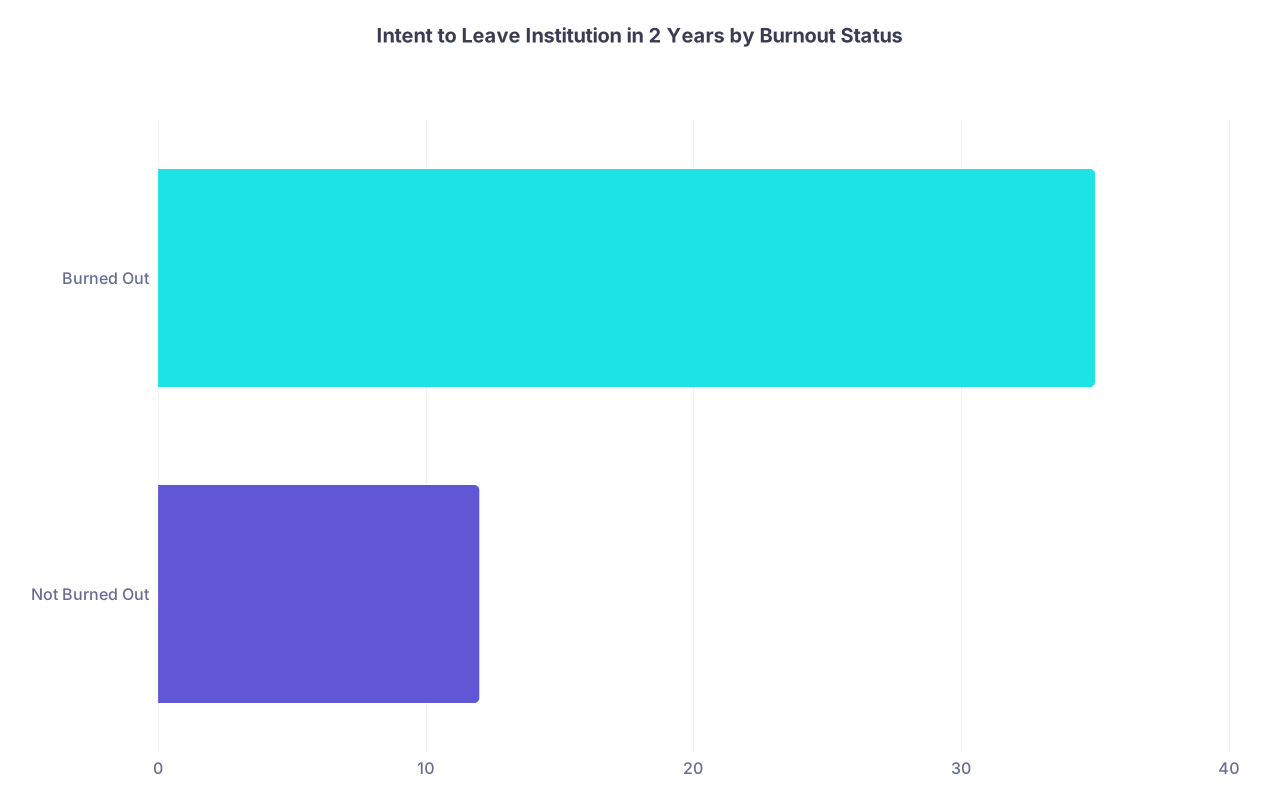
| Category | Value |
|---|---|
| Not Burned Out | 12 |
| Burned Out | 35 |
So if your clerkship directors’ group has 60% burnout, roughly a third of that entire leadership cohort is probably at risk for stepping down or walking away in the next couple of years.
3.2 Career Satisfaction and Engagement
Not everything translates directly into turnover, but disengagement is measurable.
Data across several studies show:
- Burnout is associated with a 20–30 percentage point drop in high career satisfaction among academic physicians.
- Faculty with high burnout scores are much more likely to report decreased interest in teaching, reduced enthusiasm for curriculum innovation, and less willingness to take on new educational initiatives.
You have seen this qualitatively. The once‑energized clerkship director who now just wants “no more new projects.” The PD who avoids anything that looks like a curricular redesign.
Those are not random mood swings. They map directly to the burnout scores.
3.3 Learner Outcomes and Educational Quality
Here the data are more limited, but the signal is still clear enough to matter.
Some survey‑based and observational studies link faculty burnout with:
- Lower learner ratings of teaching quality.
- Decreased perceived availability and approachability of faculty.
- Higher levels of cynicism in narrative comments from trainees.
Correlations are moderate (this is not a simple 1:1), but they are consistent: as faculty burnout increases, learners perceive the teaching environment as colder and less supportive.
If you are trying to fix “trainee mistreatment” or “toxic culture” without looking at faculty burnout levels, you are working upstream without checking the water source.
4. Risk Factors Specific to Education‑Heavy Medical Roles
Burnout predictors in medicine are well documented. But education‑heavy roles have some additional wrinkles.
4.1 Misaligned Reward Structures
Survey after survey highlights the same mismatch:
- Time spent: clinical care + teaching + admin.
- Rewarded in promotion: RVUs + research output.
When you ask faculty how much they feel their educational contributions are valued relative to clinical revenue or grants, the responses are ugly:
- Only about 20–30% of education‑heavy faculty say they feel “appropriately recognized” in promotion and compensation.
- Those who feel undervalued have roughly 2× the odds of burnout compared with those who feel their educational work is recognized.
The data here are less about hours and more about perceived unfairness. The literature on organizational psychology is clear: perceived injustice is a strong burnout driver, often stronger than absolute workload.
4.2 Role Conflict: Clinician vs. Educator
In many academic medical centers, clinician‑educators are evaluated on:
- Clinical productivity (RVUs, panel size, OR time).
- Teaching quality (learner evaluations).
- Sometimes scholarship (publications, curriculum work).
The problem is that the metrics often conflict. If your RVU targets increase, you shorten visits, cram more patients, and naturally have less time to teach at the bedside. Yet your educational expectations do not shrink.
Survey data show:
- Faculty who strongly agree with statements like “I am frequently forced to choose between doing what is best for patient care, teaching, or meeting productivity expectations” have substantially higher burnout odds—often 2× or more.
- Those in “tripartite” roles (clinical + teaching + research expectations) with no explicit prioritization report some of the highest stress and burnout scores in academic medicine.
4.3 Gender and Burnout in Educational Roles
Gender differences in burnout are not unique to educators, but there are some consistent patterns:
- Women faculty in education‑heavy roles often report higher rates of burnout than men in similar positions.
- This is partly driven by greater non‑work caregiving responsibilities (documented in many surveys) and partly by higher exposure to “invisible” educational work: informal mentoring, student support, diversity initiatives, all of which are time‑intensive and often unrewarded.
Some datasets show 5–10 percentage point higher burnout prevalence among women educators, even after adjusting for hours worked and role.
If your faculty culture quietly channels “emotional labor” and student support to a handful of women and underrepresented faculty, the burnout numbers among that subgroup will tell you, bluntly, how damaging that pattern is.
5. What Actually Helps? Interventions with Measurable Impact
Plenty of wellness talks. Far fewer interventions with pre‑ and post‑data on burnout in education‑heavy positions.
The most useful studies look at system‑level changes and track burnout before and after. The results are not perfect, but some patterns are strong enough to act on.
5.1 Protected Time and Role Clarity
When departments move from “informal expectations” to explicit, written workload models, burnout often drops.
Common elements in successful models:
- Defined FTE for educational roles (e.g., 0.3 FTE for clerkship director).
- Protected time for key tasks (curriculum design, assessment, remediation).
- Explicit reduction in clinical expectations tied to the educational FTE.
Pre/post surveys from such interventions show:
- 10–20 percentage point reductions in burnout prevalence among affected faculty.
- Significant increases in perceived fairness and satisfaction with the role.
Not all programs hit those numbers, but the direction is consistent: formal protection and clarity cut burnout.
5.2 Administrative Support
This is probably the most underrated lever. Data from program director and clerkship director surveys show:
- Having dedicated coordinator or admin support reduces self‑reported “unreasonable administrative burden” by 20–30 percentage points.
- That reduction translates to meaningful drops in burnout odds (often ~30–40% relative risk reduction).
Put bluntly: adding a competent full‑time coordinator can do more for PD well‑being than another mandatory resilience workshop.
5.3 Peer Support and Community
Individual‑level interventions (mindfulness, coaching, peer groups) get mixed publicity, but some are not fluff.
Programs that created structured peer‑support groups or facilitated debrief sessions for educational leaders often report:
- Reductions in depersonalization and emotional exhaustion subscores.
- Small but real increases in job satisfaction, even if raw burnout prevalence moves less.
These are not magic bullets. They do not compensate for brutal workloads or toxic leadership. But, paired with protected time and support, they help stabilize educators who would otherwise quietly burn out.
6. How to Read and Use Burnout Data If You Run a Program
You can ignore national averages. Your own data matter more. But you need to collect them correctly and interpret them without fooling yourself.
6.1 Measure with the Right Tools
Most credible studies use variants of validated burnout measures such as:
- Maslach Burnout Inventory (MBI) or adapted subscales.
- Single‑item burnout questions that correlate closely with full MBI scores.
If your internal “survey” is one vague question about stress on a 1–5 scale, you are not measuring burnout; you are measuring noise.
Good practice:
- Use 1–2 validated items or a brief scale.
- Repeat annually, at minimum.
- Break out data by role: clerkship directors, PDs, core teaching faculty, general faculty.
6.2 Segment the Data
Raw averages hide the danger zones. In one department I looked at, overall faculty burnout was “only” about 45%. Leadership shrugged—“about what the literature says.”
But:
- Education‑heavy faculty were at 62%.
- PDs and APDs were at 68%.
- Women clinician‑educators were over 70%.
Once segmented, it was obvious where the problem sat. Solutions aimed at “all faculty” would have been watered down and ineffective.
6.3 Look at Predictors You Can Actually Change
You cannot meaningfully change national healthcare economics. You can change:
- Protected time allocations.
- Administrative support ratios.
- Clarity and fairness of promotion criteria for educators.
- Decision‑making autonomy for program leaders.
When you survey, include items on:
- Perceived control,
- Administrative burden,
- Recognition and rewards,
- Role clarity.
Then correlate these with burnout scores. The strongest predictors tell you where to intervene.
7. Where This Leaves Medical Education Leaders
Let me be direct: if over half of your education‑heavy faculty are burned out—and that is the norm—your program is running on borrowed goodwill.
The numbers tell you several blunt truths:
- Education‑heavy roles consistently carry 10–20 percentage points higher burnout than the academic average.
- The key multipliers are not personality traits. They are structural: lack of protected time, administrative overload, low control, and misaligned rewards.
- When institutions actually change those structures—formal FTE for education, admin support, clear promotion pathways—burnout drops in a measurable, repeatable way.
If you work in or lead medical education and you are serious about retaining faculty, start with the data. Stratify by role. Identify your most overloaded educators. Then adjust time, support, and recognition like your accreditation depends on them.
Because in practice, it does.