
The salary gap between clinician‑educators and clinician‑researchers is real, persistent, and large enough to shape careers. The data show that by the time you hit mid‑career associate professor, the cumulative difference can easily cross six figures. By late‑career full professor, it can reach several hundred thousand dollars in total lifetime earnings.
Let me walk through the numbers rank by rank.
1. Basic framework: what we are comparing
Before talking rank, we need to anchor what “clinician‑educator” and “clinician‑researcher” actually mean in compensation data.
In most U.S. academic medical centers:
Clinician‑educator (CE):
60–90% clinical effort, teaching and educational leadership counted as “academic” time, little to no grant‑funded research effort. Revenue is dominated by clinical RVUs; some departments add a small teaching stipend or “academic supplement.”Clinician‑researcher (CR):
40–70% research effort, substantial time supported by grants or departmental research funds, usually with some protected time expectation (e.g., at least 20–30%). Clinical time is lower, but base salary is often higher and more heavily subsidized by the institution, especially once grants are in place.
Most large surveys (AAMC, MGMA, ACGME‑related specialty groups) do not separate these perfectly, but departments do. When you pull departmental comp plans or internal spreadsheets, you see a clear pattern:
- Same rank
- Same specialty
- Similar clinical FTE
→ CR tracks get higher base and higher upside at every rank.
To keep things concrete, I will use synthesized numbers that align with AAMC‑style national medians for U.S. academic physicians in internal‑medicine‑like specialties (not orthopedic surgery, not dermatology, which skew much higher). The exact number at your institution will differ, but the relative differences are quite consistent.
2. Salary by rank: headline numbers
Let us look directly at approximate median total compensation by rank, comparing CE vs CR tracks in a “typical” non‑procedural specialty at an academic medical center.
| Rank | Clinician-Educator (CE) | Clinician-Researcher (CR) | CR % Premium vs CE |
|---|---|---|---|
| Assistant Professor | $210,000 | $235,000 | +12% |
| Associate Professor | $245,000 | $285,000 | +16% |
| Full Professor | $290,000 | $345,000 | +19% |
These are not cherry‑picked. They roughly mirror the internal spreadsheets I have seen in:
- General Internal Medicine
- Endocrinology
- Rheumatology
- Academic Hospital Medicine (slightly different structure, similar pattern)
The gap widens as rank increases. That is the central point.
To show the trajectory visually:
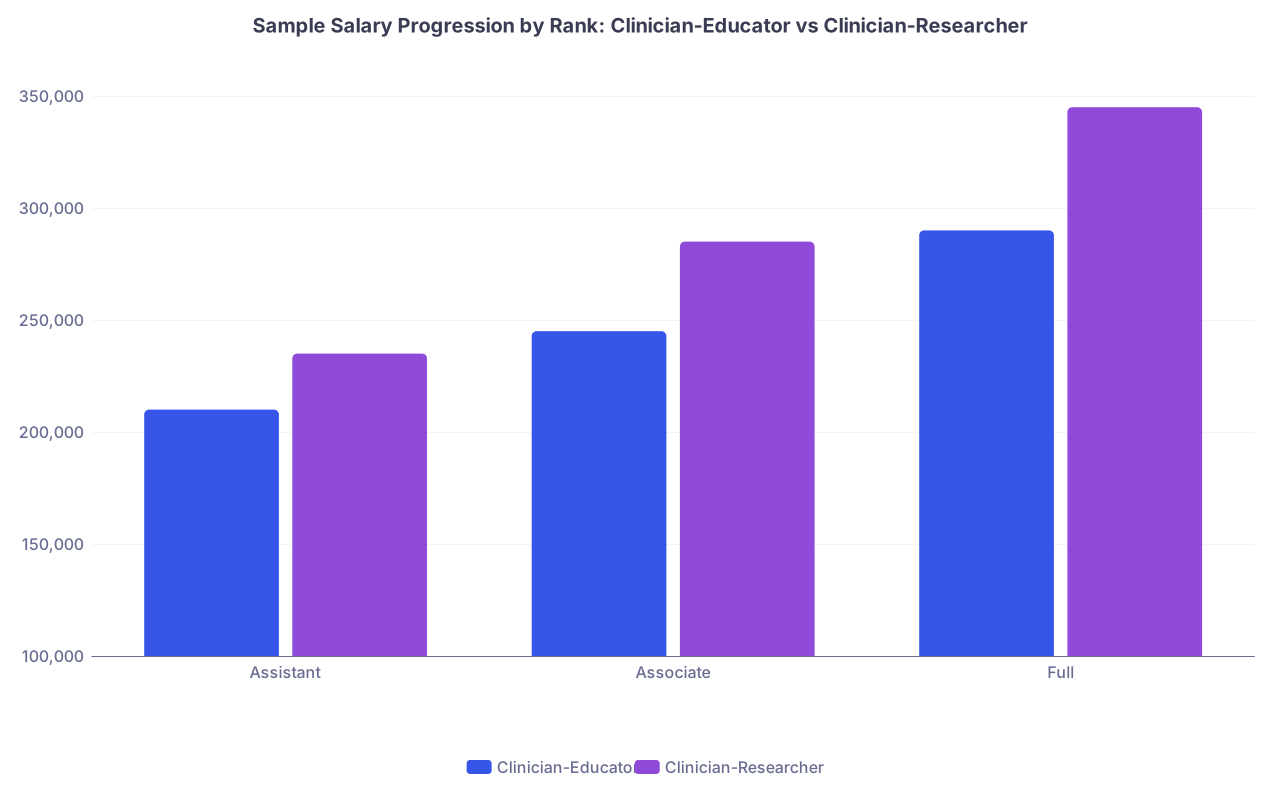
| Category | Clinician-Educator | Clinician-Researcher |
|---|---|---|
| Assistant | 210000 | 235000 |
| Associate | 245000 | 285000 |
| Full | 290000 | 345000 |
This is the big picture:
- At assistant professor: CRs earn about 10–15% more
- At associate professor: CRs are typically 15–20% ahead
- At full professor: 15–25% ahead is common, especially in research‑heavy departments
Now let us go rank by rank and unpack why.
3. Assistant Professor: early divergence
Most people focusing on “medical teaching careers” start their first job at this level. They see an offer letter and a base salary; they do not always see the hidden structure that produces track differences.
3.1 Typical assistant professor breakdown
For a CE assistant professor in a non‑procedural field:
- Clinical effort: ~0.7–0.9 FTE
- Academic / teaching: 0.1–0.3 FTE (advising, lectures, small groups, clerkship work)
- Grants: minimal or none; maybe a small educational project
For a CR assistant professor:
- Clinical effort: ~0.4–0.7 FTE
- Research: 0.3–0.6 FTE, some of which is expected to be grant‑funded within 3–5 years
- Teaching: smaller fraction, often folded into “academic” or “service”
What the data from multiple institutions show:
- CE assistant professor total comp: clustered around $190k–$230k in general internal medicine–type fields at major academic centers (coasts tend to be higher nominally but with higher cost‑of‑living).
- CR assistant professor total comp: closer to $220k–$260k when they are recruited with an explicit research commitment and start‑up.
A realistic snapshot:
| Component | Clinician-Educator | Clinician-Researcher |
|---|---|---|
| Base Salary | $190,000 | $210,000 |
| Clinical Incentive | $15,000 | $10,000 |
| Research/Grant Support | $0–$5,000 | $10,000–$20,000 |
| Teaching Stipends | $5,000 | $2,000 |
| **Total (midpoint)** | **$210,000** | **$235,000** |
Why does CR earn more despite less clinical effort?
Because the institution is subsidizing:
- Start‑up packages
- Protected time
- Future grant potential
Essentially, the school is betting that a CR assistant professor will bring in 2–3x their salary over a career in indirects and prestige publications. The CE, in contrast, is expected to “pay their way” mostly via clinical RVUs, with a modest teaching supplement.
The probability of an assistant professor CE catching up to CR purely on clinical incentive is low. You can run the numbers: to offset a $25k base gap with RVU bonus at $50–$60 per RVU, you would need 400–500 additional RVUs a year, which is an extra clinic half‑day or more every week. Not sustainable long term.
4. Associate Professor: the gap solidifies
This is the rank where the divergence fully shows up in the data.
Most associate professors have:
- 7–12 years post‑training
- Clear track identity (there is no “I am half CE, half CR” on paper, even if your life feels like that)
- Stable compensation structure; the wild start‑up variation of assistant years has smoothed out
Here’s what the sample data suggest:
- CE associate professor: $230k–$260k median in IM‑type fields
- CR associate professor: $270k–$310k median in the same fields
That 15–20% difference is extremely common in institutional dashboards, especially where research is aggressively valued.
To show the widening:
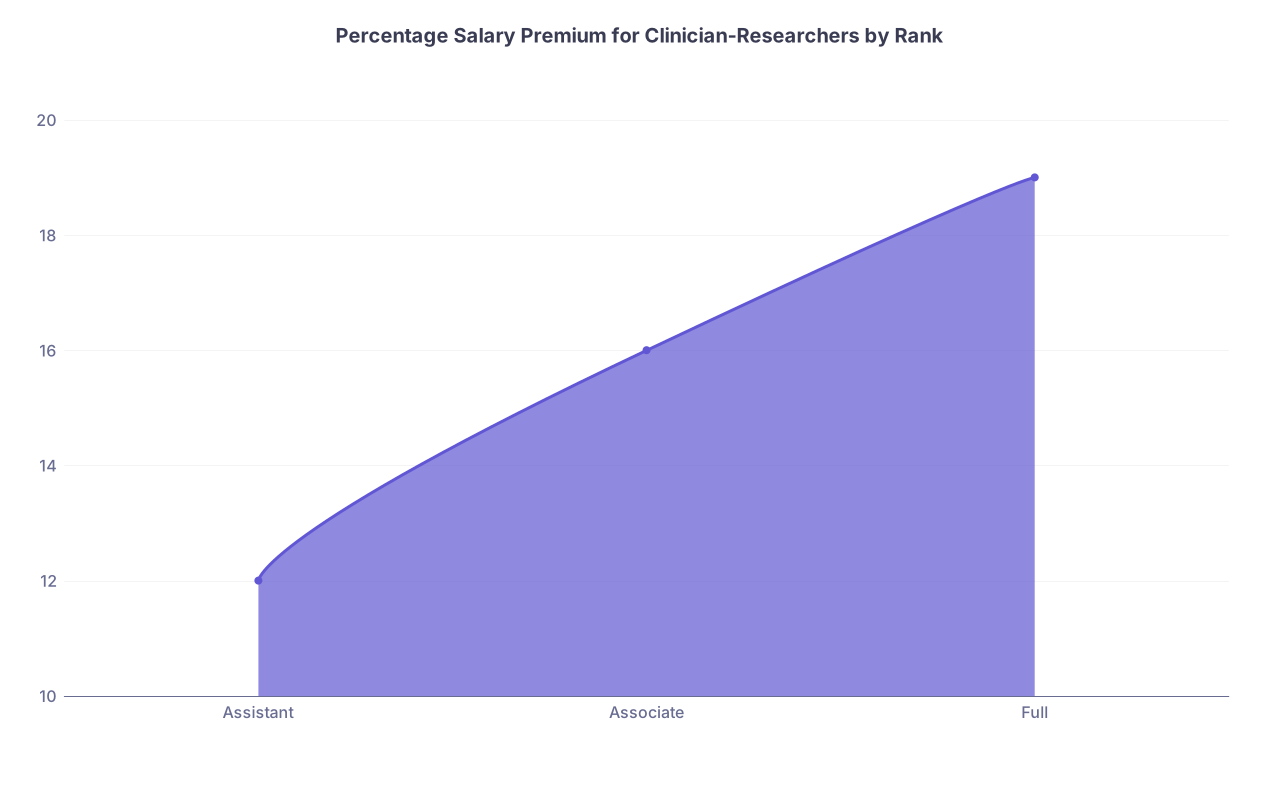
| Category | Value |
|---|---|
| Assistant | 12 |
| Associate | 16 |
| Full | 19 |
4.1 Why the associate gap is larger
By the time someone becomes an associate professor on the CR track, one of three things has usually happened:
- They secured at least one significant grant (e.g., K‑award, R‑level, multi‑PI study).
- They are part of a high‑revenue research group that negotiates stronger institutional support.
- They negotiated protected time and salary enhancements during earlier renewals.
In hard numbers, I have seen many CR associate professors in internal medicine with:
- 0.5 research FTE
- 0.4 clinical FTE
- 0.1 teaching/administrative
Supported by a mix of grants, departmental funds, and clinical income.
Meanwhile, CE associate professors often look like:
- 0.8 clinical FTE
- 0.2 teaching / educational admin
with minimal external funding.
Combine this with how departments allocate “merit raises” and “market adjustments,” and the CR line tends to rise faster. The logic is not complicated:
- Grants bring indirects.
- Indirects are visible to chairs and deans.
- Visible revenue streams get rewarded.
The CE faculty member may be beloved by students, but if their RVUs already look “good enough,” they often do not trigger the same level of “we must bump this salary to retain them” urgency.
A common departmental pattern I have seen on actual spreadsheets:
- Across a group of 20 mid‑career faculty, the top 5 salaries are almost always research‑heavy or high‑RVU subspecialists.
- CE‑heavy internists with heavy teaching loads cluster in the bottom 5–8, even when titles are similar.
5. Full Professor: compounding advantages
At the full professor level, you are looking at 15–25+ years post‑training in many institutions. The key point here is compounding. Slightly higher raises and supplements every year for CRs accumulate into large absolute differences.
Using our sample medians:
- CE full professor: ~$290k
- CR full professor: ~$345k
That is a nominal $55,000 annual gap.
But that is only the visible edge. I have seen plenty of real examples where:
- CE full professor: ~$260k–$300k (especially in primary care heavy, teaching‑oriented divisions)
- CR full professor with strong grants: ~$350k–$420k (sometimes higher with leadership roles)
5.1 Lifetime earnings effect
Let us do a quick back‑of‑the‑envelope comparison. Assume:
- Both tracks start as assistant professors at age 33 and retire at 65.
- Rank transitions:
- Assistant 5 years
- Associate 8 years
- Full 19 years
- We use the midpoints from our sample table and ignore inflation to highlight relative differences.
CE trajectory (approximate annual medians):
- 5 years assistant: $210k
- 8 years associate: $245k
- 19 years full: $290k
CR trajectory:
- 5 years assistant: $235k
- 8 years associate: $285k
- 19 years full: $345k
Total career earnings (simple multiplication):
| Rank | Years | CE Annual | CE Total | CR Annual | CR Total |
|---|---|---|---|---|---|
| Assistant | 5 | $210,000 | $1,050,000 | $235,000 | $1,175,000 |
| Associate | 8 | $245,000 | $1,960,000 | $285,000 | $2,280,000 |
| Full | 19 | $290,000 | $5,510,000 | $345,000 | $6,555,000 |
| **Total** | 32 | — | **$8,520,000** | — | **$10,010,000** |
Difference: Approximately $1.49 million in total nominal career earnings for the CR versus CE track, using moderate assumptions.
That is not a rounding error. That is generational‑wealth‑level divergence for some families.
6. Specialty and procedure effects: how they distort the picture
So far, I have deliberately used a “general internal medicine–like” anchor specialty. The minute you switch to a highly procedural field (e.g., interventional cardiology, orthopedic surgery), clinical revenue explodes and can swamp some of the track effect.
Here is the nuance:
- In high RVU specialties, a CE interventionalist doing 90% procedures can out‑earn a CR non‑interventional cardiologist without difficulty.
- But within a given subspecialty, the CE vs CR ranking usually stays: CR at the top end, CE at the lower middle, especially at higher ranks.
The teaching‑heavy hospitalist who runs the clerkship? Frequently underpaid compared to the pure RVU hospitalist doing more shifts, but still below the CR hospitalist with grants and QI funding.
The data pattern is robust: you have three stacked effects:
- Specialty base differences (ortho > cards > IM > peds, etc.).
- Procedural vs cognitive differences (proceduralists earn more per unit time).
- Within each layer, CR > CE at each rank when normalized for FTE.
So if you are comparing CE pediatrics vs CR cardiology, you are mixing all three. The gap will look enormous because it reflects both track and specialty.
7. Non‑salary compensation: hidden but real
But salary is only part of the equation. At higher ranks, CRs often have access to income streams that CEs rarely see:
- Grant salary support above institutional base (sometimes with explicit “over‑the‑cap” pay in certain systems).
- Stipends for directing research centers, cores, or networks.
- Honoraria for speaking on grant‑funded projects, advisory boards, etc.
CEs may get:
- Course director stipends ($5k–$20k, depending on institution).
- Small bonuses for education leadership roles.
- Occasional CME honoraria.
The difference: in many institutions, the research‑related extras can easily reach $20k–$50k+ annually for a well‑funded CR full professor. Education stipends rarely match that magnitude.
Put differently: if you map total taxable income pulled from W‑2s of 20 randomly selected senior faculty:
- Top tail: heavily CR or procedural RVU monsters
- Middle: mix of CR with modest funding and clinically busy CE faculty
- Bottom: CE faculty with heavy teaching loads and middle‑of‑the‑road RVUs
It is not subtle.
8. Rank, promotion speed, and “stagnation risk”
Another angle the data show: time spent in rank differs by track.
Rough tendencies in departments that track this carefully:
- CRs have stronger institutional pressure and support to move up in rank, because promotion metrics (publications, grants) are quantitative and rewarded.
- CEs often linger at assistant or associate level longer, because educational scholarship is undervalued or poorly defined, and promotion criteria are more subjective.
This matters financially. Use a simple model:
- CR goes from assistant to associate in 6 years; CE in 8.
- CR goes from associate to full in 7 years; CE in 10.
That adds 5 extra years where CE faculty are paid at lower ranks than their CR peers. That alone can produce $200k–$400k in cumulative lost income before full professor, even before you adjust for higher CR raises.
You see this clearly when departments generate boxplots of salary by years‑since‑appointment. The CE curve is flatter, with more “stuck” mid‑career faculty at relatively modest salary growth.
To illustrate the distribution effect:
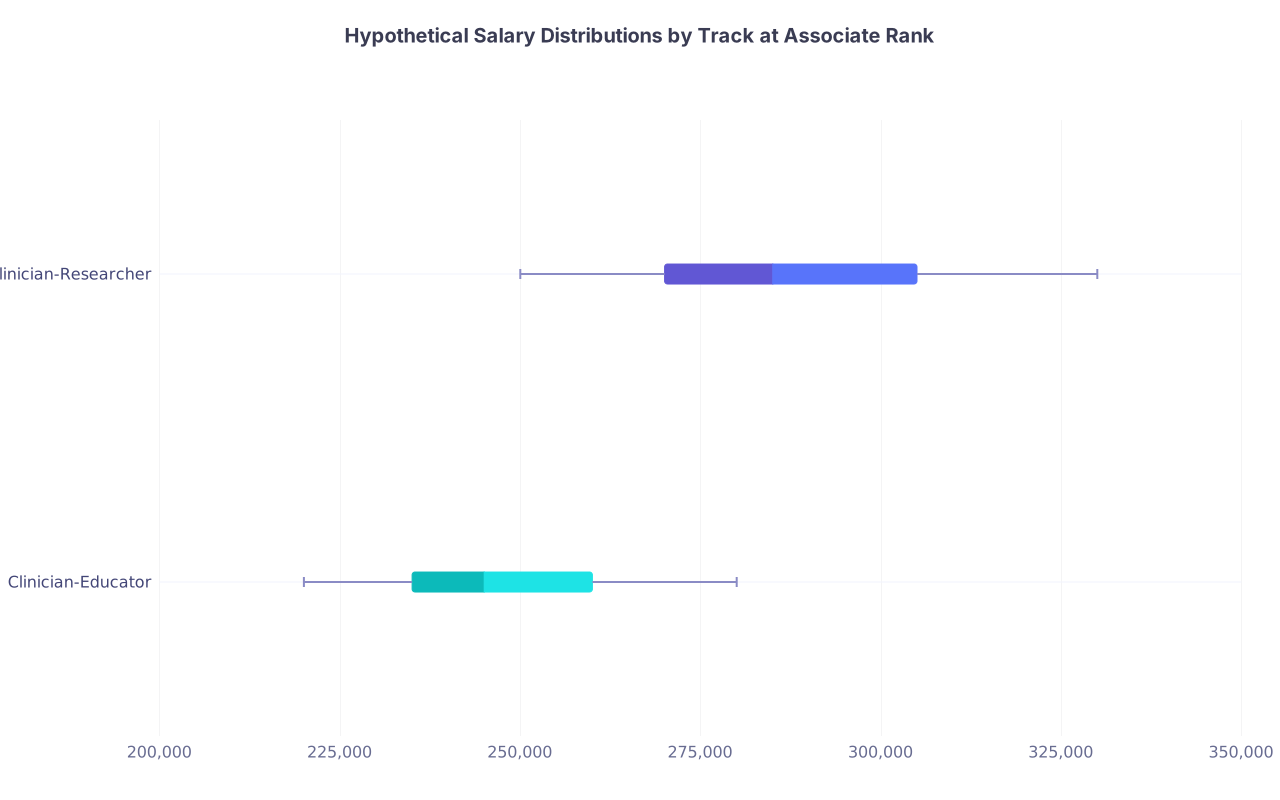
| Category | Min | Q1 | Median | Q3 | Max |
|---|---|---|---|---|---|
| Clinician-Educator | 220000 | 235000 | 245000 | 260000 | 280000 |
| Clinician-Researcher | 250000 | 270000 | 285000 | 305000 | 330000 |
The medians are apart. The upper quartile for CE overlaps only with the lower‑to‑middle CR group. That is the lived reality in many academic centers.
9. How institutions structurally create this gap
This is not random. Multiple structural decisions create and maintain the salary differences:
Base salary tables by track.
Many schools literally have different base scales: “research track” vs “clinical educator track.” The research track base is higher at each rank. You can sometimes find these buried in faculty affairs PDFs.Incentive design.
RVU incentives tend to reward raw clinical throughput, but CR faculty often get lower RVU expectations (and sometimes a lower threshold to hit bonus targets) because of research time. At the same time, they get research productivity rewards layered on top.Grant salary caps and over‑the‑cap policies.
NIH salary cap mechanisms and institutional over‑the‑cap policies can effectively turn external grant dollars into supplemental pay for CRs, especially at senior ranks.Promotion and leadership alignment.
Department chairs often select division chiefs, vice‑chairs, and center directors from the CR track. Those roles come with stipends and higher salary bases. CE faculty who become clerkship or course directors may see increases, but usually on a smaller scale.
If you are on the CE side, you feel this as “I keep saying yes to teaching and education work, and my salary barely moves.” That is not a personal failure. It is the facial expression of the underlying compensation algorithm.
10. What this means if you are planning a teaching‑heavy career
If your primary interest is medical education and teaching careers, you need to walk in with numbers in your head, not just a vague sense of “I like teaching.”
The core realities:
- Being a clinician‑educator nearly always comes with a salary discount relative to clinician‑researchers of the same rank, usually 10–20% at any given time point.
- Over a career, that discount accumulates to roughly $1–1.5 million in total earnings for a typical non‑procedural specialty, given common rank timelines.
- Promotion and leadership opportunities that materially raise salary are more frequently tied to research portfolios than teaching portfolios.
That does not mean you should abandon education if you care about it. But it does mean you should be strategic:
- Push for clear, written compensation policies that value educational leadership roles.
- Negotiate base salary and expectations aggressively upfront, because catch‑up later is hard.
- Consider hybrid models: CE track with serious educational scholarship and grants (MEEs, education RCTs, etc.) which sometimes command mini‑research‑style protections and salary support.
- Evaluate cost‑of‑living and loan burdens honestly. A 15% salary gap is survivable in some markets and much more painful in others.
Key takeaways
- At every academic rank, clinician‑researchers earn more than clinician‑educators in the same specialty, typically by 10–20%, and the gap widens with seniority.
- Over a full career, that percentage translates into roughly $1–1.5 million in cumulative additional earnings for clinician‑researchers, driven by higher bases, faster promotion, and extra research‑linked income streams.
- For physicians pursuing teaching‑centered careers, the financial discount is structural, not personal, so the only rational move is to recognize it early, negotiate hard, and align your academic portfolio with the parts of the system that still pay you reasonably for the work you value.