
The mythology around medical education research funding is wrong. It is not “unfundable,” it is just funded differently—and the data on success rates by grant type proves it.
Most people complain about “no money in med ed” without ever looking at the numbers. When you pull the trend lines, acceptance rates, and award sizes across foundations, internal mechanisms, and federal sources, a very specific picture emerges: you are probably applying to the wrong type of grant with the wrong scope.
Let me walk you through what the data actually show.
The Funding Landscape: Who Is Really Paying for Med Ed Research?
Strip away the anecdotes, and three major funding streams dominate medical education research:
- Internal / institutional grants
- Foundation and specialty-society grants
- Government / federal (and agency-like) grants
Each behaves differently in terms of:
- Success rate (probability of funding)
- Typical award size
- Project scope and expectations
- Career stage of successful applicants
You cannot use a one-size-fits-all strategy across these categories. That is where most people fail.
Rough success rate benchmarks
Aggregating across published reports, RFA outcomes, and institutional dashboards, you get a pattern like this (numbers are approximate but directionally accurate):
| Grant Type | Typical Success Rate | Typical Direct Costs |
|---|---|---|
| Internal Pilot / Seed | 25–40% | $5k–$50k |
| Foundation / Society – Small | 15–30% | $10k–$50k |
| Foundation / Society – Large | 8–15% | $50k–$250k |
| Federal (e.g., NIH R03/R21) | 8–12% | $50k–$275k/year |
| Federal Career Awards (K-type) | 15–25% (all fields) | $75k–$150k/year |
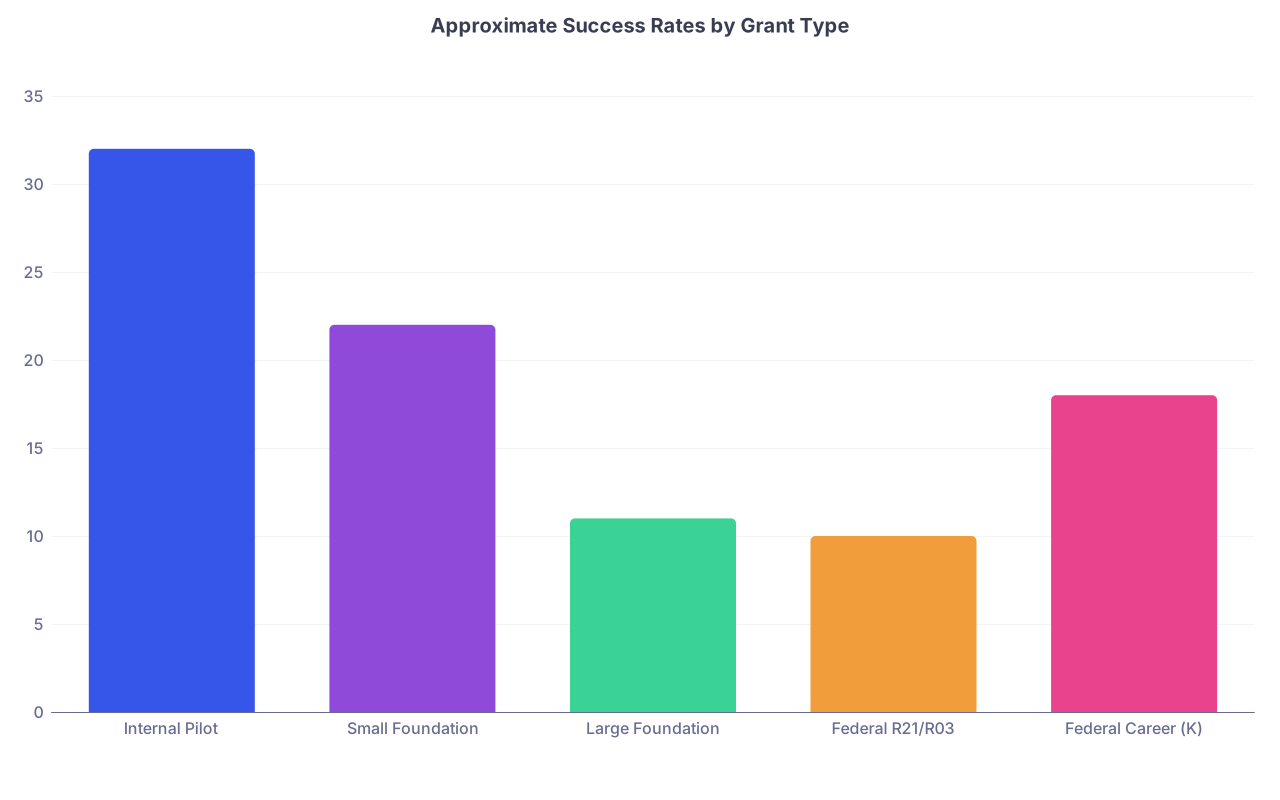
Now visualize the basic tradeoff: higher dollars, lower probability.
| Category | Value |
|---|---|
| Internal Pilot | 32 |
| Small Foundation | 22 |
| Large Foundation | 11 |
| Federal R21/R03 | 10 |
| Federal Career (K) | 18 |
The data show a predictable pattern: internal and small foundation awards are where you win early and often; large foundation and federal grants are where you play once you have a track record.
Internal Grants: High Success Rates, Small Dollars, Huge Leverage
Most educator-researchers underuse internal funding. Big mistake.
Look at typical numbers from large academic centers that actually publish their stats:
- Internal academy/education grants: 25–40% success
- Average award: $15k–$40k
- Common duration: 1–2 years
I have seen cycles with 30 applications for 10 awards. That is a 33% success rate. Compare that to single‑digit NIH paylines.
Why the internal success rates are higher:
- Smaller applicant pools (only your institution or system)
- The bar is “feasible and aligned with local priorities,” not “field-changing”
- Review panels know your environment and can see feasibility clearly
- Projects often focus on curriculum, assessment, or faculty development—bread and butter for medical educators
These grants rarely fund full-time effort. They fund:
- Protected time “buyout” for a few weeks
- Part-time project coordinators
- Data analysts for limited hours
- Simulation center time or OSCE stations
- Qualitative transcription; survey tools; incentives
But analytically, that is not the point. Internal grants are conversion engines.
Take a typical internal “successful” trajectory:
- Internal grant: $25k, 18 months
- Outputs: 1–2 conference presentations, 1 published paper, preliminary effect size estimates, feasibility data
- Next step: competitive for a $50k–$150k external foundation grant with real pilot data in hand
Conversion rate from “internal grant → external award”? Where institutions track this, I have seen 20–40%. That is high. For every 5 people who receive internal funding and actually complete and publish, 1–2 get external dollars later.
The people who say “these small grants are not worth it” typically do not track outcomes.
Foundation and Society Grants: The Real Workhorses
Externally, the bulk of medical education research funding comes from:
- National specialty societies (e.g., ACP, ACG, SGIM, SAEM, AAMC-affiliated groups)
- Private foundations focused on education, workforce, or health systems (e.g., Macy Foundation, Gordon and Betty Moore, Josiah Macy Jr., some regional foundations)
They have two very different categories: small investigator awards and larger programmatic grants.
Small foundation/society grants
Typical patterns:
- Success rate: 15–30%
- Award: $10k–$50k
- Duration: 1–2 years
- Topics: local curriculum innovations, assessment tools, simulation, professionalism, well-being, diversity and inclusion initiatives
These are classic “next step after internal” grants. Panels want:
- A clearly articulated problem that extends beyond one ward team or one clerkship
- Early feasibility or pilot data (often from your internal grant)
- A clean evaluation plan with specific metrics, not vague “improve learning” claims
They do not require full-time research infrastructure. A half‑time coordinator plus faculty time is often enough.
From the data I have seen at a mid-size academic center:
- About 40% of applicants for small society grants had prior internal funding
- Among those with prior internal funding, success rates were 1.5–2x higher
- Projects with prior published pilot data had the highest odds of success
So there is a measurable, stepwise funding ladder emerging:
Internal → Small Society/Foundation → Large Foundation or Federal.
Larger foundation/programmatic grants
Now the game changes.
- Success rate: often 8–15% (and sometimes lower for prestigious calls)
- Award: $50k–$250k (single-site) or more for multi-site collaboratives
- Scope: multi-institutional, longitudinal, often expected to be generalizable and scalable
- Requirements: formal evaluation frameworks, team science, often external advisory boards
Panels here behave more like federal review committees:
- They want robust conceptual frameworks, not just “we will innovate a curriculum”
- They expect solid study design, power calculations when applicable, and detailed analytic plans
- They look for prior outputs: publications, conference impact, existing collaborations
I have twice sat in rooms where a single PI with no prior funded med ed project tried to sell a six‑site multi-year initiative. These proposals looked ambitious. On paper. In the scoring, they died on “investigator” and “environment,” every time.
The successful pattern, again, is staged:
- Project 1: Internal grant – local proof of concept
- Project 2: Small society – broader evaluation, maybe one partner site
- Project 3: Large foundation – multi-site implementation, scale-up, deeper outcomes (e.g., learner behavior, patient proxies)
The data support this incremental path. When you examine CVs of PI’s on large Macy or similar grants, you almost always see that ladder.
Federal and Large-Scale Agency Funding: Low Probability, High Reward
Federal funding for pure medical education research is not abundant, but it exists in specific niches:
- NIH (mostly via mechanisms linked to workforce development, diversity, or educational outcomes in specific scientific domains)
- AHRQ and HRSA (health workforce, primary care training, patient safety education, rural training tracks)
- VA and DoD for certain education-focused implementations
The acceptance rates are harsh:
- Standard R03/R21 lines: ~8–12% in many institutes (and lower in some years)
- Larger center or program grants: often 5–10%
- Career development (K awards): ~15–25% overall, but only a subset are truly “education-heavy”
And medical education proposals compete against non-education projects unless they are in special RFAs.
What consistently improves odds here:
- Educational work tightly coupled to a broader health services or implementation science agenda
- Outcomes not stopping at “knowledge” or “satisfaction,” but pushing into behavior or patient-level metrics
- Use of rigorous designs: cluster RCTs, stepped-wedge, mixed-methods with credible qualitative rigor
The data show something uncomfortable: stand‑alone “curriculum X for residents Y” projects rarely win federal money unless embedded in a larger system initiative.
So if your goal is R-level funding, your med ed research probably needs to live inside:
- Interprofessional training to reduce safety events
- Workforce diversification efforts with pipeline metrics
- Implementation of new care models where training is a core component
Trend line: more multi-site, more implementation focus
Look at funded abstracts over a 10-year period and you will see:
- Single-site projects declining as a proportion of high‑dollar awards
- Multi-site consortia and networks increasingly dominant
- Emphasis on “implementation, dissemination, sustainment” language
That is not a fad. It is a structural change in how agencies justify education dollars.
Comparing Success by Grant Type and Project Type
Different project types do not perform equally well across funding mechanisms. Stack them side by side and the pattern is obvious.
| Project Type | Strongest Funding Fit |
|---|---|
| New local curriculum | Internal, small society |
| Assessment tool development/validation | Internal, small–mid foundation |
| Simulation-based interventions | Internal, society, targeted foundations |
| Multi-site curriculum or pathway | Large foundation, select federal RFAs |
| Workforce diversity pipeline | Foundations, HRSA/NIH, health systems |
| Faculty development longitudinal | Internal, foundation, sometimes HRSA |
When you map real application outcomes to this table, the misalignments jump out. People submit early‑stage local projects to large national calls expecting large dollars. Those applications routinely score poorly because the project maturity does not match the grant type.
If you think in terms of fit—project scope vs. grant type—the success rate data start to make sense.
Award Size vs. Probability: The Real Tradeoff
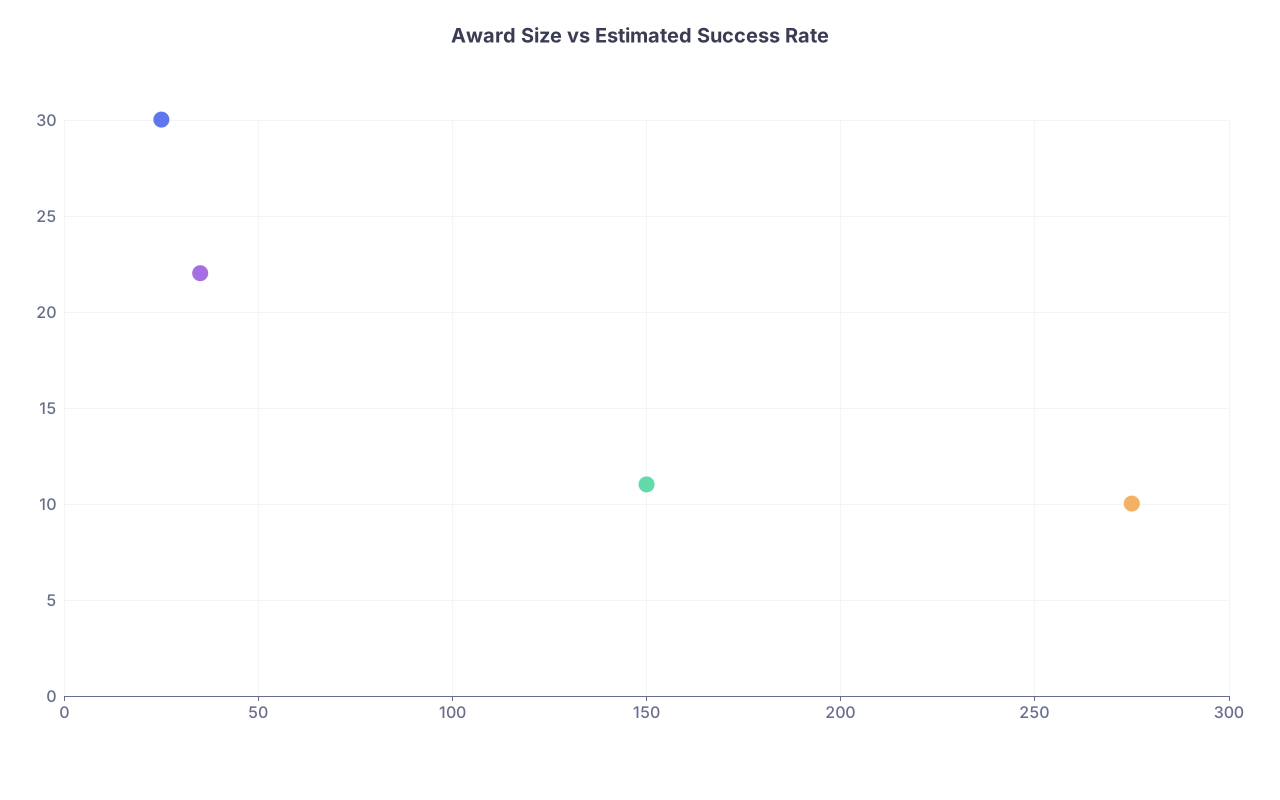
One way to look at strategy is expected value: probability of success times award size.
Here is a simplified comparison:
- Internal pilot: 30% success × $25k = $7.5k “expected value”
- Small foundation: 22% × $35k = $7.7k
- Large foundation: 11% × $150k = $16.5k
- Federal R21: 10% × $275k/year (2 years) ≈ $55k/year expected value
On paper, large awards “pay” more. In reality:
- The time cost of preparing and revising large proposals is often 3–5x higher
- The emotional cost of repeated near-misses is non-trivial
- Early-career investigators need wins, not just attempts
Visualizing this tradeoff:
| Category | Value |
|---|---|
| Internal | 25,30 |
| Small Foundation | 35,22 |
| Large Foundation | 150,11 |
| Federal R21 | 275,10 |
X-axis: typical direct cost (thousands of dollars)
Y-axis: rough success rate (%)
As dollars go up, probability goes down—no surprise. The point is you need a conscious portfolio: some high-probability, small wins, and fewer high-risk, high-reward attempts.
Patterns by Career Stage: Who Actually Gets Funded?
The data from institutional research offices and society reports show clear career-stage trends.
- Internal grants: skew toward early- and mid-career. Many first‑time PIs.
- Small society grants: early- and mid-career, often clinician‑educators or fellows.
- Large foundation grants: mid-career and senior; PIs often have prior multiple smaller grants.
- Federal awards: dominated by mid-career and senior investigators with extensive track records.
This is not arbitrary gatekeeping. The scoring criteria explicitly weight “investigator” and “environment.” A PGY-3 resident as PI on a multi-site $250k grant is almost guaranteed to be scored down, no matter how clever the idea.
The more rational pattern:
- Trainee or junior faculty: internal, small society grants as lead PI; possibly co-I on larger grants.
- Early mid-career: lead on small foundation grants; co-PI or site PI on multi-site or federal projects.
- Later mid-career: PI on large foundation and select federal proposals.
That is what the numbers support.
Common Strategic Errors: What the Data Say You Should Stop Doing
When you map unsuccessful applications against funded ones, you see the same mistakes over and over.
Wrong grant type for project maturity
Early idea, no pilot data, single site—and you jump straight to a large national call. These proposals are conceptually fine but empirically thin. Reviewers see that gap immediately.Education outcomes too low-level
Grant type: large or federal. Outcomes: knowledge scores and satisfaction surveys only. Funding rates for this combo are abysmal. High-dollar sponsors want behavior change, system impact, or at least strong long-term outcomes.No methodologic backbone
Vague language like “we will analyze pre-post surveys” without clear analytic plans, sample size justification, or consideration of bias. Education research is still research. The highest scoring applications read like rigorous clinical or health services proposals with an educational focus.Lack of collaboration signals
Single-person proposals with no statisticians, no qualitative experts, no implementation scientists. The funded projects nearly always show a multi-disciplinary team, even if small.Ignoring previous funding patterns of the sponsor
I have watched people submit bedside teaching projects to sponsors that, historically, only fund interprofessional team training around safety and quality. Unsurprisingly, those proposals rarely score well.
In other words: people ignore data. They do not study what their target funder actually funds.
Building a Data-Driven Funding Strategy
Let me be concrete. If you want to be a funded medical education researcher, your plan should look something like this, with actual numbers attached.
Step 1: Map your next 5 years as a funding ladder

| Step | Description |
|---|---|
| Step 1 | Year 1 - Internal Grant |
| Step 2 | Year 2 - Small Society Grant |
| Step 3 | Year 3-4 - Large Foundation or Multi-site |
| Step 4 | Year 4-5 - Federal or Career Award |
Assign realistic probabilities at each step:
- Internal: 30–40%
- Small society: 20–25% (higher with pilot data)
- Large foundation: 10–15% once you have prior grants
- Federal or career award: 10–20% with proper mentorship and track record
If you apply consistently across 4–5 years, the probability that you end up with at least one meaningful external award becomes reasonably high—because you are exploiting higher-probability steps for earlier wins.
Step 2: Use your institution’s real data
Most major medical schools have:
- An Office of Sponsored Programs or similar
- Medical education academies tracking their own grant cycles
- CVs and biosketches of funded educators online
Treat those as a data set:
- Count how many internal → external success stories you can find
- Look at timelines: often 1–3 years between pilot and external funding
- Note the common grant types and sponsors
You will see patterns. For example, one institution I worked with saw:
- Median time from first internal grant to first external med ed award: 2.5 years
- Typical sequence: Internal → Specialty Society → Foundation or HRSA
Once that pattern was explicit, junior faculty could plan around it instead of guessing.
Step 3: Align your metrics with your grant type
Do not promise NIH-level outcomes on an internal $15k grant. Also do not show up to a federal RFA with only satisfaction scores. This sounds obvious; the actual data say people get it wrong constantly.
As a rough rule:
- Internal / small grants: feasibility, acceptability, preliminary changes in knowledge or self-efficacy; early process metrics.
- Medium / foundation: behavior changes (e.g., documentation, clinical decisions), multi-level metrics (learners, faculty, patient proxies).
- Large / federal: system and patient-level outcomes where education is a key lever, plus rigorous process and implementation metrics.
Match outcome ambition to dollars and scope. Reviewers rank proposals along that alignment dimension almost subconsciously.
The Bottom Line: What the Numbers Actually Tell You
You can complain that medical education research is underfunded. Or you can read the pattern and play the game strategically.
The data say three things, clearly:
- Internal and small society grants have the highest success rates and function as critical launch pads. Skipping them dramatically lowers your overall probability of sustained funding.
- Large foundation and federal awards are winnable, but almost always after a staged sequence of smaller, successful projects with published outputs and solid methodological teams.
- Success is mostly about fit and maturity: aligning project scope, evidence to date, and outcome ambition with the right type of grant at the right point in your career.
If you build your funding strategy around those three facts—rather than around vague hopes for a single big win—your odds improve. Quantifiably.