<ai-image title="Medical educator reviewing outcome data dashboards" location="headline" prompt="Professional DSLR photo of a medical educator in a modern hospital conference room, looking at a large screen displaying charts and graphs of learner performance data, subtle clinical imagery in the background, cool neutral colors, no text overlays. />
The way most clinicians judge their teaching is statistically useless.
“I felt that went well.”
“They seemed engaged.”
“A lot of 5s on the evals.”
None of that predicts whether your learners will still be doing the right thing with real patients 6, 12, or 24 months later. The data on teaching impact is clear: if you want long-term outcomes, you need to track long-term metrics, not vibes.
This is the uncomfortable shift from “Was I a good teacher today?” to “Did this meaningfully change their practice a year from now?”
Let us build that system.
1. What Actually Predicts Long-Term Learner Outcomes
The literature on medical education outcomes is chaotic, but there are patterns. When you sift through the noise and focus on effect sizes, three categories of metrics show consistent predictive value:
- Retention and transfer of knowledge (measured over time, not once).
- Transferable clinical performance, especially in unfamiliar cases.
- Real-world behavior change and patient-level outcomes.
Everything else – satisfaction, “confidence,” “engagement” – is, at best, a weak mediator.
The four levels everyone quotes but rarely uses properly
Yes, the Kirkpatrick model is overused, but if you align it with measurable data, it is still useful as a scaffold:
| Level | Focus | Strong Metrics |
|---|---|---|
| 1 | Reaction | Net Promoter Score, qualitative flags |
| 2 | Learning | Pre/post + 3–6 month retention scores |
| 3 | Behavior | Chart audits, practice pattern shifts |
| 4 | Results | Patient outcomes, system metrics |
The data shows you get meaningful predictive power only once you consistently measure Levels 2–4 over time, not just at course end.
If you are serious about “impact,” your dashboard must move upstream from “did they like it?” to “does anything stay, transfer, and change?”
2. Core Metric #1 – Knowledge Retention That Actually Lasts
End-of-session MCQs are comfort food for educators. Everybody passes, everyone is happy, nothing predicts long-term performance.
Knowledge that persists behaves like a decay curve. You can model it. You can quantify it. And then you can judge teaching quality by how shallow that decay is.
The knowledge decay curve: how to capture it
For any major teaching intervention (bootcamp, longitudinal course, high-stakes skills block), you want at minimum:
- Baseline (pre-test).
- Immediate post-test.
- A delayed test (4–8 weeks).
- A longer delayed test (3–6 months) for key content.
Then you stop just looking at percent correct and start examining retention slopes.
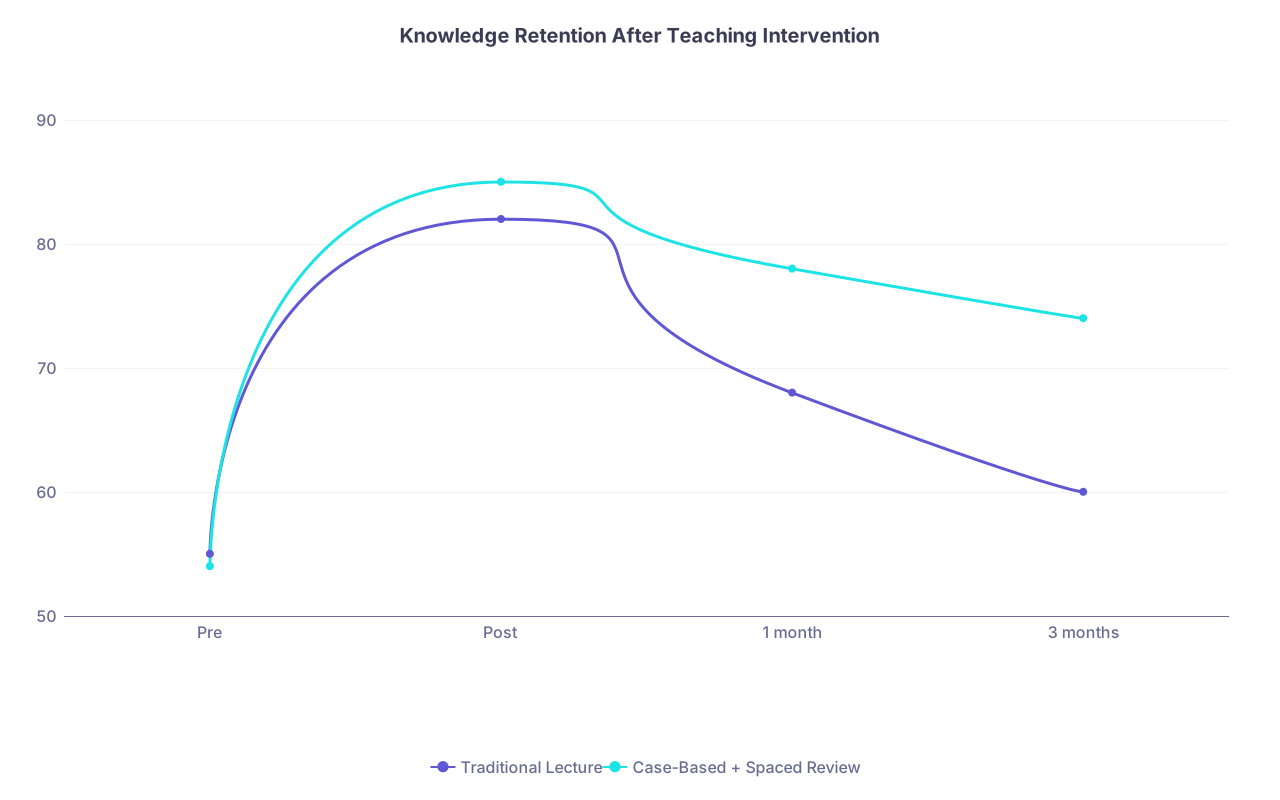
| Category | Traditional Lecture | Case-Based + Spaced Review |
|---|---|---|
| Pre | 55 | 54 |
| Post | 82 | 85 |
| 1 month | 68 | 78 |
| 3 months | 60 | 74 |
Both groups “learned” (big jump pre to post). Only one group retained. The second approach did not just improve scores; it softened the decay curve. That slope is the real teaching impact.
Metrics that matter for retention
For each learner and for the cohort:
- Absolute scores at each time point (mean ± SD, but also quartiles).
- ΔPost–Pre (immediate gain).
- Δ1-month–Post and Δ3-month–Post (decay amount).
- Proportion of learners maintaining ≥80% score at 1 and 3 months.
- Item-level retention (which concepts evaporate vs stick).
You can compress this into a single metric that is easy to track over time:
- Retention Index (RI) at time t = (Score at t – Pre) / (Post – Pre)
If RI ≈ 1 at 3 months, the knowledge stuck.
If RI ≈ 0.3 at 3 months, you ran a feel-good session that produced short-lived cramming.
Across cohorts and years, comparing RI curves is a brutally honest measure of whether your teaching design actually works.
Why this predicts long-term performance
Studies of board scores, in-training exams, and clinical reasoning all converge on one pattern: learners who show shallower decay on core knowledge domains perform better on:
- Unfamiliar variants of known problems.
- Complex multi-step management decisions.
- Time-pressured clinical tasks 6–18 months later.
Short version: if they cannot hold the facts, they cannot apply the facts.
3. Core Metric #2 – Transferable Clinical Performance
Knowledge retention is necessary but insufficient. You do not care if a resident can recite guidelines; you care if they recognize septic shock in the one patient who does not “look sick.”
So the next set of metrics focus on transfer, not recall.
Designing assessments that forecast real practice
Your assessments should be engineered like stress tests for transfer:
- New but related cases, not the exact ones from teaching.
- Increasing complexity: comorbidities, atypical presentations.
- Varied modalities: simulation, OSCEs, structured oral exams, script concordance tests.
You then track how learners’ performance on these “far-transfer” assessments predicts future outcomes.
<ai-image title="Residents performing simulation with instructor observing performance" location="inline" prompt="High-resolution photo of internal medicine residents in a simulation lab managing a deteriorating mannequin patient, with an attending physician at the observation station taking notes, clinical monitors visible, no text overlays. />
The data shows that well-designed simulation and OSCE performance correlates more strongly with later clinical behavior than knowledge tests alone, especially when:
- Checklists are behavior-focused (what they did) not opinion-focused (did the evaluator like it).
- Cases are standardized and repeated across cohorts.
- Scoring has proven inter-rater reliability (kappa, ICC > 0.7 where feasible).
Metrics that actually predict practice
For each core competency domain (e.g., sepsis management, handoff quality, informed consent), extract:
- Structured performance scores (0–100 or scaled).
- Critical error rates (did they miss X, delay Y, perform unsafe Z).
- Time-to-action metrics (time to antibiotics ordered, time to escalate, etc.).
- Variability across cases and raters (SD, range).
Now connect this forward. For a residency, for example:
- PGY1 simulation performance on sepsis → PGY2 real-world metrics:
- Time to first antibiotic in actual sepsis patients.
- Documentation of appropriate sepsis bundle elements.
- ICU transfer rates and escalation delays.
That is where it becomes a true predictive model, not an isolated “assessment event.”
4. Core Metric #3 – Real Behavior Change on the Wards
This is where most educators either give up or hide behind “too complex, too many confounders.” Yes, behavior in the clinical environment is noisy. But you can still extract meaningful signal if you are disciplined about your metrics.
From teaching event to practice pattern
Let us take a common scenario: you run a quality-improvement oriented teaching block on appropriate imaging for low back pain.
Six months later, what should you be tracking?
- Proportion of low back pain visits with imaging ordered within 6 weeks of onset.
- Rate of imaging that meets guideline criteria.
- Variation by provider type (residents vs faculty vs APPs).
- Trend line before vs after teaching.
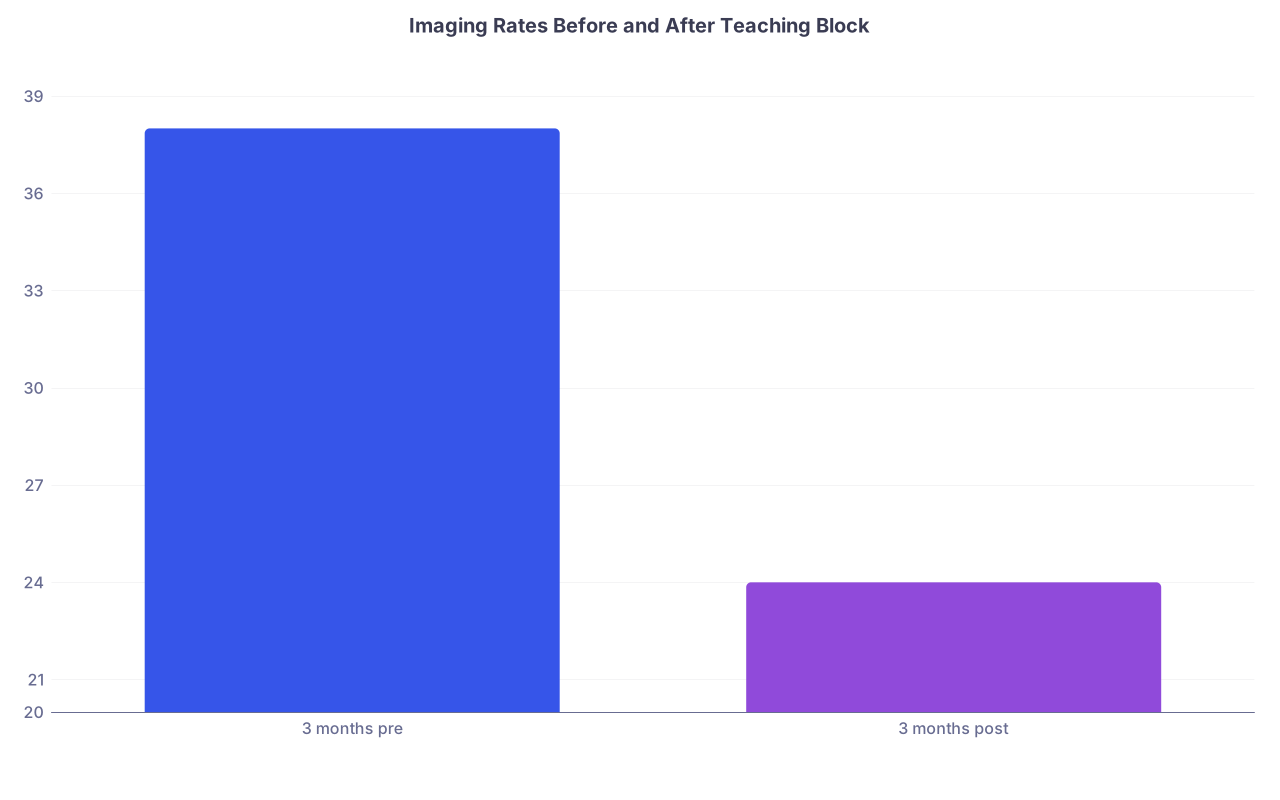
| Category | Value |
|---|---|
| 3 months pre | 38 |
| 3 months post | 24 |
If imaging dropped from 38% to 24% for guideline-discordant cases and stays there, that is teaching impact. Not because you “told them the rule,” but because their ordering behavior changed.
You anchor this to your learners by either:
- Tracking orders by provider ID (resident X, fellow Y).
- Aggregating at cohort level (all PGY2s) and comparing to control groups (PGY3s who did not receive that intervention).
Is it perfect causal inference? No. Is it far better than “they said the session was useful”? Absolutely.
Behavior metrics that scale
Other robust, trackable behavioral metrics:
- Guideline-concordant antibiotic prescribing rates.
- Use of high-value vs low-value ICU tests (daily CXRs, routine labs).
- Handoff quality scores using structured tools (e.g., I-PASS audit scores).
- Documentation completeness and accuracy for problem lists, critical diagnoses, or procedures.
- Rate of appropriate escalation or rapid response activation in deterioration events.
These are easy to audit with a decent EMR query and a small amount of manual validation.
5. Core Metric #4 – Patient-Level Outcomes and System Impact
This is where people either get overly excited or overly cynical. “My sepsis lecture saved lives.” No, probably not by itself. But your sepsis curriculum, simulation, checklists, and feedback loop together may shift outcome distributions.
You measure that with humility and statistical discipline.
From teaching to outcomes: what is realistic
Pick a few outcome domains where education is a major lever, not the only lever:
- Time-sensitive therapies (sepsis, stroke, MI).
- Safety-critical processes (procedural complications, central line infections).
- Communication-sensitive outcomes (readmissions related to poor discharge planning).
Then track trends at the unit or program level, aligned with major curriculum implementations.
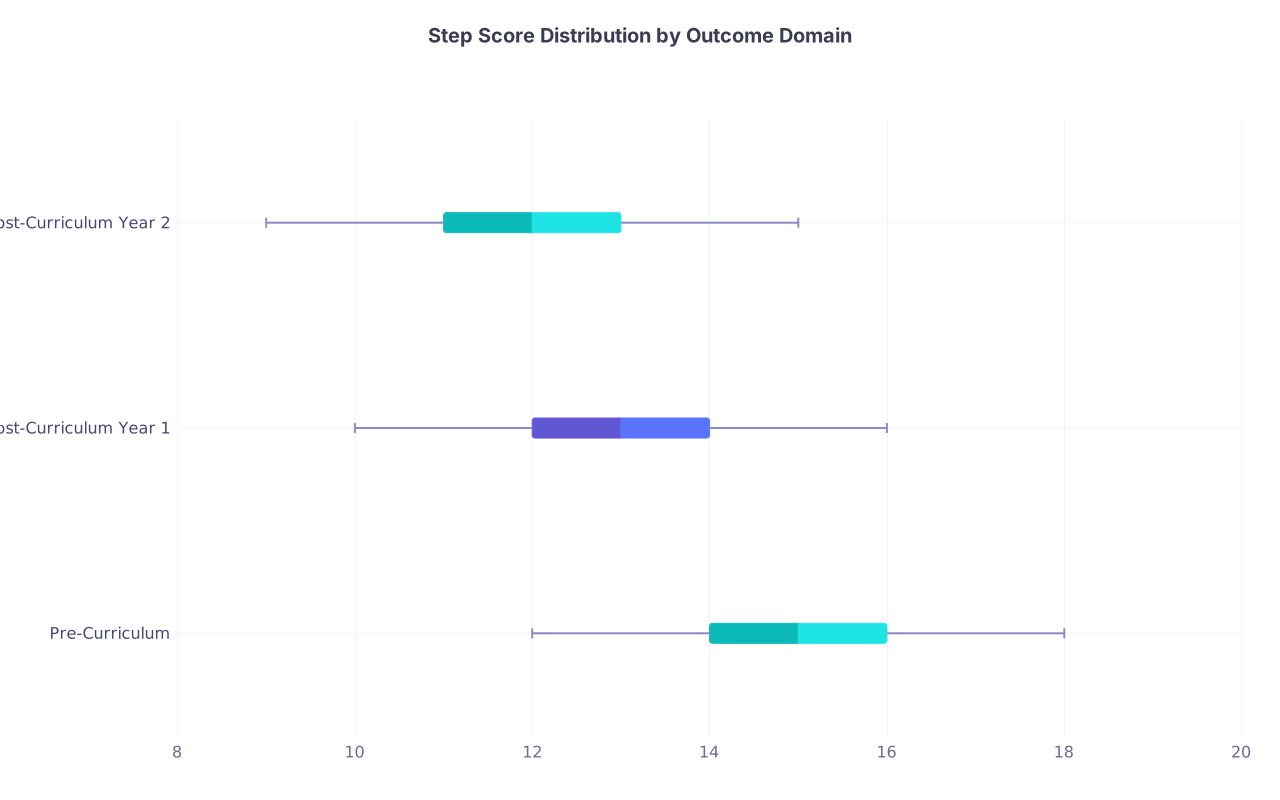
| Category | Min | Q1 | Median | Q3 | Max |
|---|---|---|---|---|---|
| Pre-Curriculum | 12 | 14 | 15 | 16 | 18 |
| Post-Curriculum Year 1 | 10 | 12 | 13 | 14 | 16 |
| Post-Curriculum Year 2 | 9 | 11 | 12 | 13 | 15 |
Pretend those are sepsis mortality per 100 cases across three timeframes. You are not attributing the entire drop to your teaching, but you are connecting:
- Implementation timing of your curriculum.
- Changes in related process metrics (time to antibiotics, bundle completion).
- Downstream shifts in mortality or ICU stay.
Then you benchmark against other sites or units that did not change their education program.
Do not chase noise
You will be tempted to overinterpret a one-year dip. Do not. Look for:
- Sustained change over 2–3 years.
- Process changes that move in the same direction as outcome changes.
- Consistent patterns across cohorts.
If your teaching leads to a cleaner process signal (e.g., 20% faster antibiotics) and that persists, that is already a strong claim. The mortality trend is then supporting evidence, not your only proof.
6. The Metrics Everybody Uses That Predict Almost Nothing
Now the unpleasant part: the beloved metrics that have weak or inconsistent relationships with long-term outcomes.
Learner satisfaction scores
You know the drill: 5-point Likert items, anonymous feedback, comments like “very engaging,” “too dense,” “great speaker.”
(Related: The Real Criteria for Being Labeled a ‘Master Teacher’)
The correlation between high satisfaction and actual learning or behavior change is weak. In some cases, negative. There are studies in which the most entertaining lecturers produced worse learning outcomes than more structured, less flashy teachers.
Common patterns I have seen in raw data:
- Faculty with exceptionally high satisfaction scores but average or below-average learner performance on delayed tests.
- Faculty with modest satisfaction scores but top-tier retention and transfer metrics.
Use satisfaction as a safety signal (are you alienating people?), not as a proxy for impact.
Self-reported confidence
Confidence increases after almost any teaching session. That is not the point. What matters is calibration: does confidence track with actual performance?
Often it does not.
You see:
- Overconfident underperformers (dangerous in procedural or diagnostic domains).
- Underconfident high performers (common in early training, particularly among certain demographic groups).
Correlation coefficients between self-rated competence and objective performance are usually modest at best. Use confidence when you want to target coaching or support, not as your primary outcome metric.
7. Building a Practical Teaching Impact Dashboard
You are not going to build a randomized trial for every grand rounds. But you can build a lean, high-yield measurement system that runs continuously in the background.
Think in terms of a dashboard for each major program or curriculum.
| Domain | Metric Example |
|---|---|
| Knowledge | 3-month Retention Index for key topics |
| Performance | Simulation score on critical scenarios |
| Behavior | Guideline-concordant ordering rates |
| Outcomes | Process times, complication or error rates |
Time-based view: cohorts and lagged outcomes
Layer on a time axis. That is where trends, not snapshots, tell the story.
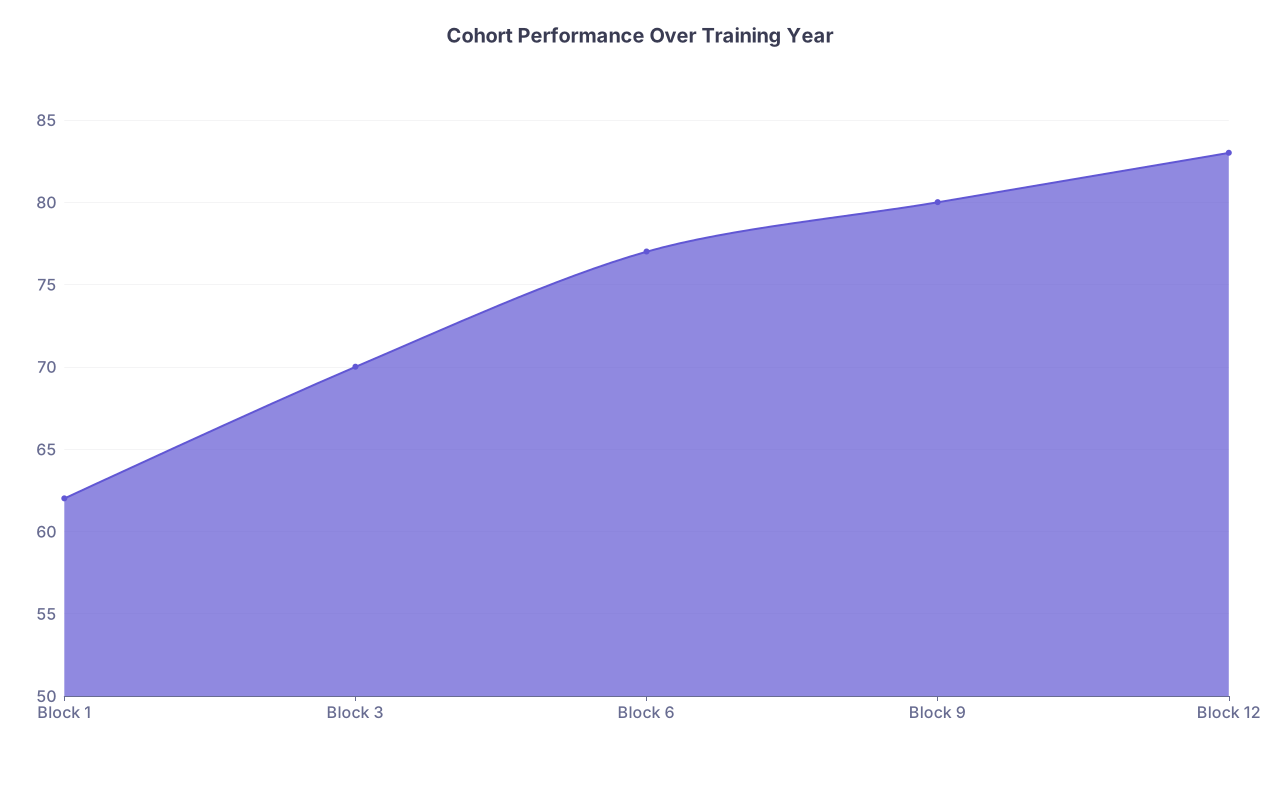
| Category | Value |
|---|---|
| Block 1 | 62 |
| Block 3 | 70 |
| Block 6 | 77 |
| Block 9 | 80 |
| Block 12 | 83 |
(See also: Why some clinicians get protected teaching time for discussion of how teaching is resourced.)
For a residency rotation-based curriculum, you might track:
- Block-level OSCE or simulation scores across the year.
- Rolling 3-month knowledge retention averages.
- Rolling 6-month behavior metrics (e.g., antibiotic appropriateness).
Then you overlay interventions: when did you introduce spaced repetition, structured feedback, a new simulation case, or a pocket guide? You watch for slope changes, not just absolute numbers.
8. A Simple Architecture for Collecting the Right Data
You do not need a full-time data scientist to do this decently. You need discipline and consistency.
Stepwise approach

| Step | Description |
|---|---|
| Step 1 | Define Target Behavior |
| Step 2 | Select 1-2 Patient or Process Outcomes |
| Step 3 | Design Knowledge and Performance Assessments |
| Step 4 | Collect Baseline Data |
| Step 5 | Implement Teaching Intervention |
| Step 6 | Measure Retention and Performance at Intervals |
| Step 7 | Extract Behavior Metrics from EMR or Audits |
| Step 8 | Compare to Baseline and Control Cohorts |
| Step 9 | Refine Teaching Based on Data |
You decide in advance what behavior and which outcome you care about, and then design assessments backward from there.
Stop bolting on random MCQs after the fact.
9. Real-World Examples: What Strong and Weak Impact Look Like
Two quick composite scenarios from what I have seen reviewing program data.
Example A – High-impact sepsis curriculum
Program introduces:
- Brief, repeated sepsis micro-teaching at sign-out.
- Monthly simulation of decompensating patients with rapid debrief.
- Pocket cards + EMR order set teaching.
Data over 18 months:
- Knowledge retention RI at 3 months: rises from 0.45 to 0.78 across cohorts.
- Simulation sepsis scenario critical error rate drops from 32% to 11%.
- Median time to antibiotic in real sepsis cases improves from 200 to 130 minutes.
- Sepsis bundle completion improves from 55% to 78%.
- ICU transfers from floor within 24 hours of admission for sepsis decrease by 18%.
You can argue about causality, but the chain from teaching → retention → performance → behavior → outcomes is visible and quantifiable.
Example B – “Great” ICU lecture series with weak impact
Program runs a monthly ICU didactic series. Highly rated speakers. Packed room.
Data over 12 months:
- Satisfaction scores: median 4.8/5.
- Immediate post-lecture quizzes: mean 88%.
- 2-month retention test for core topics: mean 61%, RI ≈ 0.35.
- ICU complication rates, ventilator days, or ordering patterns: no meaningful change compared with prior year or adjacent ICU without lecture series.
The teaching is enjoyable, but the impact signal is negligible. Without changing teaching structure (spacing, case-based practice, feedback), more of the same will not move outcomes. The data makes that argument for you.
10. What to Actually Do Next as a Medical Educator
If you want to track teaching impact in a way that predicts long-term learner outcomes, you do not start with a database. You start with ruthless focus.
Pick one domain. Sepsis recognition, safe prescribing, procedural consent, whatever is clinically meaningful in your setting.
Then:
- Define the target behavior and a small set of outcome/process metrics you can realistically extract.
- Build simple, repeatable knowledge and performance assessments that stress transfer.
- Schedule follow-up assessments at 1–3 months (and logistically at 6–12 months for high-stakes areas).
- Create a minimal dashboard showing:
- Knowledge retention (RI over time).
- Performance on transfer tasks (simulation/OSCE).
- Behavior metrics in the real environment.
- Iterate your teaching based on where the curve is weakest. If retention is fine but behavior is static, you have a transfer problem, not a content problem.
The cliché is “assessment drives learning.” The reality, if you look at the numbers, is sharper:
Measurement quality determines whether you are improving teaching or just rehearsing the same performance.
Key points:
- Long-term learner outcomes are best predicted by a chain of metrics: retention curves, performance in transfer tasks, real behavior change, and selected patient or process outcomes.
- Satisfaction scores and self-reported confidence are weak predictors and should be treated as secondary signals, not primary indicators of impact.
- A practical, high-yield teaching impact system tracks a few disciplined metrics over time, aligned with specific behaviors and outcomes, and uses those data to iteratively redesign teaching.