
The Real Criteria for Being Labeled a ‘Master Teacher’ at Your Institution
It’s 4:45 pm on a Tuesday. You’re staring at an email from the Office of Faculty Affairs: “Nominations are now open for the Master Teacher Award.”
You think about the colleague who just won it last year. Nice enough. Decent lectures. But if we’re honest? They’re not the person trainees flock to when they’re in trouble. They’re just the one whose face is on every committee flyer.
You start wondering: What actually gets someone labeled a “master teacher” around here? Is it evaluations? Awards? Publications in medical education? Or is there something else—something no one really says out loud?
Let me tell you what really happens.
The “Master Teacher” label is not about pedagogy in the way faculty development brochures pretend it is. It’s about institutional optics, politics, and a very specific set of visible behaviors that deans and program directors latch onto when they need a “teaching champion” to put on a slide for LCME, ACGME, or Magnet visits.
If you want that label—formally or informally—you need to understand the actual criteria being used behind closed doors.
What Departments Really Mean by “Master Teacher”
On paper, institutions talk about “master teachers” with words like excellence, innovation, and learner-centeredness. In closed-door promotion meetings, the language shifts. I’ve sat in those rooms. I’ve watched how the conversation actually goes.
It sounds like this:
“Who are our go-to people if the LCME site visitor asks about teaching?”
“Whose name do students keep bringing up?”
“Who do we trust to show off on interview days?”
“Who doesn’t complain when we dump another clerkship talk on them?”
Nobody says: “Who has the most scholarly approach to cognitive load theory?” They want people who:
- Make the institution look good.
- Solve the institution’s educational problems without drama.
- Are already known and liked by influential faculty and trainees.
The formal criteria—evaluation scores, teaching awards, education publications—get reverse-engineered to justify the decision after the fact.
The informal criteria, the ones that actually drive decisions, are a different list.
The Quiet Scorecard: How Leadership Actually Judges You
Let’s break down the real rubric being used in dean’s offices and department chairs’ heads. There are a few domains that actually move the needle.
1. The “Name That Keeps Coming Up” Factor
This is the single most powerful criterion. Not your CV. Not your teaching portfolio. It’s frequency.
In promotions and award committees, this happens constantly:
“Any names for master teacher?”
A few people throw out one or two. Then someone says yours.
“Oh yeah, I’ve heard the students really like them.”
“Right, and the residents mentioned them last month.”
“Didn’t they do that bootcamp session that everyone raved about?”
You get momentum. Once your name is in the air enough, the group starts retrofitting a narrative of excellence around you.
How does your name start “coming up”?
- Students mention you in town halls, GME surveys, or those anonymous “who made a difference” comment boxes.
- Residents fight to be on your team or your clinic.
- Clerkship directors and program directors call you when they have a “high-risk” learner.
- You get pulled into more and more “could you give that talk again?” emails.
You do not need to be universally loved. You need to be consistently mentioned in the right rooms.
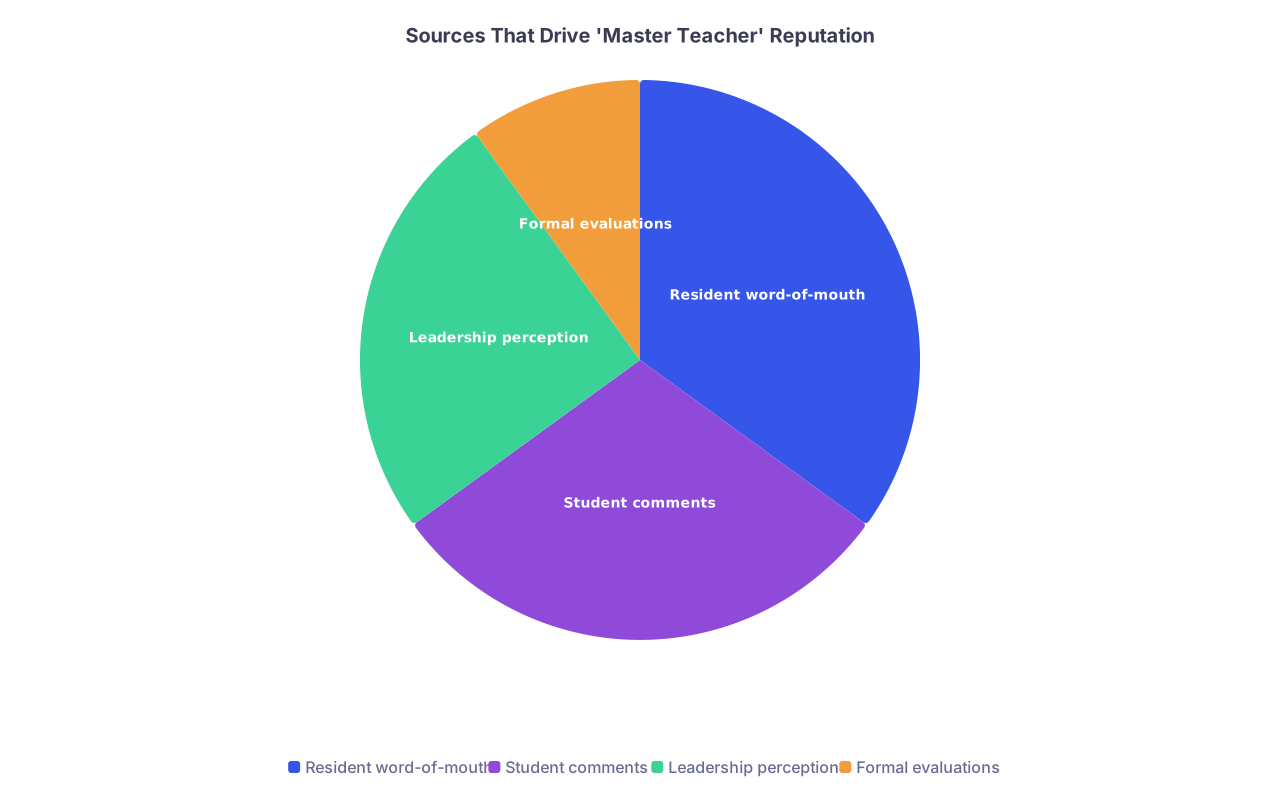
| Category | Value |
|---|---|
| Resident word-of-mouth | 35 |
| Student comments | 30 |
| Leadership perception | 25 |
| Formal evaluations | 10 |
Notice what’s at the bottom: formal evaluations. Those are used as ammunition after the fact, not as the starting point.
2. The “Trusted With Our Problem Learners” Test
One of the most revealing questions you’ll hear behind closed doors:
“If we have a struggling resident, who do we send them to?”
If your name is on that short list, you’re already halfway to “master teacher” whether your title says it or not.
Why? Because this is how chiefs and PDs think:
- Anyone can give a pretty lecture.
- Fewer can run an efficient, safe team.
- Very few can pull a marginal learner back from the brink without destroying them.
I’ve watched a chair say: “They’re a true master teacher—remember when they turned that borderline PGY-1 around?” That single intervention outweighed years of “above average” evals.
The people who get that trust share some patterns:
They’re blunt but not cruel.
They’re observant on rounds—actually seeing the learner behind the façade.
They can document concerns in a way that protects both the trainee and the program.
They don’t panic when remediation gets messy.
Show me who the PD calls when there’s a resident in trouble, and I’ll show you the real teaching hierarchy in that program.
What Everyone Overestimates: Evaluations, Workshops, and “Passion for Teaching”
A lot of junior faculty make the same mistake. They chase the visible, easy stuff—and then wonder why they’re still seen as “nice teachers” rather than “master teachers.”
Let’s cut through it.
Student Evaluations: Necessary but Weak Currency
Yes, you need decent evals. If your numbers are bad, you’re dead in the water. But the ceiling effect is brutal. Once everyone is “4.4–4.8 out of 5,” no one on the committee is parsing that.
What does get quoted are the standout comments:
- “Best attending I’ve ever worked with.”
- “The first person who made pathophysiology actually make sense to me.”
- “They treated me like a future colleague, not cheap labor.”
Those get copied into nomination letters and promotion packets. The mean score quietly goes in a table, but the story is built on that one striking comment.
| Evidence Type | Real Influence |
|---|---|
| Vivid learner comments | High |
| Word-of-mouth reputational | High |
| Standardized evaluation mean | Moderate |
| Teaching workshop attendance | Low |
| Generic teaching awards | Moderate |
Faculty Development Workshops: Overrated Signal
Your institution will push teaching certificates, academies, and workshops hard. They want numbers for accreditation and shiny slides of “Faculty Development Participation.”
Here’s the uncomfortable truth: Attendance at teaching workshops is weak evidence of being a master teacher. Everyone on the inside knows it.
I’ve seen promotion packets where the candidate listed fifteen teaching workshops. The committee chair literally said, “So they like free lunch.”
Workshops help if:
- You clearly implemented what you learned (flipped classroom, better feedback structure, new simulation).
- Trainees actually experienced a change.
- You tied it to an outcome: fewer failures, higher board pass rates, improved milestone performance.
Just stacking certificates? That’s pure checkbox. No one’s impressed.
“Passion for Teaching”: Cheap Talk
Plenty of people “love teaching” when they’re up for promotion or an award. They say all the right things in their personal statement.
Leadership looks for something else: who shows up when it’s inconvenient.
- The person who stays another 20 minutes post-call because a resident is spiraling.
- The one who takes the early morning slot to run a board review session before clinic.
- The attending who rewrites a broken rotation schedule because they’re tired of watching learners flail.
You don’t have to advertise your passion. People see it in your behavior and they talk. That’s what sticks.
The Political Layer: Visibility, Alignment, and “Safe Hands”
Now let’s talk about the part everyone pretends is not there: politics.
“Master teacher” designations—formal titles, chairs, named awards—almost always have a political dimension. You ignore that at your own cost.
1. Are You Useful to the Institution’s Narrative?
Every school and hospital has a few storylines they want ready for site visitors, donors, and brochures:
- “We’re committed to innovative medical education.”
- “We care deeply about resident well-being.”
- “We excel at interprofessional and simulation-based learning.”
- “We’re leaders in competency-based assessment.”
If you accidentally align with one of those narratives through your work, you become extremely valuable. You’re the face they can put on that story.
For example:
- You built a resident-as-teacher curriculum that actually functions.
- You turned around a toxic rotation and the GME survey comments flipped.
- You created a bootcamp that improved intern performance in a measurable way.
Now, when the dean needs a “master teacher” to stand up at the annual education retreat, you’re the obvious choice.

2. Are You in the Right Rooms?
Another piece nobody tells you early: being a master teacher is partly about being seen by other faculty, not just by learners.
If the only people who know you are third-year students and PGY-1s, your reputation is fragile. They rotate out. Graduate. Move on.
The people who confer the “master teacher” label tend to:
- Sit on promotions committees.
- Lead clerkships and residency programs.
- Run academies of medical educators.
- Show up at education councils and retreats.
If you’re never in those rooms, your name doesn’t get floated when it matters. I’ve watched painfully strong clinicians and teachers get passed over because half the committee had never heard of them.
You don’t need to be on ten committees. You need 1–2 strategic roles where your educational work is visible to decision-makers.
3. Are You Considered “Safe Hands”?
This one’s subtle but powerful.
Institutions reward people they see as safe. Not just clinically safe—politically safe.
“Safe hands” means:
- You don’t create drama.
- You don’t torch people publicly.
- You don’t embarrass the institution in front of accreditors.
- You handle conflict with a lower decibel level than Twitter.
I’ve watched brilliant, beloved teachers get quietly sidelined from leadership roles because they were seen as volatile. Great on the ward. Too risky on a committee.
You want the opposite reputation: the person they call when something has to go smoothly, on time, without noise.
What Real “Master Teachers” Actually Do Differently on the Ground
Let’s get concrete. Institutions use fuzzy language, but trainees are brutally clear. They know exactly who the genuine master teachers are.
Over the years, I’ve heard the same kinds of comments from residents and students about the faculty they idolize.
They Make Clinical Work Feel Teachable, Not Just Survivable
On a busy service, weak attendings either take over or get bulldozed by the system. Master teachers do something different: they turn the chaos into a curriculum.
Their patterns:
- Rounds are purposeful. Not “walk and talk randomly until noon,” but clear: “Today we focus on sick vs not sick and diagnostic thresholds.”
- They pick one concept per day and hammer it in—dose, not deluge.
- They use real patients to anchor teaching rather than spamming PowerPoints.
You’ll hear comments like: “I learned more in 2 weeks on that service than in 3 months of lectures.”
They Give Feedback That Hurts a Little but Makes Sense
Learners know when feedback is fake. “You’re doing great, just read more” is almost insulting.
The people residents call “phenomenal teachers” do this:
- They observe enough to be specific: “Your presentations are thorough but you bury the assessment. Tomorrow, lead with your impression in the first two sentences.”
- They separate care from judgment: “I’m pushing you on this because you are absolutely capable of being excellent.”
- They normalize struggle: “This is a PGY-2 problem, not a you problem. Let’s fix it together.”
Those conversations get quoted word-for-word years later. That’s how reputations are built.
They Protect Learners from Needless Harm, Not Necessary Stress
Learners don’t want cushy. They want fair.
The master teachers I’ve watched closely all do some version of this:
- They push hard on clinical reasoning, but they don’t humiliate at the bedside.
- They let you sweat through a tough question, then scaffold you out instead of leaving you to drown.
- They intervene quietly when a nurse, consultant, or senior is out of line with a trainee.
Residents remember who stood between them and abuse. And they talk.
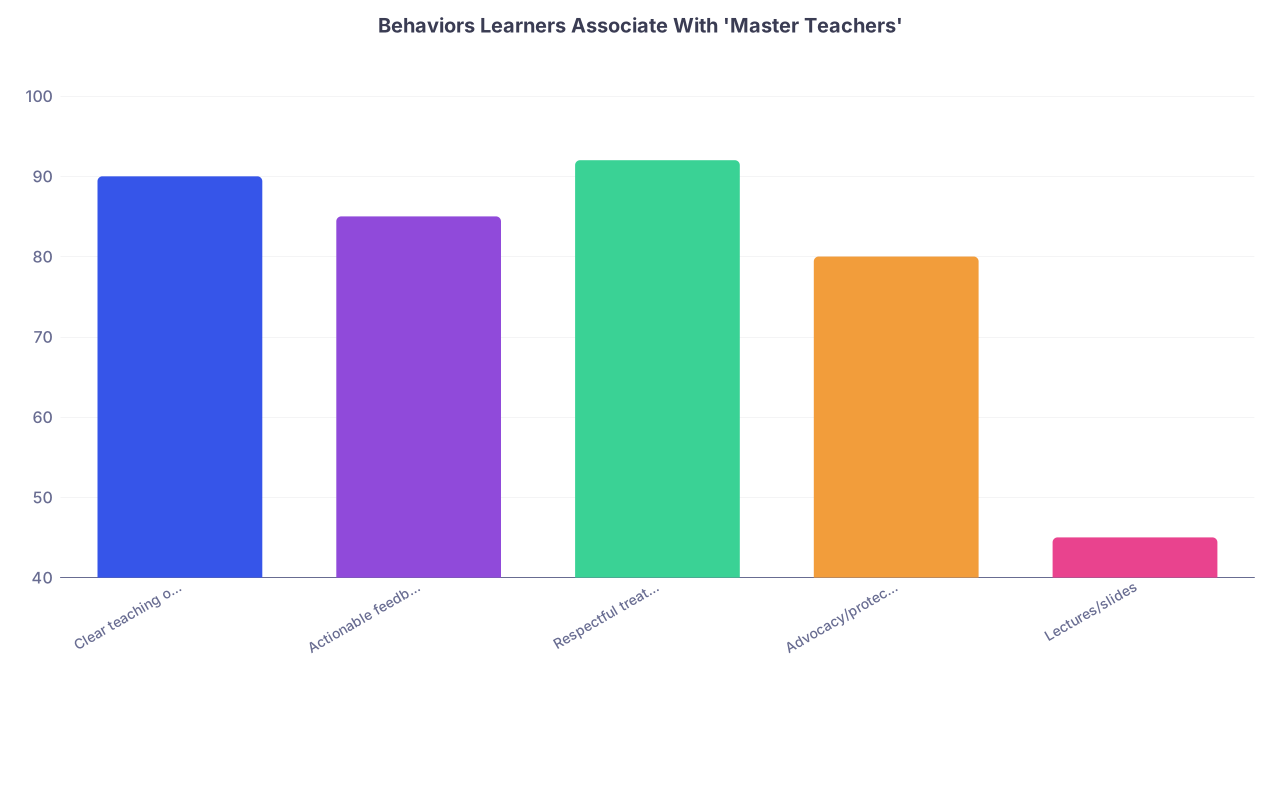
| Category | Value |
|---|---|
| Clear teaching on service | 90 |
| Actionable feedback | 85 |
| Respectful treatment | 92 |
| Advocacy/protection | 80 |
| Lectures/slides | 45 |
Notice where “lectures/slides” sits. Being a strong lecturer helps, but it’s not the core.
The Formal Stuff Still Matters—Just Not How You Think
You can’t completely ignore the formal criteria. They’re the scaffolding that supports the story people want to tell about you.
Here’s how they actually get used.
Education Scholarship: Receipts, Not the Main Show
Having some education scholarship on your CV—curriculum design, assessment innovation, simulation studies—helps in three ways:
- It shows you can name what you’re doing educationally (constructive alignment, deliberate practice, etc.).
- It gives promotion committees language to justify your advancement.
- It signals to leadership that you’re serious, not dabbling.
But you don’t need a PhD in education or a massive publications list. At most places, a small cluster of meaningful, practice-related education projects is plenty, if they match your real-world reputation.
The dead giveaway of someone trying to brute-force this: lots of tiny, forgettable abstracts with no sustained thread. Committees see right through that.
Titles and Roles: Currency of Legitimacy
Certain roles are almost pre-labeled as “master teacher” tracks:
- Clerkship Director
- Program Director or Associate PD
- Director of Simulation
- Director of Clinical Skills / Longitudinal Course
- Chair of the “Academy of Educators” type entity
Hold one of those and perform reasonably well, and the system starts to see you as a teacher by default. Do it exceptionally well, and people will start saying “they’re a master teacher” long before you get a formal plaque.
You don’t have to chase a title. But if you want the institutional label, not just hallway respect, at some point you’ll need a role that gives your work a platform.

The Behind-the-Scenes Selection Process: How the Sausage Gets Made
Let me walk you through how a “Master Teacher Award” or internal designation usually happens. The process varies, but the underlying mechanics are surprisingly similar.

| Step | Description |
|---|---|
| Step 1 | Call for nominations |
| Step 2 | Names gathered |
| Step 3 | Committee meeting |
| Step 4 | Review evaluations and comments |
| Step 5 | Brief review then pass |
| Step 6 | Check political fit |
| Step 7 | Selected as Master Teacher |
| Step 8 | Defer or choose alternate |
| Step 9 | Recognized name? |
What you think happens: They open the CVs, read your teaching philosophy, and rigorously compare everyone.
What actually happens more often than not:
- A call for nominations goes out. Half the people recycle last year’s nomination letter with a new date.
- The committee glances at the list of names. Recognition is everything. If they haven’t heard of you, you start in the hole.
- Known names trigger recall: “I’ve heard their teaching is excellent,” or “Residents love them,” or conversely “I’ve heard some complaints.”
- For the short list, someone skim-reads eval summaries and cherry-picks glowing comments.
- They check political factors: Are we balancing departments? Gender? Rank? Do we owe that division chief a favor?
- They pick the candidate who’s:
- Safe
- Liked
- Already widely perceived as “a teacher”
- Easy to justify with the paperwork on hand
That’s the game. You can hate it, or you can learn its rules and still be the kind of teacher trainees actually deserve.
How to Position Yourself—Without Selling Your Soul
You don’t need to turn into a politician. You do need to be intentional.
Here’s the basic playbook that works at almost every institution:
First, earn the reputation on the ground. That’s non-negotiable. If you’re not actually good, any “master teacher” branding will crumble.
Second, make your work visible in the right channels:
- Volunteer selectively for teaching that has high learner volume and high leadership visibility (intern bootcamps, orientation, capstone sessions).
- Say yes to being observed once in a while—by PDs, chiefs, or education leaders. Those stories carry weight.
- Put together a clean, concise teaching portfolio with real examples, not fluff.
Third, lean into one or two areas where you can be “the person”:
Maybe you’re the feedback expert. The remediation whisperer. The simulation guru. The person who makes EKGs finally click. Having a specific niche makes your name easier to remember and recommend.
And fourth, be the person leadership can rely on:
When you say you’ll run that session, it happens. When there’s conflict, you don’t pour gasoline on it. When learners struggle, you don’t punt them back to the PD with a vague “they’re not cutting it.”
That’s the composite picture committees end up labeling “master teacher”—even if the formal language is fancier.
The Bottom Line
If you strip away the brochures and mission statements, the real criteria for being labeled a “master teacher” at most institutions come down to this:
- Your name repeatedly surfaces from learners and leaders as someone who changes people—not just someone who gives good talks.
- You’re trusted with the hard stuff: problem learners, high-stakes teaching, messy rotations—and you handle it without drama.
- You align (even unintentionally) with what the institution wants to showcase, and you’re visible enough that the right people can say, “Yes, them. They’re the real deal.”
You focus on those three, and the titles, awards, and formal labels tend to follow. Ignore them, and you’ll stay “a good teacher” in whispered compliments only—while someone else, often less deserving, gets the plaque.