
You’re standing outside the dean’s suite. Frosted glass, quiet carpet, the assistant who somehow runs the entire medical school with a single Outlook calendar. You just heard that Dr. X—who you’re sure is not the “best teacher”—was just named Associate Dean for Medical Education.
You’re thinking: How did they get that job? Who actually picks these people? And what would it really take for someone like me to end up in that chair?
Let me tell you what actually happens on the inside. Because the public story—“search committees, merit, excellence in education”—is only half the truth.
The Myth vs. The Machinery
Everyone outside the dean’s office believes the same neat story: there’s an open national search, the most qualified educator applies, committees carefully review, and the best person wins.
Sometimes that’s true.
More often, the process looks like this: a small group of powerful people who already know each other decide who they can work with for the next five to ten years, then they build a search process around that reality.
The formal structures exist. Job posting. Search committee. Diversity language. Campus presentations. Feedback surveys. But by the time the posting hits the website, there’s usually a shortlist in people’s heads. Sometimes there’s already a frontrunner.
You want a career in medical education leadership? You need to understand both layers: the visible process and the quiet conversations.
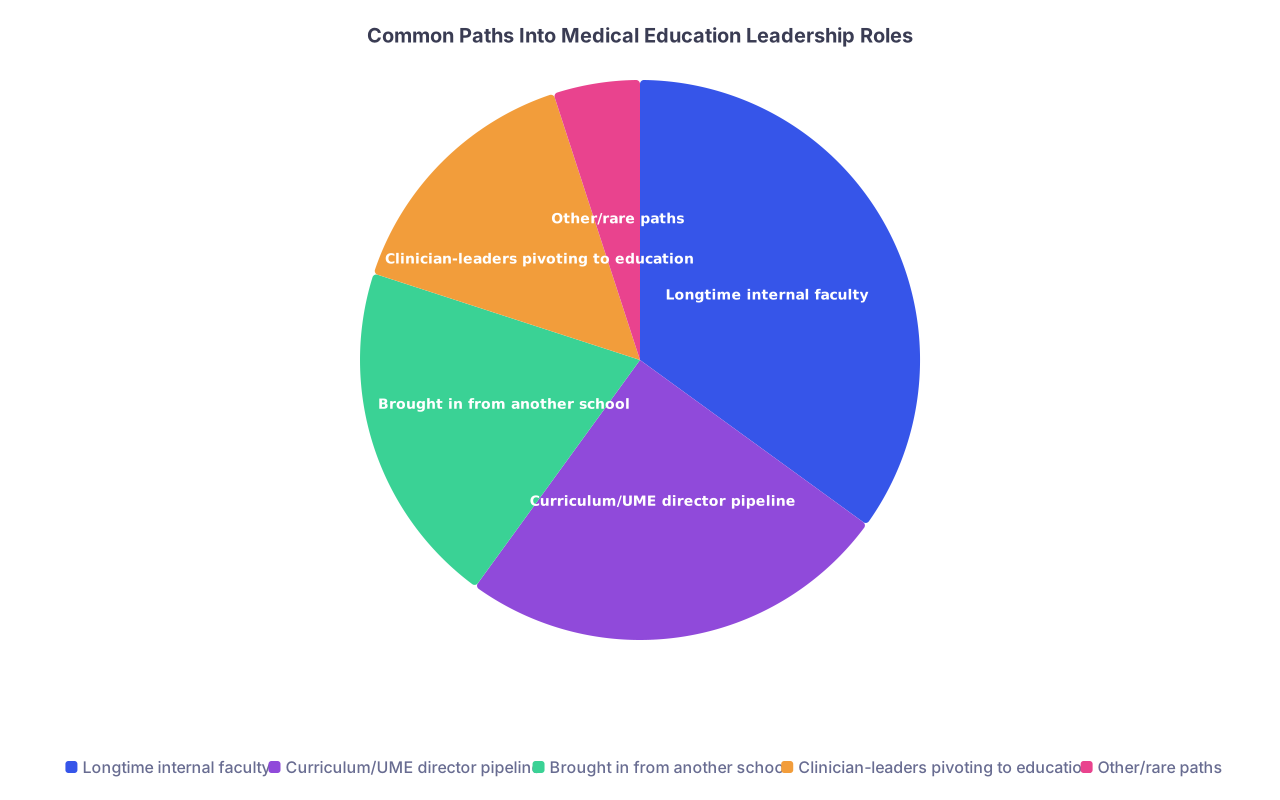
| Category | Value |
|---|---|
| Longtime internal faculty | 35 |
| Curriculum/UME director pipeline | 25 |
| Brought in from another school | 20 |
| Clinician-leaders pivoting to education | 15 |
| Other/rare paths | 5 |
Who Actually Gets Chosen (And Why)
Let’s start with what deans and provosts really look for when choosing an Associate Dean for Education, Vice Dean for Academic Affairs, or similar roles.
1. Institutional Reliability Over Brilliance
This will upset the idealists, but it is true almost everywhere: they choose reliability over brilliance.
They’re not thinking: “Who is the single best lecturer?” They’re thinking: “Who can I trust not to blow up the LCME accreditation, alienate clinical chairs, or cause a faculty revolt?”
So the people who rise tend to have a specific profile:
- They’ve already run something complex: a clerkship, a course, a curriculum reform task force, the entire assessment system.
- They’ve hit deadlines. Every time. With no drama that reached the dean’s ear.
- They do not constantly create conflict that the dean has to clean up.
- They can sit in a room with surgery, medicine, pediatrics, and psychiatry chairs and not ignite a war.
I’ve sat in those meetings where candidates are discussed. The language is telling:
- “She’s solid. Gets things done. No fires.”
- “He’s smart, but he’s… polarizing.”
- “We cannot afford another ‘visionary’ right now; accreditation is in two years.”
You think they pick the genius educator who rewrote the small group curriculum but pissed off three departments? Rarely. They pick the one who can move the ship without capsizing it.
2. Political Safety
A dean is protecting their own job, too. They know an associate dean appointment can either stabilize their leadership team or give their enemies ammunition.
So when they look at you as a candidate, they are not just asking: “Is this person good?” They’re asking:
- Will this person be accepted by the big clinical departments who bring in the RVUs?
- Will this person embarrass the school in front of the LCME, university president, or donors?
- Will they respect the chain of command, or go rogue?
And, quietly: “If this goes sideways, can I defend this choice?”
I’ve heard a dean say, word for word: “We’re not putting a grenade in that chair. I need someone boringly competent.”
Translation: if you’re talented and even moderately high-risk politically, your odds drop.
3. Visibility in the Right Rooms
Promotions into leadership do not come from student teaching evaluations. They come from visibility with people who make decisions.
Students can love you. Residents can rave about you. That gets you teaching awards, maybe a course director role.
But deans and search committees look heavily at:
- Who has chaired important committees (curriculum, assessment, LCME self-study).
- Who was trusted with sensitive projects (grading reform, professionalism policies).
- Who shows up consistently at the “boring” meetings most faculty ignore.
I’ve watched careers made because someone said “yes” when asked to chair an LCME subcommittee nobody else wanted. You know who remembered that? The dean and the LCME liaison. That name stays in their head.
How the Process Really Unfolds
Let’s walk through how someone becomes, say, Associate Dean for Undergraduate Medical Education (UME), from the inside.

| Step | Description |
|---|---|
| Step 1 | Strong teacher |
| Step 2 | Course or clerkship director |
| Step 3 | Curriculum or assessment committee |
| Step 4 | Major project or reform lead |
| Step 5 | Associate chair or vice dean \lite\ role |
| Step 6 | Associate dean for education |
Step 1: The “We Need Someone” Conversation
Before there’s a search committee, there’s the private conversation.
The dean, maybe a vice dean, sometimes the provost or health system CEO, sit together and say something like:
“We need someone stable in the education role. Accreditors are on us about assessment. Who can do this?”
They toss around names. Some get dismissed immediately:
- “Too young, not enough gravitas.”
- “Brilliant but impossible to manage.”
- “On their way out; burned out.”
- “Clinical department will never accept them.”
This is where the real shortlist starts.
If your name is not in this room, it’s very hard to win later. You can wow the search committee all you want; you’re already swimming upstream.
Step 2: The “Encouraged Candidate”
Here’s a dirty little secret: many “open national searches” already have an internal candidate quietly blessed.
What happens behind the scenes:
The dean, or someone close, calls that person and says:
“You should think about applying. I think you’d be very competitive.”
That’s code. It means: You’re our preferred option if you don’t screw this up.
Then they might say to others: “We’d like a strong, diverse national pool.” Translation: we need a real competition on paper, but the internal politics are leaning in one direction.
Do outside candidates ever win anyway? Yes. When:
- The internal option is too weak for what accreditors or the university expect.
- The school needs to change course dramatically.
- A big-name outside candidate appears who solves multiple problems at once.
But if you’re just as strong as the internal favorite? The internal person usually wins. They know the system. Less risk. Less onboarding.
Step 3: The Search Committee Theater
Committees are assembled. Faculty from different departments. Maybe a student. Maybe someone from the university side. HR involved.
They review CVs, check the boxes, do interviews. They generate their ranked list.
The official story is: committee recommends, dean decides.
The real story: the committee’s job is to make it defensible.
I’ve watched this in real time:
- Committee ranks Candidate A, B, C.
- Dean really wants B.
- Dean “reviews” the list, has “concerns” about A’s fit with strategic priorities.
- After some back-and-forth, B emerges as “the consensus best option moving forward.”
Nobody lied. But the dean had veto power from the start.
Think about that when you strategize: impress the committee, yes. But if the dean doesn’t see you as safe and aligned, it won’t matter.
Step 4: Campus Talks and Performances
The public presentations—“Vision for Medical Education,” town halls with Q&A—are less about content than people think.
I’ve listened to dozens of them. Here’s what really gets people hired:
- Can you speak like a dean? Calm, coherent, no jargon overload, no obvious blunders.
- Do you sound like you can survive angry faculty meetings and still function?
- Do you respect what already exists instead of trashing it?
- Do you show fluency in clinical, financial, and accreditation realities—not just pedagogy buzzwords?
The person who gives the most intellectually rich talk sometimes loses to the one who sounds like they can run a 200-person operation without drama.

What Marks You as “Leadership Material”
So what separates the people who get tapped from those who stay as “excellent faculty” forever?
1. You Think System, Not Session
Deans listen for mindset.
If you talk only in terms of “my small group,” “my lecture,” “my clerkship,” you get filed as a good teacher.
If you talk about longitudinal outcomes, integration across phases, assessment strategy, accreditation risk, resource constraints—you get filed as potential leadership.
I’ve heard it right after a meeting: “She’s thinking at the system level. Keep her close.”
You want to move up? Start speaking like someone who sees the educational ecosystem, not just your slice of it.
2. You Handle Conflict Without Flames
Every medical educator hits conflict. Student mistreatment cases. Grade appeals. Faculty who refuse to change. Department chairs who threaten to pull their faculty from teaching.
People are watching how you handle it.
The problem is not conflict itself. The problem is conflict that spills into the dean’s office as “a mess.”
If you become known as:
- The person who escalates everything.
- The person who never escalates anything and lets problems rot.
- The person who makes interpersonal drama out of every policy issue.
You’re done.
The ones who rise:
- Document well.
- Escalate only when proportionate.
- Keep their cool in tense rooms.
- Know when to say: “Let’s pause and regroup tomorrow.”
3. You Are Tolerable to the Power Departments
Let’s be blunt. In many schools, internal medicine, surgery, and a few other high-RVU departments have outsized influence.
If the chairs of those departments hate you, your path to dean-level leadership shrinks dramatically.
That doesn’t mean you have to be their puppet. But you cannot be at open war with them. I’ve watched a fantastic educator’s candidacy die because one powerful chair told the dean: “If you appoint them, my folks are pulling out of pre-clinical teaching.”
Was that fair? No. Was it real? Yes.
So if you want leadership, learn to:
- Speak the clinical language of throughput and RVUs, not just competencies and milestones.
- Show up when their department needs help with student issues or curriculum alignment.
- Make some visible wins that make their life easier, not just yours.
The Background CV Stuff Nobody Admits Is Screened
Let me show you what deans and search committees actually scan for in CVs of leadership candidates.
| CV Element | How It’s Interpreted Behind the Scenes |
|---|---|
| Clerkship/Course Director | Proven ability to manage logistics and faculty |
| Chair of Curriculum Cmte | Trusted with political and strategic decisions |
| LCME or ACGME role | Understands accreditation pressure and language |
| Education research/pubs | Seriousness about education beyond “I like teaching” |
| National education roles | External credibility; easier to sell to provost |
| Admin certificates/MPH/MEd | Willingness to live in systems, policies, evaluation |
Do you need all of these? No. But the more of them you quietly accumulate, the more you flip from “nice teacher” to “obvious leadership candidate” in their minds.
And notice what’s not there: student teaching awards. They help. They decorate the narrative. But they are not the engine.
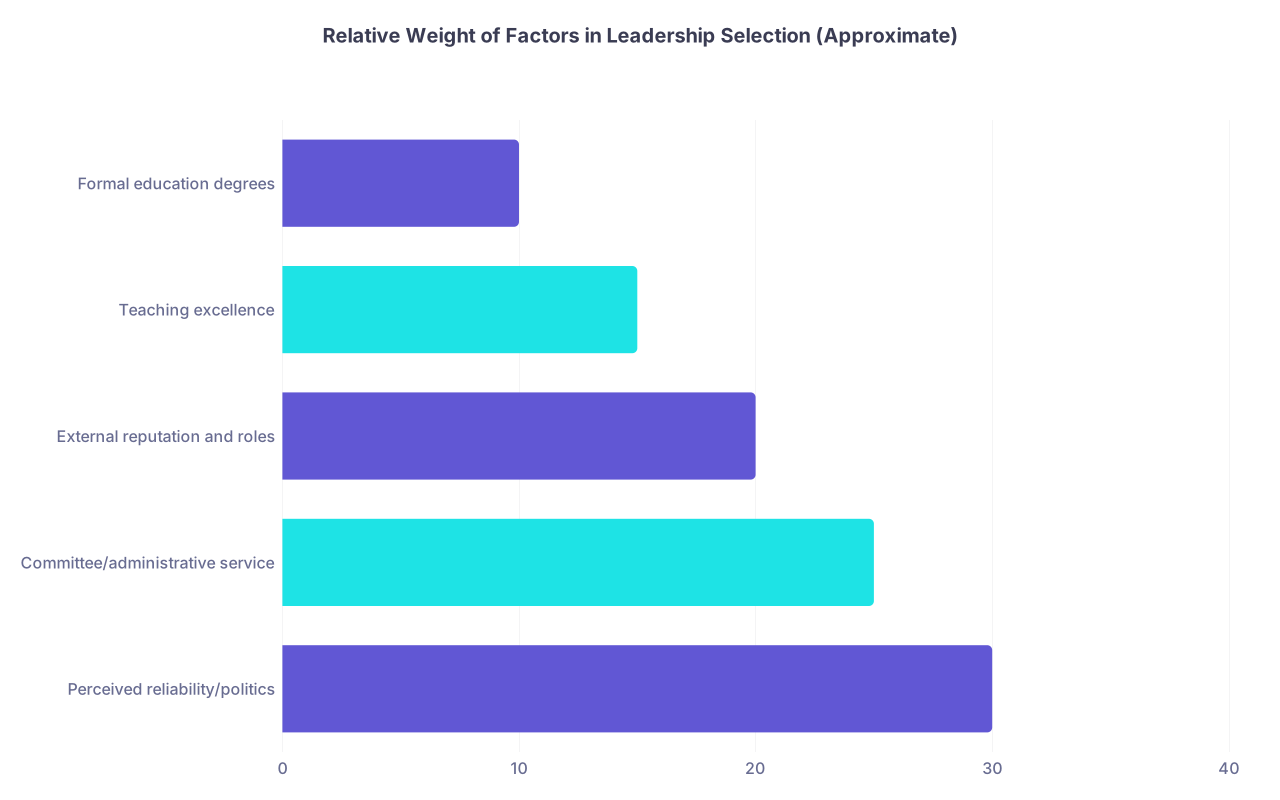
| Category | Value |
|---|---|
| Perceived reliability/politics | 30 |
| Committee/administrative service | 25 |
| External reputation and roles | 20 |
| Teaching excellence | 15 |
| Formal education degrees | 10 |
How to Actually Position Yourself for These Roles
You’re not going to game this in a year. People who become deans and associate deans of education usually spent 5–15 years unintentionally building that profile. You can be more intentional.
Build the Right Portfolio of Roles
If you’re early or mid-career and even think you might want leadership down the line, start shifting from pure teaching to educational operations.
Look for roles that:
- Put you in cross-department meetings (curriculum, assessment, learning environment).
- Give you primary responsibility for something that can succeed or fail (not just “consultant” roles).
- Connect you with the dean’s office (LCME task forces, strategic planning groups).
I watched one junior faculty member move, in six years, from small group facilitator to Associate Dean for Students at a mid-tier school. How?
- Year 1–2: Took over a longitudinal course nobody else loved. Fixed it.
- Year 3: Joined the curriculum committee, spoke rarely but intelligently.
- Year 4: Took responsibility for a piece of the LCME self-study, delivered flawless reports.
- Year 5–6: Became director of student affairs. When the associate dean retired, their name was the obvious choice.
None of this was an accident.
Develop a Dean-Level Communication Style
This part is underrated.
Stop writing 10-paragraph emails over minor issues. Senior leaders read that and think: “I cannot put this person in charge of anything political.”
When you speak in meetings:
- Be concise.
- Connect your point to institutional goals, not just your pet concern.
- Show you understand tradeoffs.
I’ve literally seen feedback from search committees saying: “We are not convinced this candidate could represent us in front of the president or hospital CEO.”
You might be brilliant; if you sound scattered or overly academic, you lose.
Learn Accreditation and Money
You do not need to love LCME standards. But if you want to be in that dean’s conference room, you need to speak that language.
Same for money. Educational budgets, FTEs, teaching buyouts, faculty compensation models. You do not have to be a finance expert, but if your answer to every problem is “they should just give us more resources,” you sound naive.
Deans remember who understands constraints and still gets things done.
External Recruits: When Someone From Outside Wins
Not every leader is “grown” internally. Sometimes the school decides it needs a shock to the system.
Here’s when external candidates win:
- The school has accreditation problems and wants someone with a track record of “fixing” another place.
- They want prestige—a name from a top-10 school—to impress the university or state legislature.
- There’s internal civil war, and nobody internally is neutral enough to take the job.
If you want to be that external person one day, your record has to be very clean and very visible:
- National roles: AAMC, specialty education groups, LCME committees.
- Publications and talks that show you can build or reform major programs.
- Reputation as someone who can come in, stabilize things, and not explode.
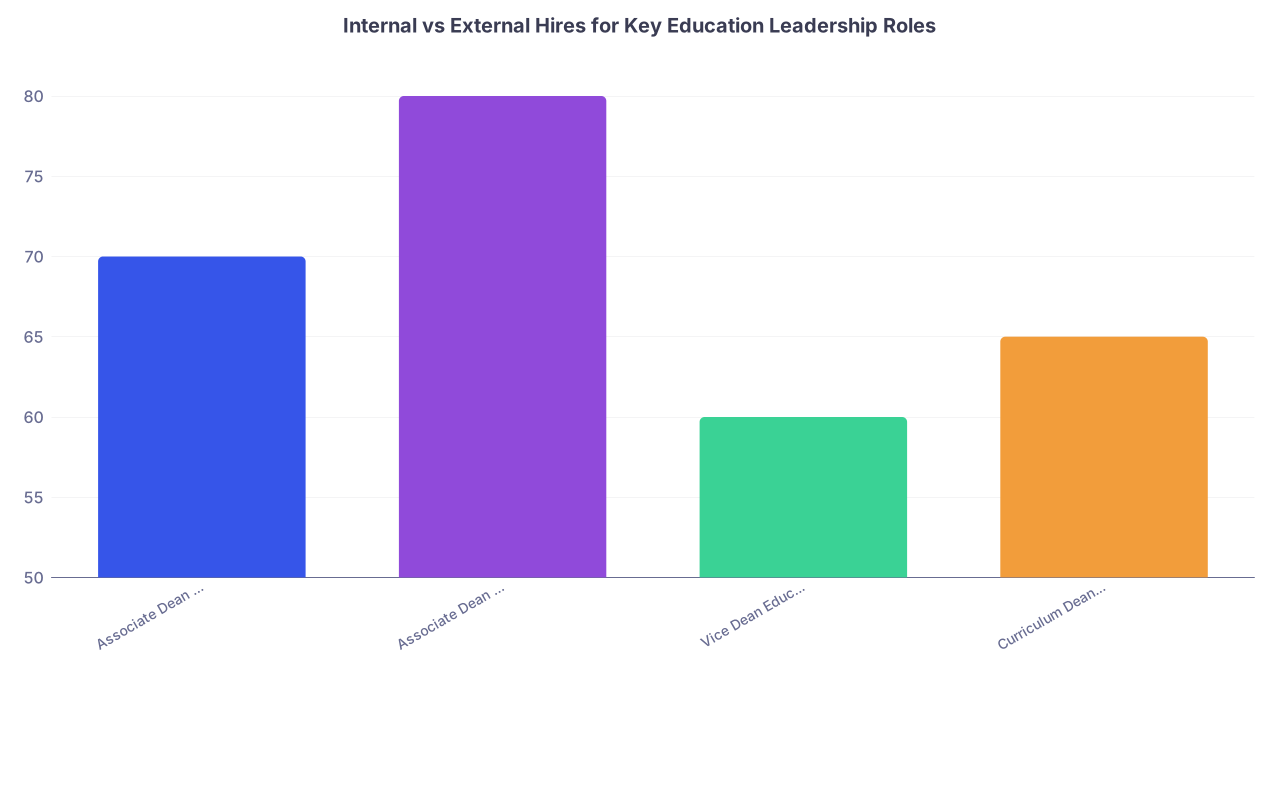
| Category | Value |
|---|---|
| Associate Dean UME | 70 |
| Associate Dean Student Affairs | 80 |
| Vice Dean Education | 60 |
| Curriculum Dean-equivalent | 65 |
(Those percentages are ballpark internal-hire estimates from what I’ve seen and heard across multiple schools. The bias is real.)

The Parts Nobody Says Out Loud
Let’s not pretend bias doesn’t exist.
- Gender and race: Many schools are trying to diversify leadership. That’s real. It can either help you (if you bring underrepresented perspective plus strong credentials) or hurt you (if you’re seen as “yet another” of the overrepresented group in power).
- Age and “gravitas”: Some committees hesitate to pick someone they perceive as “too young” for a dean-level role, regardless of competence. They worry about optics with external stakeholders.
- Personality fit: “Culture fit” is often code for “we feel comfortable with this person because they’re like us.” This can be a door or a wall, depending on who you are.
You cannot fully control any of this. But you can control your value proposition. If your expertise, reliability, and network become undeniable, bias has less room to operate.
FAQ: Inside the Dean’s Office – How Leaders Are Chosen
1. Do I need a formal degree in education (MEd, MHPE, etc.) to become an associate dean?
No. It helps, but it’s not the gatekeeper. I’ve seen deans with no formal education degree but heavy real-world leadership experience and national roles. What matters is that you show credible expertise in education systems—through program-building, scholarship, or national involvement. A degree is proof; not the only proof.
2. Are student teaching awards actually useful for leadership careers?
They’re helpful but overrated. Teaching awards make your narrative cleaner—“excellent educator rises into leadership”—and they play well in public announcements. But when leaders sit down to choose you, they care much more about: Have you run something complex? Have you worked across departments? Can you handle politics and accreditation? Awards alone won’t do that.
3. How early in my career should I start aiming for these roles?
Earlier than you think—but quietly. In your first 3–5 years, do not campaign for titles. Campaign for responsibility: course co-director, assessment projects, LCME committees, student affairs initiatives. People remember who stepped up when there was work, not who said “I want to be dean one day.”
4. What’s the single biggest mistake aspiring educational leaders make?
They confuse visibility with power. They chase panels, talks, and Twitter followers, but avoid the unglamorous, heavy-lift work (assessment overhaul, LCME prep, remediation systems) that actually convinces deans you can run operations. Titles follow from solving hard problems quietly and well, not from constant self-promotion.
5. If I’m at a smaller or “no-name” school, do I have any real shot at big leadership roles?
Yes, but you’ll need external validators. National committee work, presentations at major conferences, multi-institutional projects, and collaborations with better-known schools. Deans hiring from outside care less about your school’s brand than: Did you build or fix something real? Can you handle our scale and politics? If you can show that, where you started matters less than you think.
Remember three things.
First, educational leaders are chosen for reliability and political safety more than pure teaching brilliance. Act accordingly.
Second, the real decisions start in small private conversations long before any search is announced. Your daily behavior around committees, conflict, and follow-through is your audition.
Third, if you want that dean’s office key one day, stop thinking only like a teacher. Start thinking like the person who has to keep the entire system standing when everyone else is complaining about it.