
It’s late spring. You’re sitting in the auditorium at your med school’s “Education Awards Ceremony,” politely clapping while people whose names you barely recognize walk across the stage. The same three faculty seem to win every single year. The legendary teacher students adore? Not even mentioned. The resident who actually teaches on nights? Nothing.
You start wondering: What is this actually measuring? Because it’s sure not who taught you the most.
Let me tell you what’s really going on behind those plaques and smiling photos. Teaching awards in medical schools are not purely about “best teacher.” They’re about visibility, politics, narrative, and who knows how to work the system.
Most students and junior faculty never get this explained to them. They just see the public list of criteria and assume that’s what matters. It’s not.
I’ll walk you through how it really works, how selections are quietly shaped, and what people on committees say when the doors close.
The Real Power Behind Teaching Awards: Who Controls the Process
Start with this: the outcome is mostly determined before any votes are cast, because the structure of the award already stacks the deck.
There are a few common models. Each has its own built-in politics.
| Award Model | Main Voters | Who Has Power |
|---|---|---|
| Student-voted only | Med students | Class leaders, OME |
| Faculty committee | Senior faculty | Chairs, PDs |
| Mixed (students + fac) | Both | Deans, committee |
| Admin-nominated | Deans, OME staff | Leadership only |
In real life, teaching awards are usually controlled by one of three groups:
Office of Medical Education / Dean’s office
They’re thinking optics, accreditation, and “balanced representation across departments.” Translation: they want winners that make the school look good on paper and in brochures.Department leadership (chairs, vice-chairs, program directors)
They care about which names they want associated with their department, who needs a bump for promotion, and which “good soldiers” deserve a public pat on the head.Student leaders / class officers / curriculum reps
They do know who teaches, but they’re also influenced heavily by visibility, charisma, and end-of-block evaluation patterns.
You’ll see “criteria” like “excellence in teaching,” “innovation,” “commitment to learners.” That’s window dressing. What actually drives it is more pragmatic:
- Who is promotable and needs “teaching excellence” on their CV
- Whose name is “safe” politically
- Who has not won in a while (spreading the love between departments)
- Who is visible to decision-makers (not necessarily visible to students)
I’ve sat in rooms where someone says, about an award technically based on student evaluations:
“Look, Dr. X has the highest scores, but Dr. Y is up for promotion this year and has done a lot for the clerkship. Maybe it’s Y’s year.”
Nobody writes that in the policy document. But that is how the decision is actually made.
Why The Same People Win Over and Over
You’ve noticed this. There’s always a “usual suspects” list.
Multiple reasons.
1. Visibility beats effort
The person who gives the big high-yield exam review with 200 students in the auditorium has a structural advantage over the quiet, excellent preceptor with 4 students in clinic each month.
Committees see this:
- Big lectures
- Course director roles
- Committee work
- “Innovation” projects
They don’t see:
- Meticulous feedback on SOAP notes at 10 p.m.
- The resident who re-teaches EKGs one-on-one after a rough shift
- The attending who lets students do real procedures and debriefs afterward
So the high-visibility person gets nominated more. Nominations turn into a narrative. “Oh yes, she’s always on the list, she’s a strong teacher.” That narrative cements.
I’ve watched people pull up award history and say, “Well, she’s clearly a standout, look how often she’s nominated,” without ever having seen her actually teach.
2. Longevity and inertia
Once someone’s name is associated with “great teacher,” it sticks. Senior faculty who were excellent 15 years ago may get awards for work they did a decade ago. Their teaching now? Often coasting.
Meanwhile, a younger faculty member burning themselves out teaching gets, at best, a “rising educator” certificate if the school has one.
Why? Because committees are risk-averse. Giving an award to a legendary senior figure is safe. Giving it to a relatively unknown assistant professor is a political choice. Many chairs don’t have the backbone for that.
3. End-of-course evaluations are a blunt instrument
Those Likert scales? They’re noisy, biased, and gamed.
Students remember:
- Was the exam fair?
- Did they post slides on time?
- Were they nice?
They don’t necessarily separate those from “quality of teaching.”
Faculty learn the game. “I bring snacks to sessions,” or “I send a ‘good luck on the exam’ email with a few hints.” Scores magically rise. The person who pushes students hard, gives painful but accurate feedback, and doesn’t inflate grades gets punished.
Committees know the evals are imperfect, but they still lean on them. Why? Because they’re numeric. And numbers feel objective, even when they’re garbage.
The Quiet Filters: Who Gets Eliminated Before Voting Starts
People assume awards are “everyone considered, best one wins.” That’s not how it works.
Here’s how people actually get filtered out before real discussion:
The “they’re difficult” dismissal
This is almost verbatim from a committee I sat in:
“Dr. Z has off-the-charts student comments, but she’s… hard to work with. I don’t think we want to elevate that.”
Translation: she pushes for curricular changes, resists nonsense, and doesn’t kiss up to leadership. So despite being an actual top-tier educator, she’s considered “difficult.” That alone is enough to kill her candidacy.
Teaching awards often go to politically easy people, not the best teachers.
The “they’re not one of us” problem
If a big award is decided primarily by basic science faculty, they’ll tilt toward someone they know from their world. Same for clinical departments.
Community preceptors almost never win major school-wide awards, even if they’re the best teachers students have, because they’re not in the academic building, not on key committees, not at faculty meetings.
Students rave about Dr. Community Internist. Committees say, “Who is that again?” And move on.
The “they already have one” rationale
I’ve literally watched someone get pushed down the list because: “They’ve already gotten two awards; let’s spread it around.” This isn’t about who’s truly the best teacher; it’s about distribution politics.
That’s how award logic works internally:
- Career stage balancing
- Department balancing
- “It’s someone else’s turn” balancing
Now imagine you’re early-career and just coming into your prime as an educator. But the narrative says “you already had your turn” because you won something as a chief resident five years ago. You’re done for a while.
What Committees Actually Discuss When Doors Close
Let me walk you into a real selection meeting. Close the glass conference room door. Laptop open with a spreadsheet of nominees, evaluation scores, a column of “previous awards,” and a list of “institutional priorities” for the year.
Here’s the conversation style you never see written down:
- “We need someone from surgery this year; it’s been all medicine and pediatrics lately.”
- “Is he on the promotion list for associate? Might be useful to bolster his dossier.”
- “She is phenomenal with residents but doesn’t do much with med students; this award is technically for undergraduate teaching…”
- “He’s a fantastic teacher but politically kind of radioactive right now given the recent complaints.”
- “We need at least one basic scientist; otherwise they’ll complain this is a ‘clinical popularity contest.’”
The official criteria might say:
- Excellence in teaching effectiveness
- Commitment to learners
- Educational innovation
The operative criteria are more like:
- Acceptable political alignment
- Visibility to decision-makers
- Distribution across departments and ranks
- Fit with leadership’s current story about the school
Nobody will admit that publicly. But it drives half the final slate.
How Students Get Used As a Shield
You’ll often hear, “These are student-selected awards.” That phrase is doing a lot of work.
There are two ways this usually goes:
Students truly vote freely, but names on the ballot are pre-filtered.
So yes, students picked the winner—from a list curated by OME or faculty leadership. The amazing adjunct who’s not “on the radar” never even appears.Students nominate freely, then a faculty/administrative committee “interprets” the votes.
“We’ve got 12 nominees with similar student support; let’s use secondary criteria.” Those “secondary criteria” are where the politics creep in.
I’ve seen cases where:
- A controversial but beloved teacher had the most nominations.
- The committee quietly removed them “due to ongoing investigation.”
- The award then went to a safe, mid-tier teacher with solid evals and no known problems.
From the outside, it looked like “student choice.” Inside, students’ votes were used as cover for a politically easier decision.
Who Never Wins: The Invisible Workhorses
There’s a group that almost never gets big formal awards: the people doing gritty, unglamorous, high-effort teaching that doesn’t photograph well.
You know them:
- The nocturnist hospitalist who precepts students at 2 a.m. and actually takes time to teach between codes
- The resident who rewrites all the teaching handouts for their service and posts them to a class Dropbox
- The attending who quietly runs remediation sessions from their own time for struggling students
Why don’t they win?
Because award systems privilege:
- Big visible contributions over continuous small ones
- Things you can put in a brochure over things that happen at 11:30 p.m. in the workroom
- Faculty titles over resident or adjunct roles (unless there’s a separate “resident teacher” award ghettoized just for them)
There’s also the ugly truth: residents and junior faculty do a huge fraction of the actual bedside teaching, but the recognition and career points go to the senior people whose names appear as “course director” or “clerkship director.” I’ve seen attendings get teaching awards where their actual teaching was minimal but their residents were phenomenal.
If You’re a Student: How to Actually Honor the Good Teachers
You can’t fix the politics, but you can do more than just fill a bubble on an eval.
Here’s what actually helps the good teachers in ways that matter:
Write specific, concrete comments in evaluations.
Not “Great teacher.” Instead: “Dr. A spent 20 minutes after every shift going over my assessments and plans, gave me actionable feedback, and let me present on rounds. Best teaching I had all year.” Those comments get pulled into promotion reviews and award packets.Email the clerkship director and explicitly name great teachers.
A short, direct note: “Of everyone I worked with, Dr. B was the most effective teacher I had this year because…” That gets remembered.Write letters for teaching portfolios.
When a faculty member or resident asks if you’d be willing to write something for their teaching evaluations or portfolio—do it, and be specific. This is currency for them.Nominate people even if they’re long-shots.
Yes, the system is stacked. But a critical mass of student nominations for the same under-recognized person sometimes does break through, especially if leadership is looking for a positive story.
If You’re Faculty or a Resident: How People Actually Get These Awards
I’m going to be brutally clear. Being the best teacher is not enough. It’s necessary, not sufficient.
The people who consistently win teaching awards in medical schools tend to do three things:
They teach well in visible settings.
They don’t hide all their best teaching on a night float shift with one student. They take lecture slots, lead workshops, run M&M with a strong educational focus, and get on the schedule where large numbers of learners see them.They attach their teaching to formal roles.
Course director. Site director. Simulation lead. Bootcamp organizer. These titles put you on the radar. Committees feel more comfortable rewarding someone whose name is already attached to a role.They document everything. Relentlessly.
They keep:- Quantitative eval summaries showing they’re above mean
- Selected student comments
- Evidence of curriculum development or innovation
- Presentations at education conferences
Then, when nominations open, their chair or mentor has an easy, polished packet ready to submit. The person who says, “Oh, I didn’t realize I needed to save those” loses.
The quiet hero who says, “I don’t care about awards, I just care about teaching” usually gets exactly that: the teaching, without the recognition or promotion boost.
You don’t have to sell your soul. But you do have to be strategic if you want your work to count in the system that exists.
Why This Matters More Than Just Hurt Feelings
It’s tempting to shrug and say, “Awards are political, whatever.” But this affects careers.
Teaching awards feed directly into:
- Promotion to associate and full professor on “educator” tracks
- Leadership roles in curriculum and clerkships
- National recognition and invitations to speak
- Salary negotiations in some departments
So when the award system systematically overlooks people who do high-quality, student-centered, labor-intensive teaching, you’re not just bruising egos. You’re shaping:
- Who gets to lead curriculum change
- Whose educational philosophy gets institutional power
- Which models of teaching are rewarded and thus replicated
If only safe, politically aligned, high-visibility teachers get elevated, you end up with a very particular type of educational culture. Often shallow, sometimes performative, rarely transformative.
The students lose too. The people who actually changed how they think and practice medicine might burn out faster because the system barely acknowledges them.
Behind-Closed-Doors Translation Guide
Next time you hear certain phrases, here’s what they probably mean.

“We want to ensure broad representation across departments.”
→ Someone from a low-visibility department is going to get the award this year, regardless of pure merit.“We value both teaching and educational leadership.”
→ Course directors and people with titles are more likely to win than phenomenal frontline teachers without titles.“We considered multiple sources of evidence beyond student evals.”
→ We overruled student sentiment because we had political or strategic reasons.“We are pleased to recognize Dr. X for a long-standing commitment to education.”
→ They’ve been around forever, are well-liked by leadership, and it was time to reward loyalty.
Knowing the translation helps you keep your sanity.
A Quick Reality Check
Are there places where the best teachers genuinely win and politics barely intrude? Yes. Some smaller schools, some departments with excellent educational leadership, some student-run awards where faculty keep their hands off.
But those are the exception, not the default.
Most of the time, you’re seeing a blend:
- 60–70%: legitimately strong educator
- 30–40%: visibility, politics, distribution, narrative-fit
That’s the real recipe.
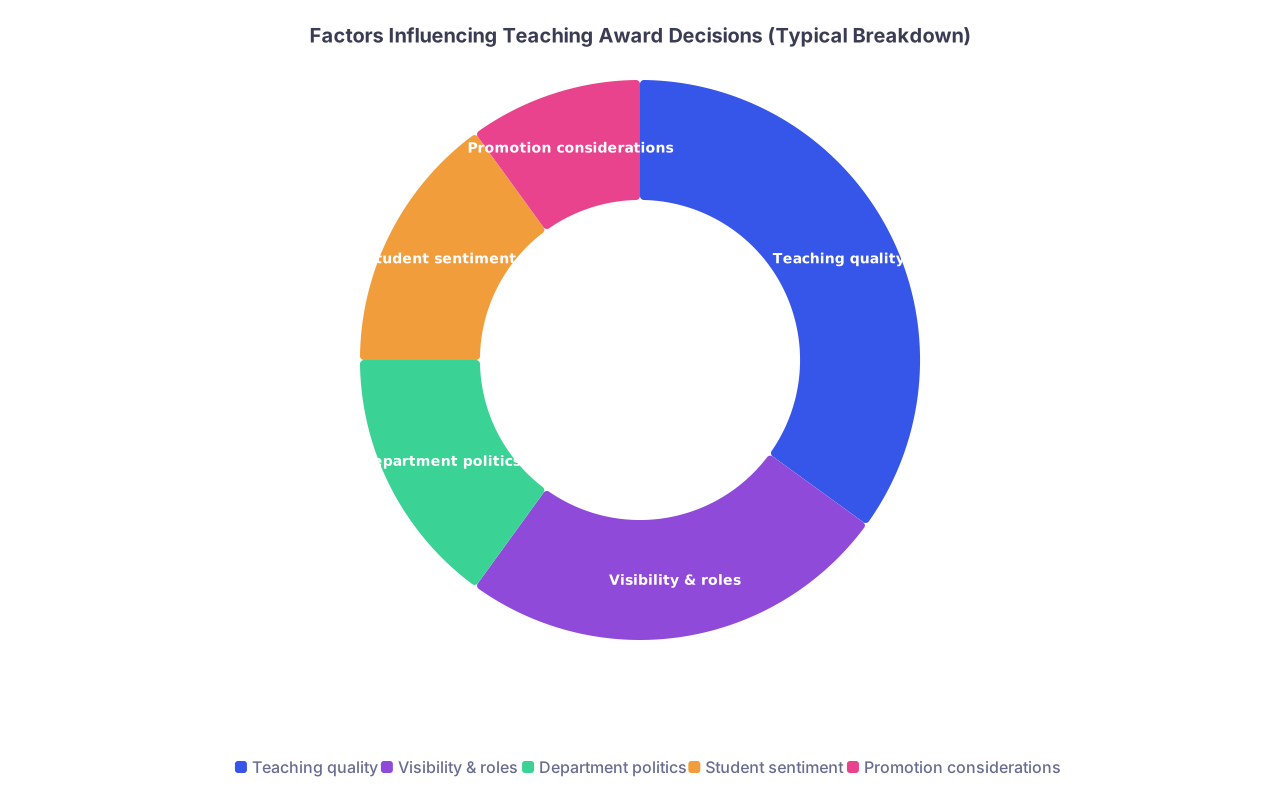
| Category | Value |
|---|---|
| Teaching quality | 35 |
| Visibility & roles | 25 |
| Department politics | 15 |
| Student sentiment | 15 |
| Promotion considerations | 10 |
Is this exact percentage real? No. But this is the shape of how it works across most places I’ve seen. Teaching quality matters. It’s just not the only thing, and not always the dominant thing.