
The fastest way to stall a promising educator career in medicine is not poor teaching. It is saying “yes” to the wrong committee service.
You are not getting promoted because you are “too busy.” You are “too busy” because you are on the wrong committees.
Let me be blunt: committee service is one of the most abused, misunderstood, and career-derailing parts of academic medicine. The culture quietly rewards you for saying yes in the short term—people call you “a team player,” “reliable,” “such a help.” The promotion and tenure committee does not care about any of that. They care about impact, leadership, and scholarship. Not the number of standing committees you warmed a chair on.
This is where educators get trapped.
Trap #1: Mistaking Committee Volume for Career Value
The most common mistake I see early and mid‑career educators make is equating “more committees” with “more visibility” and “more opportunities.”
Wrong metric.
Most service committees fall into one of three categories:
- Necessary but invisible maintenance work
- Politically important but low-yield time sink
- Strategic platform for leadership and scholarship
The trap is that on the front end, they all feel the same: calendar invites, recurring meetings, tasks in between. But the return-on-investment is wildly different.
You are especially vulnerable if you are:
- Junior faculty trying to be “helpful”
- A strong educator with less research protection
- In a non-tenure or educator track where people assume you have “more time”
- From an underrepresented group being asked to “represent” over and over
The red flag: your calendar is packed with meetings, but your CV shows no first-author publications, no clear leadership roles, and no defined educational innovations tied to your name.
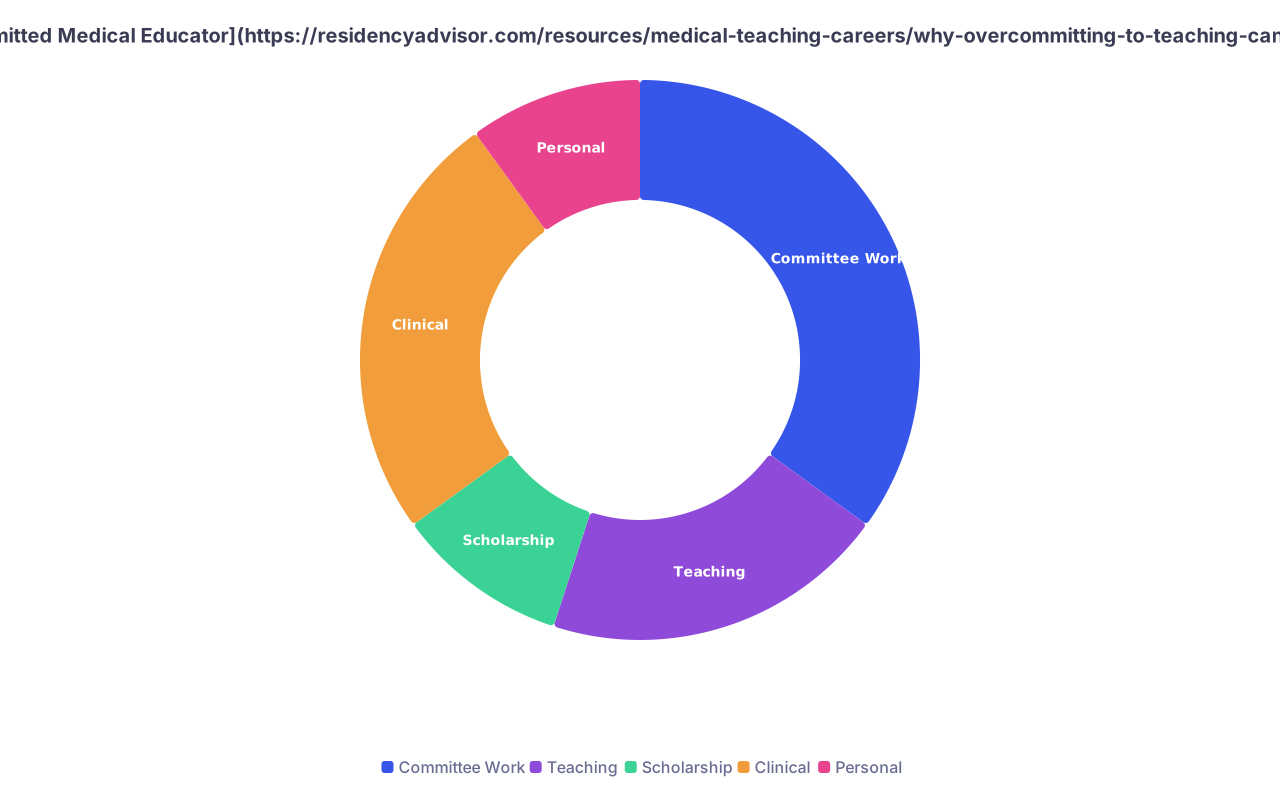
| Category | Value |
|---|---|
| Committee Work | 35 |
| Teaching | 20 |
| Scholarship | 10 |
| Clinical | 25 |
| Personal | 10 |
If this looks even remotely like your week, you are in trouble. Committee work is eating the exact time you need for promotion-critical activities: scholarship and high-impact educational leadership.
Do not assume “service” is automatically valued. Promotion criteria documents love broad phrases like “evidence of service to the institution.” That single bullet does not mean “join everything anyone emails you about.” It usually means “1–3 high-impact roles that actually matter.”
Trap #2: Saying Yes Without a Career Filter
The worst word in early academic life is “sure.”
“Can you serve on the new professionalism task force?”
“Can you join our LCME self-study subcommittee?”
“We need someone from the clerkship faculty on this wellness group; you’d be perfect.”
You say yes because:
- It feels collegial
- You are flattered
- You fear saying no will hurt you
- You have no clear career filter, so everything feels equally important
This is how you wake up in two years with eight committees and no promotion file.
You need a brutal filter. Something like this:
| Question | If the answer is NO… |
|---|---|
| Does this align with my 3–5 year career focus? | Strong reason to decline |
| Will this role be *named* on my CV (chair, co-chair, lead)? | Think twice |
| Is there a realistic chance for scholarship (papers, presentations)? | Lower priority |
| Will someone influential see my best work here? | Consider opportunity cost |
| Does my mentor agree this helps my promotion? | Serious red flag |
If you cannot say yes to at least two of these, you should almost always decline. Exception: truly required service (e.g., mandated departmental duties) that you cannot reasonably refuse.
The subtle trap: “short-term” committees that never end. Working groups that quietly become standing committees. Task forces that keep “needing follow-up.” If a committee has no defined end date or deliverable, it is a service black hole.
Before you accept, you should be able to answer:
- What is the specific deliverable?
- What is the timeline?
- What is my role in that deliverable?
- Who will know if I do this well?
If the answer to any of those is “not really clear,” you are about to make a mistake.
Trap #3: The “Good Citizen” Guilt Trip
Academic medicine is very good at weaponizing your conscience.
Phrases you should treat as alarms:
- “We really need someone like you.”
- “You’re so good with students; they trust you.”
- “We want more representation, and you’re the only one.”
- “You’re not as clinically busy as X; maybe you have a bit more flexibility?”
If your internal monologue is “I feel bad saying no,” you are about to sacrifice your actual career for someone else’s convenience.
I have seen this especially crush:
- Women educators
- Educators from minoritized backgrounds
- Clinician-educators with partial FTE protected for “education” (which people then interpret as infinite service)
The trap is that you conflate moral obligation with institutional obligation. You are not obligated to destroy your career trajectory to fix every culture problem your institution has created over decades.
Here is the harsh truth: saying yes out of guilt does not make you a good citizen. It makes you an easy target.
You protect yourself by:
- Having a written workload plan (teaching, scholarship, clinical, service)
- Making that plan visible to your chair or division chief
- Explicitly tying any new service ask to that plan and your promotion path
And then saying something like:
“I am committed to my educator portfolio and promotion timeline. To take this on, I would need to drop X, or have protected time formally added. Can we discuss that with the chair?”
If the answer is “no time, but we really hope you’ll help anyway,” the correct answer is no.
Trap #4: Invisible, Low-Impact Committees That Eat Your Prime Hours
Some committees are toxic not because they are hostile, but because they are pointless.
Common offenders:
- Standing “morale” or “wellness” committees with no authority
- Repeated “curriculum review” groups that never actually change the curriculum
- Ad hoc working groups with no budget and vague goals (“improve learning climate”)
- Large sprawling committees where 20 people spend an hour “checking in”
Signs you are in a low-impact trap:
- No agenda, ever
- No minutes that lead to actual decisions
- Recurring meetings rescheduled endlessly because “we need everyone present”
- You cannot clearly state the committee’s achievements from the last year… because there are none

The cost is not just time; it is when the time is.
When committee work eats your best cognitive hours—mid-morning, early afternoon—your scholarship, curriculum design, and deep work get pushed to evenings and weekends. That is how burnout sneaks in while you convince yourself you are “just being dedicated.”
You should ruthlessly protect:
- One or two mornings per week for protected deep work (writing, design, research)
- Blocks of time before clinic or teaching that you do not sacrifice for “just one more meeting”
If someone tries to schedule a standing committee into those blocks, your default answer should be no unless it is explicitly mission-critical for you.
Trap #5: Confusing Visibility With Sponsorship
Many educators join committees because they are told it will give them “exposure.” As if sitting in a room with senior people is somehow equivalent to having those people advocate for you.
Exposure is overrated. Sponsorship is what gets you promoted.
A sponsor:
- Knows your work well
- Has power in the system
- Uses that power to put your name forward for roles, awards, and opportunities
Most committee membership does not create that. It creates the illusion of being “known”: “Oh yes, she’s always on the assessment committee.”
Translation: “She is always available to do work that does not move her forward.”
The smarter move is to join fewer committees where:
- Your work product is visible (you lead a subproject, author a report, design a new process)
- Your name is on something concrete (policy change, new OSCE format, new curriculum module)
- At least one senior person who matters for your promotion sees you produce high-quality, on-time deliverables
Ask yourself about every committee:
“Does this environment let me show my best educator skills to someone who can change my career?”
If the honest answer is no, your visibility is cosmetic.
Trap #6: Committee Work With No Path to Scholarship
This one damages educator careers more than almost anything else.
You spend hundreds of hours on:
- Assessment redesign workgroups
- OSCE overhaul committees
- Clerkship evaluation task forces
- Remediation and professionalism review processes
- Competency committee redesigns for residency
The project finishes. The new system launches. Feedback is positive.
And there is no abstract. No paper. No MedEdPortal submission. No webinar. No national presentation. Just “service.”
You did not just miss an opportunity; you gave away a year of momentum.
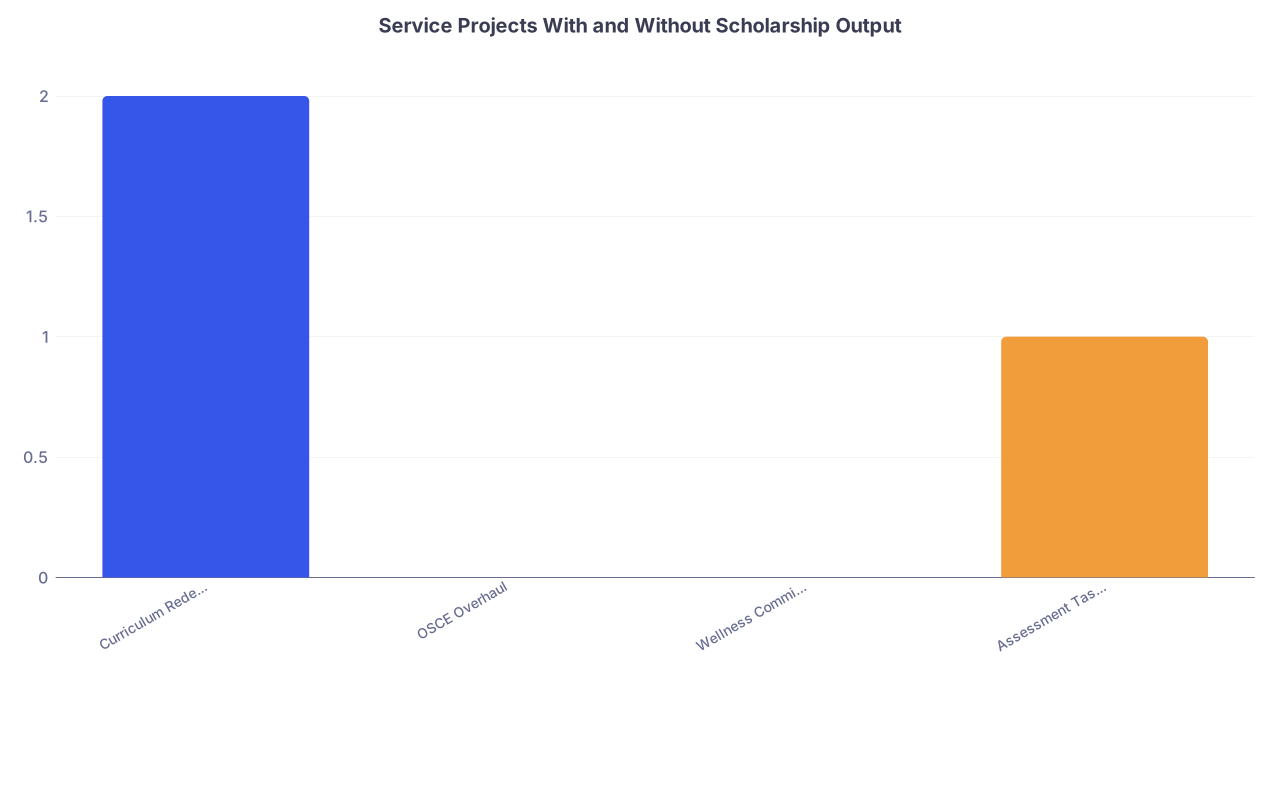
| Category | Value |
|---|---|
| Curriculum Redesign | 2 |
| OSCE Overhaul | 0 |
| Wellness Committee | 0 |
| Assessment Task Force | 1 |
This is the pattern on many educator CVs: years of real work, almost no scholarly output.
That is not because there was nothing scholarly there. It is because no one at the table insisted early: “What is the scholarly plan?”
You avoid this trap by treating any major committee project like a potential study from day one:
- Define clear questions: What are we changing and why?
- Define outcomes: What will we measure? How? When?
- Identify IRB needs early
- Keep structured documentation: process, interventions, results
- Decide who will be first author and what products will come out (poster, paper, MedEdPortal, toolkit, etc.)
And here is the test for whether you should join a big committee project:
“If this work never turns into at least one scholarly product with my name on it, will it still be worth my time?”
If not, decline or renegotiate your role.
Trap #7: Service Load Mismatch With Promotion Criteria
The institutional lie is that “all service is valued.” The reality is that promotion committees care far more about specific kinds of service than others.
In medical education careers, high-yield service often looks like:
- Leading a major curriculum initiative with clear outcomes
- Chairing a key committee (e.g., curriculum, assessment, promotions)
- Holding leadership roles in national organizations (AAMC, clerkship director groups, specialty academies)
- Task forces that directly influence accreditation (LCME, ACGME) with visible outcomes
Low-yield service looks like:
- Being one of many members on several local committees with no leadership role
- Event planning groups, morale committees, generic wellness working groups
- “Volunteer” service disconnected from your educator expertise

| Step | Description |
|---|---|
| Step 1 | Service Opportunity |
| Step 2 | Low priority or decline |
| Step 3 | Negotiate role |
| Step 4 | High value service |
| Step 5 | Aligns with educator focus? |
| Step 6 | Leadership or scholarship role? |
| Step 7 | Can role be adjusted? |
I have sat in meetings where promotion committees skim through 15 lines of “committee member, committee member, committee member…” and barely comment. Then they pause at “Chair, Undergraduate Medical Education Curriculum Committee” and ask, “What did they actually do with this?” That is where it counts.
So the trap is not “doing too much service.” It is doing too much of the wrong service while lacking the few high-impact roles that promotion committees actually notice.
Before you agree to anything, find your institution’s official promotion guidelines. Look for exact words: “leadership,” “innovation,” “impact,” “national reputation.” Then ask: “Does this committee get me closer to any of these words?”
If the answer is no, that service is optional—no matter how urgent it sounds in the email.
Trap #8: Never Exiting Bad Committees
Saying yes once does not obligate you forever.
Yet many educators stay on the same low-yield committees year after year because:
- “They count on me.”
- “I do not want to burn bridges.”
- “It is easier to stay than to explain leaving.”
This is how people wake up 7 years in with the same forgettable line on their CV and no meaningful advancement.
You must learn how to exit strategically.
You can do this without drama:
- Time-limit from the beginning: “I can serve for 1 year, then I will need to reassess based on my educator responsibilities.”
- Use natural cycles: academic year ends, accreditation cycle completed, report delivered.
- Plan your replacement: “I would be happy to recommend X, who is interested in assessment and could bring fresh energy.”
Reasonable exit scripts you can use:
“I am focusing my efforts this year on an educational scholarship project and a major curriculum role; I need to step off this committee at the end of the term to stay aligned with my promotion plan.”
“Serving on this group has been helpful, but my role has become less central, and I want to make room for someone who can commit more time. I will complete current tasks and rotate off after this cycle.”
If a leader reacts with anger when you set reasonable limits, that tells you everything about how they value people’s careers. That is not someone you owe indefinite “yes” answers to.
Trap #9: Letting Committee Work Replace Real Mentoring
Another quiet problem: using committee work as a substitute for mentorship.
Some educators convince themselves: “If I sit on the curriculum committee with the vice dean, that is like being mentored.” It is not.
Sitting in the same room is not mentorship. Completing their to-do list is not mentorship. You need people who will:
- Help you map a specific educator career path
- Read and critique your teaching portfolio, CV, promotion packet
- Connect you with national opportunities that match your focus
- Help you decide which committees are actually worth your time
If you do not have that, you will say yes to random service because you have no clear educated career plan, only vague “be more involved” energy.
Your mentor’s job includes service triage. A mentor who constantly encourages you to say yes to every ask is not protecting your career. That is a red flag.
Trap #10: Confusing “Educational Service” With “Educational Leadership”
Finally, the big conceptual mistake: assuming that doing a lot of service in educational spaces automatically makes you an “educational leader.”
Educational leadership is not about the number of meetings you attend. It is about your ownership of something that matters.
For example:
- Directing a course or clerkship with documented improvements
- Leading a remediation or coaching program that changes outcomes
- Designing and implementing a new assessment framework with published data
- Chairing a curriculum committee that successfully implements major reform
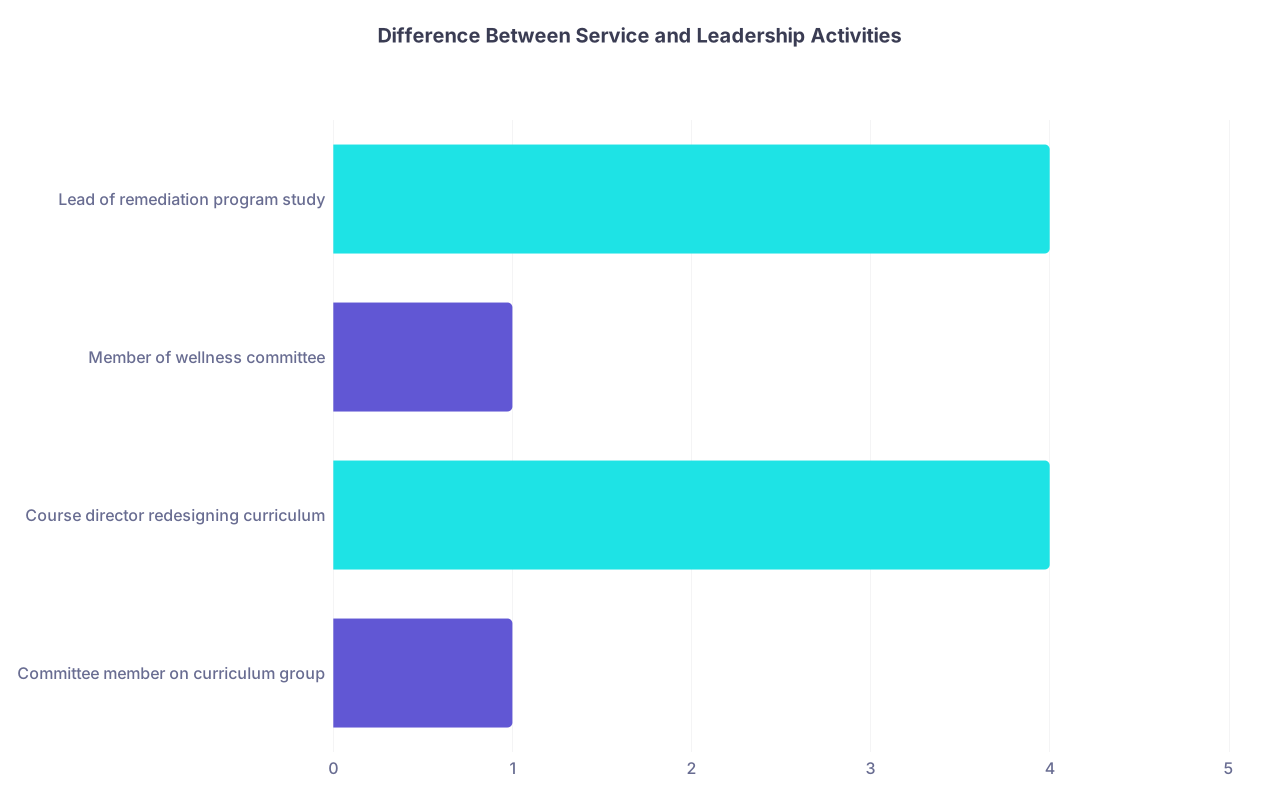
| Category | Value |
|---|---|
| Committee member on curriculum group | 1 |
| Course director redesigning curriculum | 4 |
| Member of wellness committee | 1 |
| Lead of remediation program study | 4 |
On a rough 1–5 “career impact” scale, endless membership roles sit at 1–2. True leadership and scholarship roles are 4–5.
So the trap is staying at level 1–2 work out of habit, fear, or misplaced loyalty, instead of pushing for 4–5 work that actually builds your educator identity.
You do not get educational leadership status by accumulating generic service. You get there by intentionally choosing fewer, bigger, higher-impact responsibilities and letting your other “nice” committees fade away.

Here is what I want you to do today, not someday:
- Open your CV and make a list of every committee and working group you are on.
- Next to each one, write: “High impact,” “Medium impact,” or “Low impact” based on leadership, scholarship potential, and alignment with your educator path.
- Choose one low-impact committee you will actively plan to leave at the next natural transition point—and draft the email you will send to step off.
Do that once. Then do it again in six months.
This is how you stop letting committee service quietly devour your educator career.