
If your evaluations are lazy, vague, or unfair, residents will stop respecting you long before you notice. And once you lose that respect, your teaching influence evaporates.
I have watched brilliant clinicians turn into background noise on a rotation because of how they evaluate. Not their knowledge. Not their bedside manner. Their evaluations.
You want to avoid that fate.
Below are the evaluation mistakes that quietly destroy your credibility as a clinical educator—and how to stop making them before your residents write you off.
Mistake 1: Treating Evaluations as a Box-Checking Chore
The fastest way to lose resident respect is to show them you do not care about their evaluation beyond clearing your inbox.
They notice when you:
- Submit every evaluation the same day with identical comments
- Use the same phrase for everyone: “Pleasure to work with, keep reading”
- Give only “meets expectations” no matter who they are
That tells them one thing: “My growth is not worth your time.”
In modern programs, residents talk. A lot. In WhatsApp groups. In late-night call-room debriefs. I have heard variations of this more times than I can count:
“Do not bother working hard for Dr. X. You will get ‘meets expectations, good job’ no matter what.”
Once that sentence about you circulates, you are done as an evaluator. They will still be polite to your face. They will still present cases. But they will stop investing in your feedback, because your written evaluation proved it is meaningless.
How to avoid it:
Commit, in writing to yourself, that you will never submit an evaluation without:
- At least one specific behavior
- At least one forward-looking suggestion
Example of what not to do:
“Great resident, pleasure to work with.”
Respect-building version:
“Consistently structured presentations logically and anticipated questions on rounds. Next step: practice leading family meetings independently; you are ready for that responsibility.”
One sentence each is enough. Vague praise is not.
Mistake 2: Confusing “I Like You” With “You Performed Well”
Residents lose trust in you when they see “personality grading.”
Common pattern:
- The charming, extroverted resident who laughs at your jokes gets “outstanding” across the board
- The quiet, anxious but competent resident gets “meets expectations, needs to speak up more” as a generic criticism
- The resident who pushed back once on an order? Evaluations mysteriously drop
They notice. Especially the introverts and the residents from minoritized backgrounds. They are already scanning for bias. When your evaluations track likeability more than performance, they stop believing any of your feedback is real.
The mistake is subtle. You are not consciously punishing or rewarding people. You are just letting “vibe” replace evidence.
Danger signs in your comments:
- “Great attitude” as the main comment every time
- “Needs to be more confident” with no concrete example
- “Seems disinterested” after one off day post-night shift
If you cannot point to a behavior you directly observed, it should not be on the form.
How to avoid it:
Force yourself to anchor comments to observable actions, not impressions.
Bad: “Lacks confidence.”
Better: “During new patient admissions, often waited to be called on rather than volunteering to present or propose a plan. Would benefit from deliberately speaking first for at least one admission per shift.”
When you tie evaluation to behaviors, residents recognize fairness. Even if the grade stings, they feel respected because you are critiquing work, not personality.
Mistake 3: Only Giving Feedback at the Final Evaluation (a.k.a. Professional Ambush)
Blind-siding residents with negative end-of-rotation comments you never mentioned in person is one of the most respect-destroying moves you can make.
You know this scene:
- End of block: you fill out the form
- You list “needs improvement in time management and efficiency”
- Resident sees it in the system
- Resident thinks, correctly: “Why did no one say this to me when I could fix it?”
From their perspective, you set a trap. You watched them struggle and said nothing, then documented it permanently.
I have seen residents crying in a stairwell because an attending wrote “below expectations” on professionalism for “chronic lateness” after never once raising tardiness during the month. That attending lost every shred of credibility on that service.
How to avoid it:
Use a simple rule:
If you would not say it to their face during the rotation, do not write it on the form at the end.
Then build a bare‑minimum feedback structure:
- Early check‑in (first week): “Anything you want to focus on? Here is what I am watching for.”
- Mid-rotation feedback: 5–10 minutes of “What is going well, what to adjust.”
- Brief end‑of‑shift comments: One specific thing they did well; one concrete suggestion.
You do not need elaborate feedback models. Just do not wait until the evaluation is permanent to unveil your concerns.
Mistake 4: Weaponizing “Professionalism” When You Really Mean “You Annoyed Me”
Residents stop respecting you the moment they think you use professionalism as a catch-all punishment box.
Common misuses:
- Calling out a resident’s “professionalism” because they questioned your plan respectfully
- Documenting “unprofessional behavior” for a single late arrival during a month of call without context
- Using professionalism to encode bias: “not a team player,” “too aggressive,” “poor fit” with no specific behaviors
Once residents see “professionalism” as your way to enforce obedience instead of genuine patient-centered standards, any professionalism feedback from you becomes suspect.
That is dangerous. Because actual professionalism lapses (HIPAA violations, unsafe shortcuts, disrespectful language) are serious. But if you mix those with petty grievances, residents will treat all of it as political.
How to avoid it:
If you are tempted to use the professionalism box, test yourself with three questions:
- Can I describe at least two specific, concrete behaviors?
- Did I already discuss this with the resident directly and clearly?
- Would I write the same thing if this were my “favorite” resident?
If you cannot answer yes to all three, do not label it as professionalism on the form. Address the behavior informally first. Or admit that the issue is personality friction, not true professionalism.
Mistake 5: Grade Inflation So Extreme That Nobody Believes You
Residents are not stupid. If everyone gets “outstanding” on every domain from you, they know your evaluation is worthless.
I have heard this exact line in resident rooms:
“If Dr. Y says you are ‘one of the best I have ever worked with,’ it means nothing. They say that every time.”
You may think you are being kind. You are not. You are erasing differentiation and undermining your own praise.
The problem is not high grades per se. Some rotations are stacked with strong residents. The problem is patterns:
- Every rotation: 90–100% rated “far above expectations”
- Everyone gets “top 5% of trainees”
- Narrative comments read like copy-paste: “Exceptional resident, will be an outstanding physician.”
When you finally do give someone truly exceptional feedback, it blends into the noise.
How to avoid it:
Before submitting, check your own distribution.
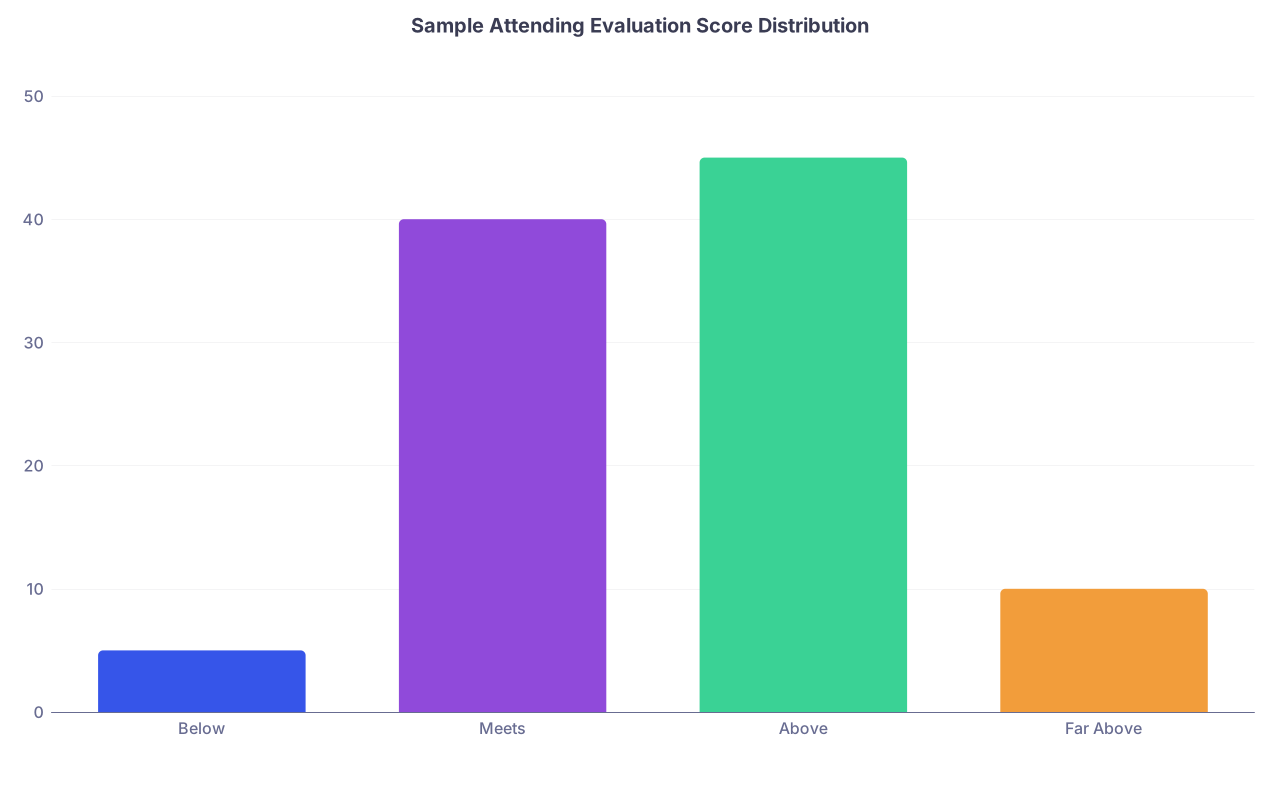
| Category | Value |
|---|---|
| Below | 5 |
| Meets | 40 |
| Above | 45 |
| Far Above | 10 |
If your personal distribution is 0% below, 5% meets, 15% above, 80% far above, you are lying to yourself and your residents.
You do not need to be harsh. You do need to be honest.
Reserve “far above expectations” for behaviors you would:
- Proactively email the program director about
- Remember clearly 1–2 years later
- Use as an example when teaching others what “excellent” looks like
Everyone else who does the job competently? “Meets expectations” or “above expectations” is not an insult. It is reality.
Mistake 6: Ignoring Context and Burnout Signals
Residents respect attendings who live in the real world of duty hours, cross-cover chaos, and emotional fatigue. They lose respect for evaluators who act like every day is an exam in a vacuum.
Classic missteps:
- Rigidly penalizing a resident who was short-tempered after a 27-hour call with nonstop codes
- Writing “seems disengaged” for someone on their 6th consecutive day of cross-cover during a surge
- Expecting identical performance from an intern at week 2 and a senior at month 18, then giving them the same generic comment
You do not have to excuse unsafe behavior. But if you pretend fatigue, workload, and system failures do not affect performance, residents quickly label you as out of touch.
They know which attendings have not done a night shift in a decade. They talk about it.
How to avoid it:
When writing an evaluation, explicitly ask:
- What was the workload on this block? Typical, light, insane?
- Did system issues (EMR crashes, staffing shortages, bed crises) limit what this resident could show me?
- Am I grading them against the right developmental level?
Then phrase your comments with that in mind:
Instead of:
“Frequently flustered during pages while on night float.”
Try:
“On a very high-volume night float block, initially became flustered with cluster paging but by week 2 was using a written task list and prioritizing safely. Next step is to anticipate pages by proactively checking on unstable patients.”
You still give constructive feedback. You also show you see the environment they are working in. That earns respect.
Mistake 7: Making Written Evaluations Totally Inconsistent With Your Verbal Feedback
Nothing kills your credibility faster than saying one thing to a resident’s face and another thing on the form.
This is how you lose them:
- On the rotation: “You are doing great, no concerns.”
- On the evaluation: “Below expectations in clinical reasoning, significant concerns about independent practice.”
Residents will feel betrayed. And they are right.
The reverse is also bad:
- In person: nitpicky, harsh, critical all month
- On the form: “Outstanding, among the best I have worked with.”
That tells them you do not mean what you say in either setting.
How to avoid it:
Align your conversations and your clicks.
At mid-rotation, literally say:
“If I had to fill out your evaluation today, I would mark you as ‘meets expectations’ across the board, with strengths in X and Y, and I would mention that you need to work on Z. Does that match how you feel?”
Then, at the end, do not surprise them.
If your perspective changed, explain why:
“Early in the block I would have said ‘meets expectations.’ You made big strides in the last 2 weeks with independent assessments, so that is why you see ‘above expectations’ now.”
Residents respect evolution. They do not respect whiplash.
Mistake 8: Writing Comments That Could Be About Anybody
If your comments could be copied to ten different residents without changing a word, expect zero respect.
Generic phrases residents see far too often:
- “Pleasure to work with”
- “Will be an excellent physician”
- “Hardworking, intelligent, compassionate”
- “Keep reading”
They skim right past these now. Residents have learned to look for one thing: specificity.
If you cannot remember a single concrete thing a resident did, you probably did not pay enough attention to evaluate them fairly. And they feel that.
How to avoid it:
For each resident, jot down 2–3 specific notes during the block. Not essays. Fragments.
Example:
- “Handled angry family in 7E calmly, de-escalated without me stepping in”
- “Recognized septic shock in 3F patient before vital signs crashed”
- “Stayed late to help cross-cover manage DKA admissions”
Use those in your narrative:
“On our second week, you independently recognized deteriorating status in a patient in 3F and escalated appropriately before vitals crashed. You also took the lead in a tense family meeting on 7E and de-escalated the situation without me intervening. These are the kinds of behaviors that build trust. Next step is to apply that same confidence when supervising interns on busy call nights.”
Now they believe you saw them. That is respect.
Mistake 9: Refusing to Put Concerns in Writing (the “Nice” Saboteur)
This is the opposite error of the ambush. Some attendings will voice concerns all month but then refuse to document anything “negative” because they “do not want to hurt the resident’s chances.”
Residents see through that too.
What happens:
- You say, “I am worried about your time management and follow-through” repeatedly
- Final evaluation: “Meets expectations, hardworking, pleasure to work with”
- Result: They discount your concerns as empty criticism, because there is no record that you actually think it matters
You think you are protecting them. You are not. You are depriving them of the leverage they need when the Clinical Competency Committee or program leadership asks, “Was anyone concerned about this pattern before?”
Residents respect attendings who are courageous enough to tell the truth kindly, on paper.
How to avoid it:
If you have repeated concerns and have given the resident a chance to improve, your evaluation must reflect that reality.
You can still be supportive:
“Across the block, we discussed several times your struggle to close the loop on follow-up tasks (calling consults, following up on critical labs). You made some progress after our mid-rotation conversation, but this remains an area needing further development. I recommend close support in upcoming rotations to build more reliable task tracking systems.”
That is honest. It is fair. And it gives the resident ammunition to ask for help.
Mistake 10: Not Understanding How Your Evaluation Actually Gets Used
Residents lose patience with attendings who clearly do not grasp the stakes of these forms.
Your evaluation is not just a feel-good note. It feeds:
- Clinical Competency Committee decisions
- Promotions and remediation
- Fellowship letters and rankings
- Awards, chief resident selection, and sometimes probation
If you fill out evaluations in 30 seconds between every other click in the EMR, while half-distracted on a phone call, you are telling residents you do not care about any of that. Again: they notice.
Programs often track which faculty chronically submit late, incomplete, or useless evaluations. Residents know those names. They classify them as “does not matter what they think.”
How to avoid it:
Treat evaluations as part of patient safety and trainee development, not clerical sludge.
Block time. Literally.
| Approach | Description |
|---|---|
| Ad hoc, in between | No blocked time, rushed |
| End-of-rotation batch | 30–45 min at block end |
| Weekly protected slot | 15–20 min each Friday |
| Daily micro-review | 5–10 min after sign-out |
Best approach for respect and accuracy? Weekly protected slots or daily micro-review. Your memory is fresher. Your comments are more specific. And residents feel like their progress mattered enough for you to sit down and think.
Mistake 11: Letting Your Biases Hide Behind “Fit” and “Instinct”
You may think you are immune to bias. You are not. Neither am I.
Residents quickly detect patterns like:
- Women consistently told they are “too quiet” or “too aggressive”
- International graduates scored lower on “communication” despite clear language proficiency
- Residents of color more frequently dinged on “professionalism” for the same behaviors others get a pass on
If your gut feeling is your only justification, residents will (rightly) distrust you.
They compare notes. They see who always gets sparkling evaluations and who always gets “needs to work on confidence” regardless of performance.
How to avoid it:
When you feel a strong positive or negative reaction, do this:
- Write down exactly what the resident did that led to that reaction.
- Check whether you have held other residents to the same standard.
- If your comment is about “fit,” force yourself to translate that into behaviors: “Often did X when situation required Y.”
And if you catch yourself writing vague, loaded words—“abrasive,” “immature,” “entitled”—stop. Ask: “If I had to defend this label to a committee, what examples would I give?” If you cannot, delete it.
That level of self-audit is what earns long-term respect.
Mistake 12: Never Asking Residents for Feedback About You
One last credibility killer: acting like evaluation is a one-way street.
If you constantly judge but never invite judgment, residents learn that your ego matters more than their learning. They may still perform for you. They will not respect you.
Residents remember the rare attendings who end a block with:
“I am filling out your evaluation this week. I would also like feedback from you. What should I keep doing? What should I change for the next group?”
And then actually listen. Without arguing every point.
How to avoid it:
Build a simple script into your final day with each resident:
- “I am going to complete your evaluation by [day]. Before that, I want to know: what helped you learn on this rotation?”
- “What is one thing I could do differently that would make this experience better for residents next time?”
You do not need to agree with everything. You do need to show that evaluation is a shared process, not a top-down verdict. That humility is what separates respected educators from just another attending with checkboxes.
Your Next Step Today
Open your institution’s evaluation system and pull up the last five resident evaluations you submitted.
For each one, ask yourself:
- Did I describe at least one concrete behavior?
- Would the resident be surprised by anything I wrote?
- Did I let likeability, fatigue, or bias shape the grade more than performance?
Pick one of those five and rewrite the narrative comment so that it is:
- Specific
- Aligned with what you said in person
- Honest about strengths and next steps
Then, the next time you are on service, tell your team upfront: “I take evaluations seriously. You will get specific, honest feedback from me during the rotation and on your final evaluation.” And make sure your actions prove it.