
Teaching does not kill research careers. Badly structured jobs and fuzzy priorities do. There’s a difference.
The idea that “if you teach, you’ll never be a serious researcher” is one of the most persistent myths I hear from medical students and fellows. It’s whispered in lab corridors, thrown out casually by bitter mid-career faculty, and reinforced by those infamous “protect your time at all costs” rants.
Let me be blunt: the data and the career paths of many successful academic physicians don’t support this myth. What kills research is not teaching; it’s unprotected time, vague expectations, and weak mentors.
You’re not choosing between teaching and research. You’re choosing between:
- Thoughtful, aligned roles where teaching and research feed each other
vs. - Chaotic jobs where you say “yes” to everything and become everyone’s warm body.
Let’s break this down properly.
Where the Myth Comes From (And Why It Sounds So Convincing)
You’ve probably heard some version of:
- “If you become a clinician-educator, you’re done with serious research.”
- “Teaching is a trap. Once they know you’re good at it, you’ll never see your lab again.”
- “Real researchers buy out of teaching. Everyone else gets stuck with it.”
These comments don’t come out of nowhere. They come from:
- People in badly designed jobs (often at lower-resourced institutions) who had no formal protection for research time and got buried in service and teaching.
- Faculty who aren’t actually funded investigators but still speak like they are.
- Trainees who only see a narrow slice of what academic life looks like.
And the big one: a complete failure to distinguish between casual, uncredited teaching and structured, recognized educational roles.
If your “teaching” is just constant ad-hoc ward talks, extra lectures no one logs, and “hey can you cover this session” emails, yes — that will kill your research. The problem isn’t teaching. It’s that you’ve become cheap, untracked labor.
What the Data Actually Shows About Teaching and Research
Let’s talk evidence, not folklore.
A few key patterns show up consistently when you look at studies of academic productivity:
- Protected time and role clarity predict research productivity far more than raw teaching hours.
- Many high-performing researchers teach — heavily — but in structured ways (core courses, well-defined mentorship, program leadership).
- Institutions that value educational scholarship explicitly do not see systematic drops in research productivity among faculty who teach, as long as roles are clear and time is protected.
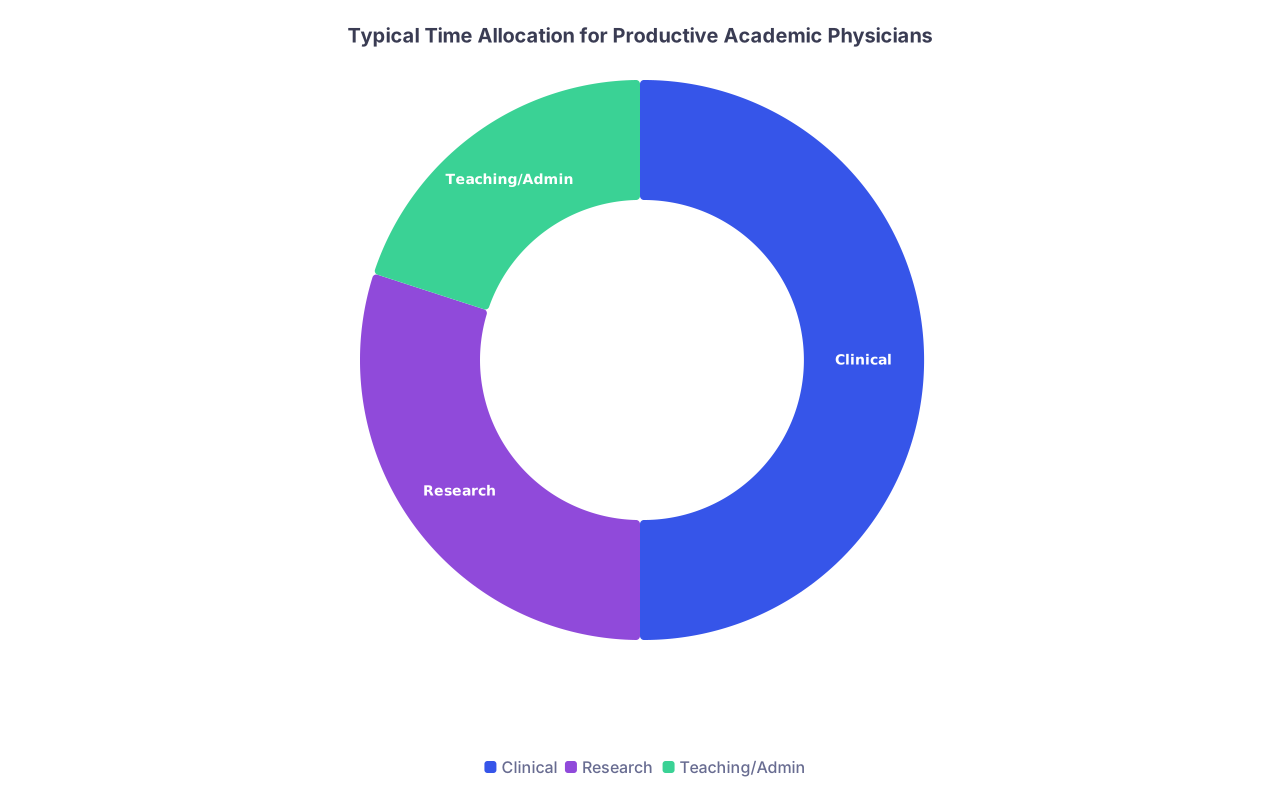
| Category | Value |
|---|---|
| Clinical | 50 |
| Research | 30 |
| Teaching/Admin | 20 |
In multiple surveys of academic physicians at large centers:
- Faculty with 20–25% formal teaching/education roles and clearly defined research time often maintain or exceed average publication output for their rank.
- The big drop in research output appears when clinical load expands, not when formal teaching does.
- High research producers often still spend meaningful time supervising trainees — they just guard their research blocks like a hawk.
The false assumption is: “hours spent teaching = hours stolen from research.”
Reality is messier:
- An hour of random, last-minute teaching often does steal from research.
- An hour of structured, scheduled teaching built into your FTE… often doesn’t. It comes from your education allocation, not your research block.
When you see faculty who “lost their research” to teaching, it’s usually:
- No clear FTE breakdown.
- No explicit expectation for research deliverables.
- No written protection of research time.
- No negotiation skills early on.
That’s not an indictment of teaching. That’s an indictment of how their role was set up.
How Teaching Can Actually Strengthen a Research Career
This part almost never gets mentioned, because the loudest people in the room are usually the ones complaining about their schedules, not the ones quietly running funded labs while directing major courses.
Here’s what well-designed teaching can do for your research life:
1. Teaching is a recruiting funnel for your lab
The best labs I’ve seen do not recruit only from CVs. They recruit from:
- The M2 who asks sharp questions in your course.
- The resident who stays after your board review session to connect a clinical case to a recent NEJM paper.
- The fellow who crushes your journal club because they actually read the methods.
Those people don’t appear in your inbox by magic. They see you teach. They see your intellectual style. They want to work with you.
2. Teaching forces you to master and update your field
If you’ve ever tried explaining propensity score matching or non-inferiority margins to a room of tired residents, you know this: you don’t really understand something until you’ve had to teach it to people who are half-listening between pages.
Good teaching:
- Forces you to stay current with guidelines and landmark trials.
- Sharpens your ability to explain your work to grant reviewers and collaborators.
- Clarifies where the gaps in clinical knowledge really are — which is exactly where good research questions live.
I’ve watched faculty turn a recurring teaching frustration (“No one understands X, we keep guessing”) into:
- A multicenter observational study.
- A grant.
- A QI-to-research pipeline.
- And then an educational intervention paper.
Teaching was the diagnostic tool that exposed the research problem.
3. Educational scholarship is legitimate, fundable research
Here’s the dirty secret: many people who say “teaching kills research” don’t recognize education research as real scholarship.
That’s ignorance.
Look at the track records of people with titles like:
- Vice Chair for Education
- Director of Education Research
- Fellowship Program Director with a funded education portfolio
Many of them:
- Publish in peer-reviewed medical education journals.
- Get foundation, NIH (or CIHR/RCUK equivalents), or internal grant funding.
- Build multi-institutional education collaboratives.
They’re full-time faculty. Their “research” is not basic science or clinical outcomes — it’s educational effectiveness, assessment, curriculum design, simulation, etc.
And no, it’s not easier. Bad medical education research is easy. Good, rigorous, methodologically sound studies are not. Reviewers at journals like Academic Medicine and Medical Education are not impressed by “we gave a lecture and people liked it.”
If you like teaching and care about evidence, educational scholarship is not a consolation prize. It’s just a different research lane.
Where Teaching Does Kill Research (If You Let It)
Now for the part people get right — but for the wrong reasons.
Teaching can absolutely crush your research productivity under certain conditions. I’ve seen it over and over. The pattern is almost comically predictable.

You’re at risk if:
Your job description is vague or verbal.
You sign a contract that says “academic appointment with responsibilities in teaching, research and clinical care” and no actual numbers. Translation: you’re at the mercy of whoever yells the loudest.You say yes to every teaching request early.
New assistant professors are prime targets: “You’re so good with residents!” “We’d love your expertise here.” Volunteering for everything feels collegial, until you’re giving 12 talks a month and writing exams at 11 pm.Your research time is “soft” and easily raided.
Your calendar says “research” but when there’s a hole in inpatient coverage or a missing lecturer, guess whose time gets cannibalized? (Hint: not the surgeon with an OR block.)You don’t track what you do.
If you can’t hand your chair a one-page summary that says “I delivered 40 scheduled teaching hours, supervised 3 theses, served on 2 education committees, and produced X publications,” you’ll lose every argument about FTE.
In short: teaching doesn’t kill research. Being unstrategic and undocumented does.
How High-Performing Physician-Scientists Use Teaching (Real Patterns)
Let’s look at how people with strong research portfolios typically handle teaching. You’ll notice they don’t run from it. They structure it.
| Role Type | % Research FTE | Teaching Pattern |
|---|---|---|
| Physician-Scientist | 60–80% | 1–2 core courses, thesis mentees |
| Clinician-Investigator | 30–50% | Bedside/ward teaching, some talks |
| Clinician-Educator Scholar | 10–30% | Heavy teaching, ed research |
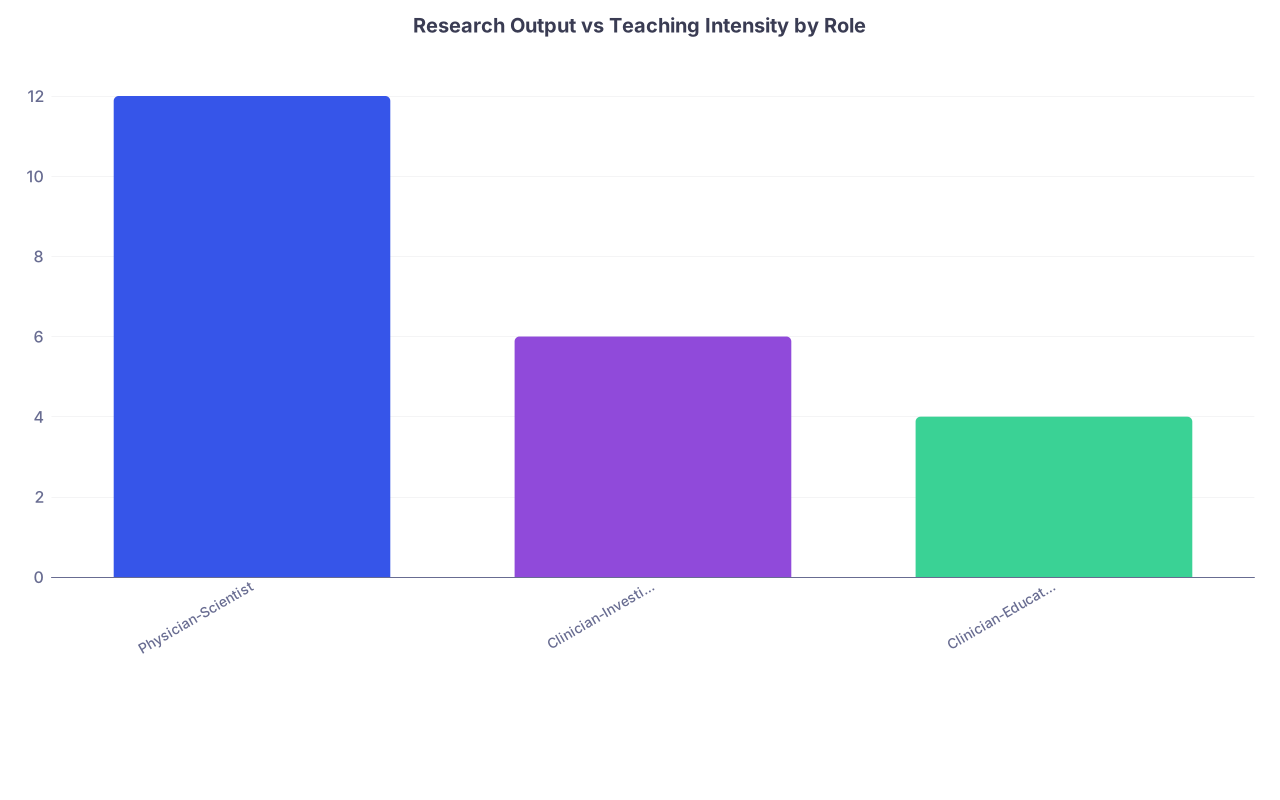
| Category | Value |
|---|---|
| Physician-Scientist | 12 |
| Clinician-Investigator | 6 |
| Clinician-Educator Scholar | 4 |
(The “values” here are rough average publications per year from multiple institutional internal reports; the point isn’t the exact number, it’s that all three groups can be productive in their lane.)
Patterns I see again and again among successful researchers who also teach:
- They focus on fewer, recurring teaching roles (e.g., co-direct a core clerkship, run one longitudinal seminar, supervise a stable pipeline of learners) instead of 50 one-off talks.
- They design teaching that overlaps their research domain, so every lecture is basically refining their grant pitch.
- They turn learner projects into sub-studies, quality improvement with rigor, or pilot data.
- They protect their research blocks with the same ferocity that surgeons protect OR time.
The people who get buried? They’re usually generalists in teaching: “I’ll talk about anything, anywhere, anytime.” Admirable. But devastating long term if you also want a research identity.
How to Structure a Career That Has Both (Without Lying to Yourself)
If you actually want to combine teaching and research, stop asking “Is it possible?” and start asking “Under what conditions does this work?”
Here’s the boring, unsexy reality that determines your fate:
1. Your initial job negotiation matters more than your abstract passion
You can love teaching and love research. If your contract is 70% clinical, 25% teaching and 5% research (on paper or in practice), guess what will suffer.
Go after roles that:
- Explicitly list research FTE with a number attached.
- Tie promotion to scholarship output, not just warm-body teaching.
- Have a track record of junior faculty actually getting promoted with combined education and research portfolios.
If a department says “Oh, we definitely support research” but can’t show you one assistant professor with real protected time who’s still standing after 5 years, that’s not support. That’s marketing.
2. Be explicit about what kind of scholarship you’re building
You need one of two primary identities:
- Clinical/bench/health services researcher who teaches.
- Education researcher/educational scholar who also does some clinical research or QI.
Straddling the line with no clear narrative — “I’m sort of into sepsis outcomes and also kind of into simulation training and also I like feedback literature” — is the quickest way to be invisible on promotion day.
Both paths are valid. Both can integrate teaching. But they require different mentors, different conferences, different journals.
3. Say no early to say yes properly later
You can’t be the unofficial problem-solver for every schedule gap and teaching hole and still run a coherent research program.
The smart move for the first 3–5 years:
- Choose 1–2 recurring teaching commitments that align with your research domain.
- Say no (politely) to almost everything else.
- Build a visible record of either scientific output or educational scholarship, then expand.
People remember outcomes, not years of vague “helping out.”

| Step | Description |
|---|---|
| Step 1 | Start Faculty Job |
| Step 2 | Renegotiate or reconsider |
| Step 3 | Select 1-2 core teaching roles |
| Step 4 | Align research with teaching |
| Step 5 | Produce scholarship |
| Step 6 | Use output to negotiate |
| Step 7 | Refine role and protect time |
| Step 8 | Defined FTE? |
The Quiet Upside: Job Security and Sanity
One more thing the “teaching kills research” crowd never mentions.
Funding is cyclical. Grants dry up. Labs close. Even high-performing investigators have bad cycles.
You know what keeps a lot of good people employed and promoted during those dry spells?
- Being indispensable in education.
- Running a clerkship, residency track, fellowship curriculum, or simulation program well enough that the department needs you.
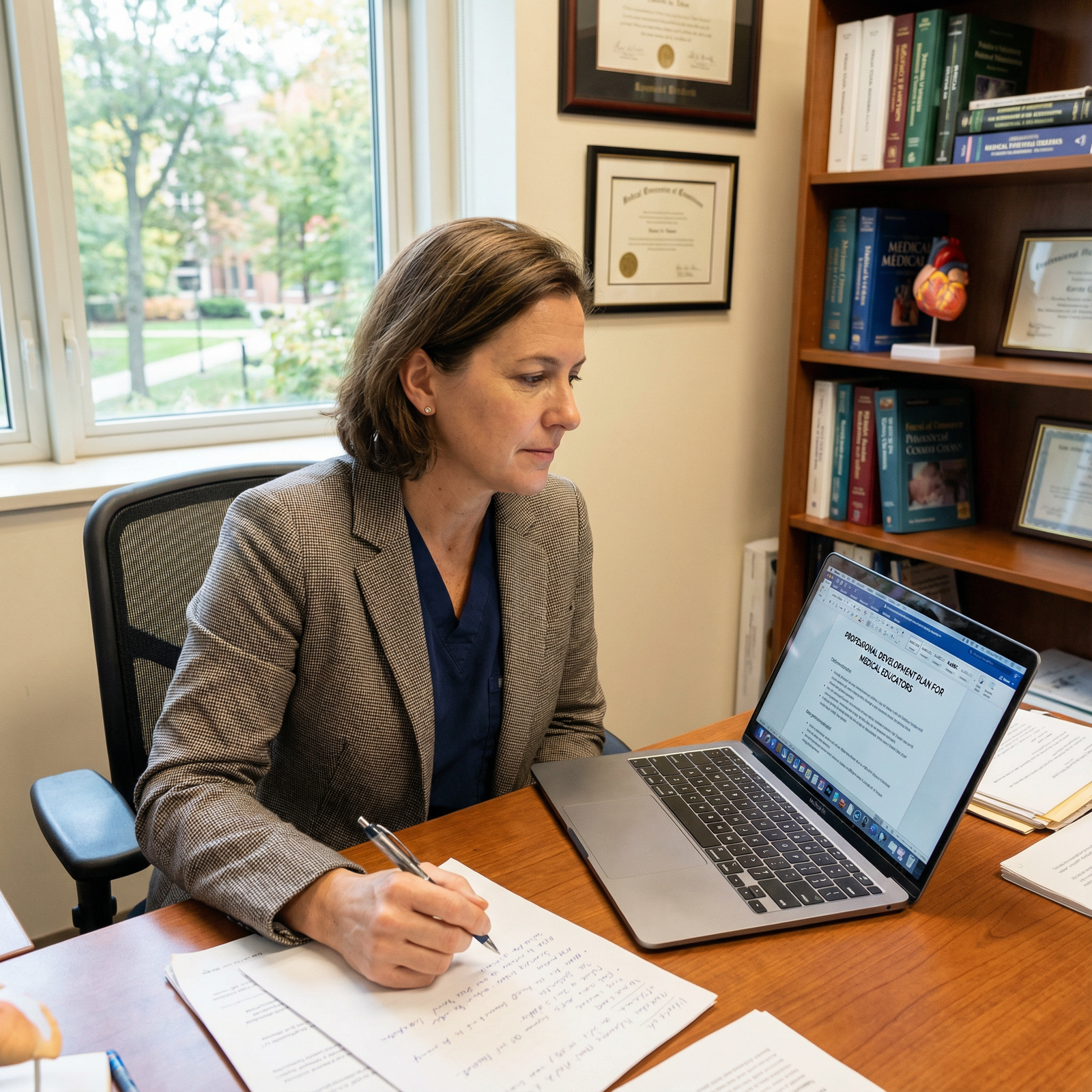
No, that doesn’t mean you can coast forever on “I teach a lot.” Promotion committees now expect documented educational impact, teaching evaluations, and increasingly, some form of scholarship.
But if you want a stable, flexible, long-term academic life, being able to do both — credible scholarship and high-quality, structured teaching — is not a liability. It’s insurance.
The Real Myth You Should Worry About
The dangerous myth isn’t “teaching kills research.”
It’s this one:
“If I just work hard and say yes to opportunities, my career will work itself out.”
That’s how people end up with:
- Five ad-hoc courses.
- Six committees.
- Three half-finished manuscripts.
- Zero protected blocks of time.
- And a vague sense that “teaching ruined my research.”
Teaching didn’t ruin anything. A lack of strategy did.
If You Remember Nothing Else
- Teaching does not inherently kill research. Unprotected time, vague roles, and saying yes to everything do.
- Well-structured teaching can strengthen a research career by feeding you mentees, ideas, and legitimacy — or become its own rigorous scholarship track.
- Your job structure, FTE breakdown, and early boundaries matter far more than the abstract question of “teaching vs. research.” Design those well, and you can have both.