
What actually happens to your career when you say “yes” to more teaching—do you move faster toward promotion, or just become everyone’s favorite exploited workhorse?
If you’re in academic medicine, you already know the script:
- “Teaching is highly valued here.”
- “We really reward excellent educators.”
- “Promotion is based on a balanced portfolio.”
Nice slogans. The data tell a very different story.
Let me walk through what actually happens to people who load up on teaching, what gets them promoted, and why doubling your teaching hours is usually a terrible career strategy if your goal is advancement.
The Big Myth: More Teaching Hours → Faster Promotion
Here’s the belief floating through every med school and teaching hospital:
“If I teach a lot, I’ll be seen as committed to education and that will help me get promoted.”
Sounds logical. It’s also mostly wrong.
What the literature and institutional promotion data show, over and over, is this:
- Promotion is driven far more by scholarship (grants, publications, educational products with measurable impact) than by raw teaching time.
- Teaching hours alone—no matter how painful or heroic—are nearly invisible in promotion decisions unless they’re attached to something measurable and “exportable.”
You don’t have to take my word for it. Promotion criteria from major academic centers (Hopkins, UCSF, Michigan, Toronto, etc.) follow the same pattern:
- Teaching is required.
- Excellence in teaching is “valued.”
- But the actual levers that move you from Assistant to Associate are:
- Peer‑reviewed publications
- Grants or funded projects
- Educational leadership roles
- Recognized innovation (curricula, assessment tools, programs) that extend beyond your own institution
Notice what is missing: “logged 400 hours of small‑group facilitation.”
That’s not an accident.
| Activity Type | Perceived Promotion Value | Real Promotion Value |
|---|---|---|
| High teaching hours | High | Low–Moderate |
| Teaching awards | Moderate | Moderate |
| Education publications | Moderate | High |
| Curriculum leadership | Moderate | High |
| Clinical productivity only | High | Low (for educator tracks) |
Most junior faculty who love teaching get trapped right in that first row.
They think being “the go‑to teacher” moves the needle. The institution thinks: “Great, someone we can schedule for every rotation that’s hard to staff.”
Different game. Different scoreboard.
What the Data Actually Show About Teaching and Promotion
Let’s pull this out of the realm of vibes and into evidence.
Across multiple studies of medical school faculty:
The single strongest predictors of promotion are:
- Number of peer‑reviewed publications
- Grant funding or major project leadership
- Holding leadership positions (course director, clerkship director, program director), especially if you produce scholarship from those roles
Teaching volume alone has:
- Weak or no correlation with promotion speed
- Often a negative correlation with scholarly productivity (because time is finite)
So you see this pattern in department after department:
One faculty member:
- Gives 150 lectures a year
- Precepts constantly
- Is beloved by students and residents
- Has almost no promotion‑relevant outputs
Another:
- Teaches far less at the bedside
- Directs one course or one clerkship
- Publishes a few education papers
- Moves from Assistant to Associate to Professor on schedule
Guess which one the dean actually calls “an educational leader.”
The hard truth:
Promotion committees do not count hours. They count artifacts.
Teaching sessions vanish. Publications, curricula, assessment tools, digital resources—that’s what remains on paper. That’s what gets cited in your promotion dossier.
You can pour 500 hours into teaching and generate exactly zero promotion‑relevant products if you never convert that work into something citable.
The Teaching Trap: How Good People Get Stuck
I’ve watched this happen in real time to more educators than I’d like to admit.
The pattern looks like this:
You’re good with learners. You get strong evaluations.
Word spreads. Clerkship directors and chiefs start emailing:
- “Could you cover just this one session?”
- “We really need someone like you on this new rotation.”
You say yes, because:
- You like teaching
- It feels aligned with your professional identity
- People say things like “This will look good for promotion”
A year later:
- Your teaching load is double
- Your evenings and weekends are gone
- Your CV has more “Session X, Residency Y” lines… and the exact same number of papers
You get “Teacher of the Year.” You do not get Associate Professor.
Teaching, by itself, is an infinite demand.
There is always another small group, one more bootcamp, another OSCE, another remediation session. There is no natural stopping point. And institutions quietly exploit that, especially for people who actually care about learners.
Promotion requirements, in contrast, are finite and specific. They usually look something like:
- X number of peer‑reviewed publications (with you in significant authorship positions)
- Evidence of impact beyond your own classroom or clinic
- Some leadership role with measurable outcomes
Those can be planned and met. Teaching requests cannot.
Where Teaching Does Help – But Only When It’s Structured Right
Now, saying “teaching hours don’t equal promotion” is not the same as saying “teaching doesn’t matter.”
Teaching absolutely matters. But not in the naive “more is better” way people assume.
Teaching helps you toward promotion when:
It’s tied to a defined role with a title
Course director, clerkship director, residency APD/PD, simulation director, assessment lead.
Titles matter because:- They justify time allocation
- They appear explicitly in promotion criteria
- They give you scope to create things that count as scholarship
You convert teaching activities into scholarly products
For example:- You run small-group sessions? Study their outcomes, publish a paper.
- You build OSCE stations? Turn them into a peer‑reviewed assessment resource.
- You overhaul a rotation? Write it up, present it nationally, submit to MedEdPORTAL.
The teaching event is not the product. The write‑up of the teaching event is.
Your teaching impact is documented and benchmarked
Promotion committees love:- Longitudinal teaching evaluations with trend lines
- Comparisons to departmental or institutional averages
- External testimonials that say, “This person’s teaching changed our program”
You see the pattern. It’s not hours. It’s structured role + documented impact + exportable work.
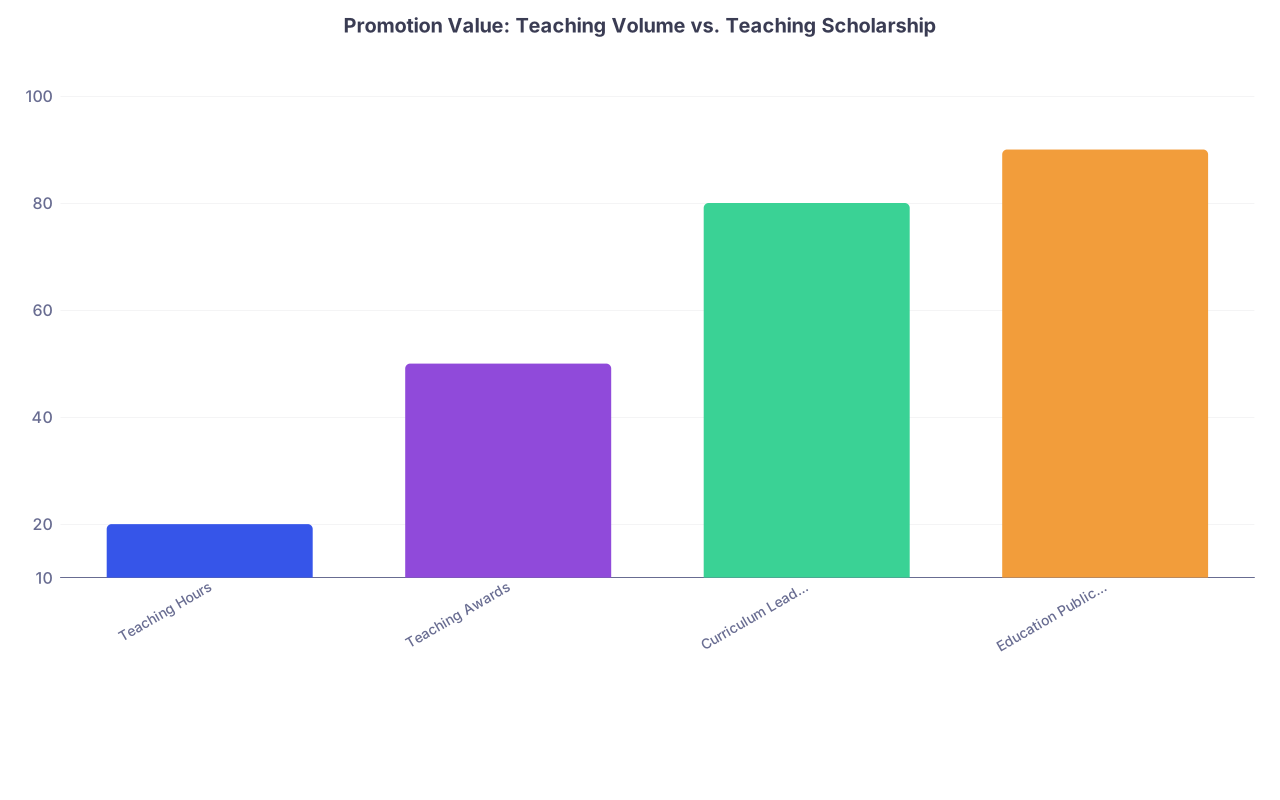
| Category | Value |
|---|---|
| Teaching Hours | 20 |
| Teaching Awards | 50 |
| Curriculum Leadership | 80 |
| Education Publications | 90 |
Those numbers are illustrative, but the relationships are accurate. Being the workhorse teacher is the weakest currency in that list.
The False Comfort of “Education Tracks”
Another modern myth: “If I’m on the clinician‑educator track, they care more about my teaching and less about my research.”
Yes and no.
Yes: expectations for R01‑level grant funding are reduced or gone.
No: the bar for scholarship doesn’t disappear. It just shifts toward education scholarship.
Most clinician‑educator or educator tracks now explicitly require:
- Evidence of innovation in teaching, curriculum, or assessment
- Peer‑reviewed education publications or products
- Regional or national reputation as an educator
They are not saying, “Teach a ton and we’ll handle the rest.” They’re saying, “Build a career around studying and improving teaching.”
Big difference.
If you’re on an education track and all you have is:
- A crushing teaching load
- A few local teaching awards
- No publications, no national presentations, no recognizable innovation
You’re still in trouble.
The promotion committee can’t, and won’t, turn “good soldier” into “Associate Professor” just because you covered everyone else’s sessions.
How to Teach a Lot and Still Get Promoted (Without Burning Out)
If you actually enjoy teaching—and many of us do—the answer isn’t “stop teaching.” The answer is “stop teaching indiscriminately.”
Here’s the strategy that actually works.
1. Decide your identity: Teacher, Scholar, or Both?
If you want promotion in academic medicine, you cannot just be “a teacher.” That’s the harsh reality.
You need to be:
- An education scholar (studying and improving teaching), or
- An educational leader (building and running programs), or ideally both.
Once you accept that, it changes what you say yes to.
2. Ruthlessly separate “busywork teaching” from “career‑building teaching”
Busywork teaching:
- One‑off lectures with no follow‑up
- Helping out constantly on other people’s rotations without a role title
- Covering last‑minute sessions “because the residents like you”
Career‑building teaching:
- Roles you can name on your CV: “Co‑director, Internal Medicine Bootcamp”
- Longitudinal teaching where you can track outcomes and iterate
- Projects that can become abstracts, papers, or national workshops
You need far more of the second and far less of the first.
3. Build scholarship into your teaching from the start
Instead of:
“I’ll design this great rotation and… maybe someday write it up if I have time.”
Flip it to:
“I’m going to design this rotation as a project that will:
- Have clear objectives
- Use defined outcomes (exam scores, direct observation, EPA performance, etc.)
- Generate data I can analyze and present”
You’re doing the work anyway. Either you walk away with nothing but warm evaluations, or you walk away with:
- An abstract for a medical education meeting
- A MedEdPORTAL submission
- A manuscript for an education journal
Same hours. Different outcome.
The Role of Teaching Evaluations and Awards: Helpful, but Overrated
Another common assumption: “If I get great evaluations and some teaching awards, that will carry me through.”
Reality:
Teaching evaluations
- Necessary to show you’re not a disaster.
- Helpful to demonstrate excellence when combined with other evidence.
- Not sufficient for promotion by themselves.
Teaching awards
- Departmental awards: minor plus. Show local value.
- Institutional or national awards: bigger plus. Signal broader impact.
- Still need to be accompanied by tangible scholarly work or leadership.
I’ve sat in rooms where someone’s dossier is full of glowing comments and multiple teaching awards, but almost no scholarship. The tone in those meetings is always the same:
“Wonderful teacher. But where’s the broader impact? Where’s the scholarship?”
It feels unfair—because it kind of is. But that’s the system you’re actually in.
How to Negotiate Teaching So It Helps Rather Than Hurts
The last piece people get wrong is negotiation. They think saying “yes” is how you show you’re a team player. Then they’re surprised when they’re drowning three years later.
When you’re asked to take on teaching, ask four questions:
What’s the role title?
If it doesn’t come with a name you can put on a CV, be cautious.
“Can we call this ‘Co‑Director of X’ and put that in my letter of offer?” is a fair ask.What’s the protected time?
If the answer is “none,” assume your own scholarship will suffer.
“For this to be sustainable and allow me to do education scholarship, I’d need X% FTE” is not unreasonable.What’s the timeline?
Teaching roles expand by default and rarely contract.
Agree to a 1–2 year term with a formal review, not a forever commitment.What’s the scholarship plan?
If you cannot see a clear path to turning the work into a paper, curriculum resource, or national workshop, you’re volunteering hours with no career return.
You don’t need to be combative. Just not naive.
The Reality Check You Probably Needed Earlier
If you’re already deep into heavy teaching with slow promotion, this can feel depressing. It should at least feel clarifying.
You’re not failing. You’re playing by the wrong rulebook.
Teaching is not useless. It’s just not the currency you were told it was. The real currency is:
- Leadership roles
- Documented impact
- Tangible products that outlive the session and can be consumed, cited, and critiqued by people who’ve never met you
So the real question isn’t “How many hours are you teaching?” It’s:
“How much of what you teach will still exist—in a usable, citable form—five years from now?”
Years from now, you won’t remember the exact number of lectures you gave on rounds. You’ll remember whether you built something that actually moved your career forward instead of just filling everyone else’s schedule.