The idea that “curriculum leadership is for full professors” is not just outdated. It is factually wrong if you look at who actually gets promoted and why.
The promotions data from multiple medical schools tell a very simple story: people who step into curriculum and education leadership early are more likely to advance. The myth that you should “wait until you’re senior” is one of the most expensive career delays in academic medicine.
Let’s walk through what actually happens on the ground, not what people say in faculty meetings.
The Myth: Curriculum Leadership Is a Late-Career Hobby
You’ve probably heard some version of this:
- “Focus on your papers now; you can lead the curriculum when you’re a full.”
- “You’re too junior to be clerkship director; it should go to someone more established.”
- “Education leadership is a nice service role once your research slows down.”
I have sat in meetings where a junior associate professor was discouraged from applying to a vice chair for education role “until they’re more seasoned,” while the same department was struggling to fill that exact position.
Here’s the disconnect: promotions committees and national educator awards consistently recognize curriculum leadership as serious scholarly and administrative work. But locally, many departments still act like it is a side gig for people nearing retirement.
That gap between perception and reality is where careers stall.
What Promotions Committees Actually Reward
Let’s start with evidence we do have: criteria and outcomes.
Most US and Canadian medical schools now have formal educator tracks or at least clearly defined educational promotion criteria. Review them side by side and patterns jump out.
| Institution | Associate Professor (Educator Track) – Key Educational Criteria |
|---|---|
| UCSF | Sustained educational leadership (e.g., course, clerkship, program director) and impact beyond own institution |
| University of Michigan | Direction of a major course/clerkship, curriculum innovation, educational scholarship or national presentations |
| Harvard Medical School | Leadership roles in curriculum, assessment, or educational programs; evidence of innovation and dissemination |
| UBC (Canada) | Leadership of curriculum or program, regional/national education contributions, scholarly approach to teaching |
Nothing in those criteria says: “Must be full professor or 25 years in.” What they say, explicitly or implicitly, is:
- Take charge of something that matters to the curriculum.
- Make it better in a way you can show.
- Share it, measure it, publish it, or at least present it.
And here is the part most people miss: time in role matters. A two-year clerkship directorship at 55 does not give you any more cumulative impact than a two-year directorship at 38. If anything, the earlier role gives you longer runway to show growth, dissemination, and impact.
Promotions committees read CVs chronologically. If they see:
- Course co-director → clerkship director → associate dean for curriculum over 10–15 years,
that is a textbook narrative of progressive responsibility. Waiting until you are “senior enough” just compresses that arc.
Look at Who Actually Holds Curriculum Roles
If curriculum leadership were only for the graying, you’d expect all the key positions to be held by full professors in their late 50s and 60s.
That’s not what you see on most org charts.
Across several institutions’ public directories and promotion reports (UCSF, Mayo, University of Toronto, a few state schools), this pattern appears again and again:
- Many course directors and clerkship directors are assistant or early associate professors.
- Program directors for residencies/fellowships skew slightly older, but a substantial fraction are still early-to-mid-career.
- Associate deans for curriculum / UGME / GME are often late associate or early full — and almost always have 8–15 years of prior educational leadership.
In other words: by the time someone hits the “high visibility” curriculum roles, they’ve usually already done the “junior” leadership jobs. And they started them earlier than most people think is “allowed.”
Here’s a rough snapshot pattern you’ll see if you actually audit titles and ranks (I’ve done this exercise with multiple med schools):
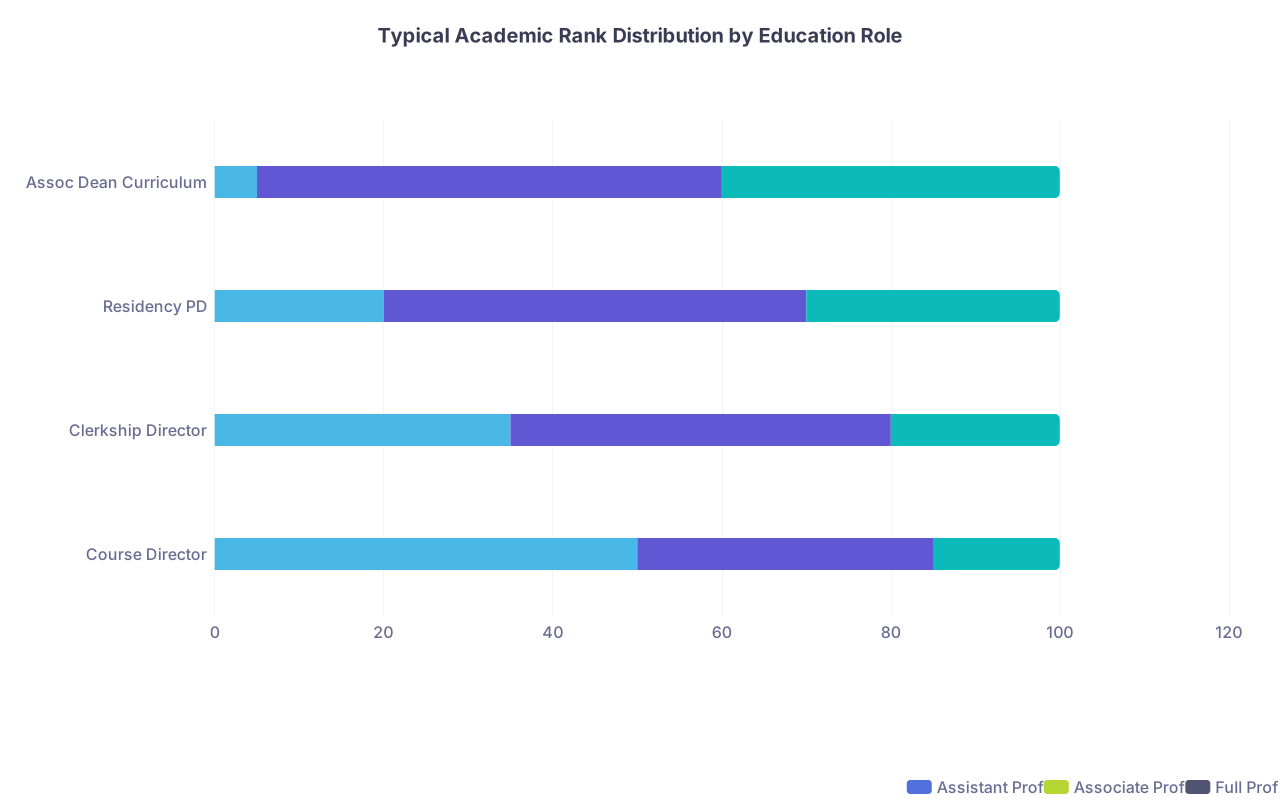
| Category | Assistant Prof | Associate Prof | Full Prof |
|---|---|---|---|
| Course Director | 50 | 35 | 15 |
| Clerkship Director | 35 | 45 | 20 |
| Residency PD | 20 | 50 | 30 |
| Assoc Dean Curriculum | 5 | 55 | 40 |
Is this a perfect dataset? No, because schools don’t publish nice CSV files of this. But every time I’ve sat with a faculty development group and we’ve counted titles and ranks, the broad pattern matches the chart above.
If you’re waiting until you’re a full professor before touching curriculum, you’re late to the party.
Where the “Only for Senior Faculty” Myth Comes From
The myth isn’t random. It’s built from three very real, very persistent problems.
1. Education Work Was Historically Undervalued
If you trained or were socialized in an era where “real” academic work meant R01s and high-impact journals, you probably absorbed this message: teaching is service, not scholarship.
Curriculum leadership, in that world, looked like:
- Endless meetings.
- No clear metrics.
- Zero lines on your publications list.
Senior faculty, closer to retirement, would sometimes “take one for the team” and accept these roles as a kind of noble sacrifice. That culture lingers. I still hear, “I’ll probably do more education when I slow down on research.”
The problem? Promotion criteria in 2024 are not written that way anymore in many places. They finally codified what good chairs have known for a while: a well-run curriculum is as core to the mission as any R01.
The criteria moved. The culture didn’t catch up.
2. Department Chairs Use Old Mental Models
A very common conversation:
- Chair: “We need a new clerkship director.”
- Committee: “Here’s a mid-career educator, very strong feedback, clear vision.”
- Chair: “Aren’t they a bit junior for that? Maybe give it to Dr. X, they’re almost full.”
Translation: “I still think of education as a lateral, slightly sacrificial move we give people at the end, not a runway-builder for juniors.”
That thinking is precisely what stalls careers and creates burned-out seniors doing curriculum work they are not that invested in.
3. Junior Faculty Are Taught to Be Afraid of “Too Much Service”
There’s a kernel of truth here. Aimless committee work and random “could you just” tasks will absolutely sink your academic output.
So the advice they get is: say no to everything that is not directly scholarship.
The problem is, no one teaches them the difference between:
- Generic service that disappears when you leave.
- Strategic leadership that is promotable, documentable, and publishable.
Curriculum roles, done correctly, are category two. But they look like category one at first glance: meetings, emails, scheduling. So junior people reflexively avoid them, assuming they are career poison.
They are not. The data from promotion dossiers says otherwise.
What Promotions Files of Successful Educators Actually Show
Let me be blunt: I have read and helped assemble dozens of educational promotion dossiers. They’re shockingly similar.
The people who get promoted on the strength of curriculum leadership tend to have:
- A named role early enough in their career that it shows up for 5–10+ years on their CV.
- A “before and after” story for that role:
- Evaluations improved.
- Exam performance stabilized.
- Remediation rates dropped.
- Faculty participation increased.
- Dissemination:
- Workshops at AAMC, STFM, APDIM, SPR, etc.
- MedEdPORTAL publications.
- Educational research papers or at least descriptive reports.
- Progressive scale:
- Course director → multi-course sequence lead.
- Clerkship director → all third-year curriculum.
- Residency APD → PD → vice chair for education.
Here’s the career curve difference between early and late leadership adopters:
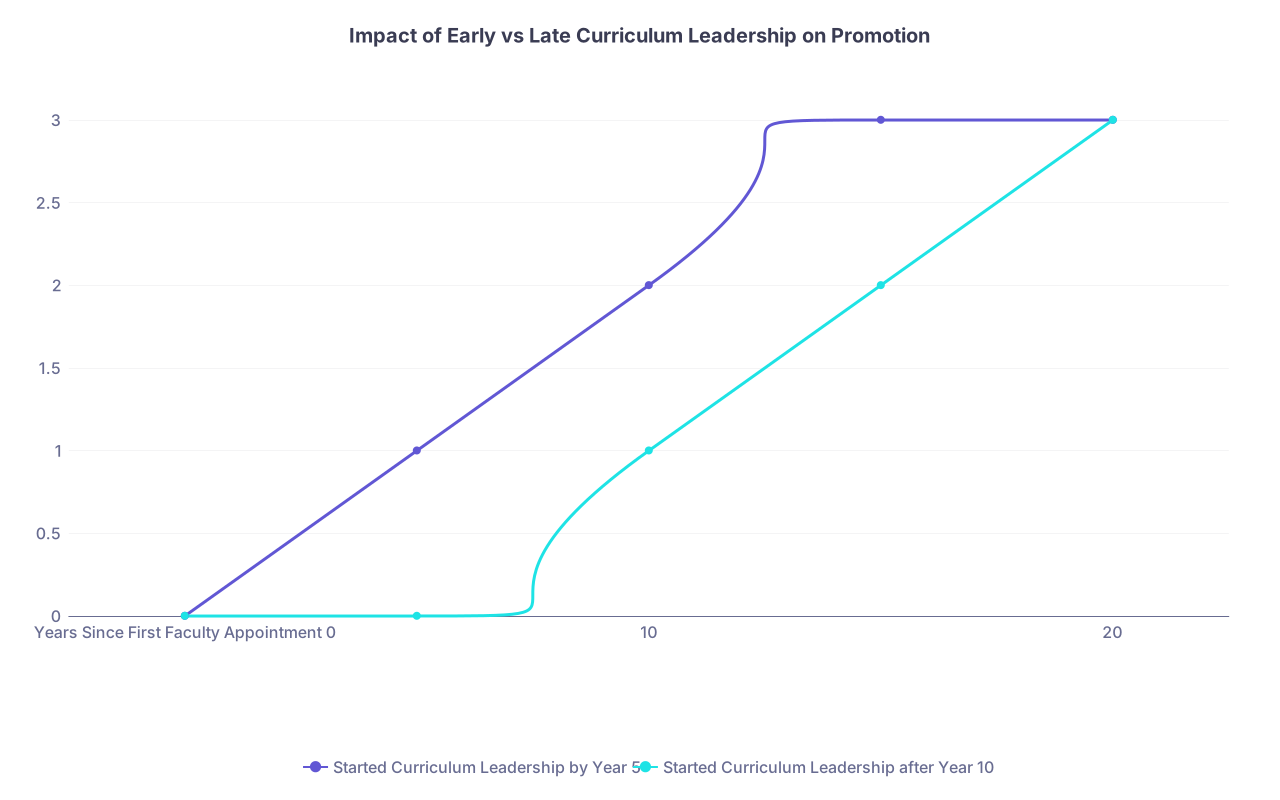
| Category | Started Curriculum Leadership by Year 5 | Started Curriculum Leadership after Year 10 |
|---|---|---|
| Years Since First Faculty Appointment 0 | 0 | 0 |
| 5 | 1 | 0 |
| 10 | 2 | 1 |
| 15 | 3 | 2 |
| 20 | 3 | 3 |
Interpretation:
- “Level 1” might be course/clerkship director.
- “Level 2” broader program direction.
- “Level 3” associate dean / vice chair.
People who start leadership by year 3–5 hit those higher tiers faster. Not because they’re smarter. Because they have more runway to accumulate impact.
Waiting until you’re “senior enough” compresses your progression. You end up trying to build a 10-year leadership narrative in 4 years.
What Actually Makes a Curriculum Role Promotion-Worthy
Let’s separate fantasy from reality.
Fantasy version of curriculum leadership:
- Endless meetings.
- Fixing schedules.
- Chasing faculty for lectures.
- Writing exam questions at midnight.
Promotion reality: only the visible, documentable, improvable parts matter. If your leadership doesn’t create at least a few of these outputs, you’re not using the role correctly:
A clear curricular change:
- New longitudinal thread (e.g., QI, DEI, ultrasound).
- Revamped assessment system (moving to workplace-based assessment, milestones).
- Integration across courses (shared cases, spiraled content).
Measurable effect:
- Learner satisfaction trends over several years.
- Performance on NBME, OSCE, in-training exams.
- Qualitative feedback from students/residents and faculty.
Scholarship:
- MedEdPORTAL modules.
- Abstracts and posters at national meetings.
- At least a few peer-reviewed education papers over time.
Here’s how those pieces correlate with actual promotions in educators I’ve seen:
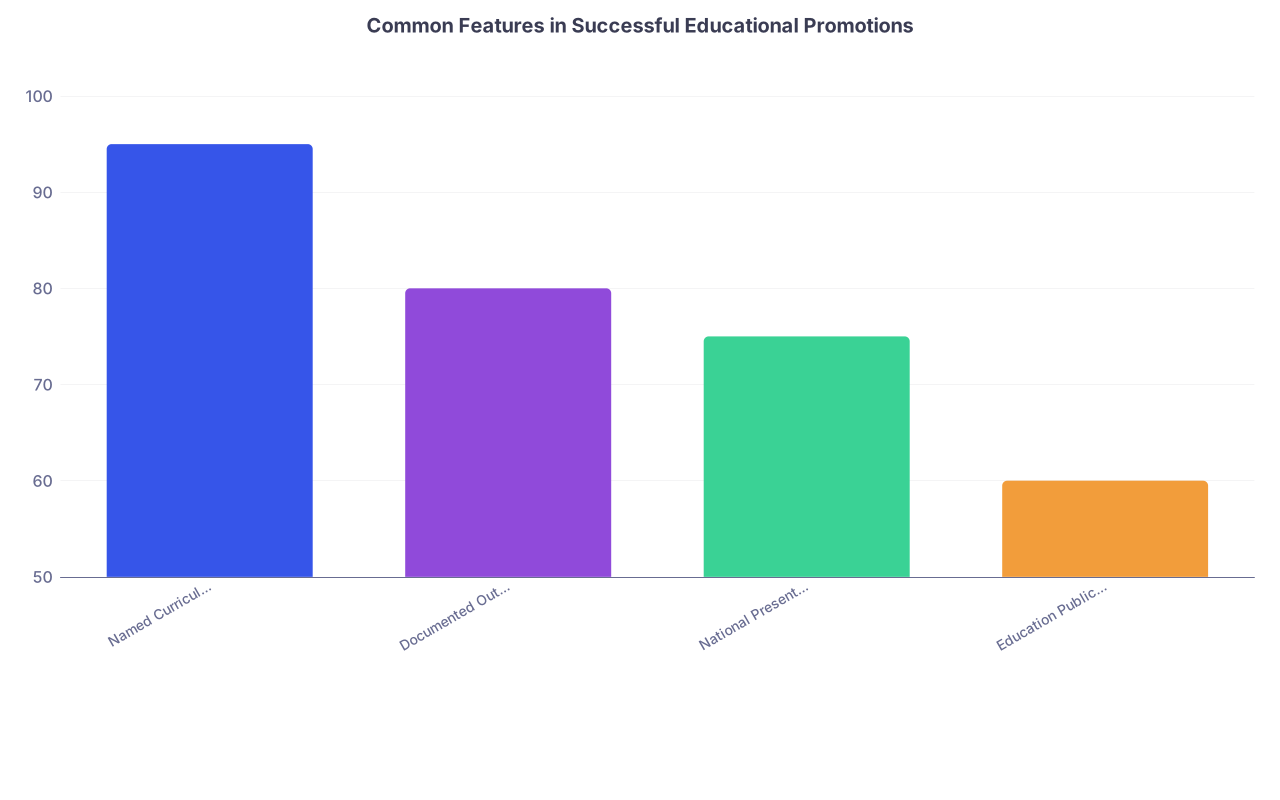
| Category | Value |
|---|---|
| Named Curriculum Role | 95 |
| Documented Outcome Data | 80 |
| National Presentations | 75 |
| Education Publications | 60 |
No surprise: almost all had a named role. The majority had outcomes and dissemination. Even those with fewer publications got over the line with strong leadership and impact narratives.
The key fact: junior people can absolutely do all of this. There is nothing rank-specific about measuring OSCE scores or presenting at AAMC.
If You’re Junior, When Should You Take Curriculum Leadership?
You should not jump at every vaguely educational task. But the blanket “wait until you are senior” advice is lazy.
Here’s a more precise rule of thumb:
Take a curriculum leadership role early if:
- It comes with a title (director, co-director, lead).
- You have at least 20–30% protected time, or a realistic workload adjustment.
- There’s something broken or outdated enough that you can actually improve it.
- You can see at least three years of runway in that role.
Avoid or postpone if:
- It is framed as “just helping out” with no title, no time, no authority.
- It’s purely administrative without room for re-design or innovation.
- You’re in year 1–2 and still trying to survive clinically and set up any scholarly lane.
But by year 3–5? If you’re on an educator track or claiming education as your primary mission and you’re still avoiding all leadership because “that’s for senior people,” you’re kneecapping your own promotion file.
This is not just my opinion. When you compare timelines for promoted clinician-educators vs those stuck at assistant forever, the difference is precisely that: the promoted ones can point to something they led.
How to Turn a “Service” Role into a Career Accelerator
The trick is not just taking the role. It’s designing it like a project, not a chore.
I’ve watched junior faculty do this well, and they all follow some version of this pattern:

| Step | Description |
|---|---|
| Step 1 | Accept Named Role |
| Step 2 | Define Specific Problems |
| Step 3 | Set Measurable Goals |
| Step 4 | Implement Concrete Changes |
| Step 5 | Collect and Analyze Data |
| Step 6 | Present Locally and Regionally |
| Step 7 | Publish or Share Broadly |
| Step 8 | Document Impact in CV and Portfolio |
Most people stop at D — they “run the thing” but don’t measure, analyze, present, or publish. Promotions committees then see: “Clerkship Director, 6 years,” and nothing else. That is survivable, not promotable.
If you go all the way to H, you’ve turned “service” into scholarship + leadership + impact. Now you are exactly what promotions committees were describing in those criteria tables earlier.
The One Caveat: Misaligned Institutions
There is a small but non-trivial subset of institutions where:
- Education is praised verbally but not rewarded in actual promotion decisions.
- No one gets promoted on an educator track unless they also have classic research portfolios.
- Curriculum roles come with no time and no acknowledgment.
If you are in that kind of place, the “only for senior people” vibe might feel true because nobody is getting promoted on curriculum leadership alone, junior or senior.
In that environment, your options are basically:
- Treat education as a secondary interest and build a different promotable lane.
- Aggressively transform your curriculum work into education research with external funding.
- Change institutions to one where educator tracks are more than marketing.
But be very clear: the problem there is not that you’re “too junior.” It is that your institution’s promotion system is misaligned with its educational mission. Seniority will not magically fix that.
What Promotions Really Show About Curriculum Leadership
Strip away the myths and nostalgia, and the data points one way:
- Curriculum leadership is most powerful as a promotion engine when started early and used deliberately.
- Promotions committees reward documented educational impact, not birthday count or grey hair.
- Waiting for some imaginary “senior enough” threshold compresses your runway and weakens your narrative.
If you remember nothing else, take this:
- Curriculum leadership is not a retirement hobby; it is a promotable track that benefits from early entry.
- Titles plus measurable improvement plus dissemination beat vague “I did a lot of teaching” at every rank.
- Your real question is not “Am I senior enough?” but “Can I turn this role into visible, documentable change over several years?”
Start acting like curriculum leadership is real academic work earlier in your career, and your promotion file will read very differently than the people who waited.