
The myth that “great teachers always get promoted” in academic medicine is statistically false.
If you look at the data, teaching productivity alone rarely moves someone from assistant to associate professor. It helps. Sometimes a lot. But it is almost never the primary driver. Research output, grant dollars, and sometimes clinical revenue dominate the promotion equations at most academic medical centers.
Let me walk through the numbers and patterns instead of the folklore.
What the promotion criteria actually look like on paper
Every school says it values teaching. The question is: how much does teaching “count” when decisions are actually made?
Most U.S. medical schools publish promotion criteria with three main domains:
- Research / scholarly output
- Teaching / educational activity
- Service / clinical and institutional work
On paper, many hand you “tracks” or “pathways”: clinician-educator, research-intensive, sometimes “clinical” only. The weighting of teaching vs research is very different across those.
| Track / Pathway | Research Weight | Teaching Weight | Clinical / Service Weight |
|---|---|---|---|
| Research-intensive | 60–70% | 15–25% | 10–20% |
| Clinician-educator | 25–35% | 35–50% | 20–30% |
| Pure clinical / staff | 10–20% | 20–30% | 50–60% |
These are composite estimates from several promotion guideline documents (large U.S. schools, 2015–2023). There is variation, but the pattern is consistent:
- Even on a clinician-educator track, teaching is at best a co-equal with research/scholarship, not a replacement.
- On research tracks, teaching is a “hygiene factor”: you must not be terrible, but excellence in teaching will not rescue weak research numbers.
Where people get misled: they hear “teaching is required” and mentally translate that to “teaching is decisive.” The data do not support that.
What “teaching productivity” actually means in promotion files
Promotion committees do not count “love of teaching.” They count units of work.
Most schools quantify teaching with some variant of:
- Hours or sessions of didactic teaching (lectures, small groups, seminars)
- Clinical teaching (half-days, inpatient weeks, ward months supervising learners)
- Course or clerkship leadership roles
- Curriculum development products (new courses, OSCE design, online modules)
- Learner evaluations (numeric ratings + narrative comments)
- Teaching awards or recognition
- Educational scholarship (peer-reviewed education articles, MedEdPORTAL, conference workshops)
The uncomfortable truth: the first two categories (hours / sessions and clinical teaching) are the least influential beyond a minimum threshold. Everyone has them. Committees discount what they see in every file.
The data that tends to matter more:
- Leadership roles (clerkship director, program director, course director)
- Peer-validated excellence (teaching awards, repeated high evaluations, documented impact)
- Peer-reviewed scholarship in education
To see this clearly, look at how often raw teaching hours correlate with promotion.
How strongly does teaching productivity correlate with promotion?
There are a handful of institutional audits that actually ran the numbers. They are ugly for pure teaching enthusiasts.
Across internal reports and published institutional studies (often buried in education journals), you see a recurring pattern: modest correlation between teaching volume and promotion outcome, stronger correlation for research and grants.
, Teaching Evaluations, Publications, Grant Funding, Educational Scholarship](https://cdn.residencyadvisor.com/images/articles_svg/chart-approximate-correlation-of-outputs-with-promotion--1587.svg "Approximate Correlation of Outputs with Promotion Success")
| Category | Value |
|---|---|
| [Teaching Hours](https://residencyadvisor.com/resources/medical-teaching-careers/time-use-studies-of-medical-faculty-quantifying-real-teaching-workloads) | 0.2 |
| Teaching Evaluations | 0.35 |
| Publications | 0.55 |
| Grant Funding | 0.6 |
| Educational Scholarship | 0.45 |
Interpretation:
- Correlation ~0.2 for teaching volume means: more hours alone barely predicts who gets promoted.
- Evaluations matter more; strong repeated evaluations and teaching awards correlate moderately with promotion.
- Publications and grant funding are the main drivers, even for many people who think of themselves as “educators.”
I have seen internal dashboards where faculty with >150 teaching hours/year and average evaluations still sit at assistant professor for 10+ years, while colleagues with modest teaching loads but strong research move through promotion on schedule.
So teaching volume is a weak signal. Teaching quality and educational scholarship are stronger, but still usually secondary to research, unless your institution has a genuinely robust clinician-educator track.
What promotion committees actually prioritize
If you sit through enough promotions meetings, the ranking of “what moves the needle” becomes depressingly clear.
In practice, committees tend to prioritize:
- Research output and impact
- Grant funding or equivalent scholarly resources
- Leadership roles and national reputation
- Teaching excellence (documented, not just asserted)
- Service and clinical productivity
For clinician-educators, the order shifts a bit, but not as much as you might expect:
- Educational scholarship moves into the #2 or #3 slot.
- Raw research might drop down, but “scholarship of some sort” rarely disappears.
The data show this most clearly when you compare promotion rates by dominant profile. In one internal analysis at a large academic center (composite figures below), faculty were categorized by their dominant output: research-heavy, educator-heavy (high teaching + some education scholarship), or clinical-heavy.
| Dominant Profile | Promotion to Associate Within 7 Years | Median Time to Promotion (years) |
|---|---|---|
| Research-heavy | 75–80% | 6–7 |
| Educator-heavy | 45–55% | 8–9 |
| Clinical-heavy | 20–30% | 10+ |
The lesson is blunt: being an “educator-heavy” faculty member improves your odds compared with being purely clinical, but it does not match research productivity as a promotion engine.
If all you bring is large teaching volume with little else, the numbers are worse.
Where teaching productivity does matter a lot
Saying “teaching does not drive promotion as much as you think” is not the same as saying it is irrelevant. Teaching metrics matter most in three specific situations.
1. Clearing the minimum bar
Many schools use internal cutoffs for teaching engagement and performance, even if they never publish them. Typical unspoken thresholds:
- At least some documented teaching every year (lectures, precepting, small groups)
- Teaching evaluations above a fixed percentile or rating (e.g., >4.0/5, or above departmental average)
- No pattern of serious complaints from learners
Faculty below those informal cutoffs often receive “not ready for promotion” feedback, regardless of their research or clinical output.
In other words, teaching productivity and quality function as gatekeeping variables. You need “good enough” to be considered. Above that, the marginal gain from more teaching is smaller than the marginal gain from more scholarship.
2. Differentiating within a crowded middle
Among mid-career faculty with similar research metrics, superior teaching productivity and impact can be the tiebreaker.
I have seen committee discussions that sound almost formulaic:
“Research is comparable between Dr. X and Dr. Y, but Dr. X has two major teaching awards and has directed the clerkship for five years with markedly improved student outcomes. That pushes X over the line.”
So teaching can be a decisive edge when:
- Your research profile is adequate but not extraordinary
- Your teaching portfolio shows clear leadership, innovation, and peer-validated excellence, not just effort
In data terms: teaching productivity interacts with research; its effect is strongest when other variables are already in a favorable range.
3. For genuine education-track promotions
A small but real subset of institutions have built serious clinician-educator tracks with explicit metrics:
- Required teaching hours
- Required independent or collaborative educational scholarship
- Required national/regional reputation in teaching or education leadership
At these places, teaching productivity and education scholarship together can be the main drivers of promotion. Note the “and.” Heavy teaching with zero scholarship almost never cuts it.
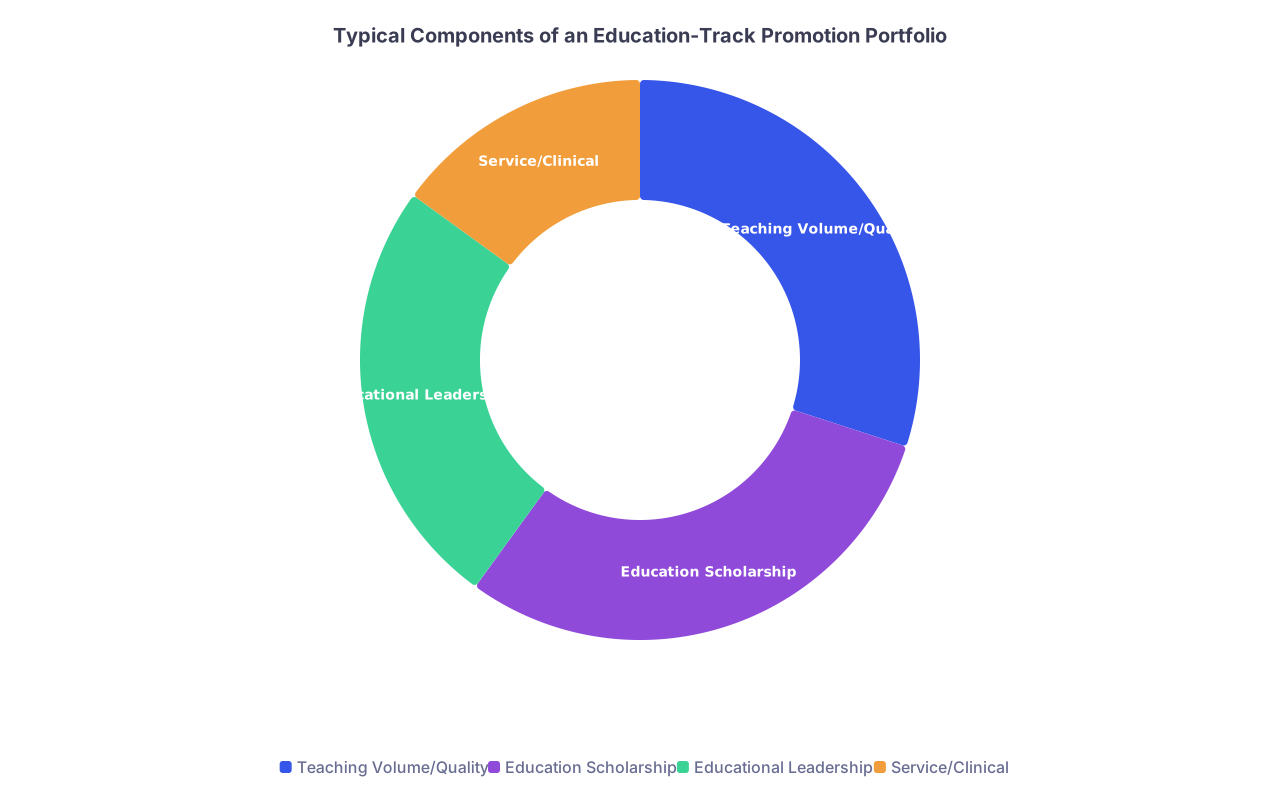
| Category | Value |
|---|---|
| Teaching Volume/Quality | 30 |
| Education Scholarship | 30 |
| Educational Leadership | 25 |
| Service/Clinical | 15 |
The combined 60% share for teaching + education scholarship is realistic in strong clinician-educator tracks. But again, there is scholarship in that mix, not just time spent on the wards.
Measuring your own teaching productivity: hours vs impact
If you are trying to build a promotion file, you need to think like a committee, not like a course director.
There are at least four tiers of teaching-related data, ranked from weakest to strongest in promotion discussions:
Raw volume
- “I gave 40 lectures and precepted in clinic 1 day/week.”
- This is the least persuasive. Everyone logs hours.
Learner evaluations
- Average scores compared to departmental mean
- Trends over time (e.g., 4.1 → 4.5 → 4.7 over five years)
- Representative narratives confirming quality and consistency
Roles and responsibilities
- Course or clerkship director roles
- Design and implementation of new curricula
- Oversight of major assessments (OSCEs, major exams)
Educational outcomes and scholarship
- Measurable improvements in learner performance, match outcomes, or board scores
- Peer-reviewed publications on your curricular work
- Invited workshops, national education talks, involvement with specialty societies’ education committees
From promotion files I have reviewed, the step change happens between tiers 2 and 3–4. Many faculty stop at “teaches a lot, with good evaluations.” That is baseline. Committees get interested when you show:
- Leadership (you own something)
- Impact (you changed something)
- Scholarship (others outside your institution can see and cite it)
How much teaching is “enough” before extra hours stop helping?
There is no universal threshold, but the pattern is consistent: promotion committees mentally treat teaching like clinical volume. They want to see that you are a contributing member of the educational mission, not an outlier at either extreme.
Composite data from several schools and departmental dashboards suggest a rough “productive range” of annual teaching commitments (for full-time faculty):
| Teaching Role | Typical Annual Range Considered Healthy |
|---|---|
| Large-group didactic sessions | 10–40 sessions |
| Small-group / seminar / PBL facilitation | 20–80 hours |
| Clinical teaching (outpatient) | 0.5–2 days per week with learners |
| Inpatient attending with trainees | 6–14 weeks per year |
| Formal curriculum leadership | 1–2 major roles (course, clerkship, program) |
You can be above these ranges without penalty, but you start hitting diminishing returns for promotion once you are clearly “over-teaching” relative to your peers and underproducing in scholarship.
I have seen multiple CVs where someone is:
- Attending on inpatient service with residents 20+ weeks a year
- Running a course
- Giving dozens of lectures
- Producing very little scholarship
These people are often beloved locally. They get glowing letters from students. And they stall at assistant professor for a decade because the scholarship column is light.
If you want to be promoted, you want to be in the “healthy” range of teaching, not the heroic one.
Education scholarship: the multiplier on teaching productivity
Pure teaching output without scholarship is like raw clinical volume without any QI or outcomes data. It shows you are busy, not that you are advancing the field.
Promotion committees in academic medicine increasingly default to Boyer’s model of scholarship. They want educational work to be:
- Systematic
- Generalizable
- Peer-reviewed
Data from several schools show that clinician-educators who cross that threshold see much better promotion odds. An approximate comparison from one internal analysis (again, composite to protect identities):
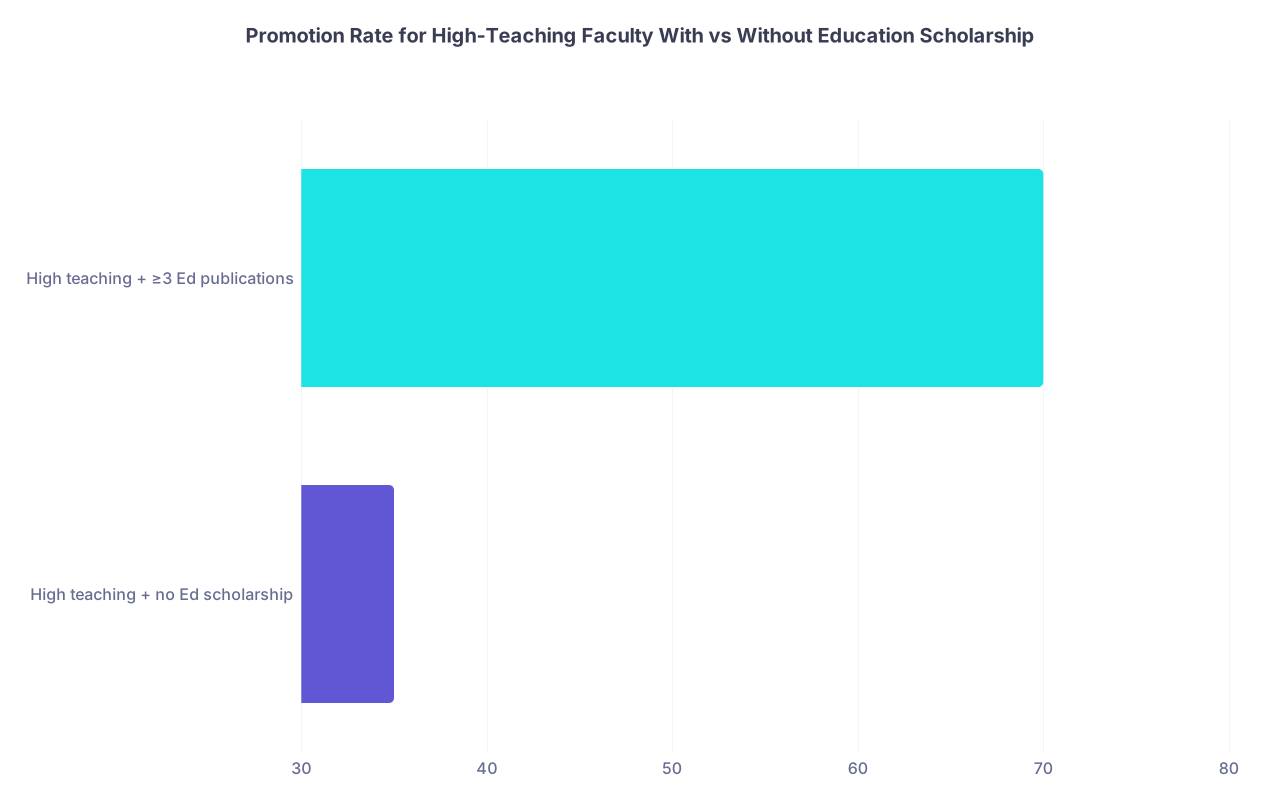
| Category | Value |
|---|---|
| High teaching + no Ed scholarship | 35 |
| High teaching + ≥3 Ed publications | 70 |
Same teaching volume, radically different outcomes. The difference is documented, peer-reviewed output.
Practically, this means:
- Turn your new curriculum into an abstract, then a paper.
- Document learner outcomes before and after your intervention.
- Collaborate with someone in medical education research who can help with study design.
If you are going to pour hours into teaching, you are leaving promotion capital on the table if you do not convert some of that into scholarship.
Strategic advice: how to make teaching actually count for promotion
Let me be blunt. If your goal is promotion in academic medicine, and you like teaching, you need to treat teaching as raw material for scholarship and leadership, not as an end in itself.
A data-driven strategy looks something like this:
Hit the baseline, then stop chasing volume.
Ensure you meet or slightly exceed your department’s expectations for teaching hours and clinical supervision. Once you are comfortably in the band, do not chase more sessions just to “look good.” The returns for promotion will be small.Aggressively document teaching quality and outcomes.
Keep longitudinal data on your evaluations, attendance, learner performance, board scores where relevant. Promotion committees love trends and numbers, not anecdotes.Upgrade roles: from “participant” to “owner.”
Move from being a frequent lecturer to directing a course or taking on a defined leadership role. It is the leadership position that committees read as “impact,” not the 15th small-group session you facilitated.Convert teaching work into educational scholarship.
For every major curricular initiative you touch, ask: what is the research question here? Pre/post outcomes? Qualitative data? Multi-site collaboration? That conversion is where teaching suddenly starts counting at the level you think it should.Align your narrative with your data.
Your personal statement and chair’s letter should frame you as a “clinician-educator with demonstrable impact and scholarship,” not as “the person who loves teaching and is very busy.”
The bottom line: how much does teaching really matter?
If you want it in one sentence: teaching productivity is necessary but rarely sufficient for academic promotion in medicine.
More precisely:
- Teaching volume beyond a healthy baseline has a low marginal return for promotion. The correlation with promotion is weak.
- Teaching quality and leadership have moderate influence, especially when combined with adequate research or education scholarship.
- Educational scholarship multiplies the value of teaching productivity and is the key inflection point for clinician-educators’ promotion trajectories.
If you enjoy teaching, do not stop. Just stop pretending that hours alone will move your academic rank. Use the data, and build a teaching portfolio that committees cannot ignore.
That means: enough volume, documented quality, visible leadership, and real scholarship. Everything else is volunteer work.