
The pipeline into medical education leadership is not a meritocracy. The data shows a patterned, predictable route that favors specific demographics, degrees, and career choices—and shuts out others just as predictably.
If you want to understand who actually gets these roles—program director, clerkship director, vice chair for education, dean-level positions—you have to treat it like any other workforce analytics problem. Look at who is in the jobs now, what they did before they got there, and who keeps getting passed over.
Let me walk through what the numbers consistently show.
1. The Current Snapshot: Who Sits in the Big Chairs?
You can argue philosophies all day. The actual composition of leadership tells a much clearer story.
Gender and leadership roles
Across multiple recent surveys from AAMC, AMA, and specialty societies, the pattern is blunt:
- Women are now about 53–55% of U.S. medical students and just over 46–47% of residents.
- But they make up substantially less of formal education leadership.
A composite of large-scale studies looks roughly like this for major education roles across academic health centers:
| Role Type | Women (%) | Men (%) |
|---|---|---|
| Clerkship Directors | 40–45 | 55–60 |
| Residency Program Directors | 30–35 | 65–70 |
| Assistant/Associate Deans (Edu) | 35–40 | 60–65 |
| Vice/Executive Deans (Edu) | 20–25 | 75–80 |
| Department Education Vice Chairs | 35–40 | 60–65 |
So: women are the majority of trainees, but a clear minority of top education leaders, especially as titles get more senior. The “leaky pipeline” cliché is painfully accurate here.
Racial and ethnic representation
The picture for racial and ethnic representation is even worse. If we benchmark against approximate U.S. population and overall faculty numbers (AAMC Faculty Roster data):
- Black physicians: ~5% of U.S. physicians; often under 5% of education leadership, many departments reporting 0–2 Black leaders in any education role.
- Hispanic/Latino physicians: ~6% of physicians; again, typically single digits in leadership.
- Asian physicians: overrepresented in faculty relative to population, but still significantly underrepresented in top leadership relative to their faculty base.
A very typical pattern I have seen in institutional workforce reports:
- Departmental education committees look diverse at the “member” level.
- Clerkship and residency leadership are modestly diverse.
- But the associate dean and vice dean levels are dominated by White faculty.
If you want one-line summary: the closer you get to budget and power, the Whiter and more male it gets.
2. Credentials That Predict Who Gets Education Roles
Who gets leadership is not random. It is highly correlated with a handful of specific characteristics and career choices.
Degree inflation: MD vs others
Formal leaders in undergraduate and graduate medical education are overwhelmingly MD or DO. PhD-only educators exist, but the data show they cluster in:
- Basic science course leadership
- Simulation program direction
- Assessment and evaluation offices
For broad “medical education leadership” (program director, associate dean for curriculum, etc.) the numbers in many institutions look approximately like:
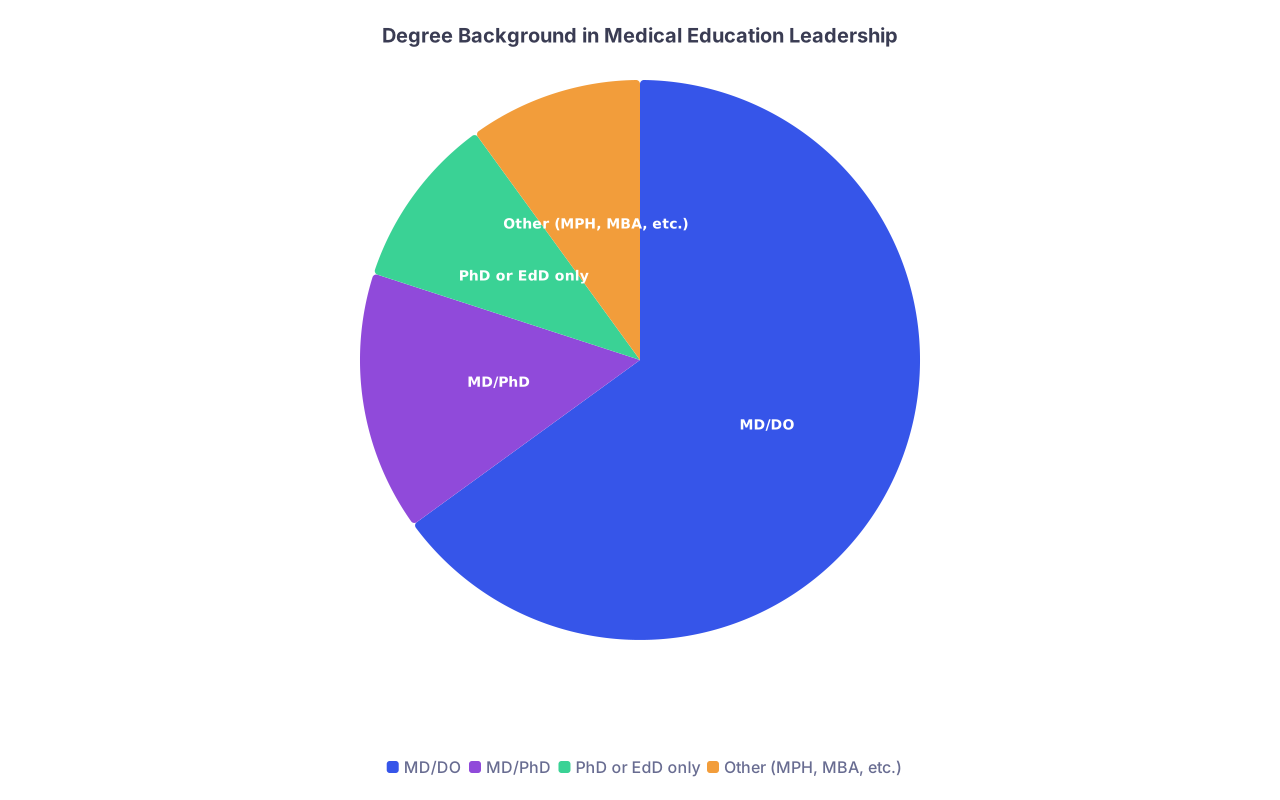
| Category | Value |
|---|---|
| MD/DO | 65 |
| MD/PhD | 15 |
| PhD or EdD only | 10 |
| Other (MPH, MBA, etc.) | 10 |
Translated:
- Around 80% of educational decision-makers have a clinical degree (MD/DO or MD/PhD).
- Pure-education or PhD educators control a minority of strategic levers.
So if you are a clinician: your degree is not a barrier, it is actually a prerequisite in many places. If you are a non-clinician educator: you will often be capped at “director-level” or confined to specific domains, no matter how strong your expertise.
Formal medical education training
Now the more interesting predictor: who has actual training in education?
Over the past decade, there has been a sharp increase in:
- Medical education fellowships (GME and UME focused)
- Master’s degrees in medical education (MME, MHPE, MEd)
- Institutional teaching academies and certificates
The catch: uptake still lags in senior leadership. The numbers I typically see in faculty surveys:
- Among program directors: maybe 25–35% have formal MedEd training (fellowship or master’s).
- Among clerkship directors: similar or slightly higher (30–40%).
- Among associate or vice deans: surprisingly often less than 25% have advanced education credentials, especially in older cohorts.
Selection bias is real here. Many senior leaders were appointed 10–20 years ago, when formal MedEd training was rare. Among new leadership appointments in the last 5–7 years, you see:
- Upward of 50–60% of new program directors in some institutions have at least a teaching certificate or short-course credential.
- 30–40% of new associate deans or vice chairs list formal education training.
So the trend line is clear: the probability of landing a leadership role is now significantly higher if you:
- Complete a medical education fellowship.
- Earn a master’s in health professions education.
- Join and actively participate in a teaching academy.
Is this causal or just selection? Both. Chairs and deans increasingly look for these credentials on CVs when filling roles. I have watched appointment committees explicitly flag “no formal education training” as a weakness.
Academic rank and scholarship
Another consistent filter: academic rank tied to scholarship productivity.
Typical residency program director profile in a mid- to large-size academic center:
- Associate professor rank (often recently promoted from assistant).
- 10–20 peer‑reviewed publications, at least 3–5 in medical education.
- Regional or national presentations (e.g., at APDIM, Council of Residency Directors, Clerkship Directors in Internal Medicine).
For clerkship directors, slightly lower bar, but the same trend: those with publications in MedEd journals and evidence of educational innovation spread beyond their institution are much more likely to be tapped.
The hiring logic from chairs is often: “I need someone who can both run the program and maintain or grow our academic footprint, especially for promotion metrics.”
Translation: if your CV has no peer-reviewed education work, your odds of being selected for larger leadership roles drop sharply, unless the department is desperate.
3. The Career Paths That Actually Lead to Leadership
You do not stumble into these roles. The people who get them tend to follow highly similar pathways. When I look across multiple institutions, three dominant feeder paths keep showing up.
Path 1: The “classic” clinician-educator ladder
This is the most common.
- Early career:
- Heavy involvement in teaching: small groups, wards, simulation.
- Participation in course/clerkship committees.
- First titles:
- Course director for a preclinical block.
- Associate or assistant clerkship director.
- Site director for a residency program.
- Mid-level leadership:
- Full clerkship director.
- Associate program director.
- Director of sub-internships or electives.
- Senior leadership:
- Residency program director.
- Vice chair for education.
- Associate dean for UGME or GME.
Most people on this path also pick up:
- A local teaching award or two.
- A teaching academy membership.
- Some MedEd scholarship.
From a data standpoint, this is a stepwise Markov chain: once you enter the “associate director” state, the transition probability to a higher role becomes very non-trivial compared with those who never occupy formal roles.
Path 2: The “operations and compliance” route
A smaller but important group gets there through system complexity:
- Graduate medical education offices (DIOs, GME directors)
- Assessment and evaluation leads
- Accreditation and quality improvement roles
These people know the rules cold: ACGME requirements, LCME standards, EPAs, milestones. They end up indispensable:
- Program directors who understand accreditation deeply are repeatedly reappointed and often promoted.
- GME office leaders become associate or senior associate deans.
- The “assessment guru” in a school ends up part of every curriculum redesign leadership team.
This path is underappreciated but extremely powerful if you tolerate bureaucracy.
Path 3: Research-heavy MedEd scholars
More common in larger, research-intensive schools:
- Start as a PhD or MD‑PhD in education science, psychology, or related fields.
- Build strong portfolios in assessment, simulation, or curriculum theory.
- Publish in Academic Medicine, Medical Education, Advances in Health Sciences Education.
These individuals often become:
- Directors of centers for medical education research.
- Vice deans for education innovation.
- System‑level education strategists in multi-site health systems.
They may not always hold “program director” titles but control big strategic decisions, funding, and evaluation frameworks.
Again, if you track appointments over time, those with >20 MedEd publications and major grants (e.g., from AHRQ, HRSA, or foundations) show a high conversion rate into senior roles.
4. Structural Inequities: Who Gets Blocked?
Now the ugly part. The data on who gets excluded are remarkably consistent.
The part-time trap
Faculty at less than 1.0 FTE face a striking disadvantage in being selected for top leadership:
- Chairs associate “leadership” with being physically and administratively present.
- Many 0.5–0.8 FTE faculty (often women or caregivers) carry heavy teaching loads but do not get leadership titles or stipends.
Survey data from several institutions show:
- Women faculty are more likely to be part‑time.
- Part‑time faculty are underrepresented in program director and clerkship director roles by large margins, even after adjusting for teaching contributions.
The result is simple: the system quietly filters out people who cannot (or will not) commit to near‑total availability.
The diversity penalty
Look at compensation and support data. Studies in multiple specialties have repeatedly demonstrated:
- Women and URM program directors frequently receive lower stipends and less protected time than their male, non‑URM peers in comparable roles.
- Women heads of clerkships report higher rates of burnout and role overload, partly driven by “service and diversity tax” obligations: mentoring, DEI work, committee service.
So you see a double bind:
- Women and URM faculty are now more often invited into entry-level education leadership (good on the surface).
- But they are frequently given under-resourced roles, ambiguous authority, and lower compensation, which increases turnover and burnout.
You then wonder why advancement to associate dean stalls.
The research productivity cutoff
Another exclusion mechanism: the unwritten rule that major education roles require an academic portfolio, even when job descriptions focus on teaching and administration.
When departments filter applicants by:
- Number of publications
- H-index
- Prior grant funding
…they systematically disadvantage:
- Clinicians in community or hybrid settings with heavy clinical load.
- Faculty who did most of their work in face-to-face teaching and local innovation without converting it into scholarship.
- Late-career switchers who discovered education interests after years of primarily clinical practice.
The net effect is a self-perpetuating cycle: those who got early career protection for scholarship (often majority, well-connected faculty) are the ones who meet the promotion criteria for leadership later.
5. Specialty Differences: Competitiveness and Culture
Leadership odds are not uniform across specialties. The environment you choose in residency and early faculty life matters more than most trainees realize.
Relative density of roles by field
Some specialties are leadership-rich. Others, barren. Look at rough estimates for typical number of formal education roles per 50 faculty:
| Specialty | Approx. Edu Roles per 50 Faculty | Notes |
|---|---|---|
| Internal Medicine | 10–14 | Multiple programs, tracks, fellowships |
| Pediatrics | 9–12 | Strong UME presence |
| Family Medicine | 8–11 | Heavy GME focus |
| Surgery (general) | 6–9 | Fewer but high authority roles |
| Radiology/Pathology | 4–7 | Smaller teaching footprint |
Translation: in medicine, pediatrics, and family medicine, you have more entry points—associate PDs, site directors, track directors. In some procedural fields, there are fewer titles, but they carry higher prestige and more resources.
Culture of education
Some departments visibly celebrate education:
- Standing teaching awards at grand rounds.
- Publicly reported “educator tracks.”
- Regular mentions of MedEd scholarship in promotion talks.
Others treat it as a soft add‑on. In those places:
- Leadership is often “assigned” to whoever said yes, rather than competitively selected.
- CVs of leaders show fewer publications, minimal formal training.
- Burnout and turnover in leadership roles are higher.
If you want to game your probabilities: join specialties and departments where education is written into the strategic plan and budget, not just lip service.
6. What Actually Moves the Needle If You Want These Roles?
Strip away the noise. Across institutions, the same handful of variables keep separating people who end up in leadership from those who stay perennial “good teachers without a title.”
Quantifiable predictors (based on observed patterns)
From a crude but useful “scorecard” perspective, strong candidates for future leadership typically meet multiple of the following:
- 2–3+ years in a defined educator role (course director, APD, site director).
- At least 3–5 peer‑reviewed MedEd publications or equivalent scholarly products.
- Formal training: certificate, fellowship, or master’s in education.
- Documented program-level outcomes: improved match rates, reduced citations, improved student satisfaction, successful accreditation cycles.
- Visibility: presentations at national education meetings, committee work in specialty education organizations.
If I had to put rough “weights” (not a formal model, but what committees behave like they are doing), it would look something like this:
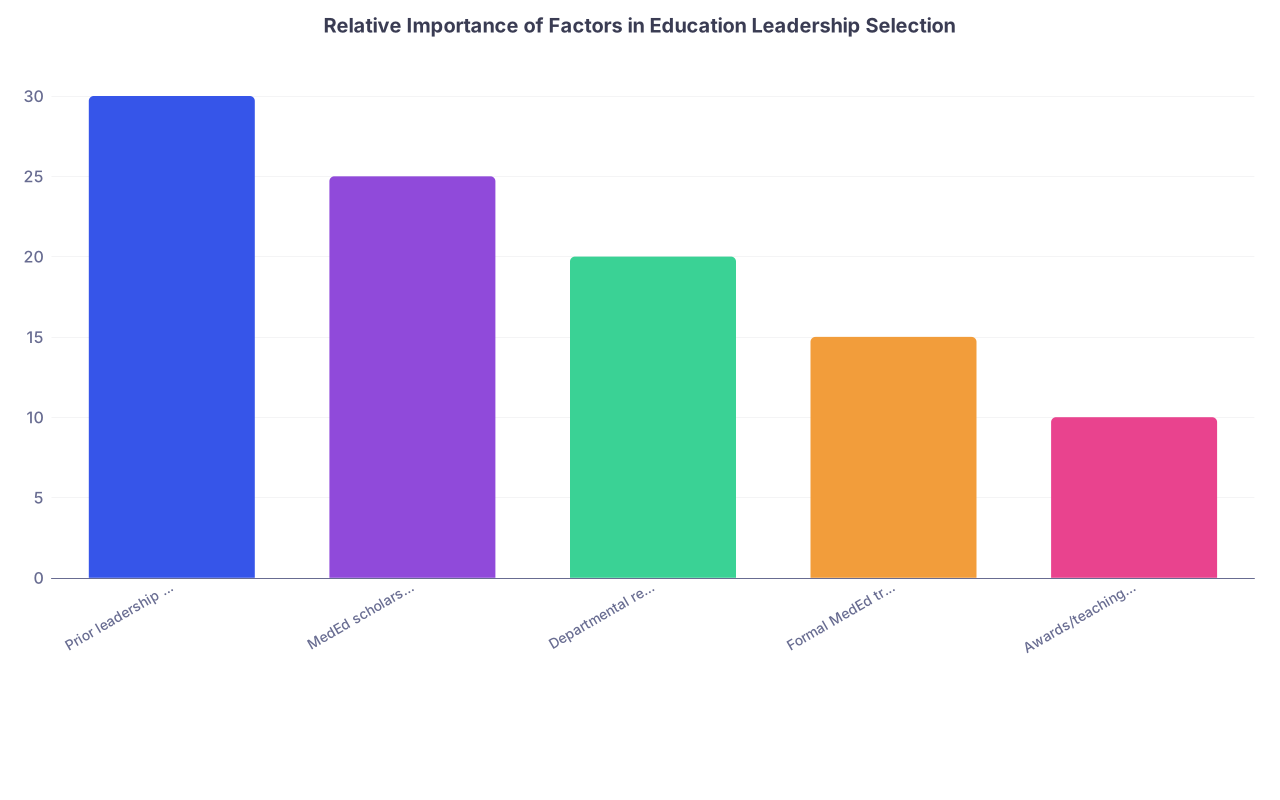
| Category | Value |
|---|---|
| Prior leadership roles | 30 |
| MedEd scholarship | 25 |
| Departmental reputation | 20 |
| Formal MedEd training | 15 |
| Awards/teaching evals | 10 |
In words:
- Prior leadership roles (even small ones) matter most. Committees almost always ask “Have they done this at some scale before?”
- Scholarship is next. Not because the job is pure research, but because it signals promotion viability and external recognition.
- Your reputation in the department (reliability, not being a political problem) is silently critical.
- Formal MedEd training is rapidly moving from “nice-to-have” toward “expected,” especially for larger roles.
- Teaching awards and glowing evaluations help, but they rarely override the other factors.
What does not matter as much as people think
The myths are very consistent:
- Being the “best teacher” in the department, by student evals alone, does not guarantee leadership selection.
- Being clinically excellent matters less than being administratively reliable.
- Years of unstructured “helping out with teaching” without a formal title rarely moves the needle if it is not documented and visible.
I have seen many superb bedside teachers passed over for leadership because their CV had no concrete leadership roles, no scholarship, and no evidence they could manage budgets or accreditation.
FAQ (exactly 4 questions)
1. Are medical education leadership roles becoming more competitive over time?
Yes. The expansion of MedEd fellowships, master’s programs, and formal educator tracks means that the average applicant for a program director or clerkship director role is now coming in with more training and more scholarship than 10–15 years ago. Many institutions are also centralizing selection processes (search committees instead of informal appointments), which increases the number of applicants per position.
2. Does getting a master’s in medical education significantly increase my chances of leadership selection?
It increases your odds, but only as part of a broader portfolio. On its own, a master’s signals commitment and gives you tools and a network, which hiring committees like. The best outcomes occur when the degree is paired with concrete roles (APD, course director), visible projects, and publications that directly relate to the needs of the unit you want to lead.
3. Can community-based faculty realistically move into major education leadership positions?
Yes, but the path is narrower. Community faculty who become site directors, develop robust rotations, and document measurable outcomes (trainee satisfaction, procedural volumes, match results) can and do move into bigger roles, especially if they engage with the main campus in committees and scholarship. The main barrier is lack of visibility and fewer protected time resources, not intrinsic disqualification.
4. If I am a late-career physician with little prior scholarship, is it too late to pursue an education leadership role?
Not categorically, but you will compete against candidates with long MedEd portfolios. Late-career entrants have the best success when they start with smaller formal roles (assistant PD, course co-director), quickly convert ongoing work into a few scholarly products (case reports, curricula, evaluation studies), and complete at least a focused certificate or fellowship. You are unlikely to jump directly into an associate dean role, but department-level leadership is still achievable with a strategic 3–5 year plan.
In the end, three points stand out. First, leadership in medical education follows a predictable pattern: formal roles beget larger roles, scholarship and training amplify your chances, and unstructured “good citizenship” is undervalued. Second, structural inequities by gender, race, and work status are baked into who gets resourced and promoted; ignoring them is naive. Third, if you want one of these jobs, treat it like a career trajectory, not a favor you might be given—build the data on yourself that hiring committees already rely on.