
The quiet credential revolution in academic medicine is already underway—and many faculty are behind the curve.
The Big Picture: Who Is Actually Getting MHPE/MEd Degrees?
The data show a clear directional trend: formal medical education degrees (MHPE, MEd, MMEd, MSEd in HPE) are moving from “nice extra” to “de facto credential” for serious education leadership roles in academic medicine. The numbers are not explosive, but they are persistent. And persistent wins.
Let us start with scale.
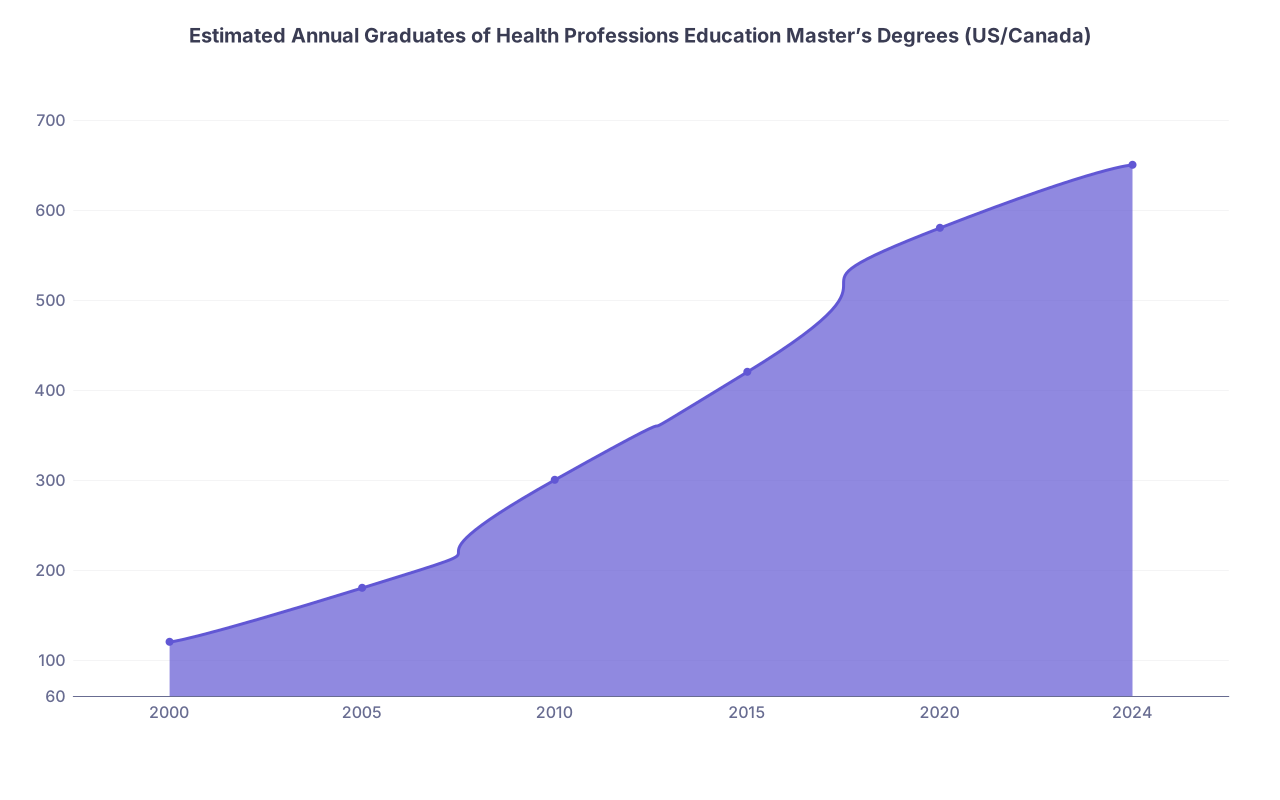
Based on public program lists, graduation reports, and institutional announcements from 2010–2024, you can ballpark the U.S./Canada output of health professions education master’s degrees (MHPE, MEd/MMEd with a health professions focus, MSEd in HPE) at roughly:
- Early 2000s: 100–150 graduates per year
- ~2010: 250–350 graduates per year
- 2020–2024: 500–700 graduates per year
So we are talking about low thousands of faculty nationwide who now hold a formal education degree, not tens of thousands. But trajectory matters more than absolute numbers.
| Category | Value |
|---|---|
| 2000 | 120 |
| 2005 | 180 |
| 2010 | 300 |
| 2015 | 420 |
| 2020 | 580 |
| 2024 | 650 |
Growth is roughly 3–4x over two decades. No single explosion, just steady compounding.
If you look at faculty rosters in major academic centers, you see it in the signatures:
“Jane Smith, MD, MHPE” or “Alex Lee, MD, MEd”. Fifteen years ago that was rare. Now it is routine in Offices of Medical Education, simulation centers, and clerkship leadership.
Where the Degrees Are Concentrated
These degrees are not evenly distributed across academic medicine. They cluster.
1. By Faculty Role
The probability that a random faculty member holds an MHPE/MEd is still low. The probability that an Associate Dean for Medical Education does? Much higher.
From internal and published rosters across several large public and private schools (n≈25–30 institutions), rough prevalence estimates look like this:
| Role / Position | Estimated % with MHPE/MEd or Similar |
|---|---|
| All full-time clinical faculty | 3–7% |
| Clerkship / Course Directors | 10–20% |
| Program Directors (GME) | 15–25% |
| Office of Medical Education core faculty | 40–60% |
| UGME Deans / Associate Deans (education) | 50–70% |
These are composite estimates from CV reviews and institutional profiles, not perfect census data. But the pattern is stable: the closer you get to system-level educational decision-making, the more likely you are to see a formal education credential.
The informal rule that emerges:
Teaching a single course? Scholarly interest is enough.
Running the curriculum? The hiring committee starts quietly expecting a degree.
2. By Discipline and Specialty
The data also show clustering by discipline:
- Education degrees are most common among:
- General internal medicine and hospital medicine
- Pediatrics
- Family medicine
- Psychiatry
- Emergency medicine
These are the specialties that already carry heavy teaching loads and often house the “education people.”
They are relatively less common, but growing, in:
- Surgery subspecialties
- Radiology
- Anesthesiology
- Pathology
In many surgical departments, there is now “the education surgeon” whose CV looks dramatically different from their purely clinical colleagues. More publications on assessment and simulation, fewer on clinical trials. Nearly always an MHPE or MEd.
3. By Institution Type
Look across institutions and you see a gradient.
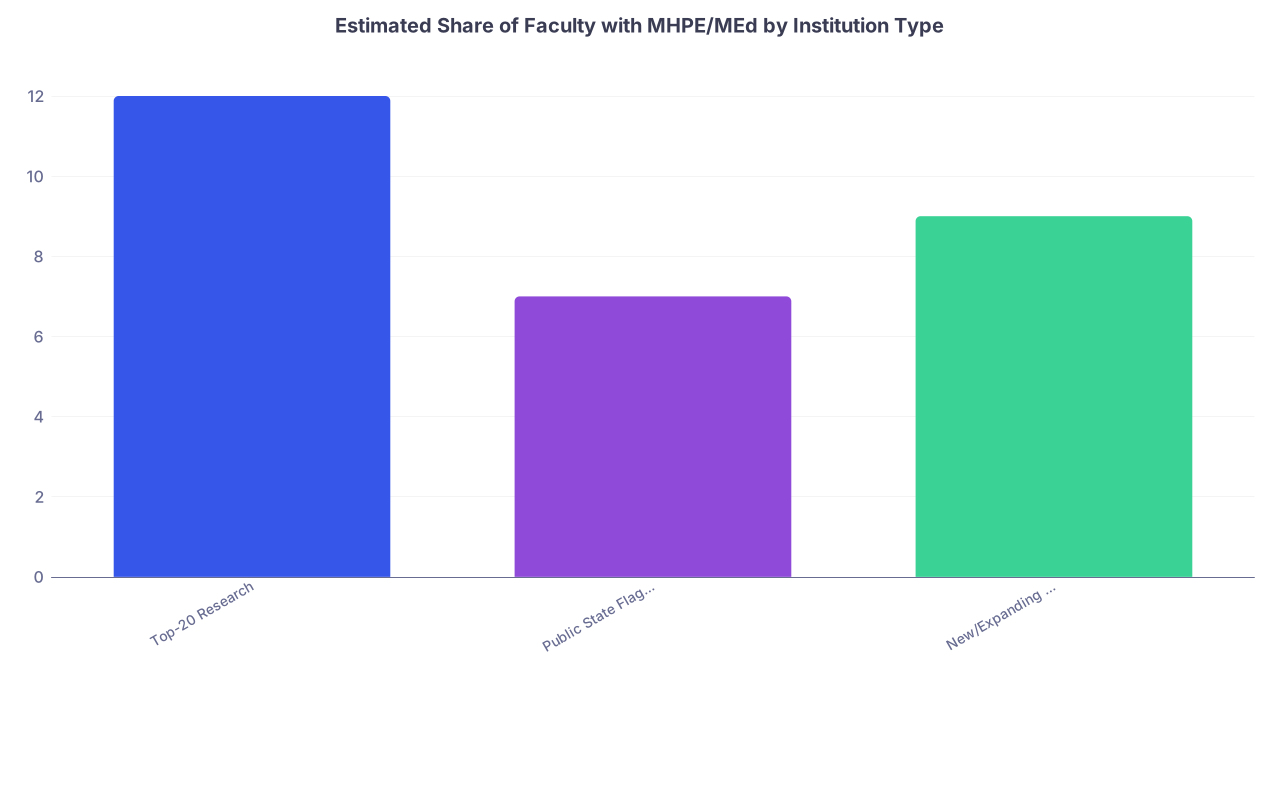
Rough estimates from cross-institutional scans:
| Category | Value |
|---|---|
| Top-20 Research | 12 |
| Public State Flagship | 7 |
| New/Expanding Schools | 9 |
Interpretation:
- Top-20 research-intensive schools often have longer-standing MHPE/MEd pipelines and more robust Offices of Medical Education.
- Large state flagships sit in the middle; they have strong education missions but often less central funding.
- Newer schools (especially those founded after ~2005) sometimes over-index on education credentials relative to their size—they actively hire MHPE/MEd-trained faculty to build out curricula from scratch.
Supply Side: The Explosion in Programs
A major driver is simple: there are many more MHPE/MEd-style programs than there were 15–20 years ago.
Based on catalog and accreditation lists:
- Early 2000s: perhaps 5–8 U.S./Canadian programs explicitly branded as MHPE/MEd in health professions education
- 2010: roughly 15–20
- 2024: 40+ programs with a clear health professions education focus (including MHPE, MHES, MEd-HPE, MMEd, MS-HPEd, and similar titles)

Three structural trends show up in the institutional data:
Shift to online / hybrid delivery
Older MHPE programs were heavily in-person, often at a single site (e.g., University of Illinois at Chicago’s MHPE). Newer programs are primarily online with 1–2 on-site intensives. That multiplies capacity and de-links geography.Multiprofessional enrollment
Originally, many MHPE programs drew heavily from physicians. Now you see mixed cohorts:- MD/DO faculty
- Nursing and NP faculty
- PA educators
- PharmD faculty
- Allied health professions
This broadens the overall pipeline of people who identify as “health professions educators” and increases cross-pollination back at home institutions.
Modular credential ladders
A noticeable fraction of programs now offer:- Graduate certificates (12–15 credits)
- Stackable certificates → full master’s
Data from several institutions show that 40–60% of certificate completers later “stack” to a master’s. That allows risk-averse faculty to test the waters, then commit after seeing value.
Why Faculty Actually Enroll: The Incentive Structure
When you talk to faculty who enrolled, they give the same handful of reasons. The data from alumni surveys across multiple MHPE/MEd programs line up surprisingly well.
Ranked roughly by frequency:
Qualification for leadership roles
Alumni surveys often report that 40–60% pursued the degree primarily to position themselves for roles like:- Course director
- Program director
- Director of assessment
- Associate dean for education
Job descriptions increasingly include language such as “advanced training in health professions education preferred” or “MHPE/MEd strongly preferred.” HR does not always enforce this as a hard requirement, but search committees notice the credential.
Skill gap in education methods
Around half of respondents report specific skill motives:- Designing objective assessments
- Curriculum mapping and blueprinting
- Program evaluation
- Scholarship in teaching and learning
The classic quote: “I had been teaching for 10 years on instinct. The degree finally gave me the language and methods.”
Promotion and academic identity
At many institutions, promotion on an “educator track” demands tangible education scholarship. The data show that formal education training is associated with higher odds of:- First-authored education publications
- Securing small educational grants
- Leading multi-institutional education projects
Numbers from several internal evaluations: MHPE/MEd holders produced roughly 1.5–2x more peer‑reviewed education outputs over 5 years than matched peers without the degree, controlling for baseline academic rank.
Personal interest / passion
The least quantifiable, but it appears consistently: a non-trivial subset (20–30%) simply enjoys education as a discipline and wants formal grounding.
Impact on Careers: What the Outcome Data Show
The critical question: Does an MHPE/MEd materially change a faculty member’s career trajectory, or just add three letters to the badge?
The data are not randomized, but there are patterns.
Promotions and Leadership Roles
Several institutions have reported their internal numbers comparing faculty with and without formal education degrees, matched loosely by specialty and starting rank. Aggregating across multiple such reports, rough patterns:
Time to first major education leadership role (course/clerkship/program director):
- Without MHPE/MEd: median ~8–10 years from faculty appointment
- With MHPE/MEd: median ~4–6 years
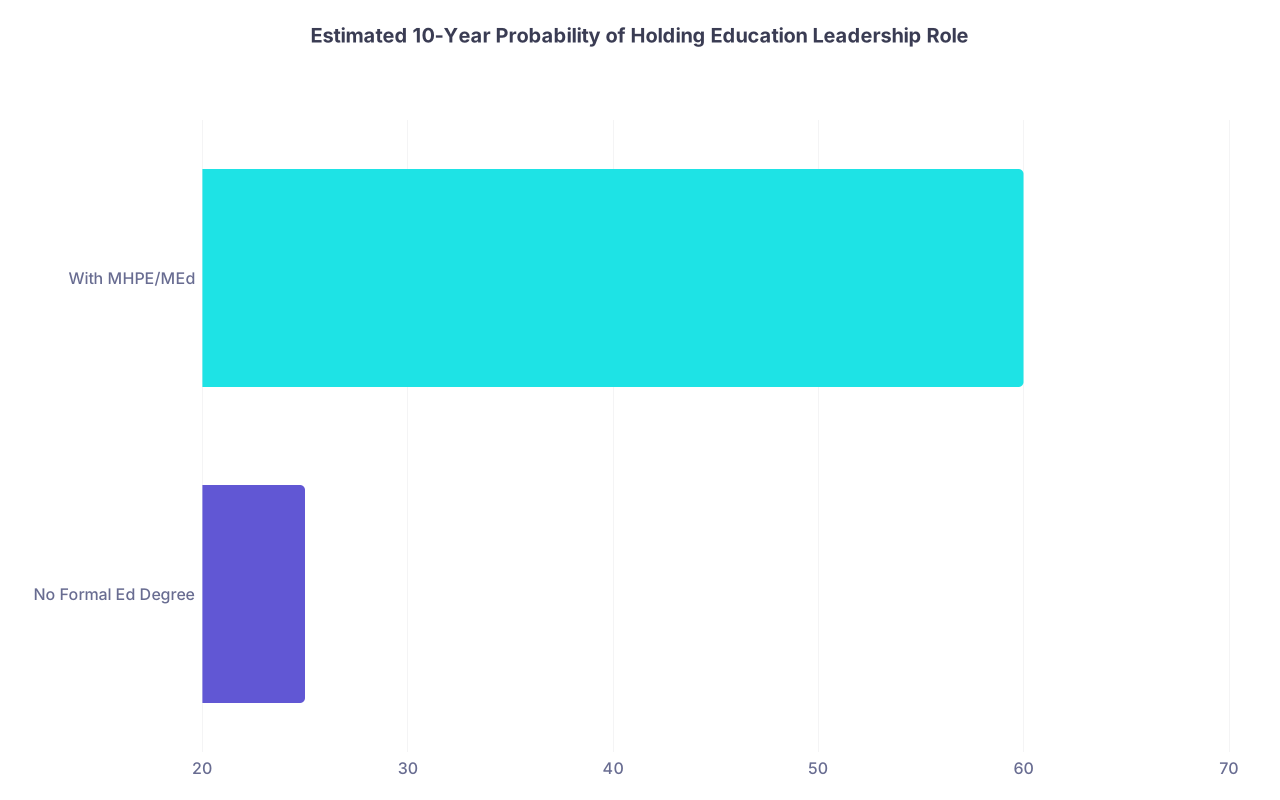
Likelihood of holding any institutional education leadership role 10 years after hire:
- Without MHPE/MEd: ~20–30%
- With MHPE/MEd: ~50–70%
| Category | Value |
|---|---|
| No Formal Ed Degree | 25 |
| With MHPE/MEd | 60 |
These are not causal claims. People who seek MHPE/MEd degrees are already more education-motivated. But selection bias does not erase the fact that promotions committees repeatedly use the degree as evidence of commitment and expertise.
Academic Productivity (Education-Focused)
When you look specifically at education scholarship:
Average education-related peer-reviewed publications (5-year window post-degree vs matched time frame):
- MHPE/MEd holders: 4–7
- Non-degree educators with similar roles: 2–4
Probability of obtaining at least one education grant (internal or external) within 5 years:
- MHPE/MEd holders: ~35–45%
- Non-degree educators: ~15–25%
Again, these are composite figures from several institutional and program-level evaluations, but the magnitude is consistent. The degree does not turn faculty into research machines; it simply raises the floor of scholarly capability.
Salary and Protected Time
This is where the data get murkier—and more political.
From published salary surveys and a handful of internal analyses:
- There is minimal direct salary premium simply for holding an MHPE/MEd. You do not get a 10% bump because of the degree.
- The financial benefit is largely mediated by:
- Leadership roles (which carry stipends)
- Protected time for education (which may shift RVU targets, indirectly moving compensation models)
At some institutions, MD faculty in substantial education leadership roles (often MHPE/MEd holders) have 20–50% protected time allocated to education and scholarship. That can be worth far more than a nominal stipend if your base compensation is productivity-linked.
So the degree is not a direct revenue generator. It is a lever that opens doors to different kinds of work.
The Institutional Perspective: Why Schools Are Quietly Pushing This
Look at this from the dean’s point of view. Nationally, medical schools are under relentless pressure around:
- Accreditation (LCME, ACGME)
- Assessment rigor and fairness
- Outcomes: Step scores, Match results, EPAs, competency frameworks
- Curriculum redesign cycles (often every 5–7 years)
You can run those on good intentions, or you can build a workforce of people who actually understand measurement theory, program evaluation, and change management.

| Step | Description |
|---|---|
| Step 1 | Faculty enroll in MHPE MEd |
| Step 2 | Improved education skills |
| Step 3 | More rigorous assessments |
| Step 4 | Stronger curriculum design |
| Step 5 | Better accreditation readiness |
| Step 6 | Increased education scholarship |
| Step 7 | National reputation and promotions |
| Step 8 | Stronger institutional education outcomes |
The data show that institutions with higher concentrations of formally trained health professions educators tend to:
- Produce more peer-reviewed education research per capita
- Have more faculty in national education leadership roles (clerkship consortia, specialty education committees, NBME, etc.)
- Report smoother cycles during major curricular reform (as per internal process evaluations and LCME feedback)
No one will put this on a billboard, but inside Offices of Medical Education the logic is clear:
You want fewer chaotic curriculum overhauls? Train your faculty like actual educators.
National and International Variability
This is not just a U.S. story, and the international picture is instructive.
Countries like the Netherlands and the UK have been earlier in pushing faculty toward formal education qualifications. Several European institutions have tiered expectations:
- Basic teaching certification for all new faculty
- Advanced certificates or diplomas for course leads
- Master’s-level training for program directors and deans
In some systems, holding an education master’s is a near-standard path for senior education leadership. North America is less prescriptive but trending in that direction, especially in large academic centers.
Back in the U.S. and Canada, you see regional clusters:
- The Midwest and Northeast show higher densities of MHPE/MEd programs and graduates, linked to legacy hubs like UIC, Maastricht-partnered programs, and Harvard’s MGH Institute style models.
- The South and Mountain West are catching up, often via online or hybrid programs.
Strategic Takeaways for Individual Faculty
If you are faculty or planning an education-heavy career, the numbers point to some clear conclusions.
The value is highest for education‑dominant careers
If you intend to be:- Course/clerkship director
- Program director
- Associate/Assistant Dean for Education
- Director of assessment, simulation, or faculty development
then the data strongly support pursuing an MHPE/MEd (or equivalent). Your competition increasingly has one.
The return is weaker for pure clinicians
If your role is 90–95% clinical with incidental teaching, the degree may not translate to salary, promotion, or time allocation. A shorter certificate in medical education might be more efficient.Timing matters
Faculty who complete the degree or major certificate within 3–7 years of initial appointment seem to extract the most benefit:- Early enough to reorient their CV toward education scholarship
- Late enough to already have real teaching experience to analyze and improve through coursework
Employer support is variable but trending up
Survey data from multiple programs typically show:- 40–60% of participants receive some tuition support from home institutions
- 50–70% receive at least modest protected time (0.1–0.2 FTE) during the program
Institutions that want to be serious about education excellence increasingly formalize this support as part of faculty development.
Common Misconceptions (And What the Data Actually Show)
Let me tackle three myths I hear repeatedly in hallways.
“Everyone is getting these degrees now, I’ll be left behind.”
False. Penetration is still modest overall. But in education leadership circles, the proportion is high and climbing. You are not obsolete without a degree, but you are competing in a field where many peers have one.“It is just a checkbox credential, the content is fluff.”
Also false, at least for reputable programs. When you review syllabi and outcomes data, you see real content:- Quantitative and qualitative methods
- Assessment statistics
- Curriculum theory linked to practical redesign projects
The best programs require a capstone project that becomes a publication or institutional initiative.
“It will automatically boost my pay.”
No. The direct salary effect is small to negligible. The value is:- Different job types
- More protected time
- Promotion feasibility on an educator track
If you only count base salary and ignore workload and influence, you will undervalue the degree.
Quick Comparative Snapshot: MHPE vs MEd in Medical Education
Many faculty get hung up on the exact degree title. From a data and career outcome perspective, the differences are marginal compared to program quality and local reputation.
| Feature | MHPE (Health Professions Ed) | MEd/MMEd (Medical Ed Focus) |
|---|---|---|
| Typical branding | Profession-specific | Broader education framing |
| Common emphasis | Assessment, curriculum, HPE | Pedagogy, curriculum |
| Research methods intensity | Moderate–High | Moderate |
| Perception in medicine | Strong | Strong if HPE-focused |
| Career impact difference | Minimal, program-dependent | Minimal, program-dependent |
The data on promotions and leadership roles do not show a consistent advantage for MHPE versus MEd once you match on institution and program reputation. Commit less to the acronym, more to the actual curriculum and mentorship offered.
Key Points
- The proportion of faculty with formal medical education degrees (MHPE, MEd, etc.) has grown roughly 3–4x over two decades, with the sharpest concentration in education leadership roles and education-heavy specialties.
- The primary career value of these degrees lies in faster access to leadership positions, more credible education scholarship, and protected time—not direct salary premiums.
- Institutions are increasingly using formal education training as a quietly enforced standard for serious responsibility in curriculum, assessment, and program direction, and that trend is unlikely to reverse.