The story medical schools tell about faculty time is fiction. The data from time‑use studies shows a very different reality from what appears in workload formulas, promotion dossiers, and budget spreadsheets.
If you work in academic medicine, you probably already feel the disconnect. Your contract says “0.4 FTE teaching, 0.4 clinical, 0.2 research.” Your week feels like 0.8 clinical, 0.5 teaching, 0.1 research, and 0.3 administration. Time‑use studies exist precisely to quantify that gap between paper and reality.
Let us walk through what the numbers actually show.
What Time‑Use Studies Are (And Why Faculty Numbers Are Usually Wrong)
Time‑use studies replace guesswork with data. Instead of asking “How much do you teach?” they ask a more precise question: “Across a defined period (week, month, year), how many hours did you actually spend in specific activities?” Then they track it in real time or near real time.
Common methods:
- Self‑reported time logs (daily or weekly)
- Random time sampling (pings via app / email: “What are you doing right now?”)
- Electronic traces (EMR timestamps, learning management system logs, calendar data)
- Hybrid designs combining logs with objective metrics
The catch: faculty workload models rarely come from this kind of data. They come from:
- Multipliers applied to contact hours (“1 hour lecture = 3 hours prep”)
- Historic norms that no one has updated since before online learning
- Negotiated FTE splits driven by budget constraints, not workload realities
So the first thing time‑use studies consistently show is simple: “teaching FTE” numbers dramatically undercount real teaching time. Usually by a factor of 1.5–3x, depending on role and course type.
How Medical Faculty Actually Spend Their Time: The Numbers
Different institutions, specialties, and roles produce different distributions. But if you aggregate across published studies from North America, Europe, and Australia, the pattern is surprisingly stable.
For full‑time clinical faculty with explicit teaching duties, a typical week lands roughly in these ranges:
- 45–60 total work hours per week (averages cluster around 50–55)
- 55–70% of time in direct clinical care
- 10–25% in teaching and educational activities (including prep, feedback, mentoring)
- 5–20% in research/scholarship
- 5–20% in administration, meetings, and “other”
Let us visualize a simple aggregate view based on composite values from multiple time‑use reports (e.g., AAMC, institutional audits, and specialty‑specific studies).
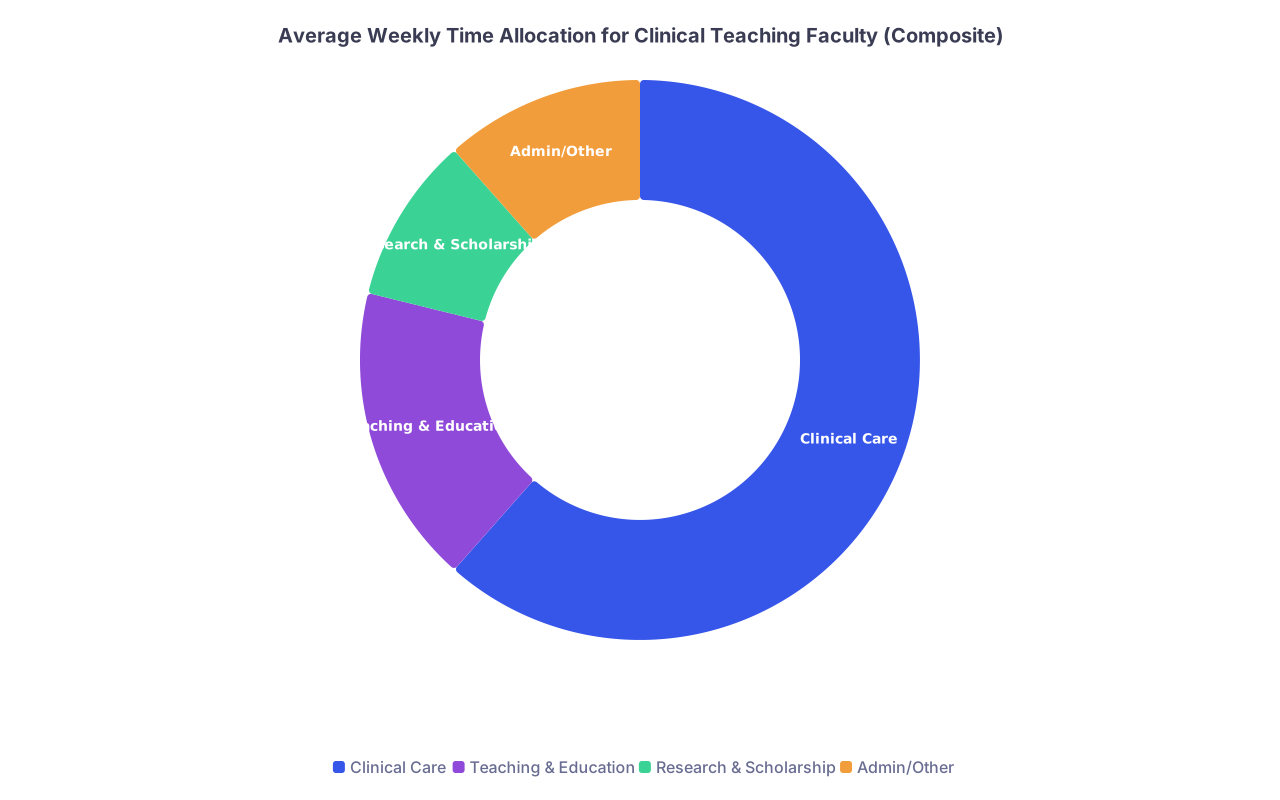
| Category | Value |
|---|---|
| Clinical Care | 32 |
| Teaching & Education | 9 |
| Research & Scholarship | 5 |
| Admin/Other | 6 |
This chart assumes a 52‑hour workweek, which is on the conservative side for many academic clinicians.
The headline takeaways:
- Teaching is never just “a few hours.” Nine hours is the center of gravity; many are far higher.
- Clinical work dominates, often crowding out protected teaching time.
- Admin creep is real; 5–8 hours a week vanishes into meetings, emails, and compliance.
Now compare this to how workload models often represent the same FTE. A common template for a “0.3 teaching FTE” on a 1.0 FTE contract:
- 0.3 teaching = 12 hours/week
- 0.5 clinical = 20 hours/week
- 0.2 research = 8 hours/week
- 0.0 admin (magically folded into everything else)
When you put real time‑use data next to these idealized allocations, they do not line up. Not even close.
What “Teaching” Actually Includes: Under‑Counted Activities
Most faculty think of “teaching” as what is on the schedule: lectures, small groups, bedside rounds. Time‑use studies, in contrast, force a more granular classification. When you push faculty to log time honestly, the “teaching” category expands fast.
Common, systematically under‑counted teaching activities include:
- Lecture / session preparation and slide updating
- Grading written assignments, OSCE checklists, and exams
- Writing narrative feedback and entrustment decisions
- Informal corridor teaching, case discussions, curbside consults with learners
- Curriculum development and mapping to competencies/EPAs
- Assessment design, blueprinting, and item analysis review
- Remediation work with struggling learners
- Mentoring and career advising (which is educational, not just social)
- Email traffic with learners (questions, clarifications, feedback on drafts)
In time‑use logs, these often appear as 15‑30 minute snippets sprinkled throughout the day and evening. Each one looks harmless. In aggregate, they add up to 5–10 hours per week that never appears in the official workload.
I have seen faculty shocked when their own four‑week logs showed:
- “I thought I spent maybe two hours weekly on email with students. The log showed 4.5 hours.”
- “I laughed at the idea that my 1‑hour lecture was ‘three hours of work.’ For a new block, I logged 9–10 hours.”
Time‑use studies convert those anecdotes into numbers you can no longer hand‑wave away.
Clinical Teaching vs Non‑Clinical Teaching: Very Different Time Profiles
Medical education is not homogenous. A pre‑clinical basic science lecturer, an ambulatory preceptor, and a surgery attending on call all “teach,” but their time‑use patterns differ radically.
Let us compare three representative faculty profiles based on composite findings:
| Faculty Role | Direct Contact Teaching (hrs) | Prep/Assessment/Mentoring (hrs) | Total Teaching Time (hrs) |
|---|---|---|---|
| Pre-clinical course director | 6–8 | 10–16 | 16–24 |
| Inpatient clinical attending (4 wks on / 4 off model, averaged weekly) | 8–10 | 3–5 | 11–15 |
| Ambulatory preceptor (1.5 clinic days/wk with learners) | 5–7 | 2–4 | 7–11 |
Several consistent patterns emerge across studies:
- Pre‑clinical roles skew heavily toward prep and assessment. Direct contact hours under‑represent half or more of total teaching workload.
- Clinical faculty have more “embedded” teaching during patient care. Prep may be lower, but cognitive load is higher because they are balancing teaching with safety, efficiency, billing, and documentation.
- Course and clerkship directors get hammered: double‑digit hours in coordination, assessment management, and quality assurance that often gets mislabeled as “admin” rather than “education.”
If your department uses a single multiplier (e.g., “1 contact hour = 2.5 total hours”) for all teaching types, the data says you are wrong. The ratio varies systematically by role:
- Pre‑clinical course director: 1 hour contact → 2–4 hours total
- OSCE examiner/coordinator: 1 hour contact → 3–5 hours total (design, calibration, debrief)
- Inpatient attending: 1 hour formal rounds → 1.2–1.8 hours including pre‑round huddles, feedback, documentation time shaped by teaching
- Ambulatory preceptor: 1 half‑day clinic with learners (4–5 hours) → 5–7 total hours when you include pre‑clinic planning, post‑clinic debriefs, slowed patient flow
Time‑use data consistently finds these ratios higher than institutions expect.
The Hidden Night and Weekend Workload
One of the most damning findings from time‑use logs: a non‑trivial proportion of educational work is done outside standard hours. Evenings and weekends are not “protected.” They are the overflow buffer where teaching prep, grading, and feedback get pushed when clinical days run long.
Several studies that dissected work by clock time find patterns like:
- 15–30% of teaching prep and grading occurs after 6 p.m. on weekdays
- 10–20% of total educational work spills into weekends for faculty with clinical loads >60% FTE
- Email with learners often spikes between 8–11 p.m.
Let us approximate a weekly view of when educational work happens for a typical clinical teaching faculty member (again, based on composites):
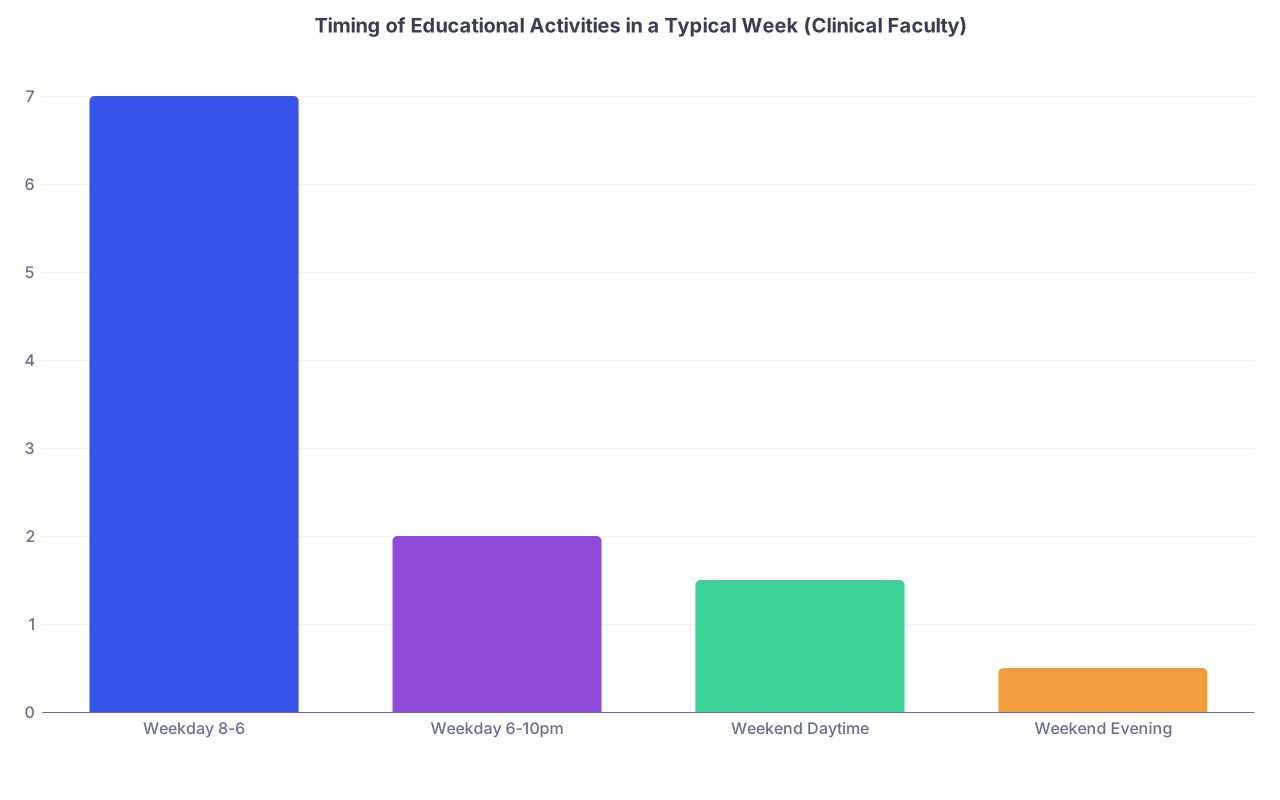
| Category | Value |
|---|---|
| Weekday 8-6 | 7 |
| Weekday 6-10pm | 2 |
| Weekend Daytime | 1.5 |
| Weekend Evening | 0.5 |
Total ~11 hours of teaching‑related work, of which roughly 4 hours happen outside standard academic hours. That is more than one‑third of educational work being done “off the books” from a scheduling perspective.
If your promotion and workload policies treat evenings and weekends as faculty “flex time” where nothing countable happens, you are ignoring about 25–40% of their real educational labor.
Time‑Use Studies vs Self‑Estimates: Faculty Under‑Report Teaching
Humans are terrible at retrospective time estimation. Faculty are no exception. They reliably misjudge how many hours they spend on teaching tasks, especially micro‑tasks like email, short feedback conversations, or document reviews.
Studies that compare:
- Prospective time logs (record as you go)
- Retrospective self‑estimates (“How many hours did you spend on teaching last week?”)
…find a predictable pattern:
- Faculty under‑report teaching time by 20–40% when asked retrospectively.
- They over‑report more “visible” activities (lectures, scheduled meetings) and under‑report fragmented tasks (feedback, email, quick consults).
- Clinical faculty show larger gaps than non‑clinical faculty, likely because their days have more task switching and interruptions.
This is why I put almost zero weight on faculty survey responses that say “I spend 4–5 hours per week on teaching.” Once you hand them a structured log and ask them to document activities for four weeks, that number jumps to 8–12 hours for similar faculty.
The data is clear: if you want real numbers, you have to track, not ask people to guess.
Specialty Differences: Who Carries the Heaviest Teaching Load?
Not all specialties are equal here. The intensity and visibility of teaching vary with clinical pace, team structure, and culture.
Composite time‑use data and departmental audits often show:
- Internal Medicine and Pediatrics inpatient services: high total teaching time, much of it embedded in rounds, consults, and case review
- Surgical specialties: lower formal teaching hours per week on service, but very high cognitive load when teaching (OR teaching, procedural supervision) and significant mentoring outside service blocks
- Psychiatry, Family Medicine, and ambulatory‑heavy fields: substantial ongoing precepting, with many short educational interactions that are time‑consuming but hard to capture in schedules
- Pathology and radiology: less face‑to‑face patient time, more one‑on‑one or small group interpretive teaching; prep and curation of cases can be significant
Here is one simplified composite view across four broad specialty categories, focusing on weekly teaching‑related hours for faculty with explicit educational roles:
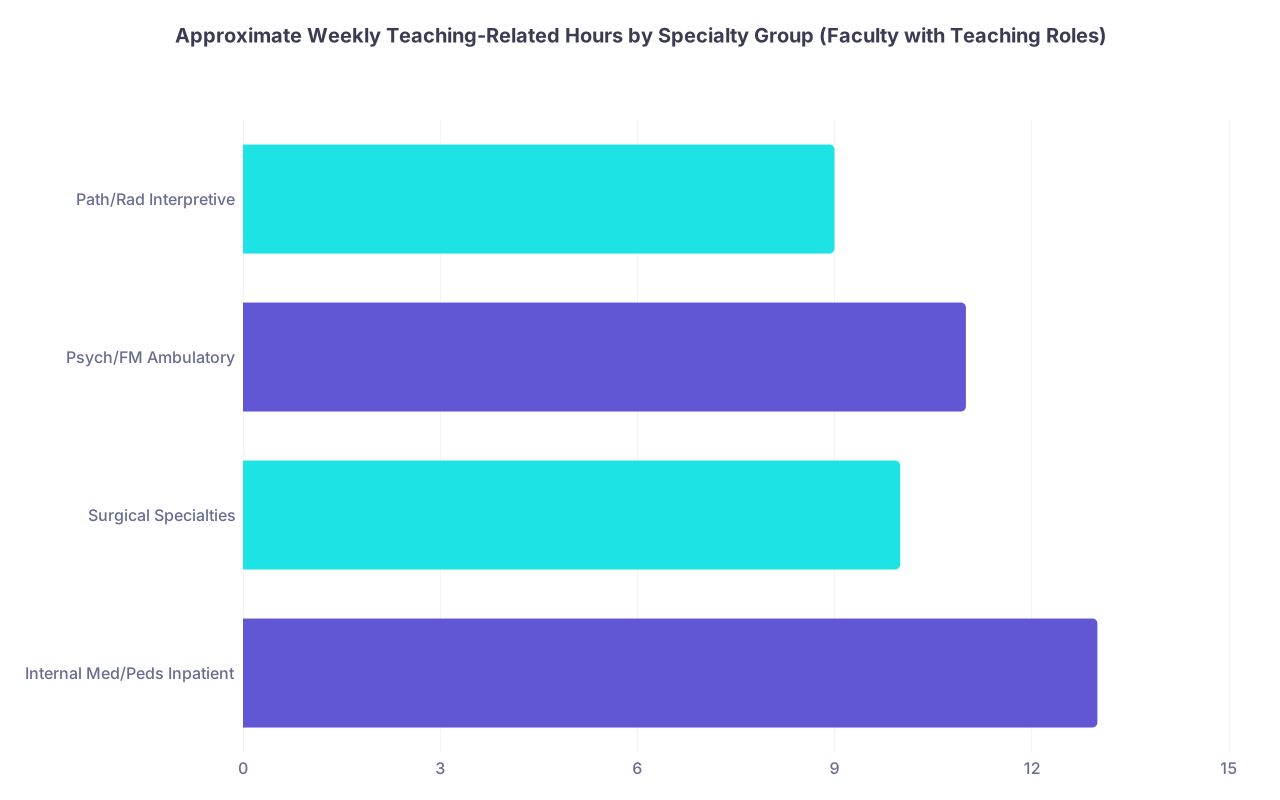
| Category | Value |
|---|---|
| Internal Med/Peds Inpatient | 13 |
| Surgical Specialties | 10 |
| Psych/FM Ambulatory | 11 |
| Path/Rad Interpretive | 9 |
These numbers include prep, assessment, feedback, and curriculum work. They are not dramatically different on raw hours, but the structure of the work is.
Two key implications:
- Time‑use studies should be stratified by specialty and role. A single institutional multiplier for “teaching time” is lazy and wrong.
- Heavy inpatient rotations with large learner teams may require explicit teaching time allowances beyond just “rounds count as service,” otherwise faculty will cannibalize evenings and weekends to keep up.
The Administrative and Compliance Tax on Teaching Time
Medical education has become bureaucratically dense: competency frameworks, EPAs, milestones, workplace‑based assessments, simulation requirements, accreditation documentation. Every one of those layers generates time costs.
Time‑use data often shows a meaningful share of “teaching” time consumed not by teaching itself, but by:
- Filling out assessment forms and evaluation portals
- Attending curriculum committee meetings, EPA calibration sessions, remediation boards
- Preparing accreditation documents and reports
- Handling learner professionalism concerns, documentation, and follow‑up
Faculty will often categorize this time as “admin,” because it feels like paperwork rather than teaching. From a workload accounting perspective, that is a mistake. These are educational tasks mandated by the institution. They should sit under educational FTE.
Based on logs I have seen, for faculty in formal leadership roles (course director, clerkship director, residency APD/PD), education‑related administration typically consumes:
- 3–7 hours per week during normal periods
- 10–15 hours per week during curricular redesigns, accreditation visits, or major assessment rollouts
If your institution assigns 0.1 FTE (about 4 hours/week) for a clerkship director who, in reality, logs 12+ hours/week of educational meetings, assessment management, and problem‑solving, you can predict the outcome: burnout, turnover, and underperformance.
How Institutions Should Use Time‑Use Data (But Often Do Not)
Time‑use studies are not just descriptive. They are tools for policy correction. When done systematically, they inform four major decisions:
FTE allocations and contracts
- Replace flat multipliers with empirically derived ratios for different teaching types.
- Align protected time for course/clerkship leadership with real administrative and assessment loads.
Compensation and incentives
- Calibrate stipends and RVU equivalents for teaching roles to actual time spent.
- Avoid “volunteerism by stealth,” where large educational responsibilities are loaded onto faculty without financial or FTE recognition.
Curriculum design and scheduling
- Identify courses or rotations where prep and assessment time is excessive relative to impact.
- Simplify overly fragmented curricula that create constant context‑switching and micro‑tasks for faculty.
Faculty development and support
- Target areas where time is being wasted through poor systems (e.g., clunky assessment platforms that double documentation time).
- Build shared resources (question banks, slide repositories, standard feedback templates) where data shows redundant effort.
The problem is that many institutions treat time‑use data like an academic exercise rather than a basis for reform. They run a one‑off study, publish a paper, then revert to old workload models that bear no resemblance to the findings.
If you are in leadership and you do that, you are not “data‑informed.” You are selectively deaf.
Practical Design of a Time‑Use Study for Medical Faculty
If you want credible data in your own setting, you need a design that balances accuracy with feasibility. The perfect, highly granular log that takes 20 minutes per day to complete will fail because faculty will not do it beyond week one.
A pragmatic structure that I have seen work:
- Sampling frame: 4–6 weeks spread across a semester or clinical block, capturing both routine and peak periods.
- Granularity: 15‑minute increments, coded into a limited, well‑defined set of categories (clinical with learners, clinical without learners, prep, grading/assessment, feedback/mentoring, admin, research, personal).
- Tooling: Simple mobile‑friendly web app or spreadsheet with drop‑down categories and optional free‑text notes.
- Prompting: Daily email or SMS reminders with a 24‑hour recall window.
- Confidentiality: Clear separation between data used for aggregate analyses and any individual‑level feedback (and no link to performance reviews without explicit consent).
Once collected, analyze at several levels:
- Overall averages by role and specialty
- Distribution (not just means—identify high‑load outliers)
- Ratio of clinical to teaching time within clinical sessions
- Proportion of educational work occurring outside standard hours
- Variance by type of educational task (prep vs assessment vs mentoring)
That last point matters. If you discover that 40% of educational time in a particular block is spent on grading and narrative comments, you might decide to redesign assessment methods to reduce that load without sacrificing quality.
What the Data Ultimately Says about “Real” Teaching Workloads
Strip away the nuance and the picture is blunt.
First, teaching FTE for medical faculty is systematically under‑assigned relative to real time use. A faculty member “budgeted” for 0.2–0.3 FTE education often logs closer to 0.4–0.5 FTE when you include prep, assessment, mentoring, and educational admin.
Second, clinical work crowds educational work into evenings and weekends. That invisible shift does not just burn people out. It quietly devalues teaching, because all the off‑hours labor is treated as personal choice rather than institutional responsibility.
Third, educational leadership roles are routinely under‑resourced. Time‑use studies repeatedly show that course directors, clerkship directors, and PDs/APDs shoulder administrative and assessment loads that dwarf their formal time allocations.
Fourth, not all teaching is equal. Pre‑clinical content, OSCEs, simulation, and competency‑based assessment frameworks generate much heavier prep and documentation loads per contact hour than traditional lectures or simple ward rounds. Any institution pretending otherwise is consciously ignoring data.
If you care about educational quality, faculty retention, and honest budgeting, you cannot keep relying on FTE fairy tales. Time‑use studies give you hard numbers. The onus is then on leadership to align workload models with reality, not the other way around.
Three points to keep in mind:
- Teaching takes far more time than contact hours suggest—typically 1.5–3x once prep, assessment, and mentoring are counted.
- A significant share of that work happens at night and on weekends, unrecognized by formal workload models.
- When time‑use data clashes with your current FTE assignments, the data is usually right. Your model is not.