
What if every successful medical educator you know has teaching awards… and you have absolutely none?
The ugly thought you’re probably having
Let me guess what’s running through your head:
- “Everyone else was chief resident or got a Golden Apple. I got… solid evals. That’s it.”
- “If I don’t have teaching awards on my CV, programs will think I’m not serious about medical education.”
- “Maybe I already missed the boat. Real educators started in med school, right? I’m too late.”
Here’s the blunt answer: yes, you can absolutely still be a medical educator without any teaching awards.
But I’m not going to lie to you: the lack of awards does change how you have to play the game.
Let’s walk through it like someone who’s a little freaked out (you) and someone who has seen this play out a hundred times (me).
Reality check: what programs actually care about
Awards look shiny on paper, sure. But they’re lazy evidence. They’re a shortcut signal.
What people actually care about when they’re hiring or promoting medical educators:
- Can you teach well enough that learners don’t hate you?
- Do you actually show up and do the work?
- Can you design or improve something — a course, a rotation, a workshop — not just “give a lecture”?
- Do other faculty trust you with responsibility?
- Are you building a track record, not just a random one-off?
Awards are one way to signal that. Not the only way.
Here’s the uncomfortable secret: sometimes awards just mean you were popular with one class, or your department decided “it’s her year.” I’ve seen truly mediocre teachers with multiple teaching awards. I’ve also seen phenomenal educators with none.
Lack of awards doesn’t kill you.
Lack of evidence does.
So your whole job now is: build alternative, undeniable evidence.
Why you don’t have teaching awards (and why that’s not fatal)
Let’s be honest about the little voice in your head:
“Maybe I don’t have awards because I’m just not good enough.”
Sometimes it’s not you. Sometimes it’s:
- Your department doesn’t give many teaching awards
- The same 2–3 “classic” teachers win every year
- Students don’t even know you’re an option to nominate
- You teach residents more than students (fewer student-driven awards)
- You’re early in training and haven’t had many chances
I’ve watched residents do tons of teaching, run bootcamps, mentor endlessly… and still never get the shiny plaque. They move on to academic jobs and become core faculty anyway.
What actually hurts you isn’t “no awards.”
What hurts you is:
- No documented teaching roles
- No leadership in education (even small stuff)
- No scholarship or QI in education
- No one who can say “this person is the go-to teacher for X”
Awards are optional. Those things are not.
If you have zero awards, here’s what your CV needs instead
Let’s say you’re starting from almost nothing. No teaching awards, no teaching titles, just “I’ve helped on rounds and maybe gave a talk.”
Here’s what you want your teaching section to say instead:
| Category | Concrete Examples |
|---|---|
| Formal Teaching | Lectures, small groups, skills sessions, bootcamps |
| Longitudinal Roles | Course liaison, small-group preceptor, near-peer |
| Curriculum/Program Work | New session, OSCE cases, rotation redesign |
| Mentoring/Advising | Long-term mentees, coaching, interest groups |
| Education Scholarship | Posters, workshops, MedEd research/QI, publications |
If you can’t check anything there yet, that’s actually good news: there’s a clear to-do list. You’re not doomed; you’re just under-documented.
Step 1: Turn “I like teaching” into real, countable roles
Right now you might be stuck in this vague zone: “I like teaching, I teach on rounds, students like me, but I don’t have anything formal.”
You need to convert that into roles.
Some things you can chase this month (not five years from now):
- Volunteer to give a recurring lecture in your department’s didactic series
“Can I take the EKG teaching block for the MS3s this year?” - Ask to help with simulation or skills labs
“I’d love to help precept in the central line or code blue sim sessions.” - Join or start near-peer teaching
“Intern/resident bootcamps, Step review sessions, OSCE prep nights.” - Get on the radar of the clerkship/education director
Quick email: “I’m really interested in med ed and would love to be involved in any teaching or curriculum projects if openings come up.”
This isn’t glamorous. It’s not “Director of X” on day one. But this is exactly how the people with teaching awards started — they just stuck with it.
Step 2: Document the hell out of what you’re already doing
Big mistake I see all the time: people are teaching, but their CV looks empty because nothing is written down.
If you have no awards, your documentation has to be airtight.
Start doing this today:
- Keep a running teaching log
Date, audience, topic, format, approx. # of learners. - Save any written feedback
End-of-rotation eval comments, anonymous student comments if they’re shared, emails that say “thank you, this was helpful.” - Convert informal teaching into something that “counts”
That “informal” M4 suturing session you did for interns? Put it under “Skills Workshops – Intern Suturing Bootcamp (Organizer/Instructor).”
You’re not inflating. You’re just not erasing your own work.
Step 3: Build a narrative that doesn’t rely on awards
You’re terrified they’ll ask, “So what teaching awards have you gotten?” and you’ll just sit there, exposed.
Here’s what you want to be able to say instead:
“I haven’t received a formal teaching award yet, but over the last three years I’ve consistently taken on these roles…”
…and then you list them like a calm assassin:
- “I’ve been a recurring small-group preceptor for the M2 cardio block.”
- “I co-developed a bedside ultrasound workshop and have run it for three cohorts.”
- “I mentor 4–5 students a year interested in [your field], with structured meetings and feedback.”
- “I presented a poster on our revamped intern bootcamp at the [education conference name].”
By then they’re not thinking “no awards.” They’re thinking “ah, this person is doing actual work.”
This is where your personal statement, cover letters, and interviews matter. Use them to:
- Show a trajectory (how your interest in teaching grew and solidified)
- Highlight impact (what changed because you taught or built something)
- Admit the gaps without apologizing for existing
“My institution has limited formal teaching awards, but I’ve sought feedback and longitudinal roles to build my skills.”
No groveling. No “sorry I’m not good enough.” Just facts.
Step 4: If you’re really anxious, build tangible “proof” projects
If your brain won’t shut up and keeps whispering “but without awards no one will take me seriously,” then give it something solid to hold onto:
Create one or two flagship education projects you can point to.
Some examples:
- A structured intern or sub-I orientation curriculum
- A series of evidence-based teaching handouts or pocket guides
- A new OSCE station or assessment tool that your program actually uses
- A longitudinal coaching program for struggling students
- A recurring simulation scenario that you designed and run
Then do two critical things:
- Collect outcomes, even small ones
- Pre/post confidence surveys
- Attendance numbers
- Simple evaluation forms
- Turn it into scholarship
- Poster at COMSEP, APDIM, SGIM, STFM, etc.
- Short article or MedEdPORTAL submission
- Workshop at a regional or institutional education day
Now you’re not “the person with no awards.”
You’re “the person who built that thing that people actually use.”
That matters way more.
Awards vs. everything else: what actually moves the needle?
Let’s be brutally pragmatic. If you’re angling for a career in med ed — clinician educator jobs, maybe later an APD or Clerkship Director — what helps you more?
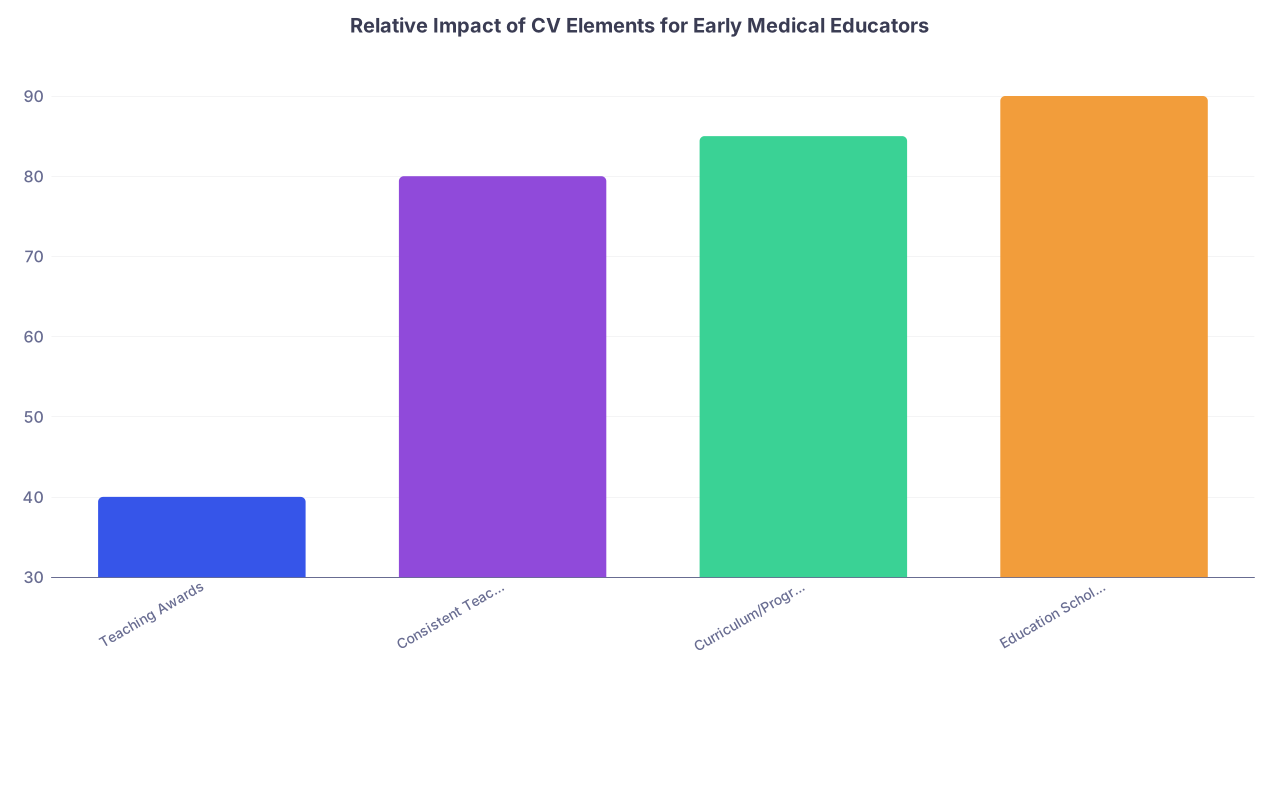
| Category | Value |
|---|---|
| Teaching Awards | 40 |
| Consistent Teaching Roles | 80 |
| Curriculum/Program Work | 85 |
| Education Scholarship | 90 |
Those numbers aren’t from a study; they’re reality-based estimates from what I’ve repeatedly seen on hiring committees.
Awards are nice. Sustained roles, curriculum work, and scholarship win.
The quiet bias you’re scared of (and how to counter it)
Let’s address the real fear: that silent judgment.
You picture someone scrolling your CV thinking, “Huh. No teaching awards. Guess they’re not that good.”
Here’s how you blunt that reaction:
- Make your education section impossible to ignore
Lots of entries, clear roles, sustained over time. - Get strong letters that explicitly say you’re an exceptional teacher
Ask writers to address your teaching, not just your clinical work. - Lean into professional development
- Attend a “medical education fellowship” for residents/fellows
- Do a teaching certificate or educator track
- Take part in faculty development workshops and actually list them
The internal monologue you want them to have is:
“Wow, this person is really serious about med ed and has already done a lot… awards or not.”
Tiny things you can do this week that actually move the needle
Your brain probably wants to fix everything right now. It can’t. But you can stack small, smart actions.
Here are realistic moves if you’re already drowning in residency/fellowship/work:
- Email your program’s education chief:
“Can I help with any upcoming sessions, review content, or support small groups?” - Ask to see your teaching evaluations
Screenshot and save the positive comments. Start a folder. - Volunteer to orient new students or interns
Then write it on your CV: “Intern Orientation – Small Group Facilitator, 3 sessions/year.” - Sign up for the next teaching workshop at your institution
Put “Completed XYZ Teaching Skills Course” under professional development. - Write down everything you’ve already done in the last 12–24 months that counts as teaching. You’ll be surprised.
You are almost certainly doing more than your anxiety is giving you credit for.
When awards do matter — and what to do then
There are specific situations where awards can give you an extra boost:
- Super competitive academic jobs at big-name institutions
- Early promotion for “excellence in education”
- Highly visible educator-track positions where leadership wants “names” they can point to
If you’re gunning for those, you don’t need to invent a past. You need to set up your future:
- Ask your department if there are nomination processes you’re not aware of
- Let mentors know that if there are opportunities for student-nominated awards, you’d appreciate being considered
- Make sure you’re visible to learners
Hard to win an award from students who barely know your name
But you should never treat “no award yet” as “I should give up.” The pipeline to those roles is long, and lots of people don’t get formal awards until fairly late.
Quick gut-check: are you actually behind, or just comparing badly?
Most people you’re comparing yourself to?
You’re seeing:
- Their Twitter bio: “multiple teaching awards”
- Their institutional profile with all the medals
- Their conference speaker page
You’re not seeing:
- The 7 years of random small-group sessions they did first
- The early failed projects
- The long stretch where they also had no awards and thought about quitting
If you’re in med school, residency, or early fellowship and already even thinking about a career as a medical educator, you’re not behind. You’re actually ahead of the average person who only realizes it 5–10 years in.
The gap is not that you lack awards. The gap is that you haven’t yet translated your interest into a track record that can stand alone.
You can fix that.

| Step | Description |
|---|---|
| Step 1 | No Teaching Awards |
| Step 2 | Take Formal Teaching Roles |
| Step 3 | Document Evaluations and Feedback |
| Step 4 | Create or Improve Curriculum |
| Step 5 | Produce Education Scholarship |
| Step 6 | Apply for Educator Jobs or Tracks |
| Step 7 | Seek Strong Teaching Letters |
FAQ (exactly what your brain is probably asking)
1. Will not having any teaching awards hurt my chances for an academic clinician-educator job?
Not by itself. Committees look at the whole education portfolio: teaching roles, curriculum work, scholarship, and letters. If your “Teaching Experience” section is robust and you’ve got at least some education-related scholarship or leadership, the lack of awards usually isn’t a deal-breaker. What will hurt is a thin teaching section with nothing but “teaches on rounds” and no evidence of initiative. Fix that first.
2. Is it dishonest to list informal teaching (like ad-hoc intern teaching) on my CV?
It’s dishonest if you exaggerate scope, frequency, or impact. It’s not dishonest to accurately describe what you actually did. If you ran three formal suturing sessions for interns, call it “Intern Suturing Workshop – Organizer/Instructor (3 sessions, 10–15 learners each).” Just don’t turn one hallway chat into “longitudinal mentoring program.” When in doubt, be precise and modest with wording. Honest detail looks more credible than vague inflation.
3. Should I wait to apply for medical educator roles until I get at least one teaching award?
No. Waiting is how people lose years. You don’t need an award to apply; you need a story and a portfolio. If you have: recurring teaching roles, clear examples of curriculum or program involvement, and at least emerging scholarship or quality improvement work in education, you’re already competitive for many early educator positions. Apply, and keep building. Awards can come later; they’re often a lagging indicator, not a prerequisite.
4. How do I talk about my lack of awards in an interview without sounding defensive or insecure?
You don’t lead with it. You focus on what you do have: “My institution doesn’t have many formal teaching awards, but over the last few years I’ve taken on X, Y, and Z teaching roles, helped build A and B curricula, and presented our work at C conference.” If they press specifically about awards, you can answer simply: “I haven’t received a formal teaching award yet, but I’ve consistently prioritized teaching and sought feedback and expanded responsibility every year.” Then pivot back to concrete examples. Calm, factual, no apology tour.
Open your CV right now and scroll to your “Teaching” section. If it looks thin or vague, pick one concrete action from this article — emailing an education leader, logging your sessions, or volunteering for a specific role — and do it today.