
The idea that you’re “too late” to pivot into medical education after residency is nonsense—and it ruins more careers than burnout ever will.
Let me say it clearly: most people in medical education didn’t start there. They drifted in. Fell into it. Backed into it sideways while trying to survive residency. You’re not behind. You’re just more honest about wanting it.
Still, I know what your brain is doing right now:
“I never did a med ed fellowship.”
“My CV is just service, service, service.”
“All my co-residents went to private practice. Do I even have ‘real’ options?”
“Programs only want people with PhDs in education and 20 publications, right?”
I’ve heard all of this. In workrooms at 2 a.m., on Zoom with PGY-3s who just matched hospitalist jobs, in hallways after M&M when someone awkwardly asks, “So… how do I, like, get into teaching?”
Let’s walk through this like someone who is tired, a little panicked, but not willing to give up on the idea of having a career that doesn’t slowly drain their soul.
You’re Not Late. You’re Just Not Linear.
Medical careers look linear on paper and are totally chaotic in real life.
The people running clerkships, directing residencies, designing curricula? Huge number of them:
- Finished residency
- Did a few years as a hospitalist or generalist
- Realized they gravitated to teaching
- Then built an education niche
They didn’t all come out of the womb as “future associate deans of undergraduate medical education.”
Here’s the part no one says out loud: Med ed structures are built on people who will take on extra teaching, committee work, and curriculum projects on top of their “real” clinical job. Departments are desperate for people who reliably show up, teach well, and don’t bail last minute.
You aren’t late. You’re untapped labor they would actually be thrilled to use—if you signal correctly and deliberately.
What “Pivoting to Medical Education” Actually Means (Not Instagram Version)
You’re probably imagining something dramatic: quitting your clinical job and magically becoming “Director of Something Important” at a med school.
That’s not how it usually goes.
Real med ed pivots often look like this:
Year 0–1 after residency:
You’re a hospitalist, or outpatient doc, or subspecialist. You start precepting students and residents, maybe a half-day a week. You give a noon lecture. Someone asks you to help write questions for an exam. You say yes.
Year 1–3:
You get labeled as “the good teacher,” “the reliable one,” “the person who actually cares if the intern understands ABG interpretation.” You start getting asked to:
- Join a curriculum committee
- Serve as a clerkship site director or assistant director
- Help with simulation sessions or OSCEs
- Mentor a QI or education project
You still don’t have a fancy title. You do have a pattern.
Year 3–5:
Now job postings start to make sense. “Clerkship Director,” “Associate Program Director,” “Director of Simulation,” “Pre-clinical Small Group Course Director.” Your CV no longer looks like “random resident who likes teaching,” it looks like “junior educator with a developing portfolio.”
That’s the pivot. Gradual, built while working, not a single leap.
The Part I’m Scared Of: Did I Miss the “Credentials Window”?
This is the loop that keeps your heart rate up at 1 a.m.:
“I never did a medical education fellowship, so I’m doomed.”
“I don’t have a master’s in education.”
“I barely have any publications.”
Let me be blunt.
Residency is not the only time to get med ed credentials. In fact, a lot of people are better positioned to do formal education training once they’re attendings, because they actually have:
- Control over their schedule (somewhat)
- Institutional CME/education funding
- Access to real projects with impact
Here are the three credential “lanes” that actually matter, and how late you can join each:
| Path | When You Can Start | Typical Time | Needed Before First Job? |
|---|---|---|---|
| Med Ed Fellowship | Late residency/early attending | 1 year | Helpful, not required |
| Masters (MEd/MEHP/etc.) | Early–mid career | 1–3 years | No |
| Faculty Development Cert | Any time | Months | No |
You can start any of those after residency. I’ve seen:
- 2nd-year hospitalists starting a part-time Master of Health Professions Education
- 40-year-old subspecialists doing a one-year certificate in curriculum design
- Program directors appointed first, then going back for a master’s later
The system cares way more about:
“Can you actually teach, lead, and not be a chaos magnet?”
than
“Did you time your degrees perfectly with a Pinterest-ready career timeline?”
Your anxiety is putting deadlines on a path that doesn’t really have them.
What If My CV Is Just… Service?
Here’s the awful feeling: three pages of your CV are “worked a ton of shifts,” and none of it screams “future director of education.”
You see people with:
- Education fellowships
- Med ed publications
- Poster after poster
- A literal degree in medical education
And you’re like, “Cool, I have… charge notes and a few noon conferences.”
Let’s reframe.
You probably already have raw material for a med ed pivot that looks useless to you because it came from a place of exhaustion and survival:
- You taught new interns how to manage night cross-cover
- You unofficially oriented all the rotating students because no one else did
- You rewrote the sign-out template to make it actually understandable
- You made a one-page antibiotic cheat sheet everyone uses
- You’re the person nurses call when they want something explained to a trainee
Those aren’t just “helping behaviors.” They’re education behaviors. You just haven’t:
- Named them as education work
- Documented them
- Turned them into durable, shareable products or roles
Your next step is to convert fuzzy goodwill into formal stuff that belongs in a teaching portfolio.
The Concrete Moves: How To Pivot Without Blowing Up Your Life
Let’s say you’re PGY-3, or a brand new attending, or 2–3 years out and suddenly realizing, “I don’t want to just grind forever; I actually care about teaching.”
Here’s the non-fantasy, “I’m tired but serious” roadmap.
Step 1: Get Visible as a Teacher Where You Already Are
No job hunt yet. No degrees yet. Start with your current institution.
Do three things:
- Email your program director / clerkship director / UME office and say, “I’d like to get more involved in teaching. Are there upcoming opportunities for small groups, skills sessions, or lectures that need faculty?”
- Say yes to 1–2 recurring teaching commitments: a weekly skills lab, a recurring simulation, a fixed precepting half-day. Consistency is the currency.
- Start collecting evaluations and feedback. Ask learners to complete the official forms. Save nice comments. Screenshot emails.
You’re not trying to teach everything. You’re trying to become known as “a go-to teacher.”
Step 2: Attach Yourself to One Education Project
Exhaustion trap: trying to say yes to twelve committees and seven workgroups. Don’t.
Pick one thing that can become a project with a beginning, middle, and end:
- Designing or revamping a small group case series
- Building a brief bootcamp for incoming interns
- Creating a structured orientation for a rotation that’s currently chaos
- Leading a QI project with residents that has an educational component
Turn that project into:
- A brief presentation locally (grand rounds, education conference)
- Maybe a poster or workshop at a regional/national meeting
- A line on your CV labeled clearly as education scholarship or innovation
You’re not chasing Impact Factor. You’re building evidence that you don’t just “like to teach,” you can actually build things.
Step 3: Get Some Formal Development (Without Quitting Your Job)
Now that you’ve signaled interest and done some real work, you add structure.
Options that don’t require blowing up your life:
- Your institution’s faculty development series in teaching skills
- Longitudinal “medical education academy” programs
- Online certificate courses in curriculum design, assessment, or simulation
- Short workshops through groups like AAMC, SGIM, APDIM, etc., depending on your field
If you want to go bigger and you can handle the bandwidth:
- Part-time master’s in medical education, health professions education, or academic medicine
- A concentrated one-year education fellowship as a junior attending (some are structured that way)
You can do these 1–5 years after residency and they’ll still “count.” There is no secret cutoff.
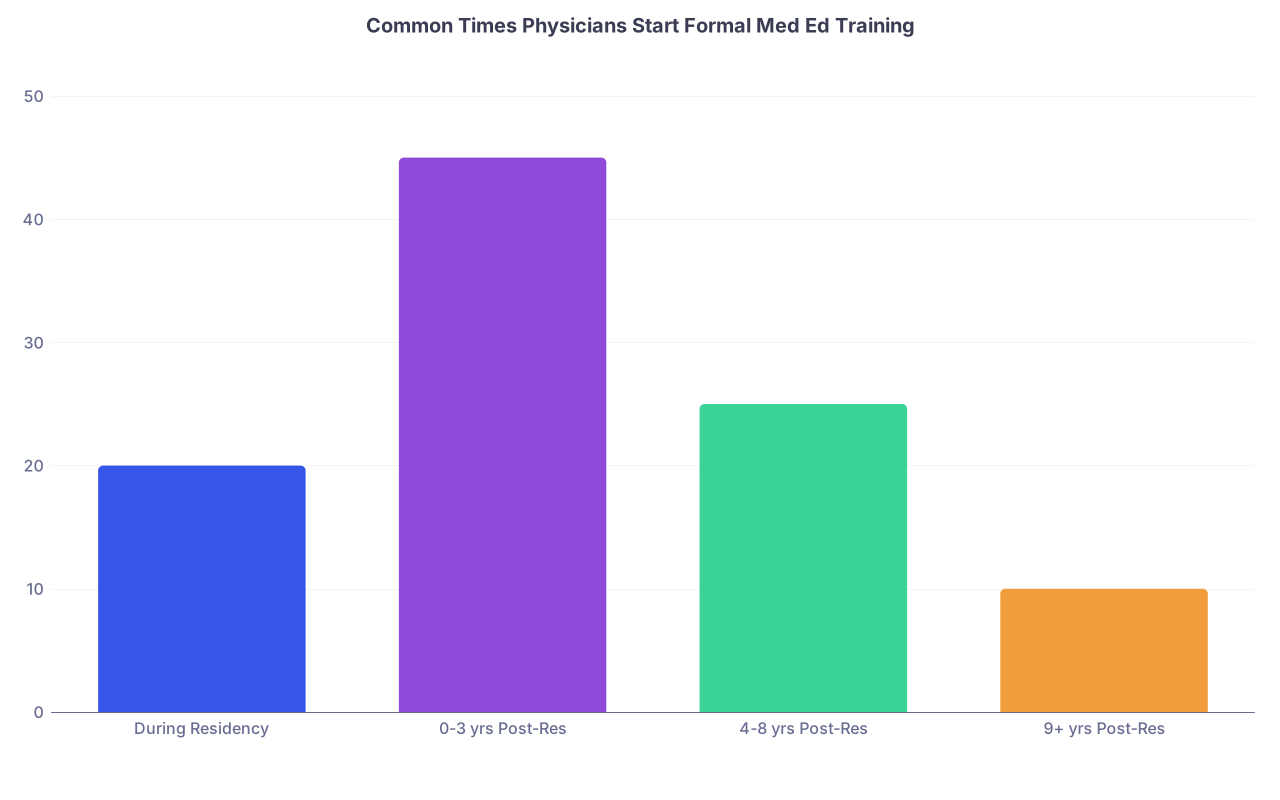
| Category | Value |
|---|---|
| During Residency | 20 |
| 0-3 yrs Post-Res | 45 |
| 4-8 yrs Post-Res | 25 |
| 9+ yrs Post-Res | 10 |
See that? A huge chunk start after residency. You’re not some bizarre outlier.
Step 4: Translate Your Work Into a Med Ed Story
Eventually, someone on a hiring committee is going to think: “Why this person for an education role?”
Your job is to make the answer painfully obvious.
You want to be able to say something like:
“I finished residency in 20XX and realized my favorite part of my job was working with students and residents on [specific skill/rotation/setting]. Since then, I’ve:
- Precepted X hours per week in [setting]
- Led [specific curriculum or project] that [brief impact]
- Completed [development program or coursework] in [topic]
- Presented [poster/talk/workshop] on [education topic]
I’m now ready to move into a more formal role where I can focus on [clerkship direction, residency leadership, curriculum development, etc.].”
That’s not fantasy. That’s what a 2–5-year pivot can look like.
But What If I’m Already An Attending and Feel Stuck?
This is a special kind of anxiety. You’ve already committed in your head to one path. Your job title doesn’t say “education” anywhere. You’re worried changing direction will look flaky or desperate.
Let me be very direct: mid-career pivots into medical education happen all the time. Especially now, with burnout and people wanting more meaning.
What usually changes is not your entire job overnight. It’s your balance.
Maybe you’re 100% clinical right now. Over 2–4 years you work toward:
- 10–20% FTE protected for education
- A title like “Associate Clerkship Director” or “Associate Program Director”
- Slightly fewer shifts, more teaching and admin
You don’t need to quit and start over. You need:
- A department that values education
- A clear ask (not “I like teaching” but “I’d like to work toward X role; what would it take?”)
- A growing track record that justifies protected time
A lot of mid-career folks finally articulate what they want and discover their chair has been trying to find someone to take on those responsibilities for years.
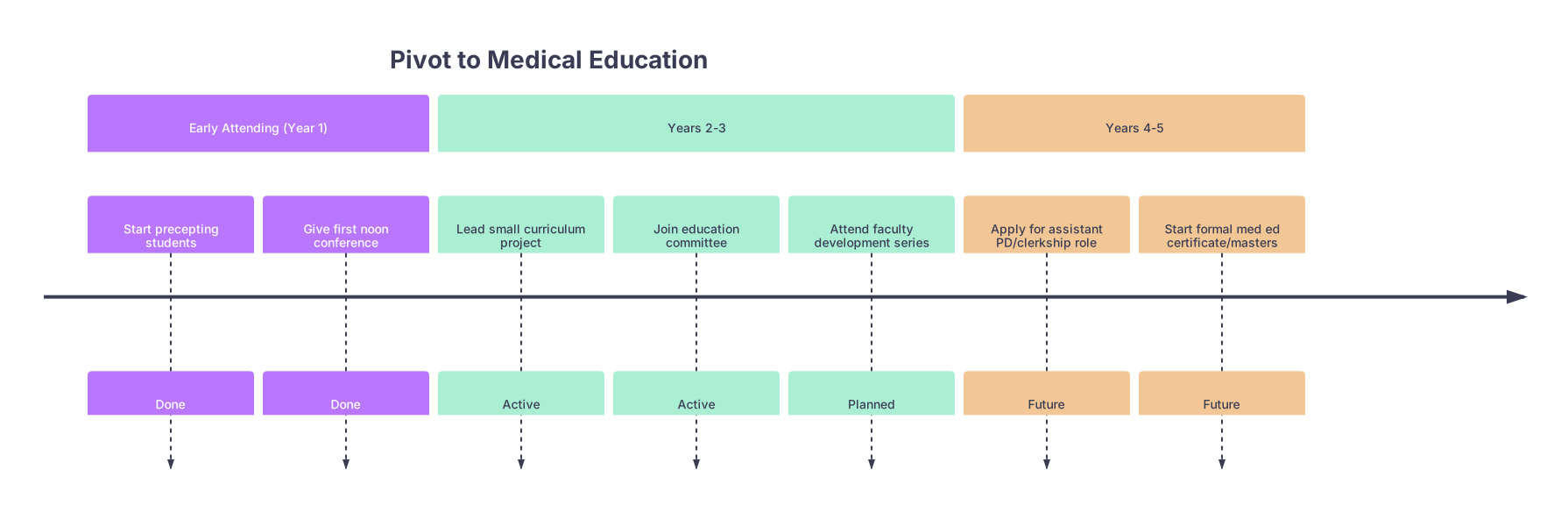
| Period | Event |
|---|---|
| Early Attending (Year 1) - Start precepting students | Done |
| Early Attending (Year 1) - Give first noon conference | Done |
| Years 2-3 - Lead small curriculum project | Active |
| Years 2-3 - Join education committee | Active |
| Years 2-3 - Attend faculty development series | Planned |
| Years 4-5 - Apply for assistant PD/clerkship role | Future |
| Years 4-5 - Start formal med ed certificate/masters | Future |
See how nothing there required being “early enough”? It’s just deliberate.
The Dark Thought: What If I’m Just Not Good Enough?
This is the one that sits under everything else: “What if I aim for med ed and they just… don’t want me?”
Here’s what I’ve actually heard from med ed leaders in rooms you’re not in:
“We just want someone who won’t cancel last minute.”
“I need a faculty member who actually likes students.”
“If they’re coachable and they show up, we can teach them the rest.”
The bar is not “perfect, fully formed educator with a 10-page teaching portfolio.” The bar is:
- You care about learning
- You show up consistently
- You can communicate like a human
- You’re willing to grow and accept feedback
You are almost certainly underestimating how thirsty institutions are for decent, reliable educators.
Realistic Constraints You Shouldn’t Ignore
I’m not going to blow smoke. There are constraints:
- Some academic jobs pay less than pure clinical work
- Protected time can be fragile and subject to budget cuts
- Certain roles (clerkship director, APD, etc.) really do expect some scholarship output
- Institutional politics exist and can be gross
This isn’t a fairy tale. It’s a tradeoff.
If your financial situation absolutely requires you to maximize income for a few years (loans, family obligations), you might have to sequence your pivot: lean clinical now, deliberately build med ed on the side, then re-balance when you can afford it.
That doesn’t mean you’re out. It means the timeline is yours, not Instagram’s.
A Quick Reality Check: What Med Ed Jobs Actually Look Like
Let’s demystify the endgame a little. Not all “medical education careers” are the same.
| Role | Typical Clinical % | Education Focus |
|---|---|---|
| Core Clinical Faculty | 80–90% | Bedside teaching, lectures |
| Associate PD | 60–80% | Residency admin, curriculum |
| Clerkship Site Director | 70–90% | Student rotations, evals |
| Simulation Faculty | 60–90% | Sim sessions, scenarios |
| Pre-clinical Small Group Leader | 80–100% | Case-based, small group |
Notice how none of those are 0% clinical. Pure education roles exist, but they’re rarer and usually mid to late career.
Your pivot is probably toward a hybrid role. Clinical + teaching + some admin. You ease into identity as an educator while still being a physician.
That’s not failure. That’s the norm.
You’re Allowed To Start Now, Even If You’re Afraid
I know the feeling—you want some sign that you’re “allowed” to go for this. Some external person to say, “Yes, this makes sense, you’re not delusional.”
So here it is: you are not too late to pivot to medical education after residency. Not at PGY-3. Not as a new attending. Not at 5 or 10 years out.
You might be too late to have the neat, linear, Instagram-ready CV. Fine. Most people don’t have that anyway.
But you are absolutely not too late to:
- Become the person learners remember years later
- Hold a real title in education
- Shape curricula and training environments
- Build scholarship around how people learn medicine
- Wake up in five years and realize your main professional identity is “educator”
You just have to stop treating your interest like a guilty secret and start acting like someone who belongs in those rooms.
FAQ (Exactly 6 Questions)
1. Do I need a medical education fellowship to have a real med ed career?
No. Fellowships are great accelerators, not gatekeepers. Lots of APDs, clerkship directors, and even deans never did a formal fellowship. What you do need is a visible track record: consistent teaching, participation in curriculum/assessment work, some scholarship or local innovation, and ideally some structured faculty development. A fellowship can bundle all that, but you can also build it piece by piece while working.
2. Should I delay graduation or do an extra chief year just to “boost” my med ed chances?
Only if you genuinely want those years for their own sake. A chief year or extra training can absolutely help—leadership, teaching experience, visibility—but they’re not mandatory tickets into education. Staying longer purely out of fear of being “underqualified” is usually a bad trade if you’re already burnt out. You can build an education path as an attending.
3. How do I explain a pivot to med ed in interviews without sounding flaky?
Frame it as a clarification, not a reversal. Something like: “In residency and my early attending years, I noticed the parts of my work that energized me most were teaching and building structure for trainees. Over time I took on [specific activities], completed [development/education training], and now I’m intentionally seeking a role where education is a core part of my responsibilities.” That sounds focused and mature, not erratic.
4. What if I’m at a community hospital or non-teaching site right now—am I stuck?
No, but you’ll need to be more deliberate. Some community settings still have students or residents; if so, start there. If not, consider: joining a nearby medical school as adjunct faculty, helping host students on elective rotations, or planning a medium-term move to a teaching institution. I’ve seen community docs build a teaching profile through regional med schools and then later jump into full-time academic roles.
5. How much scholarship is “enough” to be taken seriously for education roles?
For early roles (core faculty, associate PD, clerkship site director), you don’t need a dozen PubMed-indexed papers. A small handful of meaningful outputs is often enough: a couple of posters or workshops at regional/national meetings, maybe 1–3 education-related publications, plus local presentations. Quality and coherence of your story (“I work on assessment,” “I build simulation,” etc.) matters more than raw count.
6. What’s one thing I can do this week to move toward a med ed pivot?
Email one person with actual power in education at your institution—program director, clerkship director, vice chair for education, UME office—and write a short, direct note: “I’m very interested in doing more with medical education. I’d love to discuss where there might be opportunities to get involved in teaching or curriculum work.” That single email starts the paper trail that you are serious, and it often leads to your first real opportunity.
Open your CV right now and add a new heading called “Teaching and Medical Education Activities.” Then force yourself to list anything you’ve ever done that counts as teaching. Seeing that section grow over the next 6–12 months will be your proof that the pivot isn’t theoretical—it’s already started.