
The myth that you must have a medical education fellowship to be a good teacher is scaring way too many people away from teaching.
The Fear Behind the Question
You’re probably seeing the same thing I see: every program suddenly has “Director of Medical Education,” “Simulation Lead,” “Curriculum Fellow,” and half of them have extra letters after their names. MEd. MHPE. FAIMER. Certificates from places you’ve only seen in conference brochures.
And your brain is going:
- “If I don’t do a medical education fellowship, am I dead in the water?”
- “Will program directors laugh at my CV?”
- “What if I think I’m good at teaching but I’m actually terrible and everyone can tell except me?”
- “Will I be stuck as ‘just a clinician’ forever while everyone else gets promoted?”
Let me be very direct:
A medical education fellowship is not mandatory to have a real, respected career in medical education. But “I’ll just pick it up on the job” without a plan? That’s how people plateau at “enthusiastic resident teacher” and never move past it.
So the real question isn’t “fellowship vs. on the job.”
It’s: How intentional are you willing to be about learning to teach?
What a Med Ed Fellowship Actually Gives You (And What It Doesn’t)
Here’s where people get twisted. They imagine a fellowship is this magical doorway: walk in as overwhelmed resident, walk out as Associate Dean of Curriculum with five publications and a TED talk.
Reality is much more… regular.
Most medical education fellowships (GME or post-residency) give you some mix of:
- Protected time for educational projects
- Formal coursework in curriculum design, assessment, feedback, learning theory
- A structured project (curriculum, assessment tool, remediation program, etc.)
- A couple of conference presentations / posters
- Access to a med ed mentor and a small network
That’s it. No secret handshake. No guaranteed promotion. No auto-admit to your dream faculty job.
What they do really well is help you:
- Build a coherent story: “I’m serious about med ed, here’s the training and work to prove it.”
- Avoid reinventing the wheel. You learn tested frameworks instead of trial-and-error chaos.
- Produce actual scholarly output instead of a graveyard of half-finished “teaching projects” on your laptop.
But here’s the part nobody puts on the glossy brochure:
I’ve met fellowship-trained people who still give terrible feedback. Who can recite Bloom’s taxonomy and still run soul-crushing PowerPoints.
And I’ve met “no formal training” clinicians who are incredible teachers because they obsessively reflect, seek feedback, and deliberately practice.
So no, a fellowship is not a magical certification of competence. It’s structured help. That’s all.
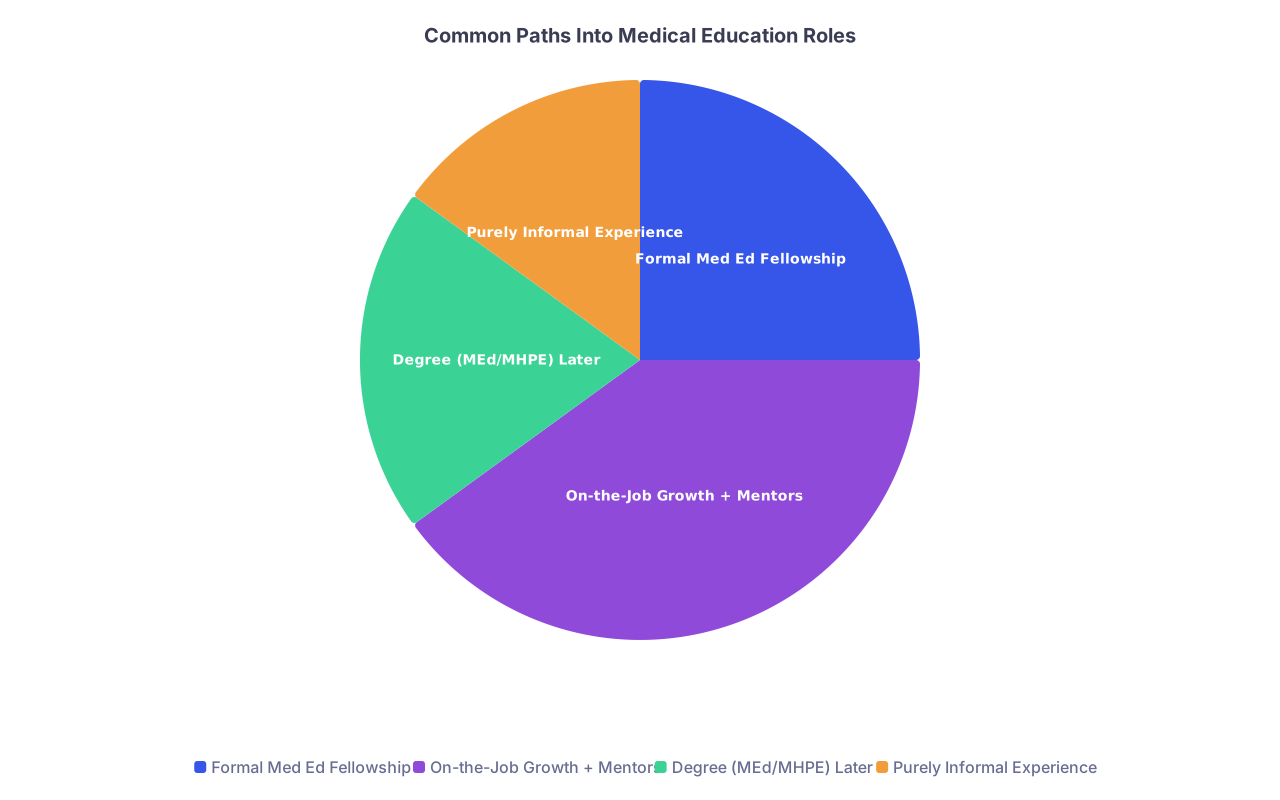
| Category | Value |
|---|---|
| Formal Med Ed Fellowship | 25 |
| On-the-Job Growth + Mentors | 40 |
| Degree (MEd/MHPE) Later | 20 |
| Purely Informal Experience | 15 |
Can You Actually Learn This “On the Job”?
Yes. People do it all the time. But “on the job” means something very different depending on how you approach it.
If your plan is:
“I’ll teach when students are around and hope I get better over time” — that’s not a plan. That’s vibes.
The people who truly learn on the job and end up in real education leadership roles usually do some version of this (even if they don’t label it):
They claim specific teaching spaces early.
Not just random bedside pearls. They own something: a recurring small group, a weekly skills session, a regular lecture, being the reliable resident who takes students on rounds.They chase feedback like it’s their job.
Not the fake “any feedback for me?” at the end of a shift. Real questions:- “When I explained that case, where did I lose you?”
- “If you had to change one thing about how I run this session, what would it be?”
And then they actually change something.
They read targeted stuff.
Not a giant med ed textbook cover to cover. Short, practical things:- One article on feedback models.
- One on bedside teaching.
- One on writing good MCQs.
They try it out. Reflect. Adjust.
They build a mini-portfolio without calling it that.
They keep slides, handouts, evaluations, emails from learners, outlines of sessions they created. When the time comes to apply for a faculty role or med ed title, they’re not starting from zero.
So yes, you can absolutely grow “on the job.” But if you do it passively, you’ll look back in five years and realize you’ve been repeating the same teaching year on loop.
Learning on the job works only if you treat teaching like a discipline, not a personality trait.
Where Fellowship Does Make a Real Difference
Now the part you’re actually afraid of: are there times when not doing a fellowship will hurt you?
Yes. In some lanes, it really can.
If you’re aiming for:
- Major UGME roles (e.g., Assistant Dean for Curriculum, Course Director at top schools)
- Big GME jobs (Program Director of a large residency, Vice Chair of Education)
- A heavily research-focused med ed career (lots of grant-funded education research, first-author education papers)
Then structured training (fellowship or formal degree) starts shifting from “nice” to “expected” the closer you get to those upper levels.
Does that mean you’re locked out forever without it? No. But in a pile of CVs, the one that reads:
“Med Ed Fellowship, X scholarly projects, Y leadership roles, formal training in assessment and curriculum design”
often looks cleaner than:
“Really likes teaching. Did a lot of it. Some stuff here and there. No clear narrative.”
Fellowship is partly real learning, partly signaling. It signals:
“I have taken this seriously enough to structure my growth, learn theory, and produce something concrete.”
You can build that signal other ways. It just takes more planning and more hustling.
| Path | Biggest Advantages | Biggest Downsides |
|---|---|---|
| Med Ed Fellowship | Structured training, protected time, strong signaling | Extra year(s), lower pay, limited spots |
| On-the-Job + Mentors | Flexible, no extra time, real-world focus | Easy to be scattered, weaker signaling |
| Later MEd/MHPE Degree | Deep theory, academic credibility | Time, tuition, can be less practical |
| Purely Informal Teaching | Immediate, no cost | Plateau risk, hard to get leadership |
The Worst-Case Scenarios You’re Imagining (And What Actually Happens)
Let’s walk through the horror stories running around in your head.
“If I don’t do a fellowship, I’ll never get a med ed job.”
No. I’ve sat in meetings where they hired a new Clerkship Director who had:
- No formal fellowship
- Solid teaching evaluations
- A clear history of owning parts of the curriculum
- A couple of practical education projects with measurable outcomes
What does get quietly filtered out are applications that say, “I love teaching” but can’t show any sustained, structured involvement.
You don’t need a fellowship. You need evidence.
“Everyone will assume I’m less serious than fellowship-trained people.”
Some will. Especially at super academic places. That bias exists. I won’t sugarcoat it.
But you can fight it with:
- A focused narrative (“I built most of my training through X, Y, Z deliberate experiences and projects.”)
- Actual output (curricula, workshops, assessment tools, quality improvement with educational impact).
- A clear lane (“I’m the person who does simulation” or “I run the remediation program” or “I own the clerkship orientation”).
I’ve seen fellowship-trained folks sidelined because they never translated their training into visible work. And non-fellowship clinicians given huge responsibilities because they got things done and didn’t just talk in theory.
“If I do a fellowship and then decide I hate med ed, I’ve wasted my life.”
No, but you might have spent a year you didn’t need to. That’s the real risk.
Before you lock yourself into a fellowship, ask yourself:
- Have I actually done enough teaching to know I like the day-to-day grind?
(Not just “I like giving one lecture.” Think remediation meetings, endless emails, angry students, assessment battles.) - Do I want to trade a year of attending salary for structured training, or would I benefit more from jumping into a job with some education time and learning there?
A fellowship is not a trap, but it is a cost. Financial, emotional, time. It makes more sense if you already know you want that path.

| Step | Description |
|---|---|
| Step 1 | Interested in Med Ed |
| Step 2 | Take on regular sessions and projects |
| Step 3 | Consider Med Ed Fellowship or Degree |
| Step 4 | Grow on job with mentors |
| Step 5 | Build portfolio and scholarship |
| Step 6 | Done real teaching yet |
| Step 7 | Want high-level ed leadership |
A Saner Way to Think About This
Here’s the frame I wish anxious applicants would use:
Don’t ask, “Is a med ed fellowship mandatory?”
Ask, “What kind of med ed career do I actually want, and what’s the lightest structure that will realistically get me there?”
If you’re picturing:
- A clinician-educator role where you teach a lot, maybe run a clerkship, maybe be an APD someday — you can absolutely get there without a fellowship, if you’re strategic.
If you’re picturing:
- Building your career around med ed research, publishing heavily, chairing national committees, becoming an Assistant Dean — some kind of formal training starts looking very helpful, even if it’s later (e.g., doing an MHPE after a few years of faculty work).
Both paths are valid. Both have people thriving in them.
What does not work well is drifting. Saying, “I’ll figure it out later” while doing nothing specific now. That’s how you wake up five years in and realize you’ve got enthusiasm but no track record.
So here’s what I’d tell you, as the person who always imagines the worst-case scenario at 2 a.m.:
You are not permanently behind because you didn’t lock in a med ed fellowship this second.
You are only behind if you use that anxiety as an excuse to do nothing structured at all.
FAQ (Exactly 5 Questions)
1. If I skip a medical education fellowship now, can I do one later?
Yes. People do late-career or mid-career fellowships and degrees all the time. You’re not burning a bridge by not doing one right after residency. What actually matters is that you keep building teaching experience and some basic scholarship so that, if you apply later, you don’t look like you just discovered education last week.
2. Will programs take me less seriously for education leadership roles without formal training?
At some institutions, yes, there’s a bias toward people with official training. But “less seriously” doesn’t mean “never.” Strong teaching evaluations, a defined area of impact (like simulation, clerkship design, remediation, or assessment), and a visible track record can absolutely compete with a fellowship, especially at community or less hyper-academic places. The weaker combo is “no fellowship + vague experience.”
3. Is an MEd or MHPE better than a fellowship?
They do slightly different things. Degrees (MEd, MHPE) tend to hit theory harder and look very strong for long-term academic careers or people who want to be heavy into research. Fellowships are usually cheaper in money (sometimes paid) but more expensive in time and are very practical and project-focused. Neither is automatically “better.” It depends whether you want more theory and letters (degree) or more project-based, in-the-system training (fellowship).
4. How much “on-the-job” teaching do I need before I know if med ed is for me?
Enough that you’ve done more than give a few lectures. You should have: run recurring teaching sessions, gotten real feedback, dealt with at least a few struggling learners, and maybe designed or revamped something (a workshop, a mini-curriculum, an orientation). If you still like it after the messy parts — not just the fun “sage on the stage” moments — then you’ve got a more honest data point that this might be your lane.
5. What should I do right now if I’m anxious but undecided about a fellowship?
Pick one concrete teaching responsibility you can own for at least 6–12 months — a recurring session, skills lab, or small group. Start keeping everything from it: outlines, slides, feedback, emails. Ask one trusted faculty member with an education title to review your work and give you blunt feedback on potential next steps. That combination (real responsibility + documentation + mentorship) will give you much clearer insight into whether you need formal training or can keep growing on the job.
Open your CV or notes app today and write a short “med ed story” section: what you’ve already done in teaching, what specific role you’d like 5 years from now, and 3 concrete things you’ll do in the next 12 months to move toward it. Once that’s written, the fellowship vs. on-the-job question gets a lot less scary — because you’re not just passively waiting for the “right” path to appear. You’re actually building it.