
The fear of bad student evaluations is massively overblown—and also, annoyingly, not completely irrational.
Both things are true at the same time.
You’re probably here because you’re either starting to teach medical students, or you’ve been doing it for a while and you’ve had a few rough evals that will not leave your brain alone. You keep replaying those anonymous comments at 2:30 a.m.:
- “Didn’t feel approachable.”
- “Made me feel stupid.”
- “Not supportive of learners.”
And your brain jumps straight to: “Great. I’m done. No teaching career, no promotion, chair thinks I’m toxic, students hate me, why do I even try.”
Let’s talk about what actually happens when you get bad evaluations—what matters, what doesn’t, and how bad it has to be before it truly hurts your academic career.
How Much Do Bad Student Evaluations Actually Matter?
Short answer: Less than you’re afraid of, more than you wish they did.
Student evaluations usually matter in three main ways:
- For promotion and appointment as teaching faculty
- For internal awards / “teaching reputation”
- For red-flag behavior (harassment, abuse, discrimination)
And these are not weighted equally. Not even close.
| Area | How Much They Matter | What People Actually Look At |
|---|---|---|
| Promotion decisions | Moderate | Multi-year trends, patterns |
| Teaching awards | High | Relative rankings, comments |
| Serious professionalism | Very High | Repeated consistent concerns |
| Day-to-day job security | Low | Only extreme patterns |
Here’s the blunt version:
One rotation’s worth of bad evals? Annoying. Stressful. But not career-ending.
Three years of “this person is dismissive, unapproachable, and students are scared of them”? That gets attention.
Academic committees look for patterns, not single catastrophic blocks.
How promotion committees actually read evaluations
I’ve watched faculty go through teaching dossiers. It’s not a forensic reading of every comment you’ve ever received. It looks more like:
- Scan the summary ratings year by year
- Look for any obvious dips: “Huh, 4.6, 4.7, then 3.8, then back to 4.5…”
- Skim narrative comments: “Strengths, areas to improve, any glaring red flags?”
- Check: “Has this person shown growth over time?”
Nobody is sitting there going, “In April 2023, one MS3 said she was condescending—that’s it, deny promotion.”
They’re thinking much more big-picture: Does this person contribute meaningfully to teaching, are students generally okay with them, and is there any sign that they’re unsafe or persistently unprofessional?
If your evals are:
- Mostly fine
- With some harsh outliers
- And you can show you’ve tried to improve
You’re going to be okay.
The Nightmare Thoughts: Are They True?
Let me go straight at the worst-case scenarios, because that’s where your brain is spiraling anyway.
“What if I get a couple of really bad evaluations on one rotation?”
Then you had a bad block. It happens. Students are people. Rotations get weird.
Real talk: Committees and clerkship directors know this.
Common reasons a block’s evaluations crash:
- New attending on service, unclear expectations
- A very vocal, unhappy student group that piles on
- System chaos (no beds, constant boarding, everyone miserable)
- You were burned out / post-call / going through something personal
You know what most clerkship directors do with a single bad block? They watch the next couple of blocks.
If it goes back to normal, they move on. Maybe they check in with you like, “Hey, that was a rough month, everything okay?” Not a tribunal. A pulse-check.
“What if one student hates me and tanks my evals?”
This is the one that really sticks. Because it feels so unfair.
Yes, a single very angry student can write brutal comments. But a single eval rarely drops your average into disaster territory, especially if response rates are decent.
Where it can sting is narrative comments. Those lines get copied into summaries and teaching dossiers. But here’s the thing: experienced eyes can usually tell when a comment is emotionally loaded or one-sided.
They can spot inconsistency:
- Ratings: 4.7 / 5 overall
- Comment: “Worst teacher I’ve had. Completely unsupportive.”
Most people reading that think: “Okay, there’s clearly more going on here than purely teaching quality.” They don’t automatically believe the most dramatic statement in the pile.
“What if a few students say I’m ‘unapproachable’ or ‘intimidating’?”
Then you have feedback you can actually work with, and committees love that.
What they want to see is not perfection, but responsiveness.
Example scenario I’ve literally watched on a promotions committee:
- Year 1 comments: “Sometimes intimidating, seems annoyed by questions”
- Faculty response: has a one-page teaching statement saying, “I realized I can come off as rushed; I started explicitly inviting questions and setting protected Q&A time.”
- Year 2–3 comments: “Expectations are high but fair, felt more comfortable asking questions over the year.”
Result? Committee says: “Great. Growth. Approve.”
Bad evals that you pretend don’t exist = fragile.
Bad evals you acknowledge and respond to = actually strengthen your case long-term.
What Actually Is Dangerous About Bad Evaluations?
I don’t want to sugarcoat this: there are things that do get people in real trouble.
The stuff that sets off alarms is repeated, consistent patterns of serious concerns, like:
- “Makes racist/sexist comments”
- “Regularly belittles students”
- “Threatened my grade for speaking up”
- “Retaliated when I asked for help”
- “Made inappropriate comments about appearance or personal life”
One isolated comment like this will trigger a quiet internal review / check-in. Repeated similar comments across multiple cohorts, multiple years? That can lead to:
- Removal from a clerkship
- Required professionalism or teaching remediation
- Being dropped from teaching roles
- In extreme, documented cases: HR involvement or formal discipline
But if your bad evals are along the lines of:
- “Expected us to read a lot”
- “Not very organized”
- “Rounds went too long”
- “Didn’t always give feedback”
Annoying? Yes. Career-ending? No.
The real danger is ignoring clear, repeated, specific feedback about problematic behavior. Not that you had one bad month where everyone was mad exams were on a Monday.
How Much Do Numbers vs Comments Matter?
Both matter, but not equally in all contexts.
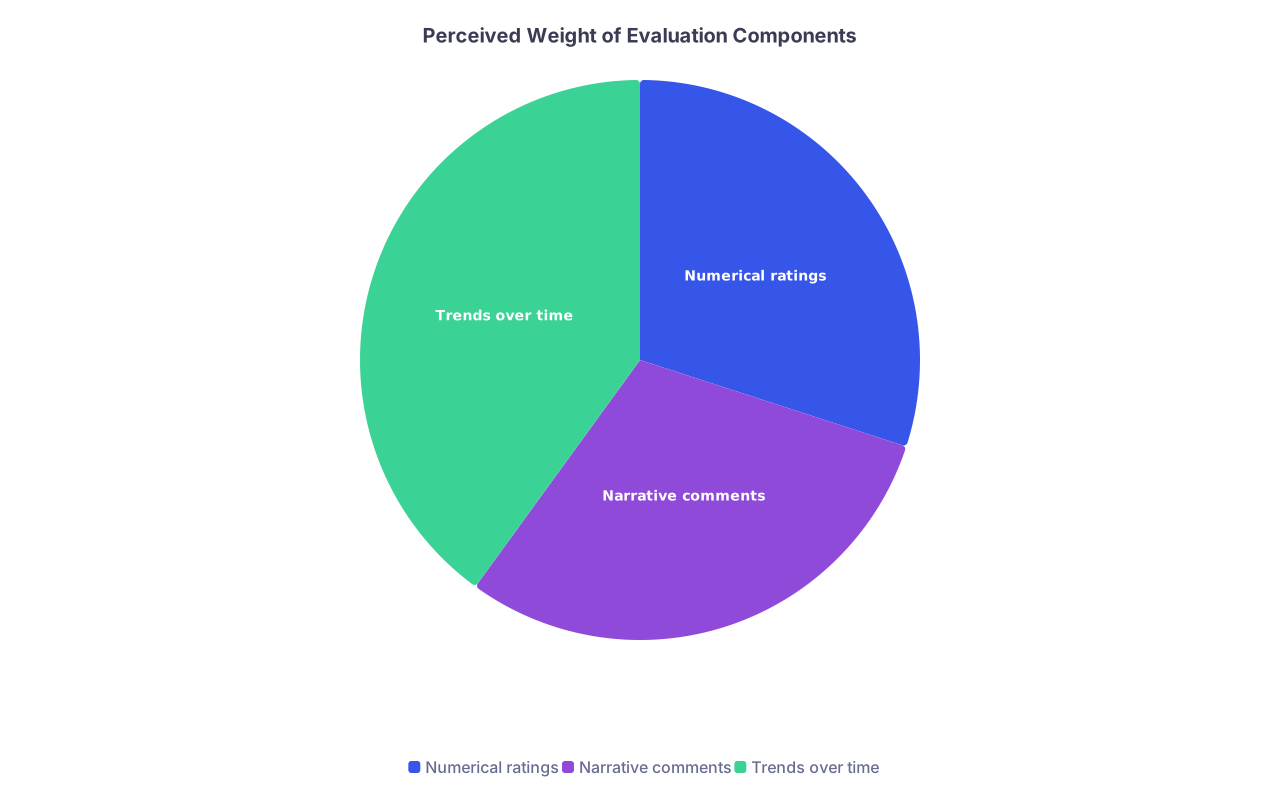
| Category | Value |
|---|---|
| Numerical ratings | 30 |
| Narrative comments | 30 |
| Trends over time | 40 |
Numbers (1–5 scales, etc.)
People skim:
- Your average compared to department or clerkship norms
- Year-over-year stability
- Any sustained drop-offs
If you’re always hovering in the “above average” range with occasional dips? Fine.
If you’re always at the absolute bottom, far below peers, every year? People notice.
Comments
Comments are where your story lives:
- “Teaches at appropriate level for MS3s”
- “Always makes time for questions”
- “Sometimes rushed, but clearly cares about teaching”
Committees will often literally quote these in letters supporting your promotion.
They also look at the mix: If 90% of comments are positive and 10% are rough, they read the negatives as areas for growth, not indictments.
Where it hurts is if the comments are:
- Consistently negative
- Specifically calling out the same harmful behaviors
- Stretching across different courses/years/services
That pattern is much more damaging than a numeric score dipping from 4.5 to 4.1 one semester.
Practical Damage Control When You Get Bad Evals
Okay, so what do you actually do after a rough set of evaluations drops into your inbox and your heart rate spikes?
1. Don’t read them alone when you’re exhausted
Reading evals post-call, at midnight, or after a brutal clinic day is asking for a spiral.
Read them:
- When you’ve eaten
- When you have at least 30 minutes of mental space
- With the mindset: “I’m collecting data, not grading my worth as a human”
If you can, skim for patterns, not individual attacks. You’ll latch onto the worst line anyway; try to intentionally zoom back out.
2. Separate “harsh but fair” from “noise”
Sometimes the meanest comments are also the most accurate. Sometimes they’re pure venting. You can usually tell.
Useful criticism sounds like:
- “Unclear expectations, wish there was more guidance early in the rotation”
- “Seemed frustrated when we didn’t know things; would help to know what we’re expected to know at our level”
- “Hard to get feedback on how we were doing”
Noise sounds like:
- “Worst attending ever”
- “Total waste of time”
- “Obviously hates students”
Use the first group to make changes. Let the second group sting briefly, then discard.
3. Put the feedback in writing—for yourself
Literally write out:
- 3 strengths students mention repeatedly
- 2–3 specific things they want changed
- 1–2 concrete actions you’ll try next block
This is gold when:
- You write teaching statements
- You’re up for promotion
- Someone asks, “How have you responded to learner feedback?”
It turns “I got some bad evaluations” into “I have an ongoing process for improving my teaching.”
How Bad Is “Too Bad” For a Teaching Career?
Let’s anchor this with some realistic scenarios.
| Scenario | Likely Impact |
|---|---|
| One bad month, then back to baseline | Minimal, mostly forgotten |
| One bad year, then visible improvement | Mild concern, then becomes positive |
| Mixed evals, no clear pattern | Normal, rarely career-limiting |
| Multi-year pattern of serious red flags | High risk, potential role changes |
| Bottom of department every single year | Concern, may trigger intervention |
If you’re worried, ask yourself:
- Over the last 3 years, are your evaluations:
- Mostly okay with some rocky blocks?
- Trending up, down, or flat?
- Full of serious accusations, or mostly about style and structure?
If your fear is based on one ugly set of evals from that chaotic medicine block in July where half the team had COVID and the hospital was overflowing… committees contextualize that. They really do.
What scares people reviewing files isn’t painful imperfection. It’s persistent dysfunction.
How To Protect Your Teaching Career Long-Term
If your brain needs a plan (mine does), here’s the basic structure.
1. Build a documented pattern of responsiveness
Any time you change something based on student feedback, save a note:
- “After 2024 MS3s said expectations were unclear, I created a one-page ‘Day 1’ expectations handout.”
- “Students wanted more feedback; I started doing 5-minute midpoint check-ins.”
You now have receipts that you’re not defensive—you’re adaptive.
2. Get non-student feedback too
Student evals are not the only voice that matters. Ask:
- A senior resident: “Can you watch how I teach on rounds and tell me what works / what doesn’t?”
- A colleague: “Can you sit in on one of my sessions and give me honest feedback?”
When your file shows both student and peer feedback, the picture is more balanced. It’s harder for a couple of angry students to dominate the narrative.
3. Keep perspective: students are not evaluating as experts
This sounds harsh, but it’s true: students evaluate from inside their own stress.
They don’t see:
- The service constraints you’re under
- The competing patient safety issues
- That your “rushed” demeanor is you desperately trying to get discharges done so they’re not leaving at 9 p.m.
Their feedback is valuable, but it’s not omniscient. It’s one angle.
You’re allowed to say, “I understand why they felt that way, and I still need to do it this way for now because of X.” That’s not dismissing students. That’s being a functioning attending.

| Step | Description |
|---|---|
| Step 1 | Bad Evaluation Arrives |
| Step 2 | Reflect and Adjust |
| Step 3 | Improved Next Block |
| Step 4 | Pattern Resolved |
| Step 5 | Seek Support |
| Step 6 | Coaching or Training |
| Step 7 | Documented Improvement |
| Step 8 | Stronger Promotion File |
| Step 9 | Pattern or One Off |
The Part Nobody Says Out Loud
There is no version of a teaching career where you never get deeply unfair, painful evaluations.
You will, at some point, get all of the following:
- A comment that attacks your personality, not your teaching
- A student who misinterprets your boundaries as hostility
- A rating that tanks a block where you felt you gave everything you had
And you will feel, in your bones, “Maybe I should just stop teaching. It’s not worth this.”
That instinct is understandable. But if you actually care about teaching—and you clearly do, or you wouldn’t be this stressed about evaluations—then you’re exactly the kind of person academic medicine needs to keep.
Promotions committees don’t want flawless gods of teaching. They want real humans who:
- Care about learners
- Don’t abuse their power
- Are willing to grow and adjust
One bad eval cycle doesn’t disqualify you from that. Even a rough year doesn’t. What defines you is what you do with it.
Years from now, you probably won’t remember the exact words of the student who shredded you in that anonymous comment box. You’ll remember whether you let that voice shrink you—or used it to become the kind of teacher you actually want to be.
FAQ (Exactly 5 Questions)
1. Can a single horrible evaluation keep me from getting promoted?
Very unlikely. Committees look at multi-year trends, not one angry student. Unless that evaluation alleges something very serious (harassment, discrimination, abuse) and is backed by other similar reports, one bad eval becomes background noise when placed in context of years of mostly solid feedback.
2. Do students’ comments actually get read by important people?
Yes, but not the way you imagine. Most leaders skim for patterns, representative quotes, and red flags. They’re not memorizing every harsh phrase. They’re asking: “What do students consistently experience with this teacher?” The random outlier rant doesn’t carry as much weight as a repeated theme over several years.
3. What if my evaluations are average, not amazing—is that bad for a teaching career?
Average is not a crime. Truly. Not everyone will be “Top 5% of all faculty.” If your evals are consistently okay-to-good, with a few rough spots you’ve worked on, you can absolutely build and maintain a solid academic career. Awards and “star teacher” reputations may lean on top-tier evals, but basic promotion and ongoing teaching roles do not require perfection.
4. How do I know if my evals are bad enough that I should be worried?
Worry if you see the same serious concern repeated across different rotations, semesters, and years—things like “demeaning,” “unsafe,” “retaliatory,” or repeated allegations of bias. If your numbers are consistently at the bottom of your department and comments are strongly negative year after year, you should talk to a trusted mentor, clerkship director, or educator-development person. They’d much rather help you early than punish you later.
5. Should I stop teaching if reading evaluations is destroying my mental health?
You might need to adjust how much and in what way you teach, not quit entirely. Some people do better in small-group settings than on high-stress inpatient rotations. Others ask faculty development or a mentor to help them interpret evals so they’re not processing them alone. If every eval cycle wrecks you, it’s worth talking to someone (mentor, therapist, program director) about boundaries and coping strategies—but walking away from teaching altogether is usually a last resort, not the first step.