The myth that “only R01-level researchers get promoted” is wrecking a lot of good careers.
You’re not crazy for worrying your thin research CV is going to cap your advancement. Promotion committees absolutely look at your scholarship, and some departments are still stuck in 1990 where only PubMed counts. But no—education scholarship can be enough to advance… if it’s actually scholarship, not just “I teach a lot.”
Let me be blunt: teaching alone won’t save you. But you’re probably closer than you think to something that will count.
The Fear: “My CV Is All Teaching and Almost No Research”
You’re looking at your CV and it feels like a horror story:
- A couple of case reports.
- Maybe one middle-author original article from residency.
- A poster at some obscure conference five years ago.
- Then pages and pages of: lectures, small groups, OSCEs, “invited” noon talks that were actually just desperate coverage for someone else.
And now you’re hearing:
- “You’ll need scholarship to go up for promotion.”
- “Education track is fine but it still needs peer-reviewed output.”
- “Committees want impact.”
So your brain does this:
- “My research CV is thin → I’ll never be promoted → I’ll be underpaid forever → they’ll replace me with someone younger with an H-index of 40 → did I just ruin my career?”
I’ve watched this exact panic spiral play out in workrooms and hallway conversations:
- Someone whispers, “She got blocked for promotion because she didn’t have enough papers.”
- Another says, “Our chair only respects NIH-funded researchers.”
- Someone else: “Education scholarship is just a consolation prize.”
Most of that is half-true at best. Dangerous because it sounds right, but usually missing context.
Here’s the ugly truth: “Teaching a lot” is not promotion currency. “Education scholarship” is. Those are not the same thing.
What Actually Counts as “Education Scholarship” (Not the Fluffy Version)
If your CV is light on traditional research, your lifeline is this: education scholarship is real scholarship if it meets scholarly standards.
Think of it as: you’re studying how we teach, train, assess, and support learners—using rigor and sharing your work beyond your own institution.
At a minimum, committees look for education work that hits these:
Grounded in something more than vibes
You don’t need to memorize every theory, but “I redesigned the clerkship because it felt better” is not enough. A simple link to existing literature or known frameworks moves it into “scholarly” territory.Systematic, not just “I tried a thing once”
There’s a plan. A clear objective. You don’t just toss in a new simulation and call it a day—you collect data, iterate, and document.Disseminated beyond your hallway
Local teaching is service. Published curricula, peer-reviewed MedEdPORTAL content, conference workshops, education-focused journal articles—that’s scholarship.
Let’s make this concrete.
Here’s how committees often mentally grade education activity:
| Activity Type | How It’s Usually Viewed |
|---|---|
| Giving recurring lectures | Service / expectation |
| Course/clerkship director (no data) | Service with responsibility |
| Running simulations/OSCEs (no writeup) | Local education effort |
| MedEdPORTAL published curriculum | Peer-reviewed scholarship |
| Education research in peer-reviewed journal | Strong scholarship |
The depressing part: a lot of us are busting ourselves with the first three rows and barely touching the last two.
But the hopeful part: much of what you already do can be converted into rows 4 and 5 with some structure and follow-through.
Yes, You Can Get Promoted With Education Scholarship (But Not by Accident)
Promotion standards vary wildly, but there are common patterns. Let me show you roughly what you’re up against, so your fear is pointed at the right target.
| Track | Research Expectation |
|---|---|
| Tenure / Investigator | High: grants, first/last-author papers |
| Clinician-Educator | Moderate: education-focused publications |
| Clinical (no title) | Low–Moderate: at least some dissemination |
Notice that “Clinician-Educator” and similar tracks don’t say “basic science” or “R01.” They say scholarship. That can be education scholarship if:
- It’s visible (PubMed or equivalent).
- It’s peer reviewed.
- There’s some sense of a coherent program of work, not 7 random unrelated things.
Most promotion packets I’ve seen for education-focused folks who did get through had some version of:
- 3–10 peer-reviewed education papers (often small, not JAMA).
- A MedEdPORTAL publication or two.
- Multiple accepted national presentations or workshops.
- A reputation locally as a go-to educator in a niche.
The bar is not “NIH portfolio.” The bar is “consistent, documentable, disseminated contributions.”
So yes—education scholarship can absolutely be enough to advance. But:
- Your “thin research CV” doesn’t magically transform just because you lecture more.
- You need to turn your teaching into evidence and output, not just hours and evals.
Turning Your Real Life Into Education Scholarship (Without Selling Your Soul to SPSS)
You probably already have raw material sitting in your inbox and SharePoint folders that could become scholarship.
The trick is to stop thinking, “I don’t have a research project” and start thinking, “What am I already doing that could be written up?”
Common examples:
- You created or revamped a clerkship, bootcamp, or rotation.
- You designed a new simulation scenario or OSCE station set.
- You built a feedback tool, evaluation form, or milestone-based rubric.
- You run an interest group, near-peer teaching program, or mentorship structure.
Here’s a basic conversion plan: practice → scholarship.

| Step | Description |
|---|---|
| Step 1 | Existing Teaching Project |
| Step 2 | Clarify Problem and Goals |
| Step 3 | Collect Structured Data |
| Step 4 | Analyze and Reflect |
| Step 5 | Write as Curriculum or Study |
| Step 6 | Submit to MedEd Journal or MedEdPORTAL |
Example:
You: “I run a weekly simulation curriculum for interns. It’s just something we do.”
Scholarship version:
- Question: Does our weekly sim series improve interns’ comfort with rapid response calls?
- Methods: Pre/post survey using a simple validated scale or even well-designed Likert items.
- Data: Confidence scores, maybe checklists of performance on sim cases.
- Output:
- Abstract → Society for Simulation in Healthcare or specialty conference.
- Manuscript → Simulation in Healthcare, Journal of Graduate Medical Education, etc.
- Curriculum package → MedEdPORTAL.
You didn’t suddenly become an RCT machine. You just framed what you were already doing in a scholarly way.
Where Anxiety Is Legit: Common Worst-Case Thoughts (and What’s Actually True)
Let’s hit the terrifying thoughts head-on.
“If I don’t get big-name grants, I’m stuck at Assistant forever.”
Reality: On education-heavy tracks, big external grants help but are not mandatory in many places. What usually matters more:
- Consistent publications and products.
- Clear niche (e.g., assessment, simulation, wellness, remediation).
- Evidence that people outside your institution care about your work (invited talks, national committee roles, multicenter projects).
Do some people get blocked? Yes. Usually because they waited until year 7 with nearly zero scholarship and then tried to panic-submit three things in 6 months. Committees see that.
“Education scholarship isn’t real; my department doesn’t value it.”
Some departments are still dinosaur-land. But even in those, promotion guidelines often explicitly list:
- Education journals.
- MedEdPORTAL products.
- National presentations/workshops.
The problem is often not that the system truly rejects education scholarship. The problem is that chairs and mentors don’t know how to help you build it, so they default to “Get more papers” without nuance.
You need to do two things:
- Get your institution’s actual promotion guidelines. Read the section on “education scholarship” like a contract.
- Find someone who has actually been promoted on an education-focused portfolio and copy their model.
How Much Is “Enough” Education Scholarship If My CV Is Otherwise Thin?
You want numbers. I get it. Your brain wants: “If I just get X publications, I’ll be safe.”
It’s never that clean, but here’s a realistic ballpark for a clinician-educator or education-focused faculty going for promotion to Associate:
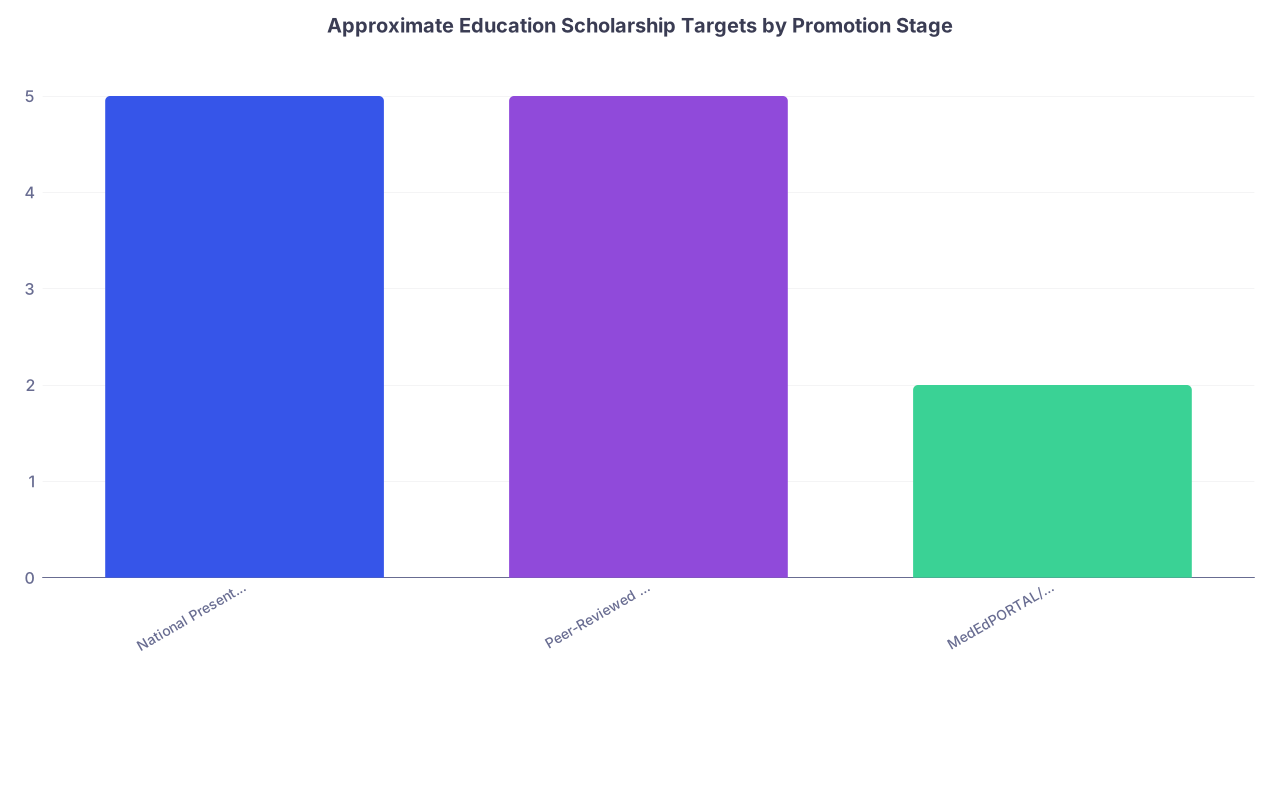
| Category | Value |
|---|---|
| National Presentations | 5 |
| Peer-Reviewed Education Papers | 5 |
| MedEdPORTAL/Curricula | 2 |
Those aren’t official numbers. But I’ve seen people get promoted with roughly that magnitude of work, sometimes less if their roles are heavy (course director, APD) and impact is clear.
The key patterns that reassure committees:
- You didn’t just do one thing once. There’s a thread.
- You’re not invisible nationally.
- Your work is showing up in places other than your own conference room.
Concrete Moves You Can Make This Year (Not Five Years From Now)
You don’t need a 10-year plan right now. You need to not feel doomed.
Here’s a one-year, realistic, anxiety-aware strategy if your research CV is thin:
Pick one project that already exists in your life
Clerkship change, sim program, bootcamp, remediation curriculum—whatever feels most “real.”Attach a simple evaluation plan to it
Pre/post survey, knowledge quiz, performance checklist, even qualitative feedback with a plan for thematic analysis. Not perfect, just intentional.Commit to one dissemination product by a deadline
For example:- Abstract to a national meeting (SAEM, SGIM, APDIM, etc.).
- MedEdPORTAL submission.
- Short communication / innovation piece in an education journal.
Get a partner who actually likes scholarship
A PhD educator, a MedEd person, or even a statistically-inclined colleague. You don’t win martyr points for doing it alone.Start an “Education Portfolio” document now
Track:- Teaching roles (with dates, hours, scope).
- Learner levels.
- Innovations you’ve led.
- Evaluation data (even basic learner quotes).
This becomes promotion gold later.
When Education Scholarship Won’t Be Enough (And You Deserve to Know That Too)
There are genuine worst-case scenarios:
- You’re on a strict tenure track with hard expectations for external grants and high-impact journals.
- Your department leadership says, on record, “We don’t consider MedEdPORTAL or education journals as scholarship.” (Red flag. Big one.)
- You’re in a basic science department where “teaching” is tolerated, not valued.
In those situations, you have three honest options:
- Change tracks to a clinician-educator or clinical educator line, if allowed.
- Change departments/institutions to somewhere that has a real education track with real promotion criteria.
- Decide that you’re okay being “stuck” in title but compensated or fulfilled in other ways (not my favorite, but some people intentionally choose it).
You’re not obligated to chain your entire career to a track that doesn’t match what you actually do. A lot of people quietly switch tracks in year 3–5 when they realize this.
Final Reality Check: You’re Probably Not as Doomed as You Think
Your fear is rational, but the story your brain is telling you—“My thin research CV means I’ll never advance”—is incomplete.
The fuller story is:
- Basic science-style research is not the only currency.
- Education scholarship is absolutely real currency if you make it visible, peer-reviewed, and at least semi-rigorous.
- You likely already have the raw material; it just needs to be packaged and pushed out of your local bubble.
- You don’t need 40 papers. You need a small, coherent body of work that shows you’re more than a warm body giving lectures.
Today, you feel behind. Five years from now, you could be the person other anxious junior faculty come to, asking, “How did you build your MedEd portfolio?”
You don’t fix this in one weekend. But you absolutely can fix it.
FAQ (Exactly 5 Questions)
1. I have almost zero publications. Should I even bother trying for an education-focused promotion?
Yes. But don’t walk into a promotion review with “almost zero.” Use the next 1–3 years to build a minimum set: a few education-focused papers or MedEdPORTAL pieces and some national presentations. Start now with one concrete project and a dissemination plan. It’s not hopeless unless you stay frozen.
2. Do things like local grand rounds, noon conferences, and invited lectures count as scholarship?
By themselves? No. They count as teaching and sometimes regional reputation, which help, but they’re not scholarship. They become scholarship if the underlying content is part of a studied or evaluated curriculum that you publish or present at a peer-reviewed venue. Think of talks as support, not the main currency.
3. Is MedEdPORTAL really respected for promotion, or is that just something people say?
In most academic settings, MedEdPORTAL is taken seriously. It’s peer-reviewed, indexed, and specifically focused on educational products. Many successful education promotions include it. Check your institution’s guidelines, but I’ve repeatedly seen MedEdPORTAL listed explicitly as scholarship. It’s not “less than” a journal article—it’s just a different format.
4. I hate statistics and formal research. Can I still do education scholarship?
Yes. Plenty of MedEd work is qualitative, descriptive, or innovation-focused. You can partner with someone who enjoys methods and analysis. Your strength might be vision, implementation, and curriculum design. Their strength is turning that into a publishable study. Don’t let “I hate SPSS” become a career death sentence.
5. How do I know if my institution actually values education scholarship or is just pretending?
Look at who’s been promoted in the last 5–10 years. Pull up two or three CVs of people known as educators who made Associate or Full. Count:
- How many publications (and what type)?
- How many national presentations?
- What leadership in education do they hold?
If your place has no one advanced on an education-heavy dossier, that’s a sign. If it does, study their path and talk to them—those are your real rules, not whatever vague thing lives on the website.
Open your CV today and highlight every single thing you’ve done in teaching or curriculum. Then pick one of those lines and write a sentence next to it: “This will become a [abstract / MedEdPORTAL / short paper] by [date].” That’s the first step from “thin CV” to “education scholar in progress.”