
It’s 4:27 p.m. on a Wednesday. You’re in a too-bright conference room, slides pulled up, heart rate slightly elevated. At the far end of the table is the curriculum committee chair, skimming your one-page summary for the first time. Two people are clearly answering email. One basic scientist is already frowning at your “innovative” longitudinal thread.
You launch into your pitch for a new course.
You think they’re listening for educational vision, learner-centered design, maybe your passion.
They’re not.
Let me tell you what’s actually running through the heads of those people around the table—because I’ve sat there, I’ve watched good ideas get torpedoed in under five minutes, and I’ve seen very average ideas sail through because they hit the right buttons.
The Unspoken First Filter: “Is This a Problem or a Pet Project?”
Before anyone cares about your outcomes, your assessment plan, or your alignment with institutional competencies, an informal triage happens in the first 30 seconds.
The thought process is blunt:
“Is this solving a problem that we already acknowledge—or is this just your hobby?”
If your opening feels like: “I’m passionate about point-of-care ultrasound and I’d like to create a dedicated elective…” you’ve already lost half the room. Not because POCUS is bad. Because the committee doesn’t care what you love. They care what’s currently breaking the curriculum.
Behind the scenes, every committee roughly has a mental list of pain points:
- Boards performance soft spots (e.g., biostats, pharmacology)
- Clinical performance gaps reported by PDs (e.g., handoffs, note-writing, clinical reasoning)
- Accreditation dings or “areas for monitoring” (e.g., interprofessional education, professionalism)
- Student complaints that just will not die on annual surveys
When your proposal walks in, they subconsciously ask: “Which of our known problems does this fix?”
If the answer is “none,” now they have to justify added complexity, hours, and faculty time for something that doesn’t help them with their headaches. That’s a hard sell.
So the insider move is this: frame your course as a direct answer to a problem that has already shown up in LCME reports, AAMC graduation questionnaires, Step scores, or clinical competency committee feedback from your own residency programs.
“Over the last 3 years, our internal medicine PDs have documented that 32% of our incoming interns struggle to write safe admission orders on day one. This proposal directly targets that gap.”
That sentence gets people to sit up. Now you’re helping them.
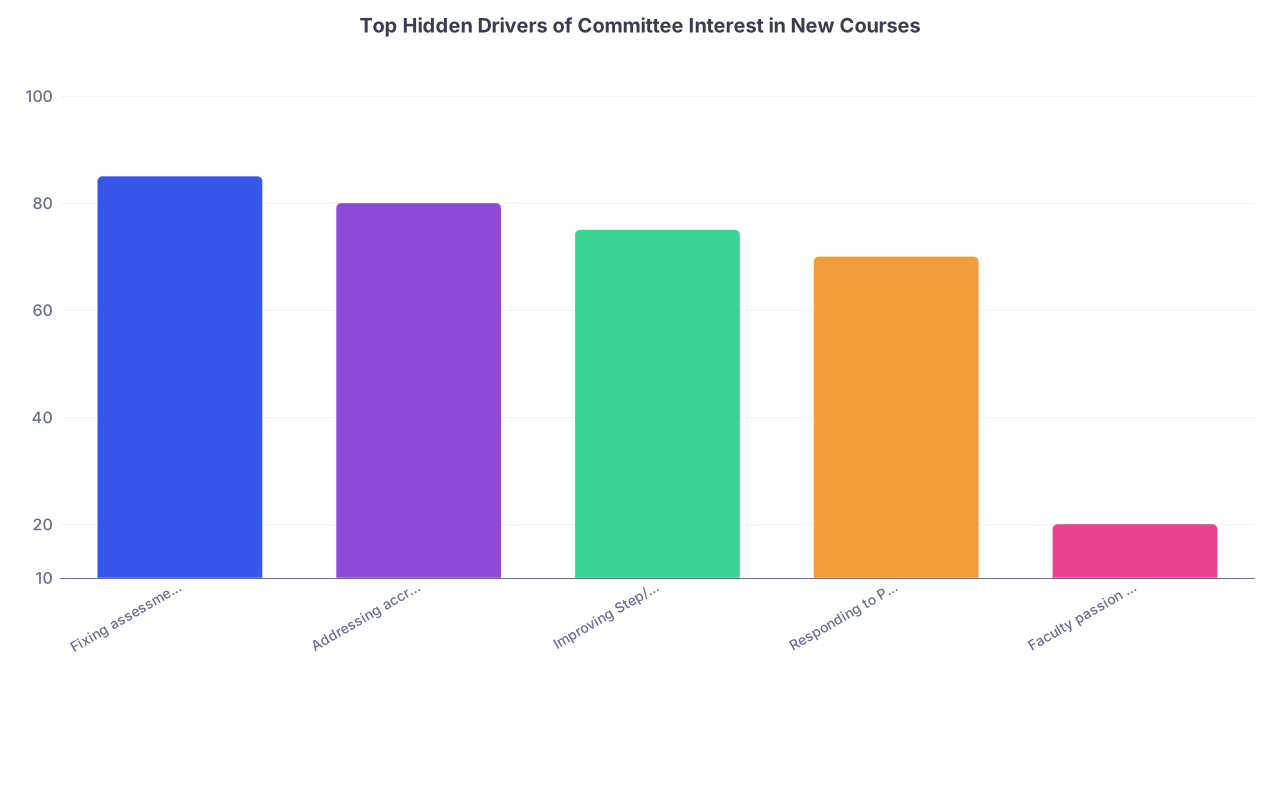
| Category | Value |
|---|---|
| Fixing assessment gaps | 85 |
| Addressing accreditation risks | 80 |
| Improving Step/boards outcomes | 75 |
| Responding to PD complaints | 70 |
| Faculty passion projects | 20 |
Notice the last bar. Passion projects almost always start at the bottom of the priority pile unless you’ve disguised them well.
The Currency That Actually Matters: Hours, FTE, and Schedule Real Estate
You think you’re proposing “just four 2‑hour sessions.”
They hear, “You want 8 more contact hours and at least 0.1–0.2 FTE protected time from somewhere in a curriculum that’s already overpacked and under-resourced.”
Curriculum committees are basically running an overcrowded airport. There are no empty gates. If your course lands, somebody else is circling or getting diverted.
Behind closed doors after you leave, the conversation sounds like:
- “Where are those hours coming from?”
- “Whose content gets cut?”
- “Who is going to teach this in year 3 when the proposer goes on sabbatical?”
This is where most early proposals quietly die. Not on educational merit. On logistics.
The savage part? Committees rarely say that out loud in the meeting. Instead, you’ll hear things like:
- “We’re not sure the timing is right.”
- “We’d like to see more integration with existing courses.”
- “We’re concerned about assessment alignment.”
Translation: “We have no idea how to pay for this or where to put it.”
If you want to look like you understand how the machine works, you walk in already having thought through the trade-offs. Not just “we’ll fit it into existing small-group time,” but explicitly:
- What you’re willing to cut or consolidate
- Which existing block you’ve spoken with, and their buy‑in
- How many faculty you’ll need, and where they’re coming from
The proposals that impress veteran committee members are the ones that come in with cost and displacement already addressed.
| Surface Question | Hidden Question Behind It |
|---|---|
| How many hours is this? | Whose hours do we cut to make room? |
| Who will teach it? | Will this implode when you leave? |
| Is this required or elective? | Will this create another accreditation reporting headache? |
| How is it assessed? | Will students take this seriously or blow it off? |
| How does it fit vertically? | Are you about to duplicate content and piss off another course director? |
If you cannot answer those hidden questions, someone on the committee will notice. And they’ll kill your proposal with a smile and “We appreciate your enthusiasm.”
What They’re Silently Checking Against: Strategic and Accreditation Boxes
Let me be blunt: curriculum committees are not blank slates. They’re working under constant pressure from the Dean’s office, LCME/COCA, institutional “strategic pillars,” and the last re-accreditation site visit.
There are themes that get shoved down their throats for 5–10 year cycles: health systems science, quality and safety, DEI, interprofessional education, telehealth, AI, you name it. You’ll see them plastered in your school’s strategic plan.
When you talk, committee members are cross-referencing you against those checkboxes like a mental spreadsheet.
“Wellness? We just created a wellness longitudinal thread, we’re good there.”
“Health equity? We’re a little light. This could help our next LCME narrative.”
“Interprofessional? We still don’t have a solid IP simulation in years 3–4. Interesting.”
The hack is simple: your proposal should explicitly carry 2–3 of those institutional keywords in the first paragraph. Not buried on slide 14. Up front.
And I don’t mean vague “this will improve professionalism.” I mean directly quoting the school’s own strategic language:
“Our proposed longitudinal course directly supports Strategic Goal 2.1 (‘Develop students as leaders in health systems science and quality improvement’) and addresses the LCME Element 7.9 expectations around interprofessional collaborative skills.”
That’s the kind of sentence that makes the Associate Dean for Curriculum lean forward instead of checking their phone.

The Accreditation Angle You Don’t See
You probably don’t know which LCME elements the school got dinged on last time. The committee does. They’ve read the secret shame list.
Common thorns:
- Inconsistent coverage of certain competencies
- Weak documentation of formative feedback
- Shaky interprofessional education experiences
- Gaps in teaching systems-based practice or safety
If your course proposal incidentally addresses one of those, you’re golden. If you explicitly say, “This will give us clean evidence for Element 7.9 in our next self-study,” now you’re not just a course proposer—you’re helping them fix past sins.
Curriculum committees reward people who help with their accreditation story. Those proposals get mysteriously more traction.
What They Really Think About Your Pedagogy and Assessment
You’ve spent hours picking the right mix of flipped classroom, TBL, simulation, and reflective writing. You’re proud of your active learning strategy. That’s fine.
Here’s the truth: as long as you’re not proposing three hours of straight lecturing every week, the committee cares far more about two things:
- Will students take this seriously?
- Can we defend this to accreditors and program directors?
That means assessment.
If your course is graded pass/fail with:
- Attendance
- A reflection essay
- A group project that everyone passes
…expect skepticism, especially if you’re selling your course as “critical to safe patient care.”
Have I seen great proposals sink because the assessments were obviously fluff? Yes. I watched a very thoughtful longitudinal professionalism curriculum get shredded, not because people hated professionalism, but because the only formal assessment was “participation in small group discussions.”
The committee conversation afterward was: “So it’s optional with extra steps.”
When they read your assessment section, they’re silently asking:
- How will this show up in the MSPE or transcript?
- What happens if a student is bad at this? Is there remediation?
- Is there at least one individual, performance-based assessment tied to real outcomes?
You don’t need a 40‑item MCQ exam for everything. But you do need something more concrete than vibes and attendance. OSCE station, structured checklist, graded oral presentation with a rubric, chart write-up with faculty scoring—those things signal seriousness.
On the flip side, don’t oversell summative complexity if your faculty cannot deliver it. Committees have long memories. If they’ve seen your department struggle to run consistent OSCEs, and now you’re promising six elaborate simulation assessments, they’re going to roll their eyes.
They care about feasibility more than glossy pedagogy buzzwords.
Politics, Turf, and the “Who Owns This Content?” Problem
This is the part nobody tells you as a new faculty member.
Curriculum committees are not just educational bodies. They’re peacekeeping forces between departments that have spent years arguing about who “owns” what:
- Does palliative care live with IM, family medicine, or anesthesia?
- Who owns ultrasound? Radiology? EM? Hospital medicine?
- Who controls ethics—philosophy faculty or clinicians?
When you show up with a new course, you might be unknowingly stepping on landmines.
I’ve seen excellent proposals get destroyed because the proposer never talked to the “territorial” department that historically owned that topic. They find out when the representative from that department raises an eyebrow and says, very politely, “We were not consulted.”
That’s basically a death sentence in many schools.
Before you ever present, ask yourself honestly: Whose toes am I stepping on? Then do the unsexy but essential groundwork:
- Talk to the relevant course directors whose content overlaps with yours
- Offer to co-brand, co-direct, or embed your content in their block
- Get an email or letter of support that says, “We see this as complementing, not duplicating, our sessions on X”
When a committee member hears, “We’ve already met with the directors of Foundations of Clinical Medicine and the clerkship directors for IM and FM, and they’re supportive,” that calms the room. You look like a collaborator, not an empire builder.

| Step | Description |
|---|---|
| Step 1 | New Course Idea |
| Step 2 | Seen as pet project |
| Step 3 | Low priority or rejected |
| Step 4 | Talk to affected departments |
| Step 5 | Shared ownership proposal |
| Step 6 | Committee asks what to cut |
| Step 7 | Aligned with strategic goals? |
| Step 8 | High chance of approval |
| Step 9 | Moderate chance, needs champion |
| Step 10 | Solves known problem? |
| Step 11 | Territory conflict? |
| Step 12 | Schedule and hours identified? |
Reading that little map is basically reading the committee’s unconscious decision tree.
The Three Kinds of Proposals Committees Secretly Love
You won’t hear this classification out loud, but over time you see the pattern. The proposals that breeze through—sometimes with minimal scrutiny—tend to fall into three buckets.
1. The “We Needed This Yesterday” Fix
Example: A structured intern-ready bootcamp with real assessment for MS4s, coming on the heels of multiple PD complaints that your grads can’t do basic admission orders or cross-cover pages.
If you walk in with data from PD surveys, quotes from CCCs, and a concrete, feasible plan that doesn’t demand 40 extra hours of MS4 time, you’re solving an institutional embarrassment.
Those get greenlit fast, often with, “How can we help you launch this next year?”
2. The “Accreditation Lifeline”
Example: A required interprofessional simulation involving nursing, pharmacy, and med students that ticks clean boxes for LCME 7.9, 7.8, and generates great narrative material for the self-study.
You show:
- Clear objectives tied to LCME language
- Documented student participation
- A simple assessment tool
- Minimal new hours (e.g., replaced an existing lower-value session)
That’s like handing the Associate Dean a gift-wrapped solution to a problem they stay up worrying about.
3. The “High-Visibility Strategic Win”
Example: An AI in Medicine longitudinal thread, co-designed with informatics and ethics, neatly branded as a “signature” part of your school’s curriculum that can go on brochures and recruitment materials.
If your leadership is leaning hard into a narrative (“We are leaders in digital health,” “We are the home of rural primary care”), anything that gives them marketing ammunition gets more runway than it probably deserves.
Your job is to figure out which of these three categories your idea can be honestly reframed into. If it’s none, you can still succeed—but you’ll need a stronger champion and more patience.
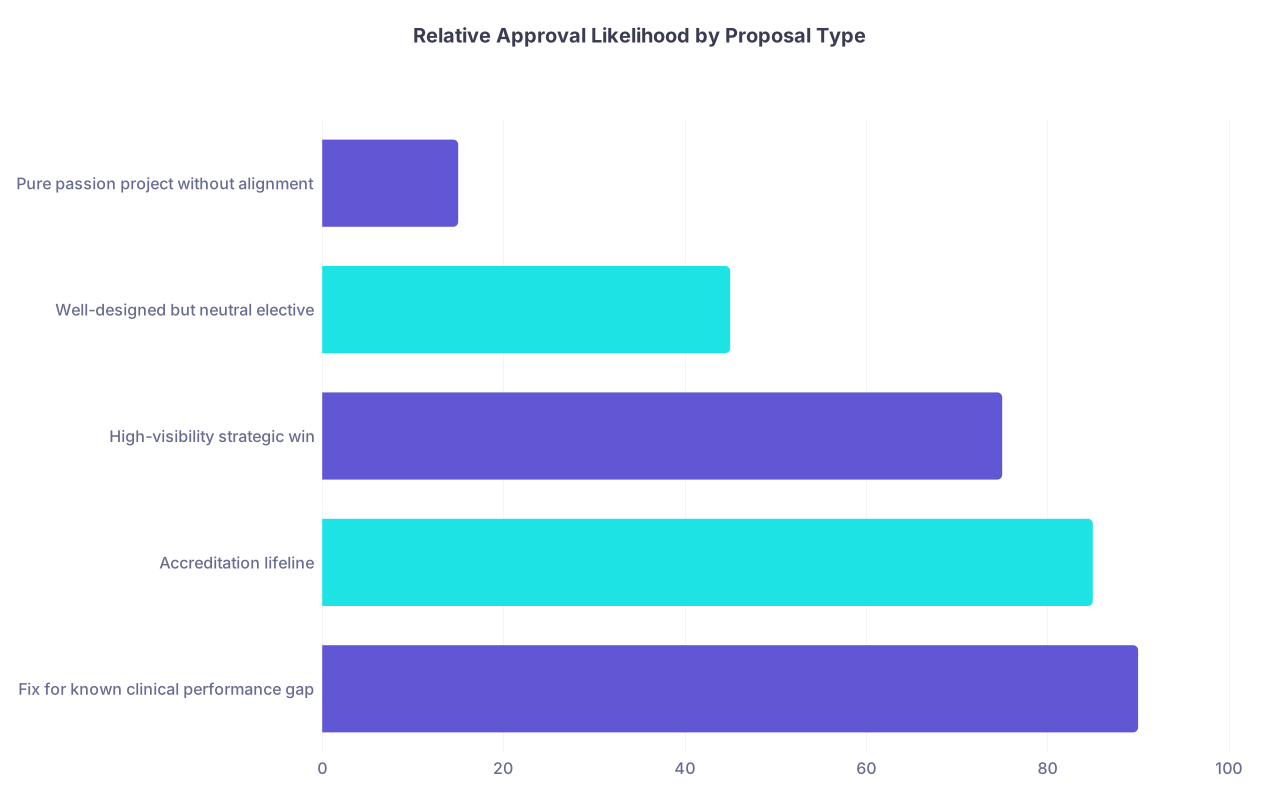
| Category | Value |
|---|---|
| Fix for known clinical performance gap | 90 |
| Accreditation lifeline | 85 |
| High-visibility strategic win | 75 |
| Well-designed but neutral elective | 45 |
| Pure passion project without alignment | 15 |
How to Walk Into the Room Like Someone Who Understands the Game
Let me pull this together into how you actually show up in that conference room.
You don’t start with, “I’m excited about…” You start with:
“In the last three years, 28% of our incoming surgery interns have required remediation in basic perioperative management, and our PDs have specifically flagged fluid and electrolyte management as weak. Our current curriculum covers this material in scattered lectures without direct assessment.
I’m proposing a 6‑hour, case-based course in the MS3 surgery clerkship that directly targets that gap, aligns with our Health Systems Science competency, and provides clean, documented assessment we can share with our PDs.”
Then, as you go, you make clear you’ve already done the hard parts they usually have to push proposers on:
- You’ve spoken with the surgery clerkship director and medicine clerkship director; they support the integration.
- You’re proposing re-purposing two existing lecture slots and one low-yield online module rather than adding net hours.
- You have three other committed faculty to teach; you’re not building a one-person empire.
- You’ve built in a simple, graded case write-up and oral presentation with a rubric as assessment, not just attendance.
You end with how this helps them:
“This gives us concrete data on perioperative reasoning we can share with PDs, contributes to our narrative for LCME 7.7, and responds directly to comments from the last GQ about wanting more practical perioperative teaching.”
Now the committee doesn’t have to work to connect your idea to their problems. You’ve already done it.
That’s when proposals get approved in one meeting instead of kicked down the road to three subcommittees and eventual oblivion.
FAQs
1. Should I start with a small elective or go straight for a required course?
If you’re early in your education career and don’t have a track record with the committee, starting with a well-run elective is often smarter. It lets you:
- Prove feasibility
- Collect outcomes data
- Build student champions
Then you come back in 1–2 years and say, “Our elective has run for four cycles, consistently fills, and students rate it 4.7/5; here’s objective evidence of impact. We’d like to expand or migrate key elements into the required curriculum.”
Required courses are heavier lifts—more scrutiny, more politics, more resource questions. Unless your idea clearly falls into that “we needed this yesterday” or “accreditation lifeline” category, it’s often easier to earn your way there.
2. How much data do I really need to justify a new course?
More than a gut feeling, less than a randomized controlled trial.
At minimum you should bring:
- At least one concrete data source that shows a gap (PD survey, Step performance trend, GQ item, internal OSCE data)
- Some form of benchmarking from peer schools (“6 of the top 10 schools now have a formal X curriculum; we’re currently at the bottom quartile for Y”)
Committees are very responsive to “we’re below peers” and “our own PDs are complaining.” They are much less impressed by, “Other places are doing this and it seems cool.”
3. What if my proposal is genuinely a passion project with weak alignment?
Then you have two options:
- Reframe it so it clearly plugs into a real institutional need, even if that means trimming or reshaping your idea; or
- Accept that it may live (at least initially) as a small, low-resource elective, student interest group series, or pilot workshop rather than a formal course.
Not every good idea deserves immediate curricular real estate. Sometimes the smartest long game is to pilot quietly, collect data, and wait until the institutional winds shift in your favor.
4. How do I know if I’m stepping on someone’s turf before it’s too late?
Ask three people before you draft your proposal in detail:
- The Associate Dean for Curriculum (or their delegate)
- The director of any course or thread that even vaguely overlaps with your topic
- A seasoned faculty member who’s sat on the curriculum committee for years
Your question to them is blunt: “If I propose X, whose toes am I at risk of stepping on?” Then go talk to those people. Invite them in. Offer them co-lead roles, guest sessions, or shared assessment responsibilities.
The committee can smell when you’ve done this homework versus when you assumed, “No one else is really doing this, so it’s mine.” They reward the former and quietly punish the latter.
You’re not just pitching a set of sessions. You’re walking into a room full of people juggling accreditation threats, political turf wars, and a curriculum that’s already bursting at the seams.
When you show that you understand their problems—and that your course solves some of them without creating new ones—you stop being “the eager junior faculty with a cute idea” and start looking like a serious educator.
With that mindset, you’ll get your first win with the committee. And once you’ve done that, the next step is bigger: shaping not just a course, but the overall direction of your school’s curriculum. That, however, is a different level of insider game—and a story for another day.