
The myth that “your attending writes your letter” is only half true. The reality is messier—and a lot more political.
If you’re building a medical teaching career—trying to move from trainee to educator, faculty, fellowship, or leadership—your letters are currency. But the way they actually get produced would probably make you a little uneasy if you saw it up close. I have. Many times. Sitting in offices, watching “letter writers” crank through piles of requests, or quietly opening a Word document that a student wrote themselves and deciding how much to fix, how much to sign.
Let’s walk through what really happens, who really writes these letters at each stage of your path, and what that means for how you play the game.
The uncomfortable truth: “Letter writer” is often a team sport
Here’s the blunt version: the name on the letter and the person who typed most of the words are frequently not the same human.
Sometimes that’s fine; sometimes it’s a problem. But you need to understand the ecosystem.
There are usually four actors involved in letters that shape medical education and academic careers:
- The named recommender (attending, clerkship director, PD, division chief, dean)
- The behind-the-scenes drafter (you, a chief resident, a fellow, a coordinator)
- The data source (eval forms, grades, RVU reports, teaching evaluations)
- The filter/reader (search committee, GME office, promotions committee, fellowship PDs)
The power lies with #1 and #4. The work often lies with #2 and #3.
Most trainees only see #1. So you overestimate how much real time and thought many of these “strong letters” actually get.
UME level: Medical student letters and teaching awards
Let me start at the medical student level, because this is where people first get seduced by the idea that “Dr. Famous wrote me an incredible letter, I’m set.”
Sometimes they did. Often, they did not.
Clerkship letters (MS3/MS4)
On core clerkships, especially at big schools, there’s a pattern I’ve seen over and over:
- Attendings complete evaluation forms (checkboxes, maybe a few lines of narrative)
- Residents add their own evals
- The clerkship office aggregates these
- A clerkship director or their coordinator assembles a “department letter” or “summary evaluation letter”
Who writes the actual prose?
At many schools, the first draft is pulled from a template—literally merge fields. I’ve seen templates like:
“Student X is a [adjective 1], [adjective 2] third-year medical student who completed the [clerkship name] at [institution]. They were rated [superlative] by their supervising residents and attendings…”
The adjectives are chosen based on your numeric scores and a few narrative snippets. A coordinator or academic specialist often does the first pass. The clerkship director then skims, softens anything that seems inflated, and signs.
You think the director sat down and wrote about you personally. In reality, they might have personally edited a single sentence.
Letters that do get personal at this stage usually fall into two buckets:
- You worked extremely closely with a single faculty member who genuinely liked you and wrote from scratch.
- You were a problem. Directors will personally write detailed letters in both directions—very strong and very concerning.
For teaching awards and early teaching roles, it’s even more formulaic. Those “teaching excellence” citations you’re proud of? The citation language often comes from a standard template the UME office uses and customizes slightly with a quote from learner comments.
GME: Residency letters, chief applications, and early educator reputations
Here’s where things start to really matter for someone eyeing a medical teaching career. Your reputation as an educator often begins in residency: as a “great teacher on the wards,” a chief resident, or the one who always volunteers for noon conference.
And here’s where the letter-writing machinery gets… industrial.
Residency recommendation letters (for fellowship, jobs, teaching tracks)
You ask your program director, APD, or a beloved faculty member for a letter. What happens next behind the door:
Common scenario #1: The “send me your CV and a draft” routine
Translation: “I do not have time to write this from scratch, but I’m willing to sponsor you if you do the heavy lifting.”
Actual workflow:
- You send your CV, personal statement, and sometimes bullet points.
- The faculty member forwards your email to a chief resident, fellow, or academic admin: “Can you help put together a draft based on this?”
- That person pulls language from previous letters, your evals in New Innovations/MedHub/ResEval, and plugs you into a pre-existing spine: clinical skills paragraph, teaching paragraph, professionalism/leadership paragraph, closing paragraph.
Sometimes, yes, you write your own draft. Almost every large program has had residents ghostwriting at some point. It’s not rare. The faculty then edits to sound more like themselves, removes self-aggrandizing lines, adds a line or two they really believe, and signs.
Common scenario #2: The PD mass-produces letters
At fellowship-heavy programs, PDs are writing 20–40 letters in a season. I’ve sat with one who literally had three Word documents open: strong template, average template, and “would not rank highly” template.
They’d open your evals, decide which bucket you were in, and tweak the templated letter accordingly. Individualization might be one or two sentences: your research project, a notable patient case, your role as a chief.
Who actually types the bulk of this? Often a program coordinator or APD who’s been doing this for a decade and knows exactly what cardiology or heme/onc wants to see.
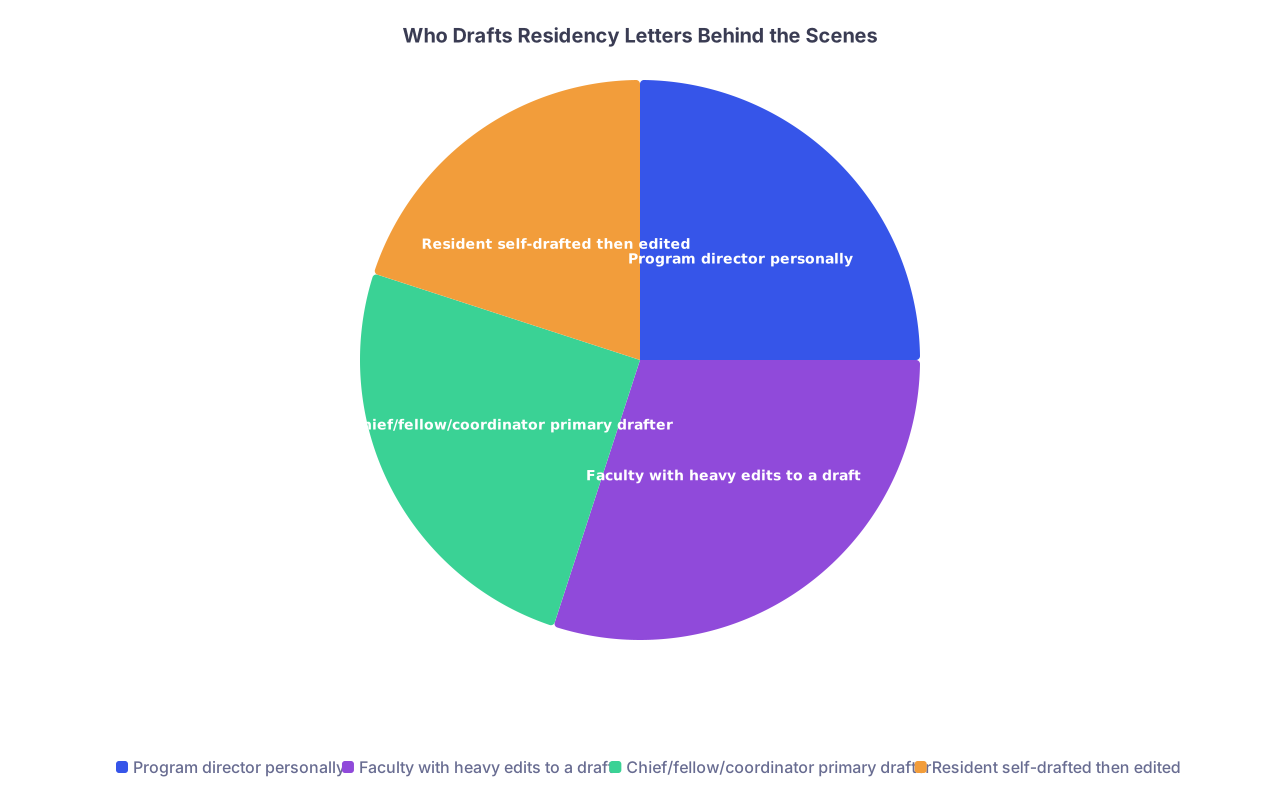
| Category | Value |
|---|---|
| Program director personally | 25 |
| Faculty with heavy edits to a draft | 30 |
| Chief/fellow/coordinator primary drafter | 25 |
| Resident self-drafted then edited | 20 |
These numbers aren’t from a published study. They’re from watching programs across multiple institutions run the same playbook with slightly different accents.
Chief resident applications and “teaching potential” letters
When you apply for chief, a teaching-focused fellowship, or a clinician-educator track, people suddenly start using the language of “educational leadership,” “curriculum development potential,” and “scholarly approach to teaching.”
Where does that language come from? A small number of senior educators recycle the same phrases across years. A PD might say to a chief: “Use the strong leadership paragraph from last year’s stellar chief, adjust it to fit this one.”
This matters, because committees can tell which programs are sophisticated about faculty development. Certain phrases become a signal that you’ve been in an environment that thinks seriously about education. You want those in your letters, even if someone else originally coined them.
Early faculty: Who writes letters for teaching-focused jobs and promotions
Once you cross into faculty territory, the stakes jump. Now we’re talking about:
- First academic job (often clinician-educator track)
- Promotion from instructor/assistant to associate
- Internal educational leadership roles (clerkship director, residency APD, course director)
- Major teaching awards
The naïve view is: “My division chief and chair write my letters.” Sometimes they do. More often, it’s a composite effort.
The internal promotions packet: a small cottage industry
For promotion in an education-focused track, you usually need:
- A detailed teaching portfolio
- Learner evaluations
- Evidence of curriculum development / assessment / scholarship
- External letters and internal letters
The internal letter from your division chief/chair is usually the most powerful. Here’s the uncomfortable detail: many chiefs copy heavily from your own materials.
I’ve seen chiefs literally open your teaching portfolio PDF, highlight phrases, and paste into their letter. They’re not being lazy; they’re being efficient. They often believe: “If you took the time to characterize your work, I’ll mirror that and then add my own judgment.”
There’s also usually an “education office” person—vice chair for education, director of faculty development, etc.—who quietly advises on phrasing. They may not sign anything, but they’ll say to the chair:
- “You need to explicitly state that this candidate meets institutional criteria for promotion at X level.”
- “Use the phrase ‘nationally recognized’ only if there’s actual outside recognition.”
- “Do not say ‘best teacher I have ever worked with’ unless you’re willing to explain that in a committee meeting.”
So the final signed letter might be:
- 40–60% language adapted from your own CV/portfolio
- 20–30% “stock” phrasing your institution uses to map to promotion criteria
- 10–30% actually unique commentary from your chief/chair
| Source | Approx Contribution |
|---|---|
| Faculty’s own portfolio/CV | 30–50% |
| Institutional template language | 20–40% |
| Chief/chair personal narrative | 20–40% |
You can rail against this or you can exploit it. If you write your portfolio in vague, unimpressive language, don’t be surprised when your promotion letter sounds vague and unimpressive too.
External letters: who really writes the “career-making” recommendations
The most serious letters in an education career are external referee letters for promotion, major education awards, or national leadership roles. These are the ones promotions committees read closely.
You imagine a senior educator at another institution sitting down and pouring their soul into your letter. Sometimes that happens. But I’ve also seen:
- External letter writers asking you for a draft. Yes, even at that level.
- Letter writers asking one of your co-authors or mentors for bullet points or a skeleton.
- People relying heavily on your CV and Google, barely knowing you personally.
When the external letter writer doesn’t know you well, two things determine your fate:
- How clearly your educational contributions are described in your CV/teaching portfolio.
- Whether the person who suggested them as a referee quietly prepped them with a narrative: “We think of her as our go-to in simulation education; she built X and Y.”
If you think “I’ll just list ‘small group facilitator, M2 pathophys course’ a dozen times and they’ll see how much I teach,” you’re missing the point. External writers pick up whatever you make legible. If your impact is buried, their letter will sound generic.
The ethics: how much ghostwriting is actually happening?
Let me say this clearly: there is ghostwriting in medical recommendation letters. From students. From residents. From junior faculty. It’s not rare.
Is it ethical? It depends how it’s handled.
Scenario that’s acceptable (and common):
- Faculty: “Send me a draft with your accomplishments and what you’re hoping the letter highlights. I’ll edit to reflect my perspective.”
- You write a factual, modest draft.
- Faculty significantly edits, deletes, reframes. The final voice is clearly theirs.
Scenario that’s sketchy:
- Faculty never reads your evals or independent data.
- You write a glowing, over-the-top letter.
- Faculty changes your name, fixes a couple of typos, and signs.
Most serious educators hate the second scenario. They know their signature is being used as a rubber stamp and it bothers them, but time pressure and administrative load push them in that direction.
The other behind-the-scenes writers are chiefs and fellows. Program directors will often say to a chief: “You’ve worked with this resident far more than I have; give me three paragraphs about them and I’ll integrate it.” That’s not unethical if the PD reads, edits, and stands behind the content. It actually improves accuracy.
How committees and PDs read letters (and spot the fakes)
You’re probably wondering: if so much of this is templated or ghostwritten, do people on the other end know?
Yes. Very much so.
I’ve been in selection meetings where:
- Multiple applicants from the same program had letters with nearly identical wording. The PD in the room: “That’s their standard letter template; read between the lines.”
- A candidate’s self-advocacy showed up word-for-word in the letter. Someone on the committee: “This sounds like their personal statement syntax, not the chair’s usual way of writing.”
Readers are not dumb. They’ve seen thousands of letters. They calibrate:
- Programs/institutions known for restrained, honest letters (when they say “outstanding,” it means something).
- Programs that write “best resident ever” for half their graduates. Those letters get discounted.
For education careers, there’s another layer: promotions and awards committees often have senior clinician-educators who can sniff out inflated teaching claims in seconds. If your letter says “national leader in medical education” and you have one poster at a local meeting, you’re hurting yourself long term.
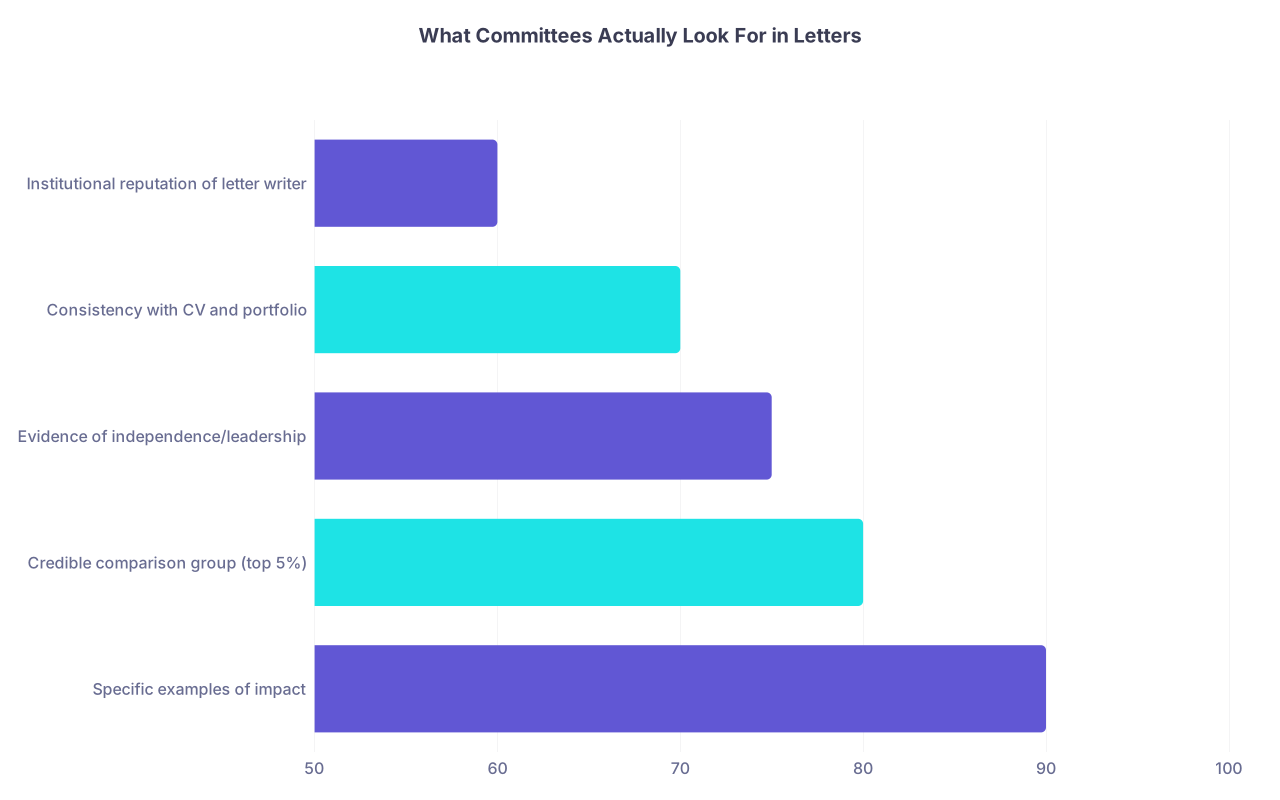
| Category | Value |
|---|---|
| Specific examples of impact | 90 |
| Credible comparison group (top 5%) | 80 |
| Evidence of independence/leadership | 75 |
| Consistency with CV and portfolio | 70 |
| Institutional reputation of letter writer | 60 |
Notice what’s not on that list: flowery adjectives with no proof.
If you're serious about a teaching career, here’s how to play this game well
You can’t control who types every sentence. You can control the inputs.
1. Assume you’re partially writing your own letters two steps upstream
Every eval comment, every teaching feedback form, every line in your CV is raw material someone will mine later. Most letter drafters don’t have time for detective work; they’ll lift your own phrasing, or your learner’s words.
So:
- Don’t describe yourself as “helpful” and “nice with students” if you’re actually running sessions, developing cases, revising assessments. Use language that reflects actual educational work: “designed,” “implemented,” “evaluated,” “mentored.”
- Make sure students and residents know what you did behind the scenes. They can’t mention your role in feedback if they never saw it.
2. Choose letter writers for how they write, not just their title
You’re told to chase big titles: chair, dean, PD. For education careers, that can backfire.
A sharp, known clinician-educator who writes specific, credible letters is often more valuable than a department chair who signs a generic paragraph. People on the other side know who actually cares about education.
If you ask a big-name chair, you might get:
- A one-paragraph “I support this candidate” letter that says very little.
If you ask the vice chair for education or the clerkship director who’s seen you teach repeatedly, you might get:
- A detailed, example-rich letter describing your educational trajectory.
Committees read the content, not just the signature block.
3. Make drafting easy—but not manipulative
When someone says “send me a draft,” don’t send them a finished, glowing letter about how extraordinary you are. That screams self-promotion.
Send:
- A concise bullet list of what you worked on with them
- A brief narrative of your teaching/education work and goals
- Any specific points you think are important for that application (e.g., “This is for a clinician-educator track position; they value curriculum development and small-group teaching.”)
If they still ask you to draft the whole thing, write something factual and restrained. Assume someone who’s read thousands of letters will eventually see it. Overwriting is how people out themselves as the ghost in their own letter.
The hidden players: coordinators, admin staff, and templates
One more group you probably don’t think about: program coordinators, education office managers, and admin specialists. These folks are the guardians of template language and workflow. They know:
- Which phrases your institution avoids (e.g., “guarantee” language)
- The standard descriptions of teaching awards and roles
- How letters need to be formatted to pass internal review
They also quietly correct obvious self-sabotage. I’ve watched an education office admin take a draft letter, delete a sentence about “still working on punctuality” and tell the faculty member, “If you want to include that, phrase it differently, or the committee will seize on it.”
You’ll never see their fingerprints, but they can make your letter sound like it came from a serious academic place instead of a chaotic department that’s never promoted an educator before.
Practical reality: what actually moves the needle
For medical teaching and education careers, the letters that matter most over time aren’t the first one or two you obsess over. It’s the pattern.
- Does your file show a consistent story of someone who teaches, designs, evaluates, and thinks about education?
- Do letters over the years evolve from “good resident teacher” to “go-to teacher” to “our primary educator in X area” to “national presence in Y niche”?
- Are the letters aligned with your visible output—curricula, workshops, publications, invited talks?
The person who “writes” the letter is less important than the fact that there is something real to write about.
You can game the wording in the short term. You cannot game the trajectory.
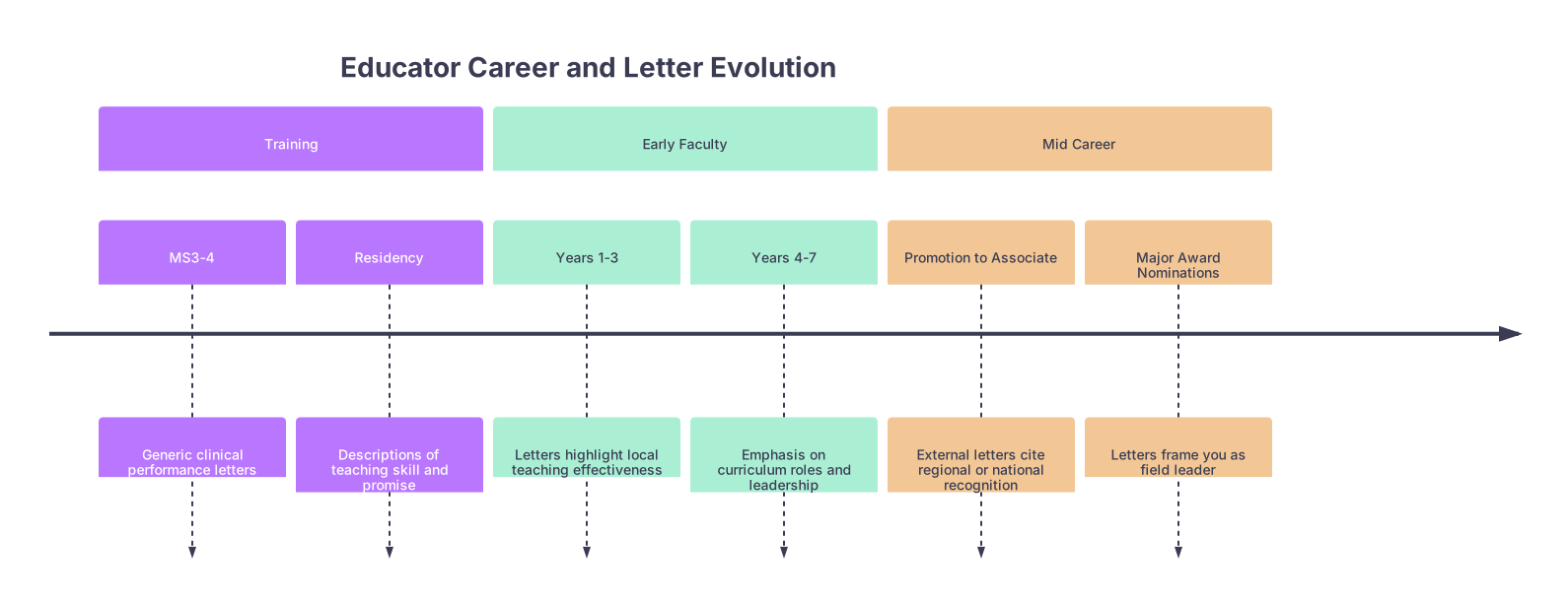
| Period | Event |
|---|---|
| Training - MS3-4 | Generic clinical performance letters |
| Training - Residency | Descriptions of teaching skill and promise |
| Early Faculty - Years 1-3 | Letters highlight local teaching effectiveness |
| Early Faculty - Years 4-7 | Emphasis on curriculum roles and leadership |
| Mid Career - Promotion to Associate | External letters cite regional or national recognition |
| Mid Career - Major Award Nominations | Letters frame you as field leader |
The letters follow the work. Or expose the lack of it.
FAQs
1. Is it okay if I’m asked to write my own letter draft?
It happens all the time. What’s not okay is treating that as a chance to write fan fiction about yourself.
If you’re asked for a draft, keep it:
- Factual: specific roles, responsibilities, outcomes.
- Modest: avoid “best,” “unparalleled,” “extraordinary”; leave superlatives to the signer.
- Structured: clinical/teaching section, scholarship section, professionalism/leadership section.
Assume the real value you’re providing is assembling accurate information in one place, not doing the recommender’s thinking for them. A responsible faculty member will still revise heavily.
2. How early should I start building relationships for strong education-focused letters?
Earlier than you think. By mid-residency if you’re leaning educator, you should already be:
- Known to at least one serious clinician-educator at your institution
- Involved in some kind of recurring teaching role (M1/M2 small groups, bootcamp, simulation, etc.)
- Thinking about a mini-project with an educational angle (curriculum tweak, session redesign, assessment improvement)
Those people become your letter writers later. Dropping in at PGY-3 or as a junior faculty saying “please write me a letter that portrays me as committed to education” without a track record is how you end up with content-light, generic letters.
3. Do committees “penalize” candidates when they suspect ghostwriting or templated letters?
Not explicitly. But they discount them.
A templated, bland letter doesn’t torpedo you; it just doesn’t help you distinguish yourself. The quiet penalty is that you blend into the pile. Ghostwritten-sounding letters full of over-the-top praise that isn’t backed by your CV or portfolio can do more damage—they make committees question your judgment and your mentor’s standards.
Strong education careers are built on credible, specific letters from people who actually know your work. Your job is to create enough real educational substance, and enough authentic relationships, that even if a chief or coordinator types the first draft, the story those letters tell about you is true.
Years from now, you won’t remember which coordinator merged which template for which letter. You’ll remember which mentors actually knew your work well enough that, when they signed their name under a page about you, it felt earned.