
The way most institutions sell “education tracks” is misleading. They are not a golden ticket to promotion. They are, at best, a translation service. At worst, they’re a branding exercise that keeps you doing more work for the same title and salary.
Let me walk you through what actually happens behind the closed doors of promotion and tenure committees when your name comes up as an “educator track” candidate. Because the myths floating around the med school hallways are getting a lot of good people stuck.
What Education Tracks Really Are (Not the Brochure Version)
On paper, an education track (or clinician-educator track, educator-scholar track, teaching scholar track—pick your flavor) sounds great. The dean’s office slides say things like “valuing teaching,” “alternative pathways to promotion,” and “recognizing diverse contributions.”
Inside the committee room, the reality is more blunt: education tracks are a way for the institution to categorize you as “not primarily a researcher” while still demanding evidence of scholarly productivity.
They do three main things structurally:
- Lower the expected bar for traditional research metrics compared to tenure/research tracks.
- Raise and formalize expectations for educational work—but only the part they can count and compare.
- Give the school a way to say publicly, “We support educators,” without actually freeing up serious time or money for you to teach.
What they do not do—no matter what your department chair hints at over coffee—is magically turn good teaching into promotion. Promotion is built on evidence. And teaching, by itself, rarely leaves the kind of evidence committees trust.
That’s the dirty secret.
How Promotion Committees Actually View Education Tracks
Here’s what I’ve heard in real committee meetings:
- “She’s on the clinician-educator pathway. Show me the scholarship.”
- “Lots of hours, but where’s the impact? Any peer-reviewed output?”
- “Good teacher, but I’m not seeing a trajectory.”
Notice what no one says: “Her students love her, that’s enough.”
Education track or not, the committee is still trying to answer the same core questions:
- Is this person doing something that extends beyond their own classroom or ward team?
- Can we defend this promotion to the dean, the provost, and external letter writers?
- Is there a coherent story: focus, growth, impact?
The track only changes the calibration of “how much” and “what type” of scholarship they expect. It does not lower the bar to “nice person who works really hard with learners.”
To make this concrete, here’s how expectations usually differ. The numbers aren’t official anywhere; they’re how people actually talk informally:
| Dimension | Research/Tenure Track | Education/Clinician-Educator Track |
|---|---|---|
| First promotion (Asst → Assoc) | ~6–10 solid original research papers, some as first/last author | ~3–6 peer-reviewed education products (curriculum papers, assessment studies, etc.) |
| Grants | External funding strongly preferred | Grants nice but not required; small education grants common |
| Teaching volume | Required but not central | High volume expected but not sufficient alone |
| Teaching evaluation weight | Low–moderate | Moderate, supporting not primary evidence |
| National reputation | Strongly emphasized | Expected but often through education venues (workshops, invited talks) |
No committee member will show you a table like this. But they will talk this way in the room.
What Education Tracks Actually Help With
They do a few useful things—if you understand their limits.
1. They Give You a Different “Currency Exchange Rate”
A research-track person spends most of their effort converting time into grants and original research articles. Teaching is background noise as long as it’s not a disaster.
On an education track, your “currency” can include:
- Peer-reviewed education articles
- Curriculum innovation with dissemination
- Assessment tools with evidence of validity
- National workshops and invited education talks
- Education leadership roles (course/clerkship/program director)
The track tells the committee, “We expect more of this kind of currency, and less traditional bench/clinical research.” But notice: it still has to be currency. Not just hours.
The common trap: people stay at the “local, undocumented good citizen” level. Lots of curriculum meetings, countless lectures, endless learner emails. No publications, no national work, no clear narrative.
Those people get stuck at Assistant Professor for a decade and then start showing up in my office asking what went wrong. What went wrong is that they believed “education track” meant “teaching effort will be counted equally to research output.” It will not.
2. They Let Committees Accept Non-Traditional Scholarship
Without an education track, a paper on “Implementing a Novel OSCE for Clerkship X” gets shrugged off as low-value. On an education track, that same paper can be a central piece of your dossier—if it’s in a real journal and tied to a sustained line of work.
Education tracks let committees count things like:
- MedEdPORTAL publications
- Simulation curricula written up and shared
- Evaluation/assessment research
- Qualitative work on learner development
- Program evaluation with publishable methodology
The nuance you never hear: they do not count all educational work. They want things that look, smell, and feel like scholarship. Peer review. Generalizable. Citable.
Your beautiful local curriculum that lives in a shared drive and is “beloved by students” but never written up? That’s service, not scholarship.
3. They Protect a Certain Kind of Career—Barely
The education track can protect you a bit when external reviewers say, “This person doesn’t have R01-level research.”
A strong external letter will say something like: “Dr. X is a nationally-recognized clinician-educator whose work focuses on assessment of clinical reasoning. Their portfolio includes a cohesive line of peer-reviewed scholarship, national workshops, and leadership roles in education organizations.”
That phrase—“line of scholarship”—is what the track buys you. You’re being judged on that line of work, not on your ability to bring in major research funding.
But if the letter instead says: “Dr. X is a valued teacher and administrator, very dedicated, and well-liked by students,” your track won’t save you. That’s code for “nice but not promotable on scholarly grounds.”
What Education Tracks Absolutely Do Not Do
This is where people get burned.
They Do Not Convert Teaching Hours into Promotion Points
I’ve sat through dossier reviews where someone had:
- 250+ lecture hours over 5 years
- Course director duties for two big pre-clinical blocks
- Sky-high student evals and teaching awards
And still the room was split on promotion. Why? Because there was no real scholarship: a few local poster presentations, one low-impact, not-very-rigorous paper, no national reputation.
The unofficial reality is brutal: your 100th lecture is worth only marginally more than your 10th. After you’ve shown sustained teaching, the committee stops counting raw hours and starts asking: “And what came of it?”
They Do Not Override Departmental Politics
Another hard truth. If your chair doesn’t care about education or sees you as easily replaceable service labor, the education track won’t protect you.
I’ve watched chairs use the education track as a dumping ground:
- “We’ll move them to clinician-educator so their lack of grants doesn’t hurt our research metrics.”
- “Put her on the education track; she likes working with students. We need someone to cover that course.”
Three years later, that same chair is sitting in a promotions meeting saying things like, “Their profile is a bit thin; not seeing much scholarship.”
The track is a label, not a shield. Departmental culture and leadership matter ten times more than which box is checked next to your name.
They Do Not Guarantee Time to Do Educational Scholarship
Biggest scam of all: people assume “education track” = “protected time to be an educator.”
What actually happens at a lot of places:
- Your clinical RVU targets stay the same.
- You pick up clerkship director or course roles “because you’re on the education track now.”
- You get no real FTE carved out for scholarship, just more meetings and emails.
End result: evenings and weekends become your only time for actually writing the papers and grants you need for promotion.
A few institutions do this right—true 0.2–0.4 FTE for education, explicit expectations for scholarly output, mentoring baked in. But they’re the minority. If your offer letter doesn’t specify protected time, assume it doesn’t exist.
How Committees Actually Weigh Common Education “Contributions”
Let me be precise about what carries real weight and what doesn’t. This is roughly how people in the room talk and think, whether or not they’ll admit it publicly.
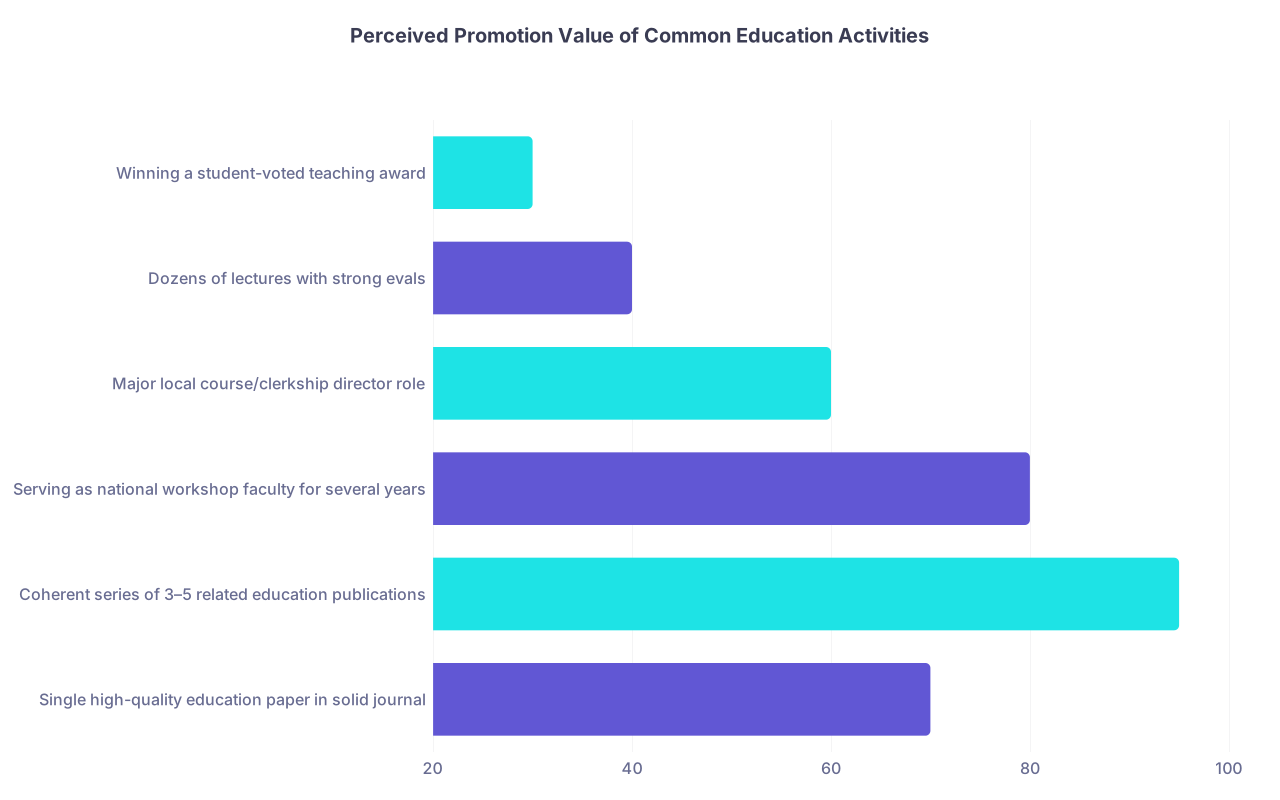
| Category | Value |
|---|---|
| Single high-quality education paper in solid journal | 70 |
| Coherent series of 3–5 related education publications | 95 |
| Serving as national workshop faculty for several years | 80 |
| Major local course/clerkship director role | 60 |
| Dozens of lectures with strong evals | 40 |
| Winning a student-voted teaching award | 30 |
Rude translation:
- One good paper beats 20 extra lectures.
- A coherent education theme beats scattered one-off projects.
- National presence (workshops, invited talks, society roles) makes the committee relax. “Okay, others vouch for this person.”
- Teaching awards and evals are supporting evidence. Rarely decisive.
So if you’re on an education track and your calendar is packed with “teaching activities” but your CV looks thin on peer-reviewed, generalizable work, you’re on the wrong side of that chart.
If You’re On an Education Track Now: How to Make It Actually Work for You
The track can be powerful, but only if you treat it like a structured career strategy, not a feel-good label.
Step 1: Pick an Education Niche—Then Ruthlessly Filter Opportunities
The kiss of death is being “the helpful person who says yes to everything involving learners.”
You need a niche that can generate scholarship for 5–10 years. Examples:
- Assessment of clinical reasoning in the clerkship years
- Simulation-based training for procedural skills
- Feedback and coaching in residency
- Remediation of struggling learners
- Curriculum for interprofessional teamwork
Once you pick your niche, you measure every new “opportunity” against it:
- Does this feed my niche and potentially produce something publishable?
- Or is this just more service that will never show up in my promotion packet?
If you’re the only one in the department who understands this filtering, you’ll feel selfish. That’s fine. The committee will not remember the random extra small-group sessions you covered when someone called in sick.
Step 2: Turn Every Major Education Role into a Study
Clerkship director? Don’t just manage schedules and tweak slides.
You should be:
- Designing a better assessment or feedback tool
- Collecting data on outcomes
- Writing it up for a real journal or MedEdPORTAL
New curriculum? You don’t “finished the course” and stop. You:
- Pre-specify outcomes
- Build in evaluation
- Present results at a national meeting
- Publish a methods/outcomes paper
The core move is this: never do pure service if you can convert at least part of it into scholarship. Service disappears the moment the committee closes your teaching table. Scholarship lives on your CV.
Step 3: Build a Visible National Education Presence Early
One of the first questions in the promotion meeting: “Tell me about their national reputation.”
For an education-track person, that usually means:
- Presenting at national education conferences (AAMC, SGIM, APDIM, specialty-specific societies)
- Running or co-leading repeated workshops
- Serving on education committees for national organizations
- Getting involved in multi-institutional education collaboratives
Do this before you’re “up for promotion.” It takes years to build, and external letter writers need time to actually know who you are.

| Step | Description |
|---|---|
| Step 1 | Start as Assistant Professor |
| Step 2 | Choose education niche |
| Step 3 | Take focused education roles |
| Step 4 | Design projects with publishable outcomes |
| Step 5 | Present at national meetings |
| Step 6 | Publish series of education papers |
| Step 7 | Gain national education roles |
| Step 8 | Apply for promotion on education track |
Common Myths I Hear in Hallways (and Why They’re Dangerous)
Let me kill off a few persistent myths that derail early-career educators.
“I’m on the education track, so I don’t really need publications.”
Wrong. You need different publications, not zero publications. I’ve seen education-track dossiers denied explicitly for thin scholarship.
“But my teaching evals are stellar. That will carry me.”
They won’t. Great evals keep you promotable; they don’t push you over the line. Weak evals will hurt you. Strong evals alone will not save you.
“My chair told me they’ll support my promotion.”
I’ve watched chairs say that in private and then hedge once the dossier leaves the department. Chairs are under pressure not to send up weak packets. Their “support” often means, “If you get there, I’ll cheer.” Not, “I’ll make sure you get there.”
You need explicit, written expectations: “For promotion on the education track, we typically expect X publications, Y national activities, Z leadership roles.” Without that, you’re gambling.
How to Know if Your Institution’s Education Track is Real or Cosmetic
Pay attention to these telltale signs.

Signs It’s Real
- Promotion criteria documents explicitly describe education scholarship with examples.
- Successful promoted educators in your department can point to clear lines of work and reasonable expectations.
- Protected FTE for education is actually honored when the schedule is built.
- You can name at least three people recently promoted on that track who look like the educator you want to be.
Signs It’s Mostly Window Dressing
- The criteria document says “excellence in teaching,” but every successful candidate still has a bunch of traditional research papers.
- People promoted on the education track are basically failed researchers with a couple of random education talks stapled onto their CVs.
- No one can explain how many or what kind of education publications past successful candidates had.
- “Protected time” evaporates every time clinical volumes go up.
You can survive in a cosmetic system, but you have to be twice as disciplined and probably look for collaborators at other institutions to build a real education scholarship profile.
The Hidden Upside of Education Tracks—If You Play Them Right
I’ve been pretty harsh so far, because the false marketing around education tracks burns people. But used deliberately, they can actually give you a better life than the traditional R01-or-bust model.
Here’s the upside no one sells correctly:
- You get to build a career around something you actually like: teaching, curriculum, coaching.
- You can craft a scholarship portfolio that’s more aligned with day-to-day work with learners.
- The national education community is, frankly, less cutthroat and more collaborative than bench science.
- Once you’re promoted, you often become “the education person” in your department, which comes with real informal influence: hiring committees, program design, strategic planning.
The key is refusing to be just the friendly workhorse. You build a brand around your niche. You protect time for scholarship like a grant-funded PI protects lab time. You learn to say “no” to things that don’t feed your portfolio.
If you do that, the education track stops being a holding pen and becomes a legitimate pathway to a respected, sustainable career.
FAQ (Exactly 3 Questions)
1. How many education publications do I really need for promotion on an education track?
At most mid-tier academic medical centers, realistic numbers I’ve seen for Assistant → Associate on an education track are around 3–6 peer-reviewed education-focused publications, with at least a couple where you’re first or senior author and they clearly fit a coherent theme. At top-tier places, they’ll lean toward the higher end and expect more methodological rigor and national reputation to match. Ask your promotions chair to show you de-identified examples of successful education-track dossiers—that’s far more informative than any generic guideline.
2. Do teaching awards and “outstanding educator” titles matter for promotion?
They help, but not the way people think. A teaching award is a nice supporting piece; it signals that your learners recognize your efforts and that your teaching is at least locally excellent. But committees rarely promote someone on the strength of awards without a solid record of scholarly activity. Think of awards as credibility boosters, not currency. Currency is still peer-reviewed, generalizable work and a visible national role.
3. Is it a mistake to go on an education track early in my career?
Not inherently. The mistake is going on an education track without a clear plan for scholarship and without understanding your institution’s actual expectations. If your passion is teaching and you’re willing to be as intentional about education scholarship as a basic scientist is about their lab work, the education track can be a good fit even early. But if your institution only pays lip service to education and every promoted “educator” really looks like a light version of a researcher, you may be better off staying on a more traditional clinical or research track until you have enough leverage and clarity to negotiate something real.
Key takeaways:
Education tracks change the type of scholarship you’re judged on, not the fact that you must produce scholarship. Teaching hours and good evals are necessary but never sufficient; every major education role must be converted into publishable, generalizable work. And the track label itself is powerless without the right niche, real protected time, and a deliberate plan to build national-level education impact.