
The faculty in your department are not all equal, and your program director already has a private ranking list in their head. Long before anyone talks about “educator awards” or “mentor of the year,” that internal list is driving who gets key roles, promotions, and protected time.
You will not find that list in any official document. But it exists. I’ve seen it discussed, quite bluntly, behind closed doors.
Let me tell you how they really rank you as an educator and mentor—and how quietly that ranking shapes your career.
The Two Invisible Columns: “Safe Hands” and “Difference Makers”
Every program director I’ve worked with—medicine, surgery, peds, EM, you name it—has some version of a mental spreadsheet for faculty. It usually has two big invisible columns:
- Can I trust this person with learners?
- Does this person actually move the needle for the program?
You might call the first one “safe hands.” No complaints, no disasters, nothing sketchy. This is the baseline. If you fall below this, you get quietly restricted from certain rotations, not invited to mentor, and eventually you lose influence.
The second one is “difference maker.” That’s where real status lives. Faculty who:
- Residents ask to work with
- Students name on every evaluation
- PDs rely on when something is on fire at 2 a.m.
Most faculty never realize they’re being ranked on these two axes. They think it’s all about titles—Clerkship Director, APD, some committee chair. Program directors are watching something else entirely.
What PDs Actually Look At (Not What You Think)
You think it’s your teaching portfolio, your MedEd courses, your “Introduction to Teaching” certificate.
Your PD is looking at patterns. Over months and years. Let me walk you through the ones they care about.
1. Resident Evaluations: Not the Scores, the Stories
Everyone knows PDs “look at evals.” Most faculty think that means the 1–5 Likert scores. That’s amateur hour.
The smart PDs ignore individual scores and focus on three things: streaks, language, and outliers.
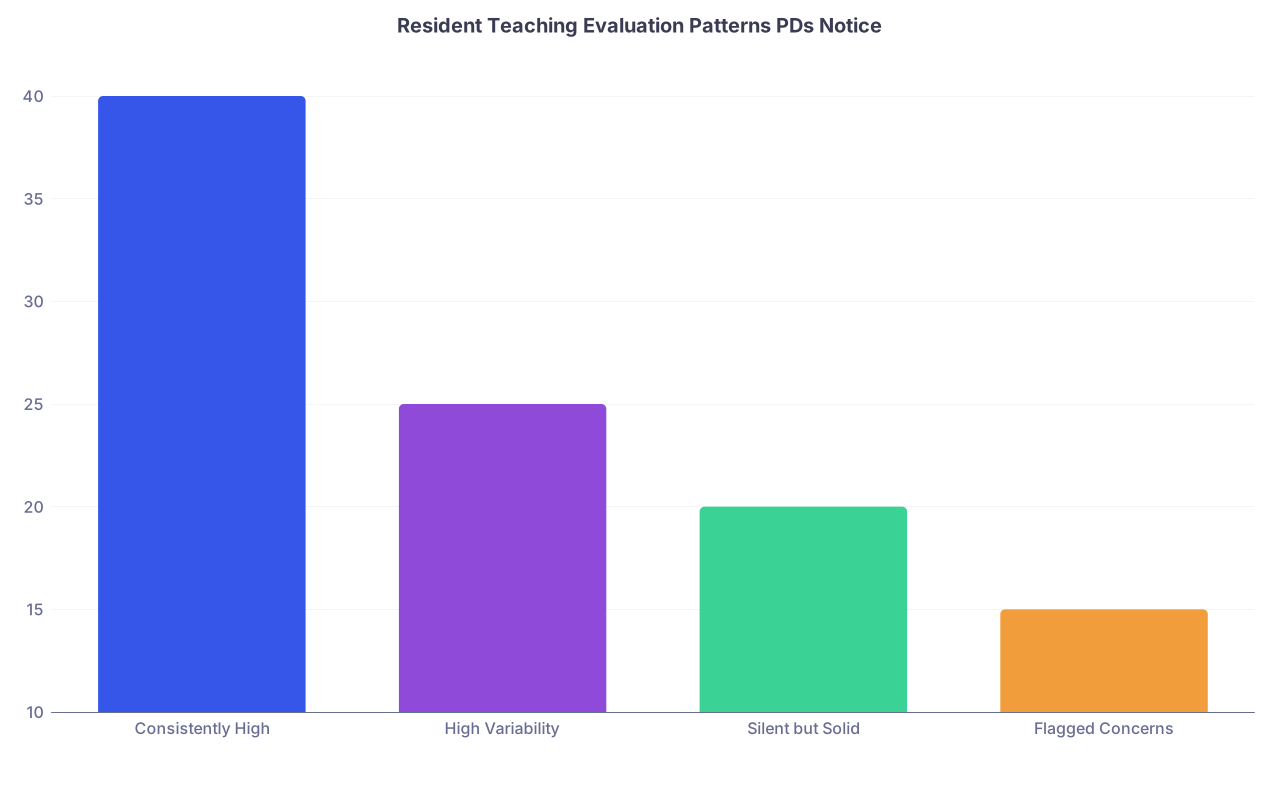
| Category | Value |
|---|---|
| Consistently High | 40 |
| High Variability | 25 |
| Silent but Solid | 20 |
| Flagged Concerns | 15 |
- Streaks: Are you consistently in the top quartile of teachers, rotation after rotation, year after year? One good month doesn’t move you on their mental list. A solid 18–24 months does.
- Language: The exact phrases matter. PDs read the comments more carefully than you think. “Teaches a lot” means nothing. “Makes me feel safe to ask questions,” “gave me actionable feedback,” “helped me think like an intern” — those are gold.
- Outliers: One scathing evaluation in a year of praise doesn’t sink you, but it does trigger a quiet check-in: is there a pattern? If three residents in a row mention “belittling,” “humiliating,” or “unsafe,” you drop several notches on the “trusted” axis immediately.
And this is the real insider piece: PDs weight senior resident comments differently than intern or student comments. A CA-3 anesthesiology resident saying, “I learned to run a room from her” counts more than an M3 saying, “He was nice.”
2. Who Learners Choose When They Have a Choice
Watch who residents gravitate to when there’s freedom: electives, scholarly projects, longitudinal clinics, informal mentors.
Program directors absolutely track this, even if only mentally. They notice when:
- The same 3–4 faculty get all the “Can you be my research mentor?” emails
- Residents ask to switch into your clinic
- Students request your team again for a sub-I
When I sat in a PD’s office doing annual reviews, we literally went through the list and he said: “Look how many people are choosing Dr. R. That’s not an accident.” That faculty member got protected time the following year. No big committee announcement. Just a quiet reallocation of FTE.
If learners are not choosing you when they have options, that’s a problem. PDs see that as a proxy for your true educational value.
The Shadow File: What PDs Hear in Hallways and Behind Closed Doors
Every program has a “shadow file” on faculty. It’s not always written down, but it absolutely exists in conversations.
3. Informal Resident Feedback: The Real Data Stream
Residents rarely file formal complaints about mediocre teaching. They just warn each other.
They say things like:
- “If you’re with Dr. X, don’t expect to leave before 9.”
- “Dr. Y is chill, but you won’t learn much.”
- “If you’re serious about cards, make sure you work with Dr. Z.”
Program directors hear this. From chief residents especially. Chiefs are the unofficial translators of resident sentiment.

| Step | Description |
|---|---|
| Step 1 | Resident Experience |
| Step 2 | Talk with Peers |
| Step 3 | Chief Resident Hears |
| Step 4 | Informal Check Ins with PD |
| Step 5 | PD Mental Ranking Shifts |
This is where your reputation is really made or broken. Not on paper. Over coffee with chiefs, during pre-rounds, at the end of rotation debriefs.
Chiefs will say:
“Honestly, the rotation is great when they’re with Dr. K, but when they get Dr. L, they’re just scut monkeys.”
That one sentence can demote you on the PD’s list for years.
4. How You Handle Struggling Trainees
Here’s a secret most faculty never hear: your reaction to a struggling resident is one of the highest-yield signals PDs use to judge you as an educator and mentor.
They pay attention to:
- How early you flag concerns
- How specific your observations are
- Whether you offer to help, or just dump the problem
When a faculty email says, “This intern is just not getting it,” that’s low-value. When it says, “I’ve watched him on five new admits—missed sepsis twice, does not integrate vital signs into assessment, seems overwhelmed by volume. I tried X and Y; here’s what seemed to help,” that’s high-value.
The faculty who send the second kind of email get labeled as “educators.” The ones who wait until the end of the block and then give a vague low evaluation? Those are “complainers.” The PD won’t say this to your face. But they use that exact division in their heads.
Time, Reliability, and the “3 a.m. Test”
Program directors are not just ranking your teaching skills. They are ranking your reliability in the messy reality of residency.
You can be a brilliant educator, but if you’re chaotic, constantly switching call shifts, or impossible to reach when something goes wrong, your ranking drops.
5. The 3 a.m. Test
Every PD I know has their own version of this question:
“If something goes sideways at 3 a.m.—a bad outcome, a professionalism crisis, a resident melting down—who do I want involved?”
The names that come to mind first are their top-tier mentors and educators. Not necessarily the most famous. The most steady.
These tend to be the people who:
- Don’t escalate drama unnecessarily
- Are honest but not cruel
- Can give feedback that actually lands
- Won’t throw the resident under the bus to protect themselves
If you’re known as emotionally volatile, vindictive, or conflict-avoidant, you might still be allowed to teach, but you will never be in the inner circle of trusted mentors.
6. The “Can You Cover?” Score
No one talks about this in teaching courses, but it’s very real. When schedules blow up—sick call, sudden leave, unexpected gaps—PDs keep score of who steps up and how they behave when they do.
Quietly, you get categorized:
- Always says yes, then decompresses appropriately = dependable, committed educator
- Always says no, or says yes but complains to everyone = not reliable core
- Always says yes and then burns out visibly = risk for future meltdown
The first group is who gets tapped for leadership later. The second group ends up wondering why promotions pass them by even though “my teaching evaluations are pretty good.” The third group gets temporarily praised, then slowly protected from further responsibility.
The Political Layer: Committees, Titles, and Who Gets Protected Time
Here’s an uncomfortable truth: your status as an educator isn’t just about teaching skills. It’s also about how you function in the internal politics of the program.
7. Who Gets Protected Time (and Why)
Protected time for teaching and mentoring is rarely awarded strictly on objective educational metrics. Yes, there are formulas and rubrics. No, they do not tell the whole story.
Behind closed doors, PDs and department chairs say things like:
- “If we give Dr. A 0.2 FTE, we’re going to see real curricular improvement.”
- “Dr. B is a nice teacher, but I don’t see them leading anything.”
- “Dr. C is poison on every committee. I’m not giving them more influence.”
So what’s actually driving those decisions? Three big factors:
- Can you execute? Ideas are cheap. PDs value people who actually finish projects—revamp the rotation manual, build a remediation plan, create a simulation series.
- Are you constructive in meetings? If every discussion with you becomes a war zone or a therapy session, you get excluded from the real decisions.
- Do residents confirm your value? If residents keep naming you as “the reason I chose this program,” that’s rocket fuel. PDs will go to bat for your FTE.
| Faculty Type | PD Internal Label | Likely Outcome |
|---|---|---|
| High evals + reliable | Core educator | Protected time, promotion |
| High evals + chaotic | Talented but risky | Used selectively |
| Low evals + helpful | Serviceable teacher | Minimal influence |
| Toxic but productive | Necessary evil | Politically constrained |
8. Who Gets Leadership vs. Who Gets Work
You’ll notice something if you sit long enough at faculty meetings: the same 5–10 names get all the “opportunities.”
Those are the people the PD has already ranked at the top of the educator/mentor list. They get:
- New roles (APD, site director, simulation lead)
- Visibility at GME meetings
- First crack at MedEd fellowships or funding
Meanwhile, others get asked to “help” but never to “lead.” PDs will say things like, “Could you pilot this small piece of the project?” That’s code for: I need labor, not leadership.
If you’ve been stuck in that bucket for a few years—doing OSCE checklists, writing questions, covering random lectures—you’re probably ranked as: good soldier, not core architect.
Mentorship Ranking: Who PDs Trust With Residents’ Futures
Teaching is one thing. Mentoring is a different tier.
Program directors keep a very specific mental list here: Who can I safely point residents to when they’re at a crossroads?
9. The “Who Should I Talk To?” Test
When a resident says, “I’m thinking about cards/onc/EM/private practice/academics,” watch who the PD names without hesitation.
Those faculty are top-tier mentors. Why? Because:
- They give realistic, not fantasy, career advice
- They don’t recruit vulnerable residents into dysfunctional niches
- They follow up on residents they meet with
- They don’t have reputations for boundary issues or favoritism
If your advice is consistently self-serving (“You should all go into my subspecialty; it’s the best”) or delusional (“You failed Step 1 twice, but sure, plastic surgery is definitely an option”), PDs stop sending residents your way.
And here’s the part nobody tells you: residents tell PDs when advice was unhelpful. After career talks, hallway conversations, those end with, “I met with Dr. M… honestly, it just made me more confused.”
You just dropped a few spots on the mentor list.
10. How You Handle Vulnerable Conversations
The conversations that make or break mentorship reputations are not about fellowships. They’re about failure, doubt, and crisis.
Program directors listen for:
- Did you normalize struggle without minimizing performance issues?
- Did you protect confidentiality or gossip to other faculty?
- Did you help the resident connect with resources (counseling, remediation, coaching) or just share war stories?
The mentors PDs truly value are the ones they can send someone in trouble to and sleep at night knowing it won’t blow up.
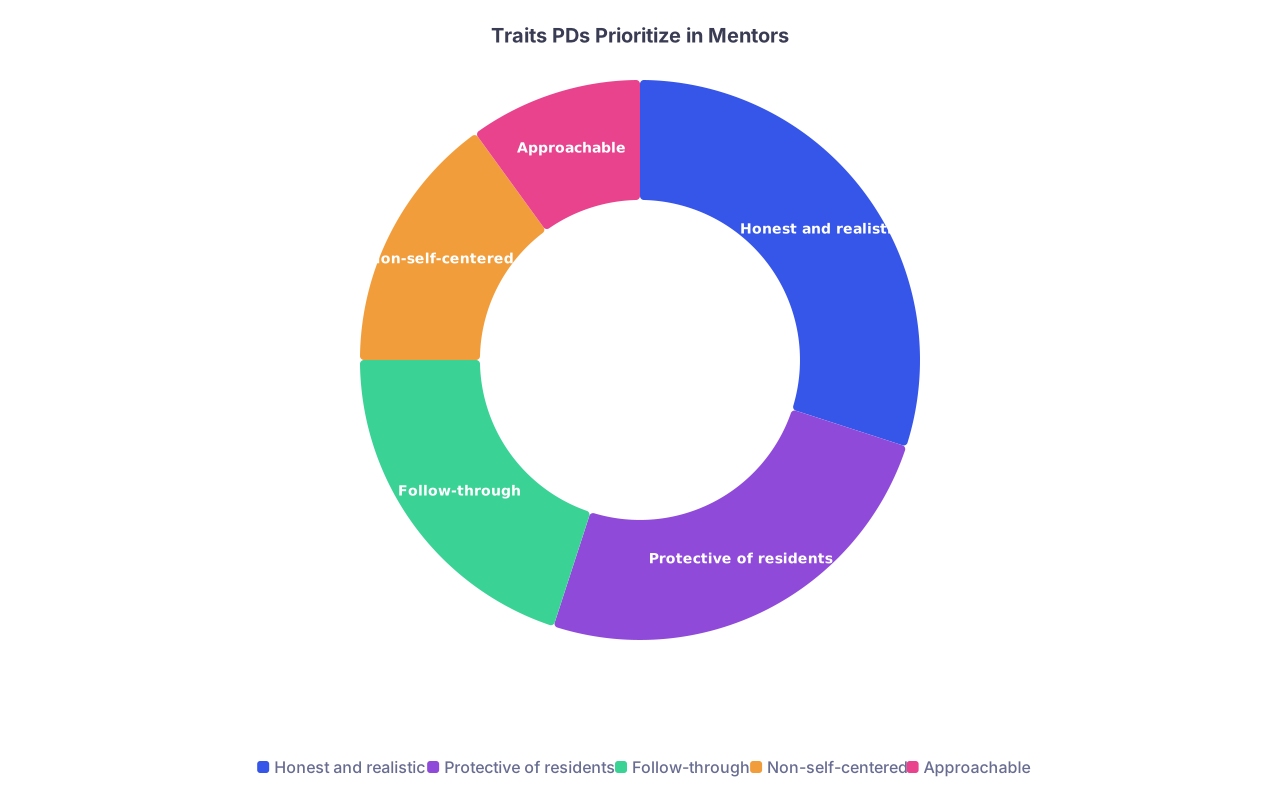
| Category | Value |
|---|---|
| Honest and realistic | 30 |
| Protective of residents | 25 |
| Follow-through | 20 |
| Non-self-centered | 15 |
| Approachable | 10 |
How You Quietly Move Up (or Down) the List
Let me be blunt: your MedEd certificate is not what’s moving your name up the PD’s internal ranking. It doesn’t hurt, but it’s not decisive.
Here’s what actually shifts your standing over 2–3 years.
11. Small, Visible, Consistent Behaviors
Program directors notice patterns, not grand gestures.
Your stock goes up when you:
- Send specific, timely, fair resident evaluations. Not “great job,” but “strong H&P, needs to tighten assessment, I suggested doing X and saw improvement by end of week.”
- Volunteer for one thing and actually make it better. You don’t need ten committees. You need one rotation, one course, one project that is objectively improved because you touched it.
- Communicate like an adult. Clear, on time, minimal drama, solutions-oriented.
The faculty who think they’re “great teachers” because they give entertaining chalk talks once a month? They rarely climb as high as they think. The ones who make the rotation work, protect residents from nonsense, and quietly shape culture? Those are the ones PDs lean on.
12. Common Ways Faculty Quietly Sink Their Rank
I’ve watched good people ruin their educator reputation without realizing it. Here are the repeat offenders:
- Publicly mocking residents’ knowledge gaps
- Giving scathing end-of-rotation evals without ever having warned the resident
- Constantly bad-mouthing duty hour rules, wellness efforts, or “this new generation”
- Offloading all teaching to fellows and then complaining about “how weak the residents are now”
- Making every project about their CV rather than the program’s needs
Each of these things gets reported back to the PD in one form or another. Often indirectly. But it gets there.
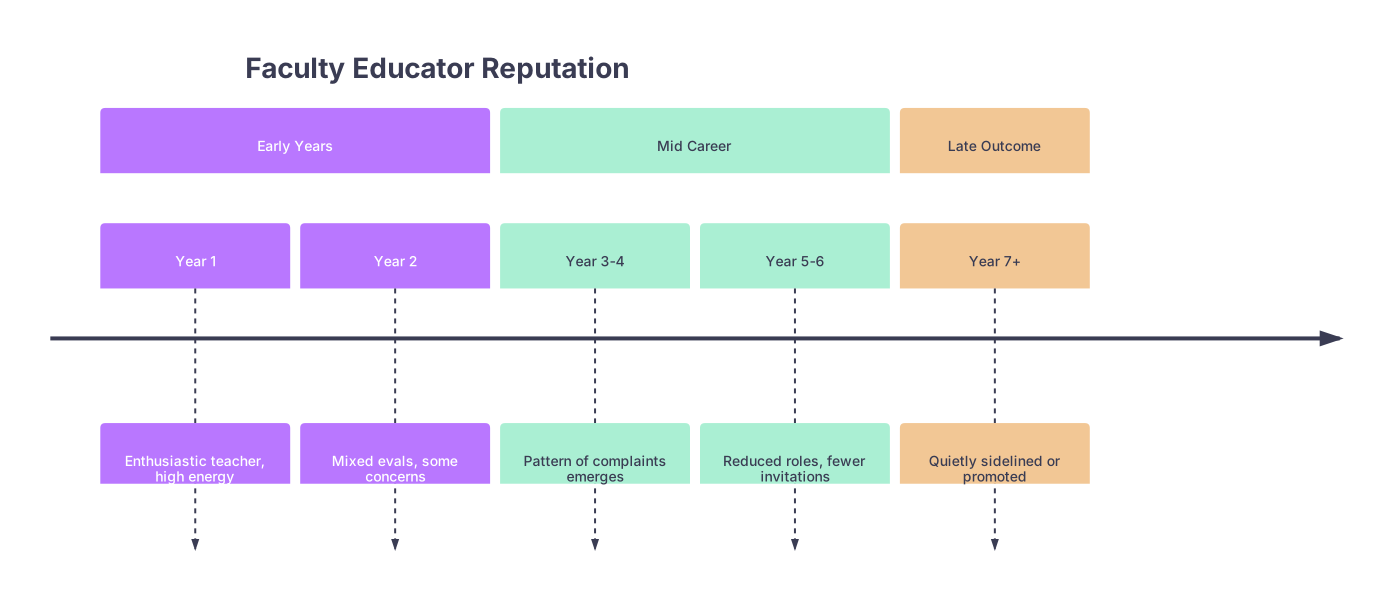
| Period | Event |
|---|---|
| Early Years - Year 1 | Enthusiastic teacher, high energy |
| Early Years - Year 2 | Mixed evals, some concerns |
| Mid Career - Year 3-4 | Pattern of complaints emerges |
| Mid Career - Year 5-6 | Reduced roles, fewer invitations |
| Late Outcome - Year 7+ | Quietly sidelined or promoted |
If You Want to Be Top-Tier: What Actually Works
You’re in medical education and continuing education; you care about this. So how do you become one of the names that automatically comes to mind when the PD thinks “best teacher” or “go-to mentor”?
Focus on these, relentlessly:
- Be predictably good, not occasionally brilliant. A solid attending on a rough service is more valuable than a charismatic lecturer who’s never there.
- Make residents feel safe and pushed at the same time. That “high expectations, high support” zone is where top educators live.
- Help PDs solve their actual problems. Struggling learners. Burned-out residents. Messy rotations. If you make those better, you become indispensable.
You do those consistently for a few years, and I promise: your name moves up the quiet list.
FAQ (exactly 3 questions)
1. How can I find out where I stand on my PD’s “internal list” without asking directly?
You watch who gets what. Who’s asked to lead new initiatives, who gets residents sent to them for career advice, who’s named in “this person really helped me” comments from residents. Compare your invitations, responsibilities, and how often residents choose to work with you. That gap between you and the obvious “top educators” is your answer.
2. Do resident teaching evaluations really matter for promotion, or is it all politics?
They matter, but not in the simplistic “average score of 4.7 vs 4.3” way. PDs and promotion committees use patterns and language in evaluations to justify what they already know from lived experience. Politics enters when there’s a mismatch—high evals but a bad reputation in the hallway. When that happens, informal reputation wins. Every time.
3. I’m mid-career and my reputation is “fine but not great.” Is it realistic to move into the top tier now?
Yes, but it requires deliberate behavior change and 2–3 years of consistency. Target one rotation or educational area, own it, and make it objectively better. Start sending high-quality, specific resident evals. Ask chiefs and PDs what problems they need solved and quietly solve one. Over time, those actions overwrite your old narrative. PDs love mid-career faculty who finally “get serious” about education—because they’re usually stable, know the system, and can execute.
Key points: Program directors are constantly, quietly ranking faculty on trustworthiness and impact as educators and mentors. That ranking is based far more on patterns of behavior, informal feedback, and how you handle struggling residents than on teaching titles or certificates. If you want to climb that list, stop chasing labels and start solving the real problems your residents and your PD face every day.