
What if that “teaching will tank your income” warning you keep hearing from senior residents is simply wrong—or at least wildly incomplete?
You’ve probably heard some version of it already.
“Don’t waste FTE on education.”
“Clinician–educator tracks are for people who don’t care about money.”
“Take the RVU-heavy job, you can always teach ‘on the side’.”
Let’s dismantle that.
The idea that teaching and medical education roles are financial dead ends is one of the most persistent myths in academic medicine. It’s also one of the least carefully examined. People extrapolate from a single low-paying assistant professor contract or a poorly negotiated role and then universalize it.
The data—and the lived reality of actual careers—tell a more complicated story. Sometimes teaching does cost you. Sometimes it pays in cash. Often it pays in leverage. And in the long run, it can even protect your income when pure RVU jobs become a grind you can’t physically sustain.
You’re not choosing between “teaching and being broke” vs “clinical work and being rich.” You’re choosing between different income structures, timelines, and bargaining power.
Let’s go through what actually happens to your wallet when you lean into education.
The Simple Myth: “Teaching = Lower Salary”
The clean story residents repeat: private practice = money, teaching = sacrifice.
Reality is messier.
If you line up average salaries by role, yes, the top quartile of pure RVU private practice folks usually out-earn most clinician–educators in the same specialty. DHS reports, MGMA data, AAMC salary surveys—pick your source, the pattern is consistent: the most RVU-heavy models pull more cash per year.
But that’s not the question you should be asking.
The better questions are:
- What’s the actual salary gap, not the anecdotal one?
- What are you getting in exchange for any gap—protected time, leadership, security, schedule, burnout risk?
- Does taking on teaching really reduce your lifetime earning potential, or just rebalance it?
Let’s start with the hard numbers.
| Role / Track | Relative Pay vs Private Practice (Same Specialty) |
|---|---|
| Private practice clinician | 100% (reference) |
| Academic primarily clinical | ~80–90% |
| Clinician–educator (50–70% clinic) | ~75–90% |
| Education leadership (PD/Clerkship) | ~80–95% (often includes stipends) |
These are composites from AAMC Faculty Salary Reports, MGMA, and specialty surveys over the last several years. It varies by specialty and region, but the pattern is stable.
So yes. In many cases, a clinician–educator at 0.8–0.9 clinical FTE makes less base than a private partner cranking full-time (or overtime) clinical work.
But that’s not the whole financial story.
Where Teaching Quietly Adds Money Instead of Subtracting It
The mistake is focusing only on base salary this year. Real people accumulate income, not snapshots.
Here’s where education roles actually increase financial value—sometimes obviously, sometimes subtly.
1. Teaching vs RVUs: The Workload You Can Actually Sustain
A lot of private and even “academic lite” jobs are built on an assumption that you can run at near-max volume indefinitely. That’s fantasy biology.
I’ve watched plenty of RVU-dominant colleagues peak at 2–3 years, then:
- drop to 0.8 FTE from sheer exhaustion
- cut call
- switch jobs entirely
- or burn out hard and go part-time for their own sanity
Now what does that do to “maximizing income”?
Clinician–educators with built-in nonclinical time (teaching, curriculum, simulation, mentoring) often:
- stay full FTE longer
- tolerate call for more years
- avoid complete career pivots out of frustration
So yes, you might earn 10–20% less per year in your 30s than hyper-RVU Dr. X. But if Dr. X flames out into 0.5 FTE at 45, and you’re still at 1.0 with a stable gig and leadership stipends, the lifetime earnings comparison flips.
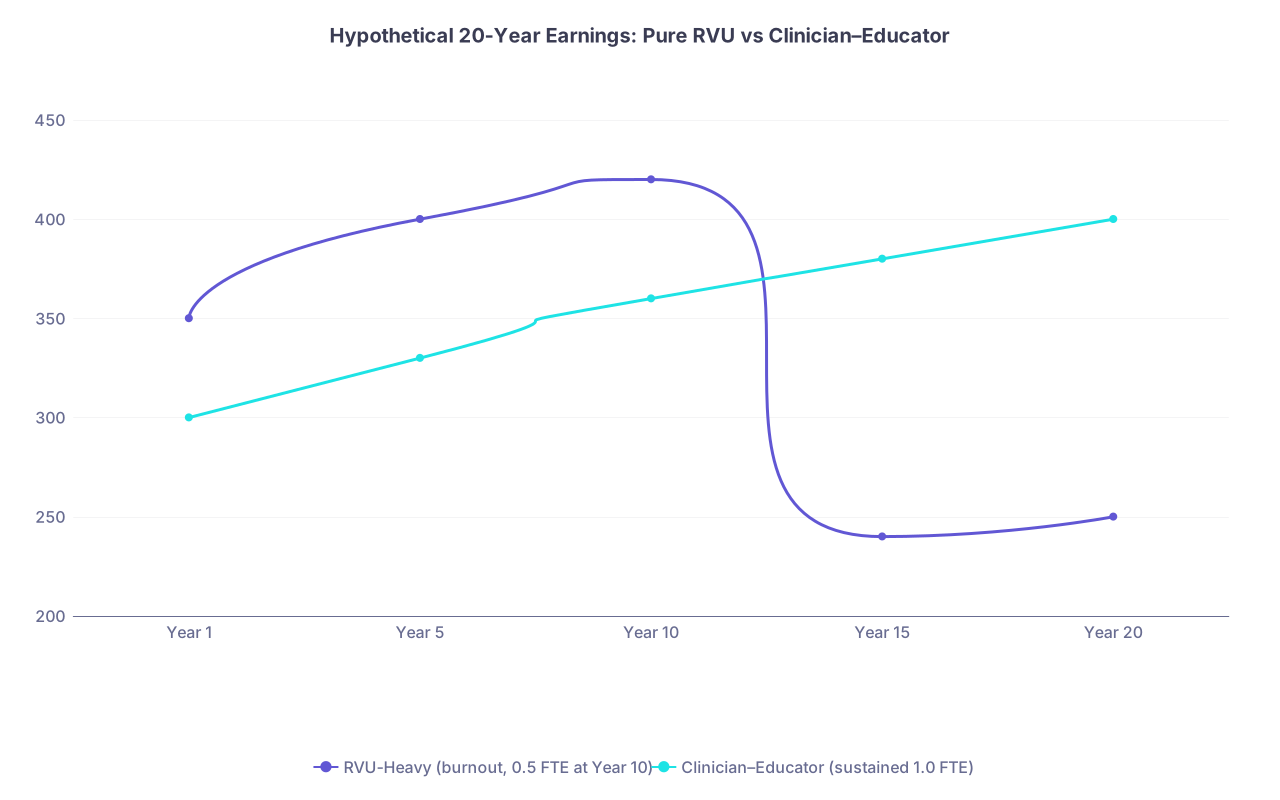
| Category | RVU-Heavy (burnout, 0.5 FTE at Year 10) | Clinician–Educator (sustained 1.0 FTE) |
|---|---|---|
| Year 1 | 350 | 300 |
| Year 5 | 400 | 330 |
| Year 10 | 420 | 360 |
| Year 15 | 240 | 380 |
| Year 20 | 250 | 400 |
The exact numbers aren’t universal. The pattern is. A slightly smaller annual number that holds for longer can beat a short, hot run.
2. Teaching as Salary Floor, Not Ceiling
In several systems, the base salary for faculty educator tracks is pegged to AAMC percentiles. That means:
- Your base doesn’t free-fall if volume dips.
- You’re not totally at the mercy of RVU “productivity adjustments.”
- Your pay floor is anchored to national benchmarks, not your admin’s mood.
Irony: some clinician–educators have more predictable income than high-variance private folks whose volume whipsaws with market changes, hospital politics, or referral patterns. That stability has real financial value when you’re planning mortgages, kids, and retirement.
3. Education Stipends and Leadership Pay: The Part Everyone Forgets
When people say “teaching doesn’t pay,” they’re usually thinking of informal, uncompensated teaching: letting students shadow, answering resident questions, giving the odd noon lecture. Yes, that’s mostly free labor.
But formal, defined education roles often come with actual dollars:
- Program Director
- Associate Program Director
- Clerkship / Sub-I Director
- Simulation Director
- Vice Chair for Education
- Course director in pre-clinical or longitudinal curriculums
Those roles often come with either salary supplements (a few thousand to tens of thousands per year), FTE buy-down that preserves your base, or both.
| Role | Common Range (USD/year) |
|---|---|
| Clerkship Director | $10,000–$30,000 |
| Associate Program Director | $10,000–$25,000 |
| Program Director | $20,000–$60,000+ |
| Vice Chair for Education | $20,000–$75,000+ |
| Simulation/Skills Director | $10,000–$30,000 |
Are these universal? No. Are they negotiable? Absolutely. But pretending they don’t exist is just willful ignorance.
The catch: if you take on the work without insisting on clearly funded FTE or stipends, you really are donating labor. That’s not an inherent feature of education. It’s a contract failure.
Where Teaching Really Does Cost You
Let me be blunt: there are ways to do this where you lose money and get steamrolled. People who say “teaching doesn’t pay” are often describing these exact traps.
1. Hidden Expectations vs Written FTE
Classic scenario:
You’re hired as “clinician–educator” at 1.0 FTE with vague promises of “20% protected time.” Your contract? Lists only “1.0 FTE clinical faculty.” No explicit FTE carve-out for education. No stipend line. No RVU adjustment.
Fast-forward 6 months. You’re still at full patient volume. You’re also running morning teaching rounds, helping with resident schedules, and giving talks. Guess which part is recognized at your annual review? The RVUs.
You’ve just proven the myth right—for yourself.
Because here’s the reality: protection that isn’t written is fantasy. Teaching that isn’t allocated FTE or paid as a stipend is charity. And yes, charity doesn’t pay.

2. Early-Career Discounting
In some departments, new grads get low-ball “assistant professor clinician–educator” packages with the sales pitch: “You’re getting protected time and academic prestige instead of higher salary.”
Then you look closely and find:
- “Protected” time is half-eaten by meetings, not actual deep work
- No clear path to promotion-based raises
- No revenue-sharing on programs you help build (courses, CME, certificates)
So yes, if you accept unstructured “education work” at a depressed salary without building toward a leadership role or a differentiated skill set, you are paying a financial tax for the warm glow of teaching.
That’s not teaching’s fault. That’s you getting underpaid in a system that’s thrilled you’re not asking questions.
3. Misaligned Promotions and Money
In many academic centers, you can build a gorgeous teaching portfolio, get promoted to associate professor as an educator… and your salary barely budges because the real money is still tied to RVUs or grants.
This is where people get disillusioned. They poured themselves into education but never linked that to tangible, contractual rewards: leadership positions, named roles, or revenue-generating initiatives.
Promotions without pay are prestige cosplay. Looks nice. Doesn’t pay the mortgage.
The Financial Upside of Being “The Education Person”
Here’s where the myth collapses if you actually think beyond the first job.
Systematically building an education portfolio gives you something that pure RVU grinders rarely have: optionality.
1. Multiple Job Markets, Not One
If you’re just “good clinician, high volume,” your value is tightly coupled to one market: your specialty’s clinical demand in your region.
If you invest in education, suddenly you’re tradable in several markets:
- Medical schools launching or expanding campuses
- Health systems building new residency/fellowship programs
- Simulation centers and skills labs
- Online medical education, CME providers, bootcamps
- Ed-tech companies needing clinical content leaders
I’ve watched clinician–educators pivot into:
- Full-time Dean/Associate Dean roles
- VP for Education at health systems
- Well-compensated CME/content companies
- Consultancy with high hourly rates because they “speak both languages” (clinical + pedagogy)
These roles often command salaries competitive with, or higher than, late-career clinical jobs, especially when you factor in lower malpractice risk, no nights/weekends, and the ability to work beyond the physical limits of heavy clinical practice.

| Step | Description |
|---|---|
| Step 1 | Resident interested in teaching |
| Step 2 | Clinician educator job |
| Step 3 | Program leadership |
| Step 4 | Medical school leadership |
| Step 5 | Simulation or curriculum director |
| Step 6 | Dept or GME leadership |
| Step 7 | Associate Dean or Dean |
| Step 8 | Education company or CME role |
2. Leverage in Negotiations
There’s a big difference between “I’d like to teach” and “Here is my documented track record and portfolio of funded educational work.”
If you can put on the table:
- Curriculum you’ve built that other programs adopted
- Measurable improvements in learner outcomes
- External recognition (teaching awards, invited talks, publications)
- Evidence of bringing in educational grants or GME funding
You become harder to replace. That matters at the negotiating table.
Departments know it’s not trivial to find someone who can:
- Teach well
- Lead residents without drama
- Pass ACGME reviews
- Design and maintain curricula that actually work
That scarcity is monetizable—if you push for it.

3. Side Streams: CME, Courses, Content
Plenty of education-focused physicians quietly build side incomes that dwarf the 10–20% salary delta they supposedly “lost” by not going private practice:
- Paid CME lectures and workshops
- Structured board review courses
- Online teaching platforms and subscription content
- Textbook chapters and review books (less lucrative now, but still real)
- Consulting with ed-tech or simulation companies
Individually, none of these are guaranteed. Collectively, they create a portfolio of options that a purely clinical physician usually doesn’t exploit.
And no, you don’t need to become some YouTube-famous “medfluencer.” Just being known and respected in your niche is enough.
How to Make Teaching Actually Pay (Instead of Just Feeling Good)
Here’s the part that separates the people who get burned from the people who make education a financially smart move.
1. Treat FTE Like Money (Because It Is)
If you get 0.2 FTE for education, that’s 20% of your working life. Treat it as worth 20% of your salary. Anything less is a pay cut.
Your job when negotiating:
- Make sure that 0.2 FTE is explicitly defined
- Ensure clinical expectations are scaled down accordingly
- Protect that time from casual clinical creep (“just a few extra patients…”)
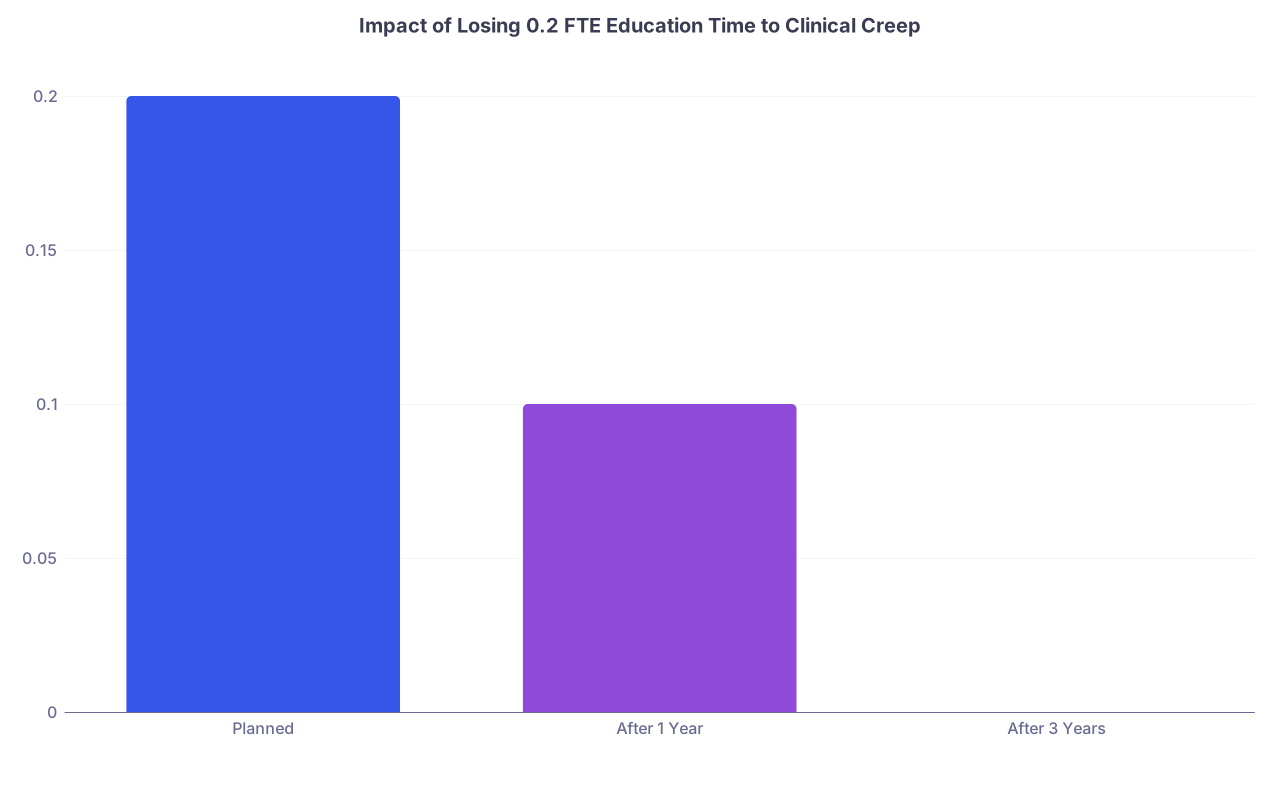
| Category | Value |
|---|---|
| Planned | 0.2 |
| After 1 Year | 0.1 |
| After 3 Years | 0 |
The chart above is what usually happens if you don’t defend your time. Education FTE erodes. Your pay doesn’t increase to match the extra work. You just work more for the same money.
2. Never Do Permanent Leadership Work on Temporary Terms
Program director “interim” for a year with no raise?
Acting clerkship director “until we find someone”?
“Help out with residency recruitment this season”?
That one-year “favor” has a nasty habit of becoming your new job—without your new pay. Get clarity up front:
- What’s the stipend or FTE for this now?
- If this becomes permanent, what’s the salary and title structure?
- How will this show up in my annual review and promotion dossier?
If the answer is vague, the answer is no.
3. Build Documented, Transferable Education Skills
“People like my teaching” is warm and fuzzy. It’s not a financial asset.
Things that do translate into leverage:
- Leading a curriculum redesign with outcome data
- Building assessment systems that survive ACGME scrutiny
- Running a simulation program with measurable impact
- Designing and publishing on innovative teaching methods
- Successfully guiding a program through an accreditation visit
That’s the stuff departments and schools will actually pay for—because there’s risk if they get it wrong.

So, Does Teaching Pay?
Sometimes it doesn’t. If you:
- accept vague “protected time”
- do unpaid leadership work indefinitely
- never negotiate stipends or FTE
- and never convert your teaching into formal roles or transferable skills
Then yes, teaching is mostly a donation. The myth holds—for you.
But if you:
- insist teaching time be explicitly funded
- build toward defined leadership roles
- document impact and outcomes
- develop a skill set that’s scarce and portable
- and protect your nonclinical time as zealously as RVU people protect their volume
Then teaching absolutely can pay. Directly in salary and stipends. Indirectly in sustainable careers, leverage, and optionality when others are stuck.
Here’s the short version:
- “Teaching doesn’t pay” is lazy shorthand for “unstructured, uncompensated teaching doesn’t pay.” Structured education roles can and do pay—if you demand it.
- A slightly lower annual salary with protected education time can beat a pure RVU grind over a 20–30 year arc, especially when you factor in burnout and career pivots.
- Education is a long game. If you treat it like a hobby, it’ll pay like a hobby. If you treat it like a career asset, it becomes one.