
Did that shiny “Outstanding Clinical Teacher” plaque just change your promotion prospects—or is it basically an engraved participation trophy?
Let me ruin the suspense: in most academic medical centers, teaching awards help. But they do not matter the way people think they do, and they certainly do not matter as much as the rhetoric about “valuing education” would suggest.
If you’re building a teaching career in medicine and assuming awards are your golden ticket to promotion, you’re operating on a myth.
The Myth: “If I Win Enough Teaching Awards, Promotion Will Follow”
You’ve heard versions of this in the workroom:
- “She has like five teaching awards. She’ll have no problem making associate professor.”
- “I need at least one institution-level teaching award before I go up.”
- “The promotions committee wants to see recognition. Awards are key.”
This story is comforting—especially if you’re on a clinician-educator track, drowning in service and teaching while your research colleagues guard their “protected time” like it’s transplantable. Awards feel like objective proof that you’re valuable.
But when you look at actual promotion criteria, what promotion committees say, and the few studies that exist, the picture is blunter: teaching awards are modest supporting evidence, not primary currency.
They’re like garnish. Nice on the plate. Not the meal.
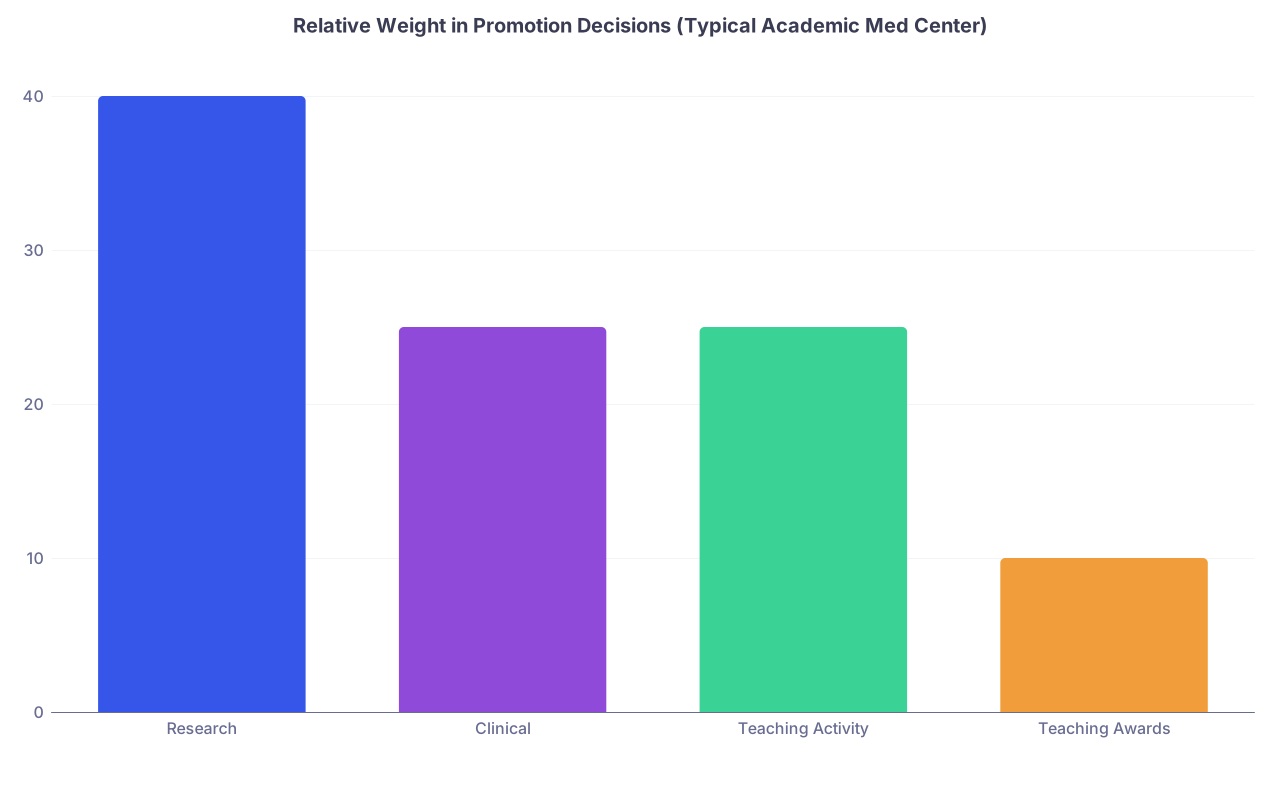
| Category | Value |
|---|---|
| Research | 40 |
| Clinical | 25 |
| Teaching Activity | 25 |
| Teaching Awards | 10 |
Those numbers aren’t from one specific institution; they’re a realistic composite of how many promotions committees actually talk behind closed doors. On research-heavy tracks, the “teaching awards” bar often drops even lower.
What Promotion Committees Actually Look For
The core problem: people treat teaching awards as if they’re a proxy for an entire educational portfolio. Committees don’t.
Most medical schools—and you can verify this on their websites—say something like:
- “Evidence of excellence in teaching”
- “Regional or national recognition as an educator”
- “Scholarly contributions to medical education”
An award fits into one or two of those buckets, sometimes. But it’s not the whole story. When I’ve sat in rooms where CVs are being dissected, the discussion around teaching goes more like this:
- What’s the scope and volume of teaching? (Years, learners, settings.)
- Has this person created anything beyond routine teaching? (Curriculum, courses, simulation programs, assessment tools.)
- Any education scholarship? (Peer-reviewed med ed papers, MedEdPORTAL, national workshops.)
- Leadership roles in education? (Program director, clerkship director, vice chair for education.)
Awards come up as, “Oh, and they have a couple of teaching awards—that supports the narrative.” Not, “They have awards, so the rest doesn’t matter.”

The hidden hierarchy of “teaching excellence”
Not all “evidence of teaching excellence” is created equal. Rough informal ranking, based on what actually moves committees:
Top tier:
- Peer-reviewed education research or innovations
- MedEdPORTAL or equivalent publications
- Nationally invited workshops or talks on education
- Leadership of major educational programs (director roles)
- Competitive regional/national education awards (from specialty societies, national organizations)
Middle tier:
- Robust, well-documented teaching portfolio
- Consistently excellent learner evaluations across years and sites
- Institution-level teaching awards
- Development of new courses/rotations with measurable impact
Low tier:
- Single-department teaching awards with fuzzy criteria
- One-off lecture evaluations
- “Recognized as outstanding teacher by the class” without any details
- Vague lines on a CV like “Highly regarded teacher”
So where do most people’s “teaching awards” actually sit? Middle-to-low tier. Helpful, but not decisive.
What the Data Actually Shows About Teaching Awards and Promotion
Hard data here is thinner than it should be, but we have enough to see the pattern.
Several med-ed studies that surveyed or interviewed promotions and tenure committees (and department chairs) show a consistent theme:
- Teaching is talked up, but underweighted. Educational contributions get praised in narrative form, but when push comes to shove, publications and grants still carry more numeric weight.
- Awards are viewed as corroborating evidence. Committees see them as one piece among many, not as primary drivers.
- Education-heavy faculty are often promoted more slowly. Especially in research-centric schools, even with excellent teaching reputations.
Where awards help most is when they align with a clear educational narrative. For example:
- A hospitalist who built a point-of-care ultrasound curriculum, published on it, presents workshops at SHM, and wins a society-level education award.
- An emergency medicine educator with a sustained simulation program, multiple MedEdPORTAL products, and a national teaching award.
Here, the award reinforces a visible trajectory: “This person is a recognized educator in X domain.” Committees like coherent stories.
Where awards are nearly meaningless:
- One department-level teaching award six years ago, no portfolio, no education scholarship, no roles in curriculum design or leadership.
You’d be surprised how many CVs look like that and then list “teaching excellence” as a primary claim for promotion.
Why Teaching Awards Don’t Mean What You Think They Mean
Let’s be honest about why teaching awards are a weak proxy.
1. They’re often popularity contests
A big chunk of teaching awards are based heavily—or entirely—on learner voting. And learners consistently confuse “easy/grading lenient/entertaining” with “educationally impactful.”
You know this is true. You’ve seen the “funny, tells good stories, lets us out early” person win an award while the person who actually pushed residents’ clinical reasoning gets mediocre scores because they “pimp too hard.”
Promotion committees know this too. Which is why they rarely overvalue such awards.
2. Criteria are vague or nonexistent
I’ve seen award nomination forms that say literally: “Why does this person deserve the award?” That’s it.
No defined competency domains. No multi-rater assessment. No comparison to standards. Just warm feelings.
When awards lack transparent, rigorous criteria, they’re hard to treat as anything but supportive fluff. Committees will still mention them, but they won’t override real evidence.
3. They’re not calibrated across departments or institutions
A “Best Teacher” award in a small community program with 12 residents is not equivalent to a national teaching award from a specialty society. But on a CV, they sit in the same line type. If you’re not explicit, people may assume the weaker version.
Some departments hand out “teaching awards” every year to several people because it looks good for morale. That’s fine for morale. It dilutes the signal for promotion.
| Award Type | Signal for Promotion* |
|---|---|
| National specialty-society teaching award | Strong |
| Institution-wide medical school award | Moderate–strong |
| Department-level educator-of-the-year | Weak–moderate |
| Single cohort/class-selected “favorite” | Weak |
*Assuming everything else (portfolio, scholarship, roles) is equal. It rarely is.
4. They’re lagging indicators, not building blocks
By the time you’re competitive for a serious teaching award, you probably already have the real promotion ingredients: sustained teaching, innovation, maybe scholarship, leadership roles. The award comes at the end of that pipeline.
Committees tend to credit the pipeline more than the plaque.
The Tracks Where Awards Matter (and Where They Don’t)
Teaching awards don’t have the same value across all career paths.
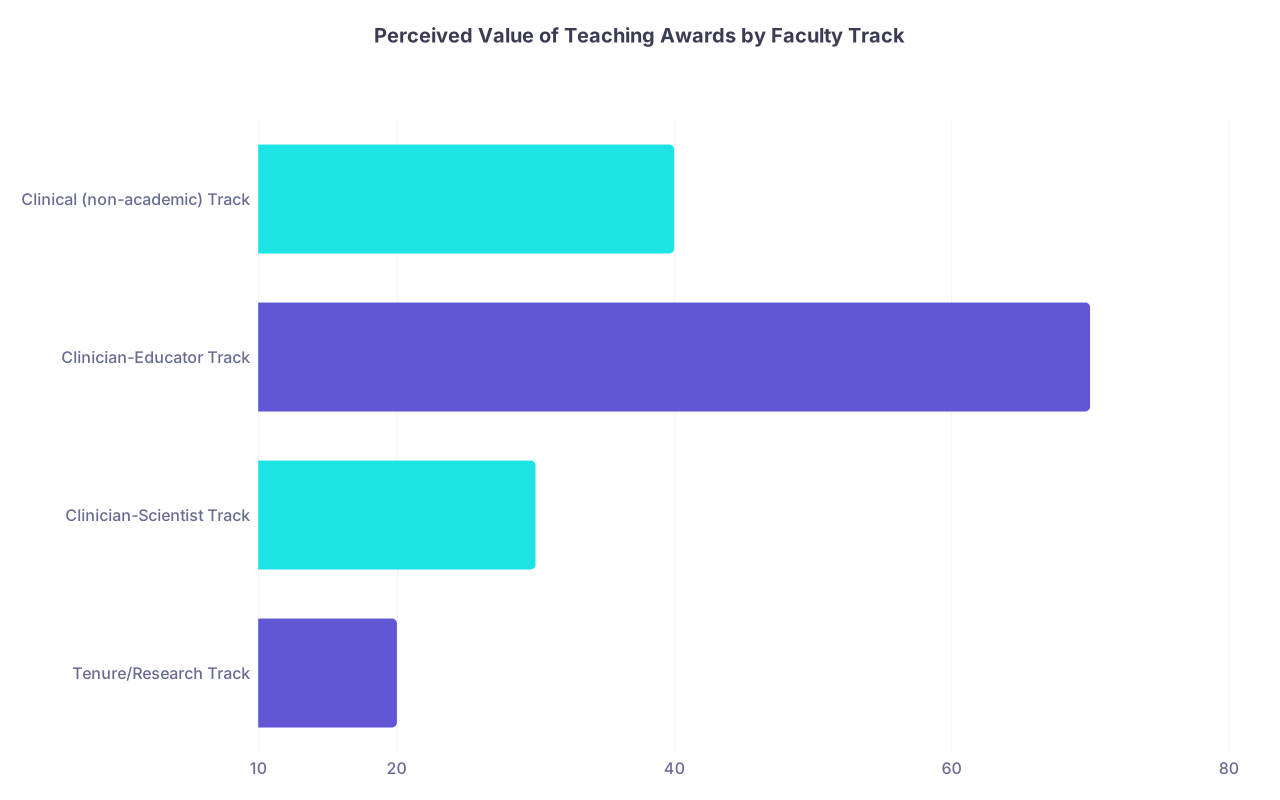
| Category | Value |
|---|---|
| Tenure/Research Track | 20 |
| Clinician-Scientist Track | 30 |
| Clinician-Educator Track | 70 |
| Clinical (non-academic) Track | 40 |
Rough, but directionally accurate.
Tenure / Research-heavy tracks
Here, awards are almost purely decorative. Promotions for these people hinge on:
- Grants
- Publications
- National reputation in research
Teaching awards help slightly with the “citizenship and service” flavor of the dossier but will not rescue someone who’s weak on research metrics.
If you are on a true tenure track and pouring enormous time into chasing multiple teaching awards instead of producing scholarship, you’re sabotaging yourself.
Clinician-educator tracks
This is where awards have their best shot at mattering, but only if combined with:
- Documented teaching volume and quality
- Educational program development
- Some degree of education scholarship
- Institutional or national involvement in education committees, working groups, boards
For clinician-educators, having at least one substantial teaching award can be a strong asset—because it reinforces the story that you’re not just teaching a lot, you’re good at it, and people outside your immediate team recognize that.
But again: reinforcement, not foundation.
Pure clinical tracks
In some institutions, there’s a “clinical professor” or “clinical associate professor” track with softer scholarship expectations. On those tracks, teaching awards can be quite valuable—especially if teaching is a formal part of your job description.
Even there, though, promotion packets almost always want:
- Clear documentation of teaching activities
- Positive evaluations
- Evidence of impact on local education (mentorship, curriculum tweaking, supervising QI projects, etc.)
One teaching award and nothing else? Still thin.
How to Make Teaching Awards Actually Work for You
Here’s where people get it wrong: they slap “2019 Department Teaching Award” in a list and assume the reader will infer greatness. That’s lazy.
You can make modest awards work harder for you if you do three things.
1. Embed them in a coherent educational narrative
Write your personal statement and portfolio so the award becomes evidence within a story, not a lonely line item.
Example of weak framing:
- “2019: Department Teaching Award”
Stronger:
- “In recognition of my multi-year effort to redesign the inpatient medicine rotation around explicit diagnostic reasoning and bedside feedback, I received the Department Teaching Award in 2019. This followed 3 consecutive years of top-decile resident teaching evaluations and invitations to lead faculty development sessions in bedside teaching.”
Same award. Very different signal.
2. Be explicit about scope and competitiveness
Promotion committees do not magically know whether an award is meaningful. Spell it out (briefly, not like a bragging LinkedIn post).
“Selected from among 120 full-time clinical faculty based on multi-source evaluations and peer review of teaching materials.”
Or, for a national award:
“One of 3 national recipients selected by the education committee of the American College of X from 40 institutional nominees.”
That gives the award weight without sounding desperate.
3. Convert the recognition into opportunities that do count more
The real value of awards is often what they unlock:
- Invitations to give workshops at other institutions
- Appointment to educational committees
- Opportunities to publish about your educational innovations
- Assigned leadership roles in curriculum or program direction
So after you get an award, don’t just put the plaque on your office shelf. Use it as credibility to ask for what actually drives promotion: roles, projects, and platforms where you can generate tangible, citable impact.

| Step | Description |
|---|---|
| Step 1 | Receive Teaching Award |
| Step 2 | Publicize to Chair and Dean |
| Step 3 | Request Role in Curriculum or Program |
| Step 4 | Lead Education Project or Innovation |
| Step 5 | Present at Conferences or Workshops |
| Step 6 | Publish Education Scholarship |
| Step 7 | Build National Educator Reputation |
| Step 8 | Stronger Promotion Packet |
What You Should Actually Focus On If You Want Promotion
If you’re serious about academic promotion as a medical educator, re-orient your priorities.
Instead of obsessing over getting “one more award,” ask:
- Do I have a robust teaching portfolio that documents what I do, for whom, with what feedback and outcomes?
- Have I created anything in education that’s distinctive? A curriculum, assessment tool, bootcamp, series, or longitudinal course?
- Have I moved even a small piece of this work into scholarship? A MedEdPORTAL submission, a peer-reviewed article, a research project, or a rigorously evaluated innovation?
- Am I visible outside my own institution as an educator?
Awards should be a byproduct of doing those things well. Not the main goal.

If you do somehow collect several serious awards and still can’t get promoted, that’s a red flag for something deeper:
- You’re on the wrong track for your strengths (true tenure instead of clinician-educator, for example)
- Your institution says it values teaching, but structurally does not
- Your documentation of what you’ve actually done is poor
- Or your awards are impressive-looking but shallow in terms of criteria and competitive context
That’s not a “work harder” problem. That’s a “change strategy or environment” problem.
The Real Story, Stripped Down
Let’s end without the fluff.
First: Teaching awards are real signals—but weak ones on their own. They help, they rarely hurt, but they’re supporting actors, not stars.
Second: Committees are looking for sustained, documented, and ideally scholarly educational impact. If your awards don’t sit on top of that foundation, they won’t save your promotion case.
Third: The smartest play is to treat awards as leverage. Use them to get roles, visibility, and opportunities that translate into the stuff promotion truly runs on: leadership, innovation, and scholarship in medical education.