
The fastest way to stall your academic career is not bad teaching. It is handling negative teaching feedback badly.
I have watched smart, clinically strong junior faculty sabotage themselves in a single semester—not because their learners disliked a lecture, but because their reaction to that dislike rang alarm bells with every division chief, clerkship director, and med ed dean within earshot.
You will get negative feedback. Sometimes fair, sometimes lazy, sometimes flat-out wrong. The career-ending risk is not the comment itself. It is the unprofessional, brittle, or avoidant behavior that follows.
Let me walk you through the most common mistakes junior medical faculty make when they get hit with bad teaching evaluations—and how to avoid turning a minor bruise into a fracture.
1. Treating Every Negative Comment as a Verdict on Your Worth
The first amateur move: personalizing everything.
You see a line like “Dr. X did not seem interested in teaching” or “Confusing lecture, slides too busy,” and your brain translates it as:
- “I am not good enough to be faculty.”
- “They see I do not belong here.”
- “Everyone thinks I am a fraud.”
This is how you spiral into defensiveness, burnout, or both.
Here is the problem:
- Feedback is a data point, not a diagnosis.
- Student comments are often emotional reactions, not precise critiques.
- Early in your career, your teaching skills are still in beta. Bugs are expected.
What not to do:
- Reread the comment 20 times at 1 a.m., catastrophizing about your promotion dossier.
- Bring the comment up to every colleague for reassurance (“Do you think I’m a bad teacher?”).
- Let one sour evaluation overshadow 30 solid ones.
Better way to process:
- Ask: “What specific behavior is this describing, if any?”
- Separate identity from performance: “This is about how I ran that session, not about whether I am fundamentally capable.”
- Look for patterns over time, not isolated zingers.
If you handle feedback like an existential attack, you will either avoid it (and stay stuck) or overreact to it (and look unstable). Both are noticed by leadership. Nobody wants a faculty member who falls apart every time a student writes, “Too much detail.”
2. Arguing with Evaluations and Trying to “Correct the Record”
This one is lethal.
Junior faculty get a batch of clerkship evaluations. One says:
- “Faculty frequently arrived late to rounds and seemed disorganized.”
You know you were late twice because of back-to-back consults. You tell yourself the students “just don’t understand clinical demands.” So you:
- Email the clerkship director with a point-by-point rebuttal.
- Ask if the evaluation can be removed because it is “unfair.”
- Try to track down which student wrote it based on timing or details.
- Vent to residents: “Can you believe what these kids wrote about me?”
Do not do this.
You look:
- Thin-skinned.
- Unable to self-reflect.
- Potentially retaliatory.
That combination will kill your teaching reputation faster than a low mean score ever will.
What you can reasonably do:
- If there is a clear factual error with institutional implications (e.g., “Attending made racist comments”), you can clarify with your program director or chair, factually and briefly, without demanding erasure.
- Ask for context: “Is this comment consistent with other feedback you have seen about my organization on rounds?”
What you should not do:
- Ask who wrote it.
- Ask for the comment to be deleted because you disagree with the student’s perception.
- Draft an email response addressed “To the student who wrote X,” even if you never send it. It feeds your resentment.
Here is the rule: The more you try to argue with subjective learner impressions, the more objective your unprofessionalism looks to everyone else.
3. Ignoring Patterns Because “Students These Days Are Too Sensitive”
The opposite mistake: blowing off all negative feedback as generational fragility.
I have actually heard this in faculty rooms:
- “They just want entertainment, not real teaching.”
- “If I push them, they call me unapproachable.”
- “Evaluations tank when you stop spoon-feeding.”
Some of that has a grain of truth. It is also a very convenient way to avoid growth.
If multiple students across rotations say:
- “Unclear expectations.”
- “Did not provide feedback.”
- “Did not explain reasoning.”
- “Created an unsafe environment for questions.”
You are not the victim of a cultural shift. You have a modifiable teaching problem.
Here is where people go wrong:
- Dismissing consistent themes as “just one class” or “this site’s complainers.”
- Comparing yourself to the most popular faculty and telling yourself, “Well, they just give everyone honors.”
- Using cynicism as a shield: “I am here to take care of patients, not to make friends.”
Translation to leadership: “I am not interested in improving my teaching.”
That is how you get quietly excluded from new teaching roles, curriculum projects, and eventually from promotion committees’ serious consideration.
To avoid this:
- Ask your clerkship or program director to pull 1–2 years of your teaching data.
- Look specifically for repeated words or phrases, not tone.
- Pick one or two behaviors to change (e.g., “I will state my expectations at the beginning of every rotation,” “I will schedule 10 minutes per day for feedback”).
You are not required to be warm and fuzzy. You are required to be coachable.
4. Venting in Public Spaces and on the Wrong Platforms
Another rookie error: processing raw frustration where students or colleagues can hear it.
Patterns I have seen:
- Complaining about “entitled med students” in the workroom while a student is at the computer 6 feet away.
- Posting screenshots (even “anonymized”) of evaluations on Twitter, Threads, or group chats to mock them.
- Rolling your eyes or making comments about “these evaluations again” during resident sign-out or teaching meetings.
Once learners believe you resent them for evaluating you, your scores will dive further. And any hope of honest feedback evaporates.
Worse, screenshots circulate. Suddenly the associate dean for education gets forwarded your post:
“Today’s eval gem: ‘Dr. Y made me feel dumb when I did not know the answer.’ Sorry that I expect you to read UpToDate, future colleagues.”
That is how people end up in unpleasant professionalism conversations.
Where you can vent safely:
- One trusted senior mentor. Behind a closed door.
- Faculty development or coaching sessions that are explicitly confidential.
- Your own private notes, where you write the raw version—and then never act directly from it.
If you feel compelled to broadcast your annoyance with learners, that tells your colleagues something: you do not see teaching as part of your actual job.
They will remember that when they decide who gets the new course director role or the funded education project.
5. Overcorrecting Based on One Bad Comment
A single biting evaluation can whip a junior faculty member into frantic overcorrection.
Example:
- One student writes: “Too pimp-heavy, felt humiliated.”
- You react by:
- Stopping all cold-calling.
- Switching to pure mini-lectures.
- Telling students, “I heard someone thought I was too harsh, so now I am trying to be more ‘fun.’”
Result? You lose your authentic teaching style and still do not fix the underlying issue (probably tone, not questions themselves).
Or:
- One learner says: “Slides were too advanced; I was lost.”
- You simplify everything to the point that the next group says: “Content too basic, waste of time.”
The mistake is whiplash. Loudest comment wins.
Instead, you need a basic filtering system:
| Situation | Wrong Reaction | Better Response |
|---|---|---|
| Single harsh comment | Change entire teaching style immediately | Flag it, look for pattern next cycle |
| Recurring theme over several rotations | Dismiss as “sensitive students” | Plan 1–2 specific behavior changes |
| Mixed comments (some love, some hate same feature) | Try to please everyone | Decide deliberately what you keep vs adjust |
Do not redesign your whole curriculum because one student did not like your style. Wait. Gather more data. Adjust gradually and intentionally.
6. Treating Feedback as a Private Secret Instead of a Career Tool
A subtle but serious mistake: treating your evaluations like something to hide.
Signs you are doing this:
- You never show your teaching evaluations to your mentor unless forced to for annual review.
- You do not ask for teaching observations because “I am still figuring things out.”
- You never present your teaching data when seeking roles (“I do not want them to see that one bad semester”).
The psychology is obvious. You are afraid that any negative data will be used against you.
The reality in academic medicine: promotion committees and education leaders are more worried about faculty with no feedback trail and no documented development than about faculty with a few rough years and clear improvement.
What not to do:
- Delete or “lose” evaluations that you think look bad.
- Cherry-pick only your best scores in your teaching portfolio and hope nobody asks for the full record.
- Avoid faculty development courses because “I do not want to admit I need help.”
What to do instead:
- Select 2–3 representative years of evaluations and identify trends yourself before others do.
- Bring both strengths and weaknesses to a mentor: “Students say I am approachable but also that I am disorganized on rounds. How would you tackle that?”
- Use feedback data as a talking point on applications for education roles: “Here is where I started, here is what I changed, here is how my ratings shifted.”
Leaders do not expect perfection. They expect adult-level ownership of imperfection.
7. Confusing Emotional Processing with Professional Response
You are human. Some comments will sting more than they “should.”
Two classic traps:
Responding while flooded
- You read a nasty comment (“Borderline unprofessional, made sarcastic remarks”) right before clinic.
- You spend the first half of clinic distracted, then snap at a student for a basic question.
- Or you fire off an email to the clerkship director defending yourself, full of emotional language.
Never processing at all
- You skim evaluations, feel a flash of anger, then shove it all down.
- You tell yourself, “Whatever,” and move on.
- Those unprocessed hits pile up into slow-burn resentment toward teaching.
Both are mistakes.
You need a simple two-step protocol:
Emotional space
- Decide when you read evaluations. Not at midnight. Not between codes.
- Read them with the explicit goal of “just seeing what is there,” not fixing anything yet.
- If you feel your heart rate climb, step away. Literally. Take a walk. Do not email anyone yet.
Professional response
- 24–72 hours later, revisit them with a pen and a cooler mind.
- Extract themes and action items.
- If something really seems off or concerning, now you can send a calm, brief note to a mentor or leader: “I received some feedback I would value your perspective on.”
Failing to separate feeling from responding is how you end up saying or writing things that become part of your professionalism record, not the student’s.
8. Ignoring Power Dynamics and Confidentiality
Another way junior faculty mishandle feedback: forgetting that you hold power over learners.
Common missteps:
- Bringing up specific evaluation comments during group teaching: “Someone last block said I was intimidating. Was that you?” followed by a joking “You can tell me.”
- Asking residents to guess who wrote which evaluation.
- Mentioning to a student, “I know what you wrote on my evals” (even if you do not actually know).
Even if you mean it humorously, students and trainees do not experience it that way. They hear:
- “It is not safe to be honest.”
- “My grades or letters could be affected if I say something critical.”
That is how you get reputational damage you never see directly: private complaints to the dean, off-the-record warnings about you during rotations, students avoiding your electives.
You also must be careful how you discuss learners’ feedback with colleagues:
- Do not share specific quotes in identifiable contexts (“The tall student on neurology said…”).
- Do not recap negative comments in front of other students or residents.
- Do not use evaluations as ammunition in conflicts (“Well, students say you are disorganized too”).
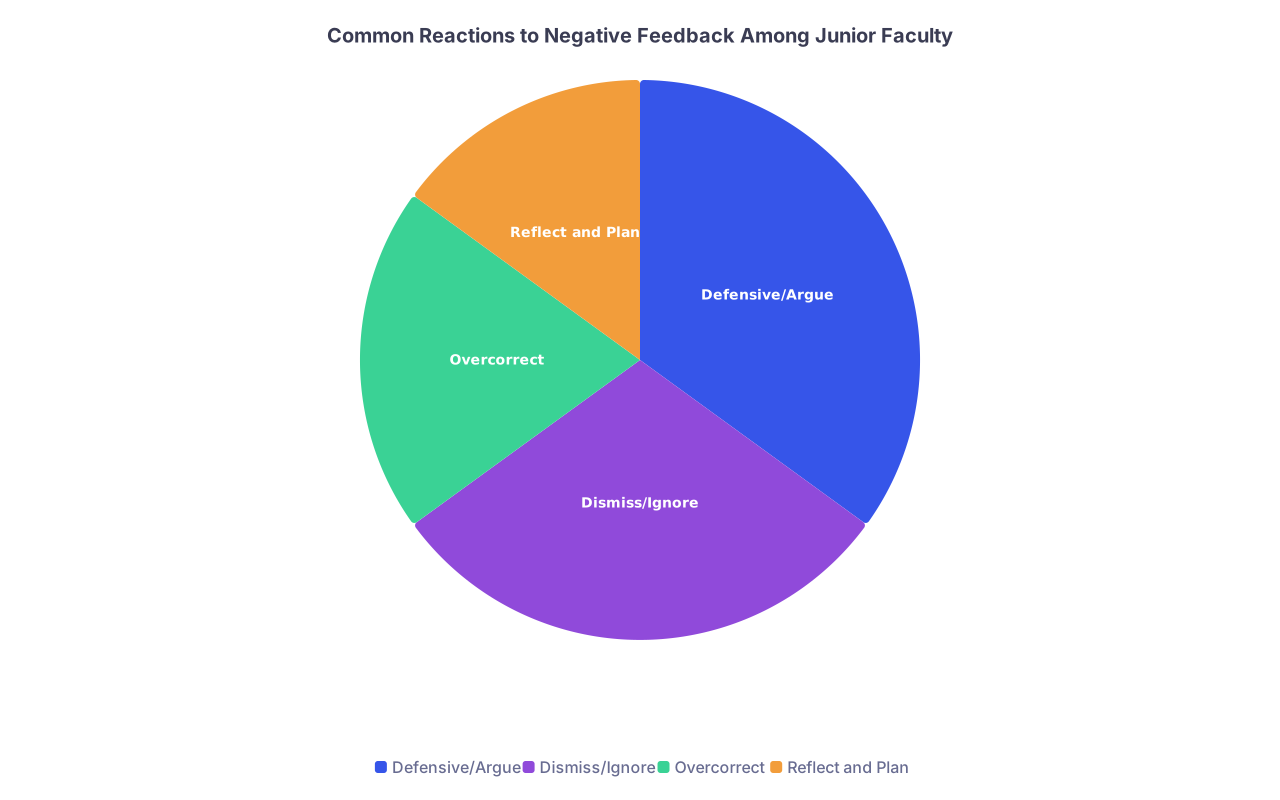
| Category | Value |
|---|---|
| Defensive/Argue | 35 |
| Dismiss/Ignore | 30 |
| Overcorrect | 20 |
| Reflect and Plan | 15 |
The reflective group is the minority. Do not join the majority who look unsafe or petty when it comes to evaluations.
9. Failing to Distinguish Content Critique from Bias and Boundary Violations
Not every negative comment deserves equal weight. But junior faculty mishandle this in two opposite ways:
- Treating all feedback as valid, including clearly biased or inappropriate comments.
- Dismissing any mention of communication style, “tone,” or “approachability” as “just bias” without examining it.
You have to sort comments into categories:
Legitimate content/process feedback
- “Objectives unclear.”
- “Too much focus on minutiae.”
- “Did not explain reasoning out loud.”
Style/interaction feedback
- “Seemed annoyed when we asked questions.”
- “Feedback was vague and not timely.”
Biased or inappropriate feedback
- Comments about your appearance, accent, name, pregnancy, gender, race, or culture.
- Sexualized remarks.
- Stereotyping (“very aggressive for a woman,” “too soft to be a surgeon”).
Mistakes you must avoid:
- Internalizing biased comments as performance data (“Maybe I am too emotional because I am a woman,” “Maybe my accent makes me a bad teacher.”)
- Ignoring patterns of bias and never flagging them to leadership, letting the system stay broken.
- Hiding bias-based comments from mentors, which means you miss support and advocacy you could have had.
What to do with biased comments:
- Document them. Screenshot and date.
- Share with a trusted senior ally or the course/clerkship director.
- Ask explicitly: “How do you recommend we handle this kind of biased comment in the evaluation process? I do not want it counted against my teaching.”
Many institutions are now trying (imperfectly) to adjust evaluation systems for bias. They cannot do that if junior faculty silently absorb the hits.
10. Never Turning Feedback into a Concrete Improvement Plan
The most quiet but costly mistake: reading feedback, feeling some combination of shame and irritation, then… doing nothing structured with it.
You tell yourself:
- “I will just try to be better next time.”
- “I should probably use clearer objectives.”
- “I guess I should ask for feedback more often.”
Then another year passes. Evaluations look the same. Promotion packet time arrives and your teaching narrative is vague fluff.
Academic leaders do not want to see perfection; they want to see trajectory.
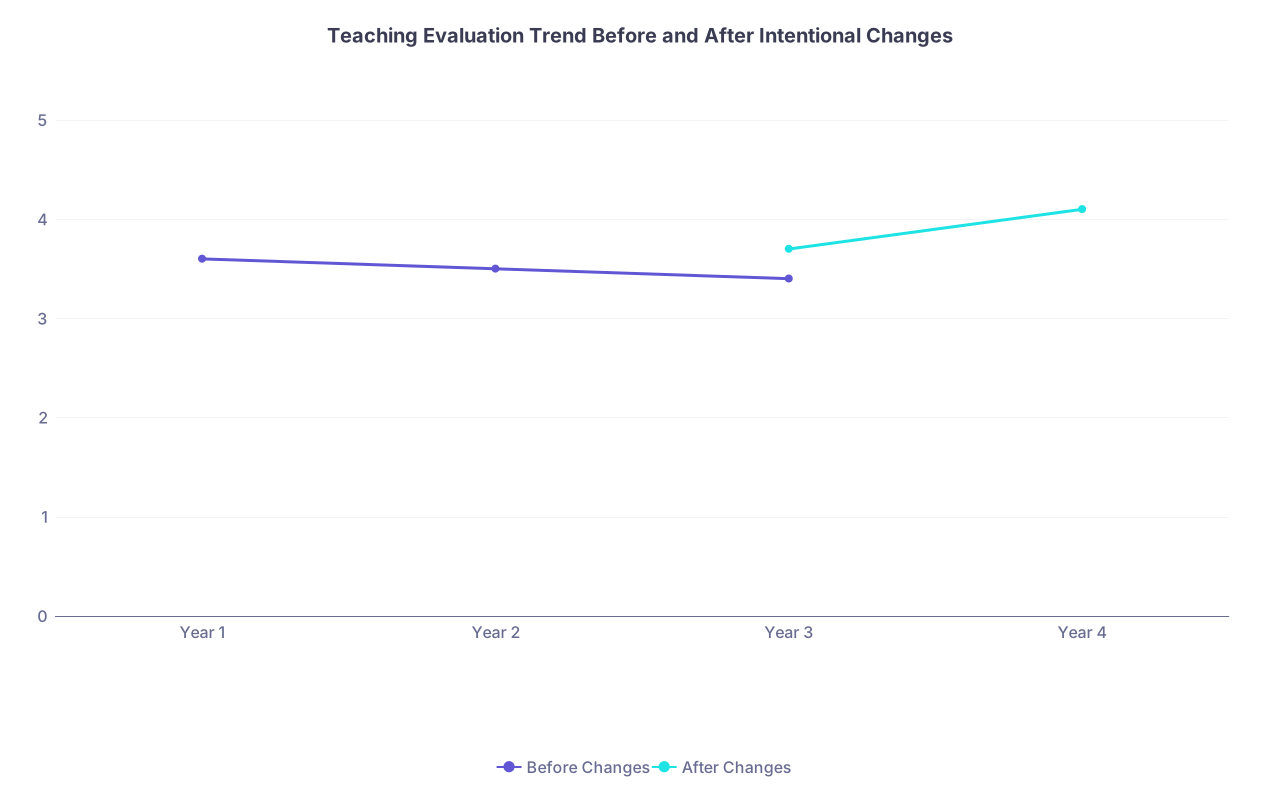
| Category | Before Changes | After Changes |
|---|---|---|
| Year 1 | 3.6 | null |
| Year 2 | 3.5 | null |
| Year 3 | 3.4 | 3.7 |
| Year 4 | null | 4.1 |
Notice the story you can tell yourself and others:
- “Early on, students found my sessions disorganized. I met with a mentor, simplified my slides, added clear objectives, and built in five minutes for questions at the end. Over the next year, my scores for ‘clarity’ and ‘overall effectiveness’ improved steadily.”
Versus:
- “My scores were 3.5–3.7 for years. No clear story. No visible growth.”
Practical way to avoid this mistake:
- Pick one domain each 6–12 months (clarity, feedback, psychological safety, organization).
- Identify two concrete behaviors you will change.
- Ask a colleague or mentor to observe you once and give targeted feedback on those behaviors.
- After a cycle, look at comments again. Did the language shift?
Do not just “try harder.” That is not a plan. That is wishful thinking with a white coat on.
Final Takeaways
Three things you absolutely must not screw up:
- Do not react defensively or publicly to negative teaching feedback. No arguing with evaluations, no calling out students, no social media rants. You look unsafe and unprofessional, not “strong.”
- Do not dismiss or ignore repeated themes. Patterns in feedback are not attacks. They are the roadmap to becoming the teacher senior faculty actually trust with important roles.
- Do not keep your feedback journey secret. Use mentors, document bias, build a visible story of growth. Your career will be judged less on where you started and more on how you responded when the evaluations were not pretty.