
What makes smart, well‑prepared faculty get quietly blacklisted from the teaching schedule after just one or two lectures?
It is almost never their knowledge. It is almost always their lecture design.
You can be the smartest person in the hospital and still have residents dreading your sessions and your chair rolling their eyes at your name on the schedule. I have watched excellent clinicians sabotage their academic careers with the same avoidable design mistakes, over and over.
Let’s walk through the traps that ruin your reputation with learners and chairs—and how to avoid stepping in them.
1. Designing for Yourself Instead of for Exhausted Clinicians
The biggest error: building the lecture you would enjoy, not the lecture they actually need.
You know this lecture is in trouble when you hear:
- “I really want to show them everything that is exciting about…”
- “I built this from my grand rounds deck; it is a bit long but it’s comprehensive.”
Translation: you designed for your ego and your interests, not for their bandwidth or their exams.
Mistake: Ignoring the real constraints of your audience
Residents and practicing clinicians are not leisurely undergrads. They are:
- Post‑call or pre‑call
- Charting in their heads while you speak
- Studying for boards with specific test frameworks
If your lecture demands fresh, rested, wide‑open attention, it will fail. Not “might.” Will.
Design error #1: cognitive overload. You push through dense slides at 7 a.m. and wonder why no one engages. They are at 40% cognitive capacity on a good day.
How to avoid it
Before building a single slide, answer three ruthless questions:
- What 3–5 things do I want them to be able to do differently tomorrow?
- What can I cut that does not clearly support those things?
- At which minute markers will they be mentally gone, and what will I do right then?
If you cannot answer that, you are not designing a lecture. You are dumping content.
2. Slide Design That Signals “I Don’t Respect Your Time”
Your slides are not just visual aids. They are political signals.
Bad slides tell learners: “My time was more important than yours.” Bad slides tell chairs: “You are risky to put in front of external visitors or accrediting bodies.”
Classic slide design errors that quietly destroy credibility
- Wall‑of‑text slides that you read verbatim
- Microscopic tables copied from UpToDate or NEJM
- Color choices that look like a 1997 PowerPoint template
- Random clip art or low‑resolution images
If your slide deck looks like you exported your Word document into PowerPoint, you are making this mistake.

The most common offender I see in medicine: the “everything I know about this topic” slide—18 bullets plus a complex algorithm in 8‑point font. Learners stop trying after slide 3. Chairs notice.
A quick comparison: what learners and chairs hate vs. respect
| Aspect | Hurts You (Common Error) | Helps You (Better Choice) |
|---|---|---|
| Text per slide | 10–18 bullet points | 3–5 concise bullets |
| Font size | 16 or smaller | 24+ for main text |
| Tables/figures | Full journal table pasted in | Simplified, redrawn key data |
| Color scheme | Random or default bright colors | Consistent, high-contrast palette |
| Images | Decorative clip art | Relevant, explanatory visuals |
Chairs notice who makes visually professional decks. Those people get invited back. They get entrusted with visiting professor slots.
How to avoid it
- Force a 6x6 rule: no more than 6 lines per slide, 6 words per line (yes, be that strict at first).
- Redraw any table/figure you did not create. Extract the one message and plot only that.
- Use one clean template and stick to it. No rainbow experimentation.
If you would not show the slide to an external accreditor, do not show it to your own trainees.
3. “Comprehensive” Content That Misses What Matters
Another career‑limiting habit: trying to be comprehensive to impress colleagues, instead of being selective to help learners.
You know this pattern:
- 80 slides for a 45‑minute talk
- Ten rare zebras, two common workhorses
- Long digressions about the pathophysiology of something they will never manage independently
Learners walk out unable to answer: “What should I do differently on my next shift?”
Chairs walk out thinking: “You used an hour and changed nothing.”
The illusion of rigor
Overstuffed lectures look serious. Lots of references. Complex diagrams. It feels rigorous.
It is not. Rigor is selecting what matters, discarding what does not, and making the essentials unforgettable.
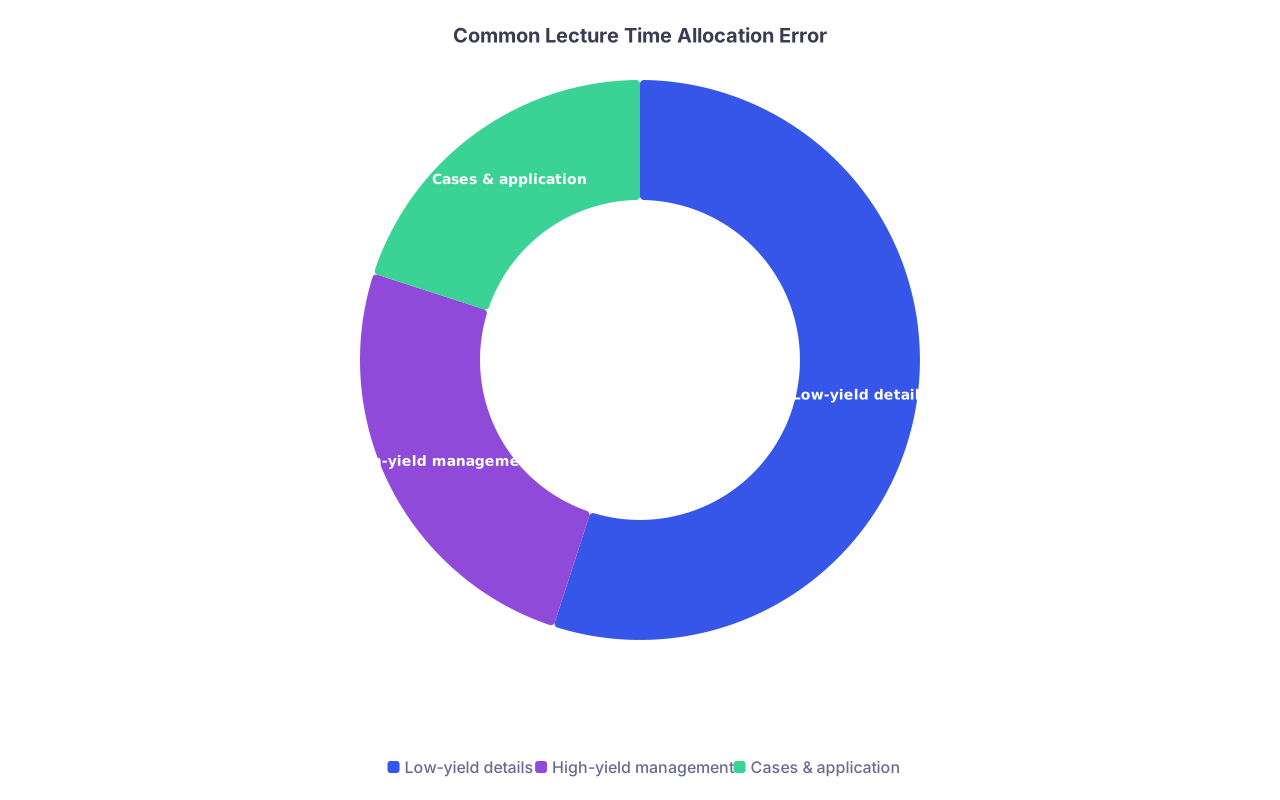
| Category | Value |
|---|---|
| Low-yield details | 55 |
| High-yield management | 25 |
| Cases & application | 20 |
Most poor lectures spend over half the time on low‑yield details for this specific audience. That is how you make residents hostile and program leadership unimpressed.
How to avoid it
For each major section of your talk, write this on paper:
“If they only remember one thing from this part, it should be: _________.”
If you cannot fill that blank in one sentence, do not teach that section.
Then do a brutal slide cut. If you are early in your teaching career:
- Aim for 1–1.5 slides per minute. Not 3.
- Prioritize: common presentations, dangerous misses, things boards love, and things learners routinely get wrong on the wards.
Your chair does not care that you could talk for 3 hours on the molecular mechanisms. They care that your residents stop harming patients and start passing boards.
4. No Structure, No Roadmap, No Cognitive Hooks
A lot of painfully bad lectures are not wrong in content. They are just impossible to follow.
Common structure errors:
- No clear agenda slide. No outline. Just: “Today we’ll talk about X,” then a chaotic cascade.
- Constant back‑and‑forth between topics: diagnosis → treatment → pathophysiology → historical note → back to diagnosis.
- No signaling when you transition: learners cannot tell if they are halfway or almost done.
When learners cannot build a mental map of your talk, they give up trying to retain anything. Chairs notice the energy in the room flatten.
You must explicitly structure it—for them and for you
At minimum, your audience should see a simple roadmap and feel you sticking to it.
Something like:
- Why this matters in your practice
- How to recognize it early
- What to do in the first hour
- Mistakes that kill people or get you sued
Then actually follow that.

| Step | Description |
|---|---|
| Step 1 | Open with case |
| Step 2 | State learning objectives |
| Step 3 | Agenda slide |
| Step 4 | Core content blocks |
| Step 5 | Case application |
| Step 6 | Summary of key actions |
| Step 7 | Questions and next steps |
Your chair cares a lot more about this kind of coherence than you think. A well‑structured, repeatable format is how they can trust you with recurring teaching slots.
How to avoid it
- Start with one short clinical case or story with a decision point. That is your anchor.
- Show an agenda slide with 3–4 simple bullets. Refer back to it 1–2 times as you progress: “We just did recognition; now we’re moving to management.”
- Group content into clear sections, not a continuous stream. Use section title slides, even if they feel obvious to you.
Obvious structure for you is life support for tired residents.
5. No Interaction Until the Last Five Minutes (Or None at All)
This is where you lose both learners and chairs.
The pure monologue, 45‑minute didactic, with “Any questions?” tacked on in the last 90 seconds—this is how you brand yourself as old‑school and out of touch.
Residents hate it. Chairs know accreditors hate it.
Common interaction design failures
- Asking “Any questions so far?” to a room of 40 people. Of course no one answers.
- One big audience response question near the beginning, then nothing interactive again.
- Cold‑calling without psychological safety, then acting surprised when no one volunteers after the first awkward exchange.
You cannot fix a fundamentally passive lecture with a single polling slide.
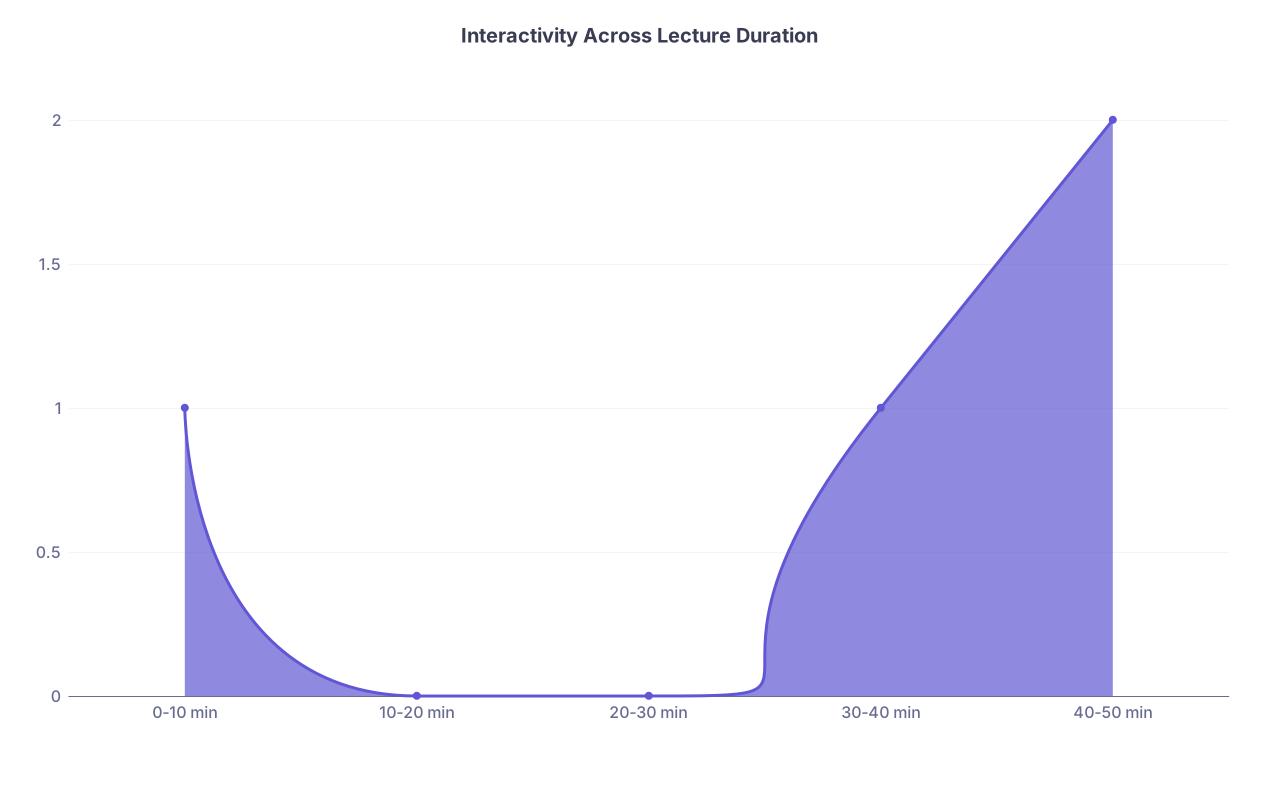
| Category | Value |
|---|---|
| 0-10 min | 1 |
| 10-20 min | 0 |
| 20-30 min | 0 |
| 30-40 min | 1 |
| 40-50 min | 2 |
That pattern—brief engagement, long dead middle, token engagement at the end—is what I see in 80% of mediocre talks.
How to avoid it
You need a plan for interaction baked into the design. For busy medical learners, keep it simple:
- Very short “turn to the person next to you” moments. One minute. One clear question.
- One or two multiple‑choice questions at key decision points in your case. You can use Poll Everywhere or just hands.
- Ask for predictions: “What do you expect the troponin to show?” “What is the most likely complication here?”
Design for 3–5 micro‑interactions sprinkled about every 8–10 minutes. Not one big awkward Q&A at the end.
Your chair will notice when learners start actually discussing and sparring a bit during your talks. That reads as engagement. That reads as effective teaching.
6. Ignoring Time: The Fastest Way to Annoy Your Chair
Let me be blunt: finishing significantly late is one of the quickest ways to get unofficially banned from prime teaching slots.
I watched a talented junior faculty member cut their own throat this way. Excellent content. Residents liked him. But he consistently ran 10–15 minutes over, blowing up clinic schedules and sign‑out times. After three complaints from chiefs, the program director quietly stopped inviting him for core curriculum and used him only for optional sessions.
The time‑management design errors
- Cramming 60 minutes of content into a 45‑minute slot
- No time checkpoints: you have no idea where you should be by minute 20
- Saving “key takeaways” for the final 3 minutes, then skipping them because you are behind
If your last slide always gets rushed or skipped, your problem is not speaking speed. It is bad design.
How to avoid it
Build time into the deck itself:
- Decide in advance: “I will spend ~10 minutes on section 1, 15 on section 2, 10 on cases, 5 on summary/Q&A.”
- Put a subtle “time marker” icon or note on your own copy: by slide X you should be at 15 minutes, by slide Y at 30 minutes.
- Ruthlessly cut content to protect your end: key takeaways and final case application do not get sacrificed. Mid‑deck details do.

Chairs care deeply about schedule discipline. They do not want the 7 a.m. conference turning into a 7:55 a.m. marathon that backs up the whole day. They remember who respects the clock.
7. No Feedback Loop: Repeating the Same Flaws for Years
Plenty of faculty give essentially the same flawed talk for 5–10 years straight. Same bloated deck. Same puzzled faces. Same evaluations: “Too much content, not enough cases, slide font too small.”
They never change the design.
Why? Because they never look for—or act on—specific feedback.
Design mistake: treating evaluations as personal attacks or noise
Common defensive reactions I have heard:
- “Residents always say it is too detailed; they are just lazy.”
- “They wanted more cases but also more background; you can’t win.”
- “Well, the content is correct, so I am not changing it.”
That is how you stall your teaching career. Chairs see the same critique year after year and realize you are not coachable.
How to avoid it
Be surgical about feedback. Do not ask, “Did you like the talk?” Ask two targeted questions after each session:
- “What is one part I should definitely keep the same next time?”
- “What is one part I should cut or simplify next time?”
And then actually act on it.
Also, at least once, ask a trusted colleague (someone who teaches well and will be honest) to sit in and critique exactly these:
- Slide density
- Clarity of structure
- Balance between content and application
- Use of time
Do not waste their time asking if you are “good.” Ask where you are wasting learners’ time.

Chairs notice who evolves. When evaluations improve, they remember. Those people get picked for new courses, CME sessions, and leadership roles.
8. Misaligning With Program and Chair Priorities
You can absolutely lose political capital by teaching the “wrong” things the “wrong” way.
Program directors and chairs have obligations:
- Milestones and competencies
- Board pass rates
- ACGME or specialty‑specific requirements
- Institutional cultural or safety priorities
If your lectures consistently live in your niche interests and ignore those realities, they will quietly move you off the main stage.
Examples of misalignment
- You love rare vasculitides, but what the program really needs is strong, repeated teaching on sepsis, diabetes management, and safe handoffs.
- You spend 25 minutes on the basic science of a topic while residents are failing on practical management questions.
- You teach in a style that contradicts agreed institutional approaches (e.g., you advocate a controversial protocol the hospital does not use).
Your score on “enthusiasm” will not save you from misalignment.
| Priority Type | Faculty Default Focus | Chair/Program Needed Focus |
|---|---|---|
| Topic selection | Personal subspecialty interests | High-volume, high-risk conditions |
| Depth | Pathophysiology, mechanisms | Initial management, decision-making |
| Outcomes | Impress colleagues | Better patient care, board scores |
| Evaluation criteria | “Did they like me?” | “Did this move our metrics?” |
How to avoid it
Ask your chair or program director one pointed question each year:
“If I am going to invest in improving 1–2 of my lectures, which topics or skills would you most want me to emphasize for our learners?”
Then actually shift your content in that direction. Swap out one nice‑to‑have talk for one must‑have but unglamorous topic that the program struggles with.
And watch how quickly leadership stops seeing you as “that idiosyncratic lecturer” and starts seeing you as “someone who helps solve our curriculum problems.”
FAQ (Exactly 4 Questions)
1. How many slides is “too many” for a 45‑minute medical lecture?
If you are early in your teaching career, more than 45–60 slides is almost always too many. That range assumes many slides are simple visuals or questions, not paragraphs of text. If you routinely skip slides or rush the last third, that is your sign you are overstuffed. Cut content until you can finish comfortably with 5 minutes to spare.
2. Should I share my slides with learners before or after the session?
Share them after, not before, unless your program has a specific requirement otherwise. Pre‑sharing often encourages residents to check out, thinking they can “review later,” which rarely happens. Post‑session sharing, ideally with a slimmed‑down handout or key‑points version rather than the full deck, lets them review without undermining in‑room engagement.
3. How many interactive elements should I include without the session feeling gimmicky?
For a 45–60‑minute talk, aim for 3–5 short, meaningful interactions. That could be two prediction questions, one think‑pair‑share, and one case‑based multiple‑choice question. If every third slide is a poll, it feels juvenile. If only the first and last slides are interactive, it feels like a token gesture. Spread a few high‑yield interactions across the session.
4. What is the biggest single change I can make to improve my lecture design quickly?
Trim. Strip your content down to the few decisions or actions you want learners to do differently tomorrow, and build everything around those. That usually means cutting 20–40% of your existing material, enlarging fonts, adding one clear agenda slide, and integrating one or two clinical cases. Those changes alone dramatically improve learner engagement and chair satisfaction.
Key points to walk away with:
- Overstuffed, unstructured slides and passive monologues are not minor quirks; they are career‑limiting habits that annoy both learners and chairs.
- Design your lectures around what exhausted clinicians must do differently, with clear structure, realistic timing, and a few deliberate interaction points.
- Align your topics and style with program priorities and feedback; people who adapt get invited back, trusted more, and promoted faster.