It’s 9:45 p.m. You’re still in your clinic workroom, half‑eaten granola bar on the desk, flipping between three open PowerPoint decks. Tomorrow you’ve got:
- Morning report for the residents
- A med student small group on sepsis
- A noon conference you “volunteered” to cover when someone else dropped
You still haven’t pre‑charted tomorrow’s patients. Your inbox is a mess. Your kid’s school play was tonight. You missed it.
But hey, you’re “a dedicated educator,” right?
This is exactly how people burn out in academic medicine while telling themselves they’re just being good teachers. Overcommitting to teaching is one of the most common, most socially rewarded, and most career‑damaging mistakes I see in academic physicians and fellows.
Let me be blunt: saying yes to every teaching request is not noble. It’s reckless. And it can quietly wreck your career, your reputation, and your sanity.
You want to teach. Good. This is not an argument against teaching. It’s a warning against weaponized altruism and institutional convenience disguised as “opportunities to teach.”
Let’s walk through where people screw this up—and how you can avoid becoming the exhausted “super-teacher” everyone praises while quietly stepping over.
1. The Hidden Math of Teaching: Why “Just One More Session” Is a Lie
The first mistake is underestimating the true cost of teaching.
You keep telling yourself: “It’s only a one‑hour lecture.”
No. It is not “only” one hour. That’s fantasy math.
Here’s what that one “hour” usually turns into:
- 2–6 hours: content prep (longer if it’s a new topic or audience)
- 30–60 minutes: emailing coordinators, sending slides, uploading to LMS
- 1 hour: actual delivery
- 30–60 minutes: follow‑up emails, sharing resources, evaluation forms
- 1–2 hours: updating the talk next time because guidelines changed or feedback suggested revisions
So now your “1‑hour” teaching slot is actually 5–10 hours of work. On top of your clinical, research, admin, and home life.
To make this painfully clear:
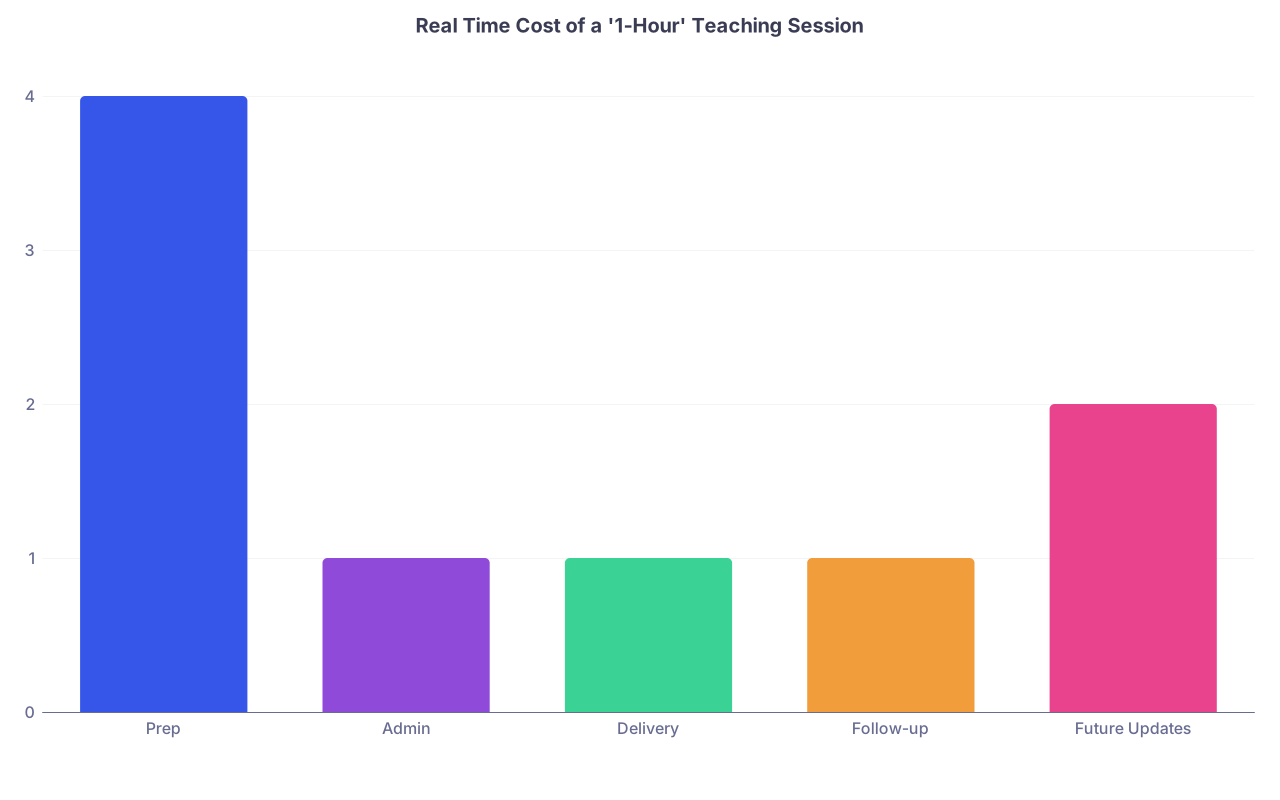
| Category | Value |
|---|---|
| Prep | 4 |
| Admin | 1 |
| Delivery | 1 |
| Follow-up | 1 |
| Future Updates | 2 |
And yet people stack three, five, ten of these commitments per month and wonder why they’re constantly behind.
The mistake:
You’re counting visible time (the lecture hour) and ignoring invisible time (prep, coordination, revisions). Institutions count on you doing this bad math.
How to avoid it:
- For every new session, assume 5x the delivery time as total time cost, minimum
- If it’s a brand‑new lecture or course, assume 8–10x the delivery time
- Do not accept any new teaching request until you’ve literally blocked the estimated time on your calendar and seen how ugly the month looks
If, after that, your calendar looks like a game of Tetris on hard mode, that “teaching opportunity” is not an opportunity. It’s a trap.
2. The “Good Citizen” Trap: When Saying Yes Becomes Career Suicide
Academic medicine runs on guilt and “being a team player.”
Here’s how it usually goes:
- “We really need someone to cover this small group—it’s for the students.”
- “The dean personally cares about this series.”
- “You’re so good with learners; we immediately thought of you.”
Notice what’s missing? Any mention of:
- Protected time
- Formal credit in your workload
- Concrete career benefit for you
Instead, you’re paid in flattery and vague promises: “This will look good on your CV.”
Let me say it clearly:
Random, scattered teaching does not automatically advance your career.
In some cases, it dilutes it.
Especially early in your career, overcommitting to teaching can block the exact things that actually count at promotion:
- Grants submitted
- Manuscripts accepted
- Meaningful educational leadership roles (not just foot soldier work)
- Program development with clear outcomes
Here’s a rough reality check:
| Activity | Promotion Value (Typical) | Time Cost | Overcommitting Risk |
|---|---|---|---|
| Leading a core required course | High | Very High | High |
| Giving 10 ad hoc noon lectures | Low–Moderate | High | Very High |
| Developing a curriculum with eval | High | High | Moderate |
| Covering “emergency” small groups | Low | Moderate | Very High |
| Co‑authoring education papers | High | High | Moderate |
The mistake:
Confusing volume of teaching with strategic teaching that clearly supports your promotion packet.
How to avoid it:
- Before accepting, ask yourself:
“If I do this for three years, where does it show up in my promotion packet?”
If you can’t answer in one sentence, it’s probably not worth it. - Prioritize teaching roles that:
- Are named, ongoing responsibilities (course director, clerkship co‑director)
- Come with documented FTE support or reduced clinical time
- Are tied to measurable outcomes or scholarship potential
- Say no to repeated one‑off sessions that don’t build into anything larger, unless they’re directly replacing something lower‑value
If your CV reads like “gave lecture… gave lecture… gave lecture…” with no ownership of anything, that’s not a strong academic trajectory. That’s a treadmill.
3. When Teaching Hurts the One Thing You Can’t Replace: Your Reputation
This one stings, because it’s exactly the opposite of what people intend.
You overcommit to teaching because you care. Then you:
- Show up underprepared
- Reuse dated slides that haven’t been updated
- Rush through material because clinic ran long
- Answer emails late or not at all
- Cancel at the last minute because you’re buried
And the learners talk. They always talk.
Typical hallway comments I’ve heard:
- “She gives a lot of talks, but half the time she’s winging it.”
- “He’s clearly overextended; the session felt scattered.”
- “This was basically the same lecture we saw two years ago.”
Ironically, the quantity of your teaching starts to poison the quality—and that’s what actually shapes your reputation.
Overextension leads to:
- Sloppy sessions
- Minimal feedback to learners
- No follow‑through on promised resources
- Little to no innovation in your teaching methods
This is how good people become “background noise” in the teaching program. Always there, rarely excellent.
You don’t want that.
How to avoid it:
- Set a personal cap:
- X lectures per month
- Y new talks per year
- Only commit to what you can execute at an A‑level. If you realistically can’t do it well, do not do it at all. A mediocre session from you does more harm than a cancelled one covered by someone who can prepare properly.
- Protect prep time like a clinic block. No “I’ll squeeze it in tonight.” That’s how quality drops.
Your teaching reputation is built on consistency and excellence, not martyrdom.
4. The Scholarship Black Hole: When You Teach a Ton but Advance Zero
Here’s a scenario I’ve seen more times than I like:
A junior faculty member:
- Teaches in three courses
- Runs a few simulation sessions
- Gives eight noon conferences a year
- Supervises residents constantly
Five years later they sit down with their promotions committee and hear variations of:
- “You have a lot of teaching, but not much educational scholarship.”
- “We don’t really see evidence of impact.”
- “Can you come back with more publications or innovation?”
They’re stunned. “But I’ve done so much teaching.”
Yes. And most of it wasn’t designed with scholarship in mind. It was operational work. Necessary for the institution, not particularly career‑advancing for you.
Teaching without scholarship is like operating without documenting your cases. You worked. You just don’t have evidence that matters for advancement.
Common mistakes:
- Recreating sessions every year from scratch with no plan to study or publish them
- Never collecting outcome data beyond generic course evaluations
- Saying yes to 10 different things instead of going deep on 1–2 projects that could yield papers, presentations, or grants
The fix is not “do less teaching.” It’s “do targeted teaching that can be turned into something.”
A more strategic model:

| Step | Description |
|---|---|
| Step 1 | Choose 1-2 Priority Teaching Roles |
| Step 2 | Standardize Session Design |
| Step 3 | Collect Outcomes Data |
| Step 4 | Analyze Results |
| Step 5 | Present Locally |
| Step 6 | Submit to Conference or Journal |
Better to be the person who:
- Co‑developed a new assessment strategy
- Studied its impact
- Presented it regionally or nationally
- Published in a reputable journal
Than the person who “taught twelve lectures” with nothing to show except tiredness.
How to avoid the scholarship black hole:
- For any recurring teaching role you accept, ask:
“What’s the publishable question here?” - Collect:
- Pre/post knowledge or confidence data
- Performance data when appropriate
- Qualitative learner feedback that goes beyond Likert scale comments
- Collaborate intentionally:
- Loop in an education researcher from the start
- Put timelines on manuscript development, not “someday we’ll write this up”
If there is no realistic path to scholarship, be very cautious about how much time you sink into that teaching role.
5. Burnout by “Good Deeds”: The Emotional Toll Nobody Talks About
Overcommitting to teaching doesn’t just steal time; it drains emotional bandwidth.
Teaching well is emotionally heavy:
- You’re performing
- You’re responsible for learner morale
- You’re often absorbing their stress and anxiety
- You’re trying to be “on” even after a brutal call night or complicated patient case
Do that on top of full clinical loads and research pressure, and you start seeing classic burnout markers:
- Dread when you see teaching on your calendar
- Resentment toward learners (“Why are they so unprepared?” when actually you’re the one overextended)
- Emotional numbness in other areas of your job
- Cognitive fatigue—your clinical and research work gets sloppier
Then something worse happens: you start associating teaching with suffering. You used to love it. You now flinch when the medical education office emails you.
That’s how people who were born to teach become bitter, disengaged, or leave academics entirely.
To visualize the shift:
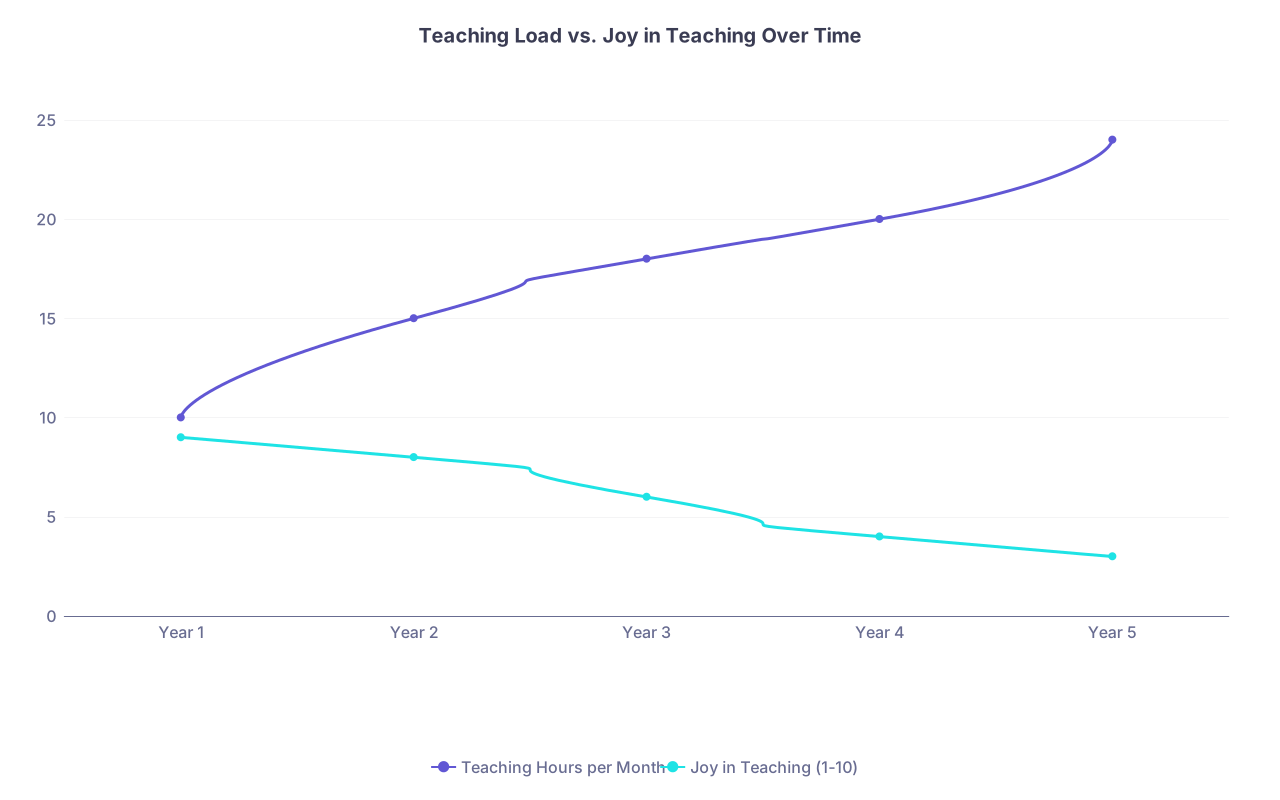
| Category | Teaching Hours per Month | Joy in Teaching (1-10) |
|---|---|---|
| Year 1 | 10 | 9 |
| Year 2 | 15 | 8 |
| Year 3 | 18 | 6 |
| Year 4 | 20 | 4 |
| Year 5 | 24 | 3 |
How to avoid burning out on the one part of your job you actually liked:
- Watch for your own early warning signs:
- You find yourself hoping sessions get cancelled
- You start recycling old slides without caring about accuracy
- You feel disproportionate anger at minor learner behavior
- Commit to fewer, higher‑impact teaching roles that you can actually enjoy:
- Longitudinal relationships (coaching, mentoring, small groups)
- Topics you genuinely care about
- Formats that match your style (some people thrive in small groups, others in large lectures)
You’re no use to learners if the hidden curriculum you’re conveying is: “This job is miserable.”
6. The Power of Early Boundaries: Saying “No” Without Becoming the “Difficult” Person
The fear is real:
“If I say no, they’ll stop asking. I’ll be seen as selfish or not committed to education.”
Reality:
If you never say no, they’ll keep asking—because you’ve taught them you’re the person who never refuses. And they will not protect you from yourself.
You must set boundaries early. They’re much harder to install later.
Here’s what not to do:
- Long apologies
- Overexplaining your schedule
- Offering to “maybe” do it if they can’t find anyone else (they will always “not find” anyone else)
Here’s what works:
- Clear, short refusals that leave the door open strategically:
- “I’m at my teaching capacity this semester, but I’d be happy to reconsider next year.”
- “I’m focusing my efforts on the X course right now so I can deliver at a high level. I can’t take this on.”
- “I’ve committed to limiting my new lectures to one per semester to protect quality. I’ll have to pass on this one.”
If you want to be extra useful without self‑sacrifice:
- Offer alternatives:
- Suggest a more junior person who wants exposure
- Share existing resources or slides (if appropriate)
- Volunteer once to co‑teach as a transition, not to own it forever
Remember: someone will always be unhappy. You just have to decide whether it will be you, or someone sending email requests.
7. Designing a Sustainable Teaching Portfolio (So You Don’t Hate Your Life in 5 Years)
Let’s get practical. You need a teaching portfolio that:
- Matches your career stage
- Has clear promotional value
- Is sustainable in your actual life
Here’s a rough framework I’d use with junior faculty or late‑stage fellows.
Step 1: Pick Your Primary Identity (for the next 3–5 years)
Not forever. Just this phase.
- Clinician‑educator
- Researcher with selective teaching
- Education scholar
- Program leader
Your teaching commitments should fit this identity, not fight it.
Step 2: Set Hard Numeric Limits
Yes, numbers. Because vague intentions like “I’ll try not to overcommit” always fail.
Examples:
- New lectures: max 1–2 per year
- Longitudinal teaching commitments: max 2 at a time (e.g., clerkship + one elective)
- Uncompensated extra sessions: max 1 per month
Write these limits down. Tell your mentor. Tell your division chief. Make it real.
Step 3: Build Around 1–3 Anchor Roles
Anchors are substantial, recurring roles where you can make a name for yourself:
- Co‑directing a clerkship
- Running the resident simulation curriculum
- Developing and owning a specific, high‑impact module (e.g., ultrasound bootcamp, EPAs for interns)
Then use that role to:
- Collect data
- Innovate
- Write and present
Sprinkle in a small number of one‑off sessions you actually enjoy. That’s your maximum.
A sustainable portfolio might look like:
| Role Type | Example | Volume |
|---|---|---|
| Anchor Role | Associate clerkship director | Year‑round |
| Secondary Role | Resident simulation series (3 sessions/year) | 3 half‑days |
| Limited Add‑Ons | 2–3 noon conferences on your niche topic | 3 hours + prep |
| Mentoring/Coaching | 3–5 longitudinal mentees | Ongoing, bounded |
If your portfolio looks more like “11 different unrelated small groups and lectures,” you’re setting yourself up to be scattered and invisible.
8. Red Flags That You’re Already Overcommitted (Be Honest Here)
If you see yourself in these, you’re past the early warning stage:
- You routinely finalize slides after midnight the night before a session
- You can’t name your top 1–2 teaching roles without thinking—you just say “I teach a lot”
- You frequently send last‑minute “sorry for the delay” emails to education coordinators
- You dread teaching days because they feel like “extra work” on top of your “real work”
- Your mentor or chief has said some version of: “You’re doing a ton of teaching; where’s the scholarship?”
Do not ignore these. This is the point where some people double down (“I just have to work harder”) and others course‑correct.
Course‑correct. Now.
9. How to Step Back Without Burning Bridges
Maybe you’re already overcommitted and need to unwind some of it. That’s doable—but you need to be deliberate.
A simple playbook:
List every teaching activity you currently do
- Who “owns” it (course director, program, clerkship)
- Time cost (real, not fantasy)
- Whether it aligns with your 3–5 year plan
Rank in three buckets
- Keep and possibly grow
- Maintain but not expand
- Exit over 6–18 months
For “exit” items, plan a clean transition:
- Identify a replacement (sometimes a more junior faculty member wanting opportunity)
- Offer to co‑teach once as a handoff
- Give plenty of notice (a semester or academic year)
Example script:
- “I’ve really appreciated being involved in this small group these last three years. As I take on more responsibility in the clerkship and focus my efforts, I need to step back from this role after this academic year. I’m happy to help transition someone else into it.”
If someone tries to guilt you:
- “We really rely on you.”
Response: “I value the work too, and that’s exactly why I want to ensure someone with adequate bandwidth can give it the attention it deserves.”
Notice what you’re doing: protecting quality, not apologizing for having limits.

10. The Quiet Upside of Doing Less: You Actually Become a Better Teacher
When you stop overcommitting, something funny happens:
- You have time to critically rethink your sessions
- You can integrate active learning instead of flipping slides
- You actually read learner feedback and make thoughtful changes
- You can respond to students’ emails like a human, not a stressed robot
You start showing up not as the harried, exhausted faculty barely keeping the lecture ahead of the slide, but as someone who is prepared, engaged, and clearly not resentful.
Learners feel that difference. And so do your colleagues.
Over time, the person who strategically teaches fewer, higher‑impact sessions with visible excellence and scholarship gets:
- Invited to meaningful leadership roles
- Nominated for teaching awards
- Credibility when they say no (because when they say yes, it’s good)
While the person who is everywhere, doing everything at a B‑minus level, gets… more requests to do more thankless things.
Do not be that person.

Key Takeaways
Overcommitting to teaching is not virtuous; it’s dangerous. It quietly erodes your time, your reputation, and your path to promotion while institutions smile and keep handing you more.
Volume is not value. Ten scattered, low‑impact teaching gigs will never beat one or two well‑chosen roles with clear impact and scholarship potential.
Protect your future self. Set hard limits, say no more than feels comfortable, and build a focused teaching portfolio you can sustain without hating the one part of academic medicine you actually enjoy.