
The quickest way to be labeled “not serious about medical education” is not a bad teaching evaluation. It is a sloppy CV.
Your CV is the first test of whether you understand what academic medicine actually values. If you fail that test, most program directors, clerkship leaders, and education committees will not give you a second one. I have watched outstanding clinicians get quietly sidelined for educator roles because their CV screamed: “I dabble. I do not lead.”
You do not want to be that person.
Let me walk you through the CV mistakes that instantly raise red flags for people hiring or promoting faculty, fellowship applicants in med ed, or leadership roles like clerkship director, simulation lead, residency core faculty. These are the errors that make reviewers close the PDF and move on.
1. Treating Your CV Like a Generic Clinical Resume
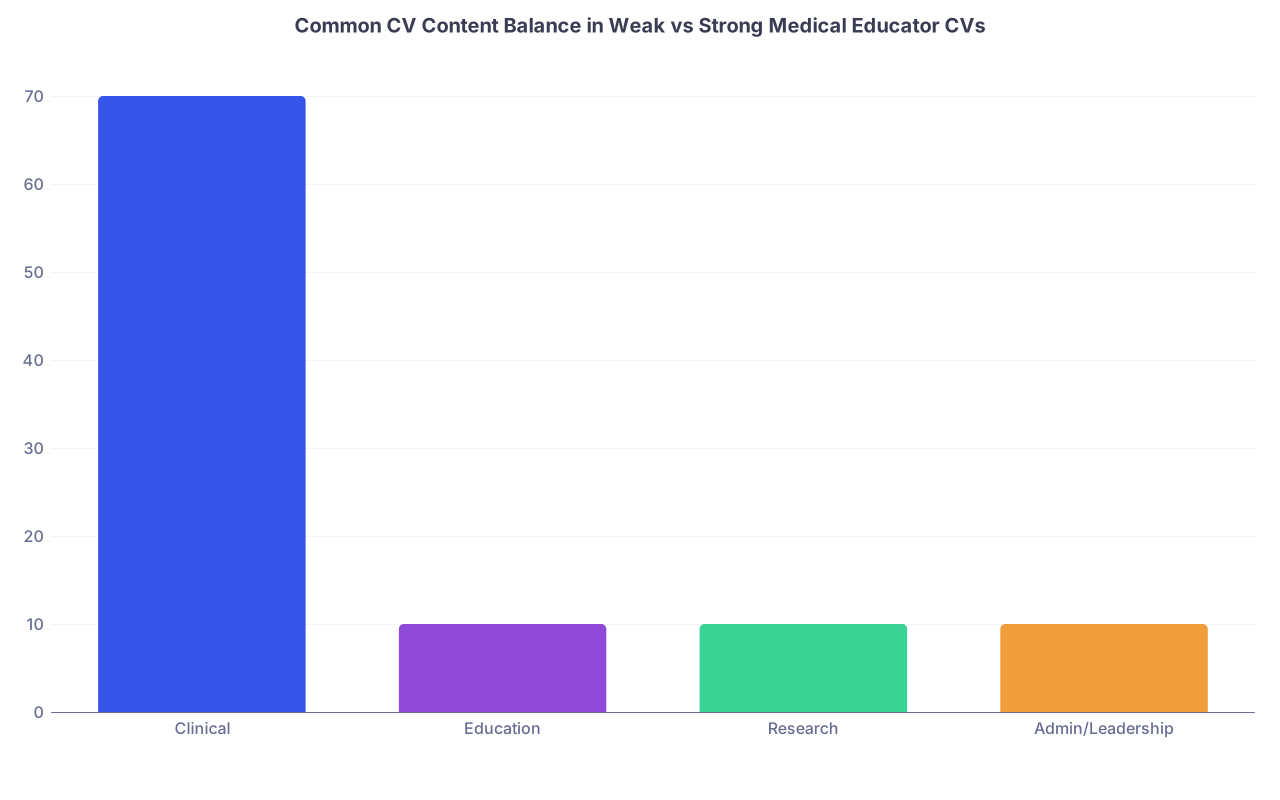
| Category | Value |
|---|---|
| Clinical | 70 |
| Education | 10 |
| Research | 10 |
| Admin/Leadership | 10 |
The most basic mistake: sending in a “clinical CV” for an education-focused role.
You know this CV when you see it. Pages of:
- Detailed lists of procedures
- Every locums job you ever took
- “Strong communicator, team player” in the summary statement
And almost nothing about teaching.
For an education role—fellowship in medical education, clerkship director position, CME course director, even a serious teaching award—this says one thing: you do not understand the job.
Medical education CVs must clearly answer:
- Whom do you teach? (students, residents, fellows, interprofessionals)
- What do you teach? (courses, clerkships, simulations, CME, QI curricula)
- How do you teach? (methods, innovations, technology, assessment)
- How have you grown and contributed? (scholarship, leadership, training in education)
If your CV is 90% service and clinical billing and 10% teaching, then you are signaling that education is an afterthought.
How to avoid this:
- Create a distinct “Medical Education CV” template that foregrounds teaching. Do not just recycle your job-application CV for hospitalist roles.
- Move the “Teaching Activities” section directly under academic appointments, above clinical responsibilities.
- Add a brief “Focus: Medical Education” statement in the header or near the top that lists your primary education interests (e.g., simulation, assessment, curriculum design).
If the reader has to hunt for your teaching, they will assume it is not important to you.
2. No Structured Teaching Section (or a Useless One)

The second big mistake is either having:
- No teaching section at all, or
- A one-liner: “Teach medical students and residents regularly.”
That sentence is a red flag. It tells me you either:
- Have no record of what you actually do, or
- Did not care enough to document it.
Serious educator CVs treat teaching like procedures: logged, categorized, and described.
A robust teaching section should separate, at minimum:
- Formal teaching: lectures, small groups, courses, OSCEs, simulation sessions
- Clinical teaching: ward attending, precepting, continuity clinic, bedside rounds
- Educational roles: course director, small group leader, skills workshop lead, simulation faculty, OSCE examiner
Each entry should have:
- Title of session/course
- Audience level (MS1, interns, PGY-3, multidisciplinary, CME)
- Setting (clerkship, boot camp, noon conference, grand rounds)
- Year(s) or frequency
“Precept medical students 2018–present” is lazy. “Ambulatory Preceptor, Internal Medicine Residents and MS3s, weekly continuity clinic, 2018–present” is the minimum.
If you are early in your career, you will not have huge volume. That is fine. But if your teaching section is two vague lines after five years on faculty, committees will not buy that you are serious about education.
3. Ignoring Educational Leadership and Responsibility

| Step | Description |
|---|---|
| Step 1 | Informal Teaching |
| Step 2 | Recurring Sessions |
| Step 3 | Course Component Lead |
| Step 4 | Course or Clerkship Director |
| Step 5 | Program Director or Vice Chair Education |
Another mistake: listing yourself as “core faculty” and letting it sit there like it means something.
“Core faculty” is so overused it is nearly meaningless. Reviewers want to know: What do you actually own?
Signs of a “not serious” CV:
- No titles like “co-director,” “thread lead,” “site director,” “assessment lead,” “simulation lead.”
- Vague language: “involved in residency education,” “participate in curriculum,” “help with orientation.”
- No progression of responsibility over time.
An educator CV should show trajectory. Slight upward slope. You started as a small group facilitator. Then maybe you took over a course week. Then became co-director. That arc matters.
Spell out roles clearly:
- “Co-director, MS2 Renal Pathophysiology Course (co-led curriculum design, scheduling, assessment), 2022–present.”
- “Site Director, Internal Medicine Clerkship, Community Hospital X, 2020–2023.”
- “Lead, PGY-1 Simulation Boot Camp for Emergency Medicine Residents, 2021–present.”
If you have been “interested in medical education” for 7+ years and your CV shows zero leadership roles, people will question how seriously you pursued that interest.
4. Weak or Nonexistent Documentation of Educational Scholarship
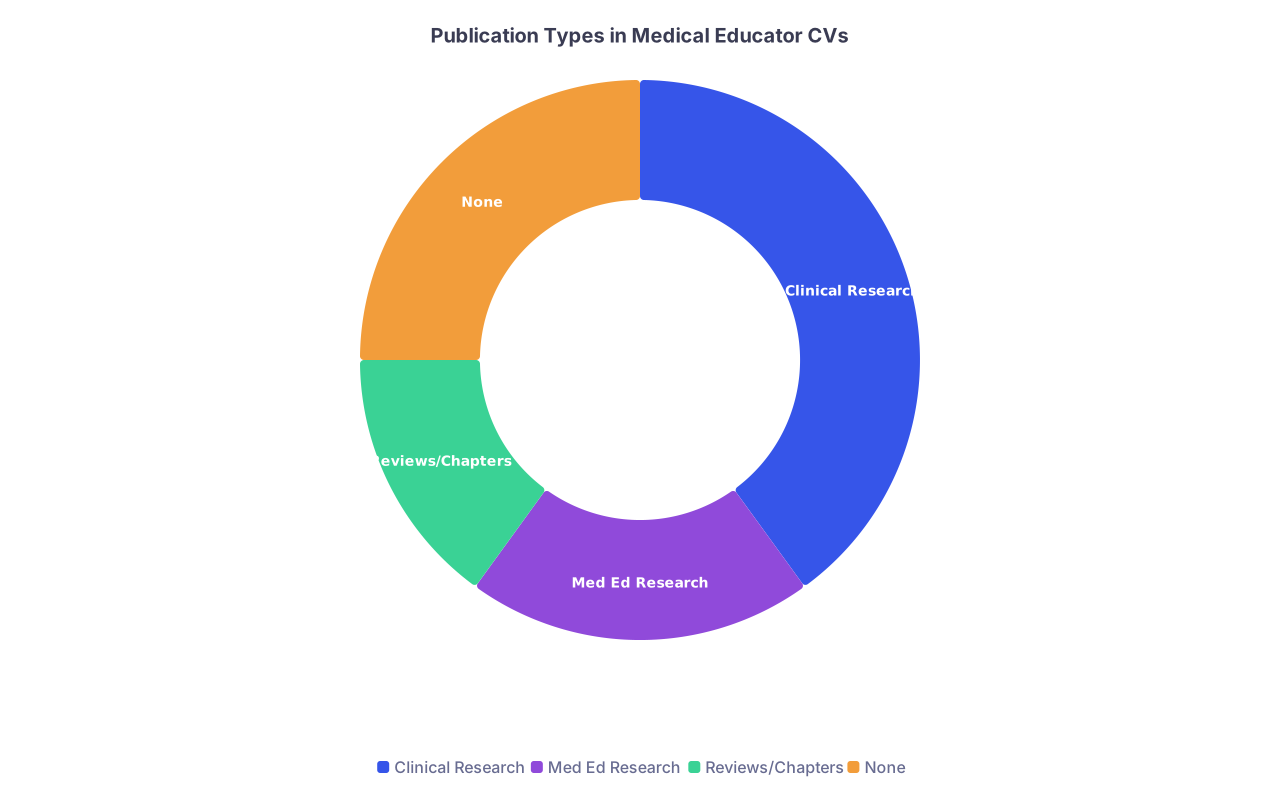
| Category | Value |
|---|---|
| Clinical Research | 40 |
| Med Ed Research | 20 |
| Reviews/Chapters | 15 |
| None | 25 |
You cannot claim to be a serious medical educator forever with no trace of scholarship. At some point, someone will ask: what have you actually contributed beyond your own learners?
The mistake I see constantly:
A long list of clinical research publications, maybe some QI, but absolutely nothing in medical education. Yet the cover letter says: “My passion is teaching.”
That disconnect is loud.
Now, you do not need a JAMA paper in med ed to be taken seriously. But you do need at least some of:
- Abstracts or posters at education meetings (Clerkship Directors in Internal Medicine, AAMC, COMSEP, SAEM education track, etc.).
- Short communications, innovations, or perspectives in education journals.
- Book chapters or online modules explicitly about teaching, assessment, curriculum, professionalism, etc.
And you must label them clearly. Do not bury your med ed work under a generic “Publications” heading where it sits between a sepsis outcomes paper and a case report.
Create a subsection: “Educational Scholarship” or “Medical Education Publications and Presentations.” That sends a different message: “I see this as a real field, not a hobby.”
If you have genuinely done education research but it is scattered and unlabeled, you are sabotaging yourself. The reviewer will not do the archaeology for you.
5. No Evidence of Formal Training in Medical Education

Another major signal of unseriousness: zero formal development in education over a long period of time.
Red flags:
- 8+ years on faculty, heavily “interested in teaching,” and not a single faculty development workshop, certificate, or course listed.
- Pursuing an education leadership role with no mention of having learned any actual education theory, assessment principles, or curriculum design.
Serious educators treat education as a discipline. They have at least some of:
- A certificate program in medical education or health professions education.
- A master’s degree in education, medical education, or related field.
- Longitudinal faculty development programs (Harvard Macy, Stanford Educator-4-CAREER, local “Teaching Scholars” programs).
- Documented training in assessment, feedback, simulation, or curriculum design.
If you have done these, but they are scattered under “Other” or “Miscellaneous,” you are wasting leverage. Pull them into a dedicated section: “Formal Training in Medical Education” or “Faculty Development in Medical Education.”
If you have done none of this yet want a serious education role, fix that before you apply. And then document it clearly.
6. Vague, Inflated, or Dishonest Descriptions
Nothing kills credibility faster than a CV that smells padded.
Classic offender language:
- “Designed and implemented innovative curriculum for residents” (but you gave one noon conference).
- “Led major education reform efforts” (but you were one of 12 people at a committee meeting).
- “Expert in assessment and feedback” (with no formal training or scholarship to back that up).
Education folks have a finely tuned radar for this. We have all sat through the same painful meetings. We know what major reform actually looks like.
The fix is simple and non-negotiable:
- Be specific about your contribution. “Co-authored OSCE cases and co-facilitated faculty training.” Not “led OSCE program.”
- Quantify when you can. “Delivered 6–8 small-group sessions per year on EKG interpretation, MS2s, 2019–present.”
- Avoid grandiose adjectives: “innovative,” “major,” “transformative” unless your role truly matches the claim.
If your CV forces the reviewer to decode what you probably really did, they will assume the worst.
7. No Outcomes, No Impact, Just Activity
| Type | Weak CV Entry | Strong CV Entry |
|---|---|---|
| Teaching | Gave lecture on sepsis | Developed and delivered annual 1-hour sepsis module, rated 4.7/5 by residents, 2019–present |
| Curriculum | Helped with resident rotation | Co-created new night float curriculum; reduced duty hour violations by 30% over 1 year |
| Assessment | Involved in OSCE | Co-designed 8-station OSCE; inter-rater reliability improved from 0.55 to 0.78 after faculty training |
Activity without impact looks like box-checking.
A lot of CVs read like this:
- “Lecturer, MS3 Internal Medicine Clerkship.”
- “Facilitator, M&M conference.”
- “Participation in resident noon conference series.”
That tells me nothing about whether any of this mattered.
Now, not everything needs outcomes data, but serious educators try to connect their work to results:
- Learner evaluations
- Participation numbers
- Changes in exam performance or clinical metrics
- Adoption of your materials by other sites or programs
- Awards or recognition tied to specific initiatives
Even simple additions help:
- “Resident Boot Camp, co-creator and facilitator, 2020–present; 95% of participants reported increased confidence in managing night-on-call scenarios.”
- “Co-lead, EBM curriculum redesign; subsequent In-Training Exam EBM subscore improved from 48th to 65th percentile nationally over 2 years.”
If your CV shows three pages of teaching with no hint of outcomes, the impression is: you talk a lot; I have no idea if it helped anyone.
8. Disorganized, Hard-to-Scan Structure
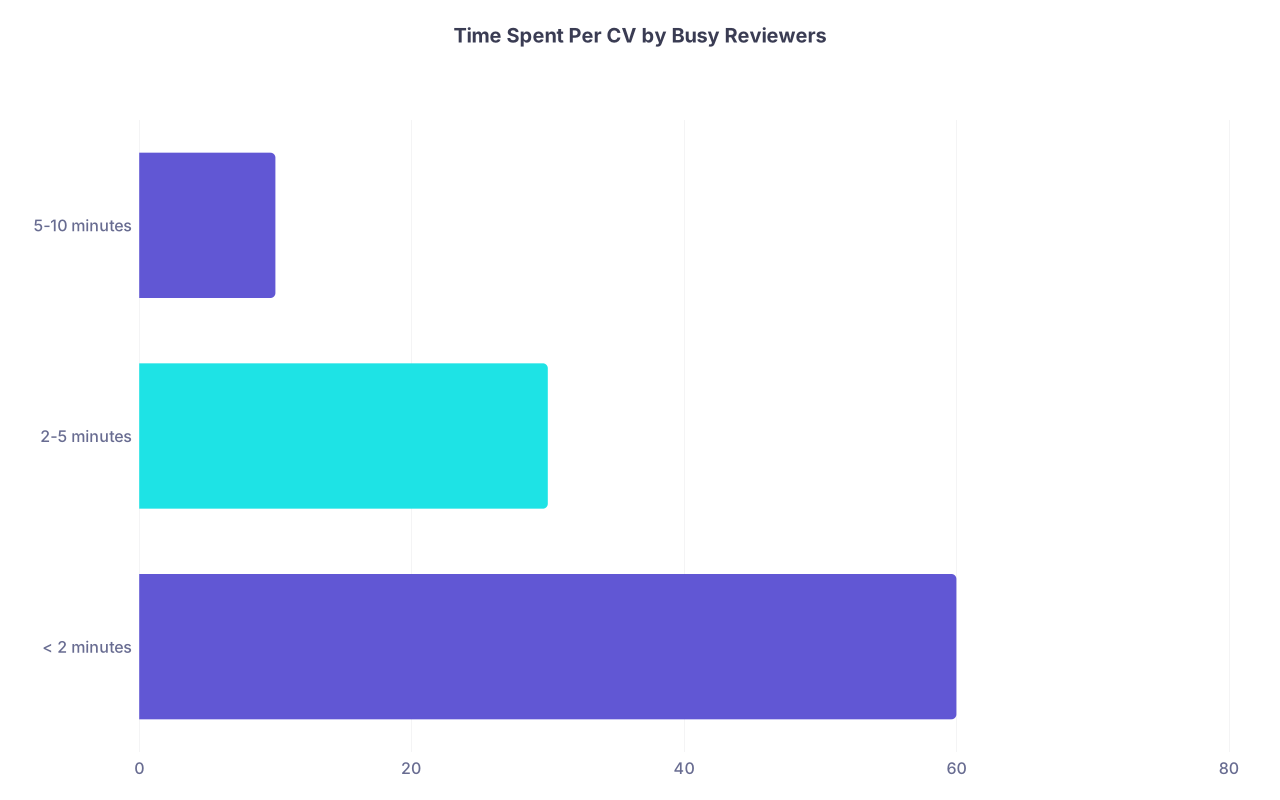
| Category | Value |
|---|---|
| < 2 minutes | 60 |
| 2-5 minutes | 30 |
| 5-10 minutes | 10 |
Busy selection committees do not read your CV. They scan it for patterns.
You lose them instantly if:
- Teaching is buried under “Other Professional Activities.”
- Education scholarship is mixed with basic science publications.
- Leadership roles are hidden inside bullet points that start with clinical duties.
Serious educator CVs are structured to make the educational narrative unavoidable. A clean structure for someone serious about medical education might look like:
- Contact and current position
- Academic and hospital appointments
- Focus or brief summary (1–3 lines) with education emphasis
- Education and training (include med ed degrees/certificates)
- Teaching activities (structured subsections)
- Educational leadership roles
- Educational scholarship (publications, presentations, curricula)
- Other scholarship (clinical, basic science)
- Honors and awards (with teaching awards clearly marked)
- Service and committee work (with education committees highlighted)
If the reviewer has to scroll back and forth to piece together your education story, they will not. They will just conclude: “Not a real educator.”
9. No Alignment With the Specific Medical Education Role

| Step | Description |
|---|---|
| Step 1 | Your Experience |
| Step 2 | Highlight courses, clerkships, small groups |
| Step 3 | Highlight supervision, assessment, milestones |
| Step 4 | Highlight workshops, systems, leadership |
| Step 5 | Role Type |
Another classic mistake: sending the same generic CV for every education-related opportunity.
Medical education is not one monolith. Teaching MS1s in a pre-clinical course is not the same as being an APD for a residency. Yet I routinely see CVs that:
- Heavily emphasize student teaching when applying for residency leadership roles.
- List tons of resident supervision but barely mention the single, highly relevant CME course you run.
- Lead with research publications when the role is 80% curriculum administration.
Misalignment says: “I want any education thing; I have not thought about this specific one.”
You do not fabricate, but you do re-order and highlight:
- For undergraduate medical education roles: put student teaching, course leadership, small-group facilitation, OSCE work, and any pre-clinical curriculum work first.
- For GME roles: emphasize supervision, competency-based assessment, CCC involvement, milestones, remediation experience.
- For CME/continuing education: elevate talks, workshops, course director roles, and system-level education efforts (guideline rollouts, QI teaching).
If the role screams “assessment and remediation” and your CV screams “I give great lectures,” you will not look like a serious candidate.
10. Sloppy Presentation: Typos, Inconsistent Citations, Amateur Formatting

Academia is petty. It cares about the details. Medical education doubly so, because you are modeling professionalism for learners.
CVs that scream “not serious” often look like this:
- Different citation formats on the same page (Vancouver here, APA there, random punctuation everywhere).
- No consistent date formatting. “2019–present” in one line, “2018 to 20” in another.
- Spelling errors in journal names, course titles, or—worst—“Medical Eduaction.”
- Weird fonts, colored text, clip art, or embedded logos. This is not a sales brochure.
Some people will defend this with “I have been too busy taking care of patients to care about formatting.” That excuse does not convince anyone serving on an education committee.
Educators are expected to:
- Produce clean, accurate materials.
- Model professional documentation.
- Pay attention to detail.
Your CV is supposed to be the best-formatted document you produce all year. If even that looks chaotic, reviewers will assume your teaching materials and evaluations look worse.
11. Missing or Minimized Teaching Evaluations and Awards
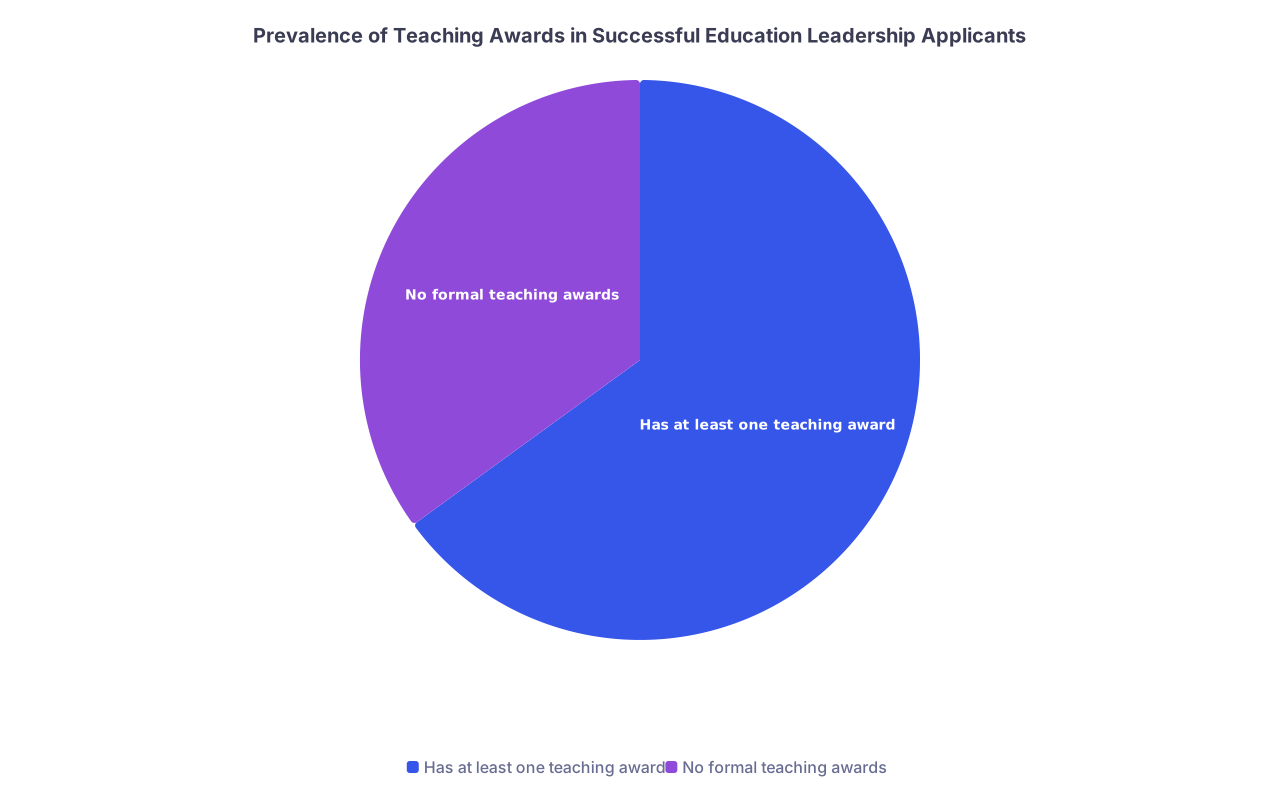
| Category | Value |
|---|---|
| Has at least one teaching award | 65 |
| No formal teaching awards | 35 |
If you are serious about medical education, some evidence of how learners and colleagues perceive your teaching should eventually show up. Not on day one. But after years? Yes.
Two mistakes here:
- Never mentioning teaching evaluations at all.
- Hiding teaching awards deep in a generic “Awards” section behind random conference travel grants.
Fix it by:
- Adding a brief section: “Selected Teaching Evaluations” or “Summary of Teaching Effectiveness” with a couple of representative averages (with context, not cherry-picked one-offs).
- Clearly labeling teaching awards as such and grouping them: “Teaching Awards and Educational Honors.”
- Linking specific awards to specific work in your CV entries when relevant.
If you have numerous clinical or research awards but nothing related to teaching, yet claim teaching is your core identity, that mismatch will be noticed.
FAQ (Exactly 5 Questions)
1. I am early in my career and have very little on my CV. Does that automatically make me look “not serious”?
No. Lack of volume is not the problem. Lack of intention is. An early-career CV that clearly lists even a few teaching activities, a faculty development workshop or two, and a basic teaching section is fine. What looks unserious is someone 5–10 years in with vague, undocumented, or scattershot teaching entries.
2. How many medical education publications do I need to be taken seriously for educator roles?
There is no magic number. For entry-level educator roles or fellowships, 1–3 clear education-related outputs (posters, short communications, innovation reports) can be enough if they are well-presented. For major leadership roles (clerkship director, APD, vice chair for education), you are generally expected to show a pattern of education scholarship over time.
3. Should I separate my medical education CV from my clinical/research CV?
You should at least have a dedicated medical education version where the structure and ordering signal that education is the focus. You do not invent content, but you foreground teaching, educational leadership, and education scholarship. Sending a generic “everything CV” to an education search committee is a common and avoidable mistake.
4. How far back should I go with teaching activities on my CV?
If you are more than 10 years out of training, you can usually drop generic, non-distinct teaching from medical school and early residency. Keep early items that clearly show a long-standing track in education (e.g., teaching electives, early curriculum projects), but do not clutter the CV with every tutoring job you ever had.
5. My institution does not provide formal teaching evaluations. How can I show evidence of effectiveness?
You still have options. Document informal feedback (organized, not cherry-picked emails), peer observations, repeat invitations to teach specific sessions, selection to teach high-stakes content (boot camps, OSCEs), and any local recognition—even if informal. Then, once you recognize this gap, push your institution to implement more systematic evaluation or seek teaching opportunities in settings that do provide structured feedback.
Remember three things. First, a generic clinical CV sent for an education role tells people you do not understand the field. Second, vague, inflated, or impact-free descriptions erode your credibility faster than thin experience ever will. Third, structure your CV so that your education story is impossible to miss—clear sections, honest details, visible trajectory.