What if you like teaching, love your community hospital, but keep hearing, “Serious med ed careers only happen at big academic centers”? Are you actually stuck—or can you build a real medical education career where you are?
Here’s the answer: yes, you absolutely can build a serious, sustainable medical education career at a community program. But it won’t look exactly like the classic “assistant professor at Huge University School of Medicine” path. Different rules. Different levers. Different ceiling in some areas, but surprising advantages in others.
Let’s walk through what’s real, what’s myth, and how to play the game smart if you’re at a community site.
Big Picture: What “Medical Education Career” Really Means
Before you get hung up on the word “university,” get clear on what you’re actually trying to build.
A real medical education career usually includes some or all of this:
- Teaching: clinical teaching on the wards, didactics, small groups, simulation, skills labs, etc.
- Leadership: clerkship/site director, residency APD/PD, fellowship director, curriculum lead, simulation director, etc.
- Scholarship: curriculum work, QI that touches education, assessment tools, conference presentations, education research.
- Mentorship: advising students and residents, career counseling, research mentoring.
- Recognition: local awards, regional talks, national workshops, med ed society involvement.
You can do every one of these at a community program—if you’re intentional.
Where community programs differ is:
- Less built-in infrastructure (offices of medical education, grant admins, PhD educators).
- More clinical service pressure.
- Less reflex prestige in the eyes of some academic people.
But the flip side:
- Shorter distance to leadership roles.
- More freedom to build things from scratch.
- Often more direct access to learners and front-line teaching.
Community vs University: What Actually Changes?
Let’s be concrete. Here’s what tends to differ if you’re based in a community program.
| Factor | Community Program | University Program |
|---|---|---|
| Teaching opportunities | High, often flexible | High, but more structured |
| Leadership access | Easier to move up quickly | Slower, more competition |
| Research infrastructure | Limited | Strong support, formal structures |
| Promotion titles | Often through affiliate appointments | Direct faculty promotions |
| Protected time | Variable, often needs negotiation | More standard but still competitive |
Here’s how that actually feels on the ground.
At a community program, you’re more likely to hear:
“Can you just take over the didactic schedule?”
“We need a site lead for the med students, can you do it?”
“We’d love a new simulation curriculum; if you build it, go for it.”
At a university, you’ll hear:
“Submit a letter of interest for APD, we’re interviewing multiple faculty.”
“Education research needs IRB, statistician, collaboration with the ed office, 3 meetings, and a committee.”
“Your promotion dossier needs X peer-reviewed med ed papers.”
Neither is better for everyone. They’re just different ecosystems.
Core Strategy: Anchor Locally, Connect Academically
If you want a med ed career from a community base, this is the formula:
- Become indispensable as an educator in your local program.
- Leverage your program’s university affiliation for titles and promotion.
- Build a portable academic footprint that isn’t tied to where you work.
Let’s break it down.
1. Max Out Local Roles
Start where you are. These roles are absolutely med ed positions, even if nobody puts “academic” in the title:
- Core residency faculty
- Site director for med student clerkship
- Simulation lead
- Didactics coordinator
- Remediation lead or coaching lead
- QI/Patient safety curriculum leader
Your early aim: say “yes” to focused education work, not random committee noise. If they ask you to sit on 5 hospital committees that have nothing to do with education, say no. If they ask you to build a resident coaching program or revamp morning report, say yes.
Then, do two things:
- Document everything. Who are the learners, what did you build, what changed?
- Turn service into scholarship. That new curriculum? Present it at a regional meeting. Turn that remediation framework into a workshop.
This is how community physicians end up with legit CVs that look like “academic people,” even though their badge says Community Hospital.
Getting a University Title from a Community Base
Here’s the thing most people miss: you don’t have to work at the university hospital to get a university appointment.
If your community program is affiliated with a medical school, there are usually pathways like:
- Volunteer clinical faculty
- Clinical instructor / Clinical assistant professor
- Affiliate faculty
- Community faculty appointments
These are absolutely real appointments. They go on your CV. They count when people evaluate your “academic” track record.
Your steps:
- Ask your PD or DIO: “What’s the process to get an academic appointment with our affiliated med school?”
- Find out the rank they typically grant new community faculty. Sometimes you start as “clinical instructor,” sometimes straight at “clinical assistant professor.”
- Ask explicitly what’s expected for promotion. They usually have a rubric: teaching hours, teaching awards, presentations, publications, committee work, etc.
Then build toward that systematically.
For people who eventually move full-time into university roles, this affiliate appointment—plus a trail of documented teaching and scholarship—is often the bridge.
Education Scholarship from a Community Program: Very Doable
People get stuck on this. “I’m not at a big university; I can’t do education research.”
That’s wrong. You just won’t do a giant, multi-center RCT right away. But real, promotable scholarship? Very possible.
Three high-yield paths that work well in community settings:
Curriculum development and dissemination
You build something that solves a real problem (handoffs, night float teaching, point-of-care ultrasound teaching, intern bootcamp).
Then you:- Present it at a regional conference (ACP, AAFP, CORD, SAEM, APGO, etc.).
- Submit it as a MedEdPORTAL publication or similar education journal.
- Collect feedback data and outcomes (even simple pre/post measures).
Educational quality improvement (QI + education)
Example: You create a structured feedback tool to improve resident note quality, pair it with a teaching intervention, measure outcomes. That’s both QI and scholarship.
Community programs are often better labs for this because:- Less red tape.
- More control over local processes.
- Quicker implementation.
Assessment and coaching projects
Things like structured feedback tools, milestone assessment process improvements, remediation plans. Document the framework, describe outcomes, write it up.
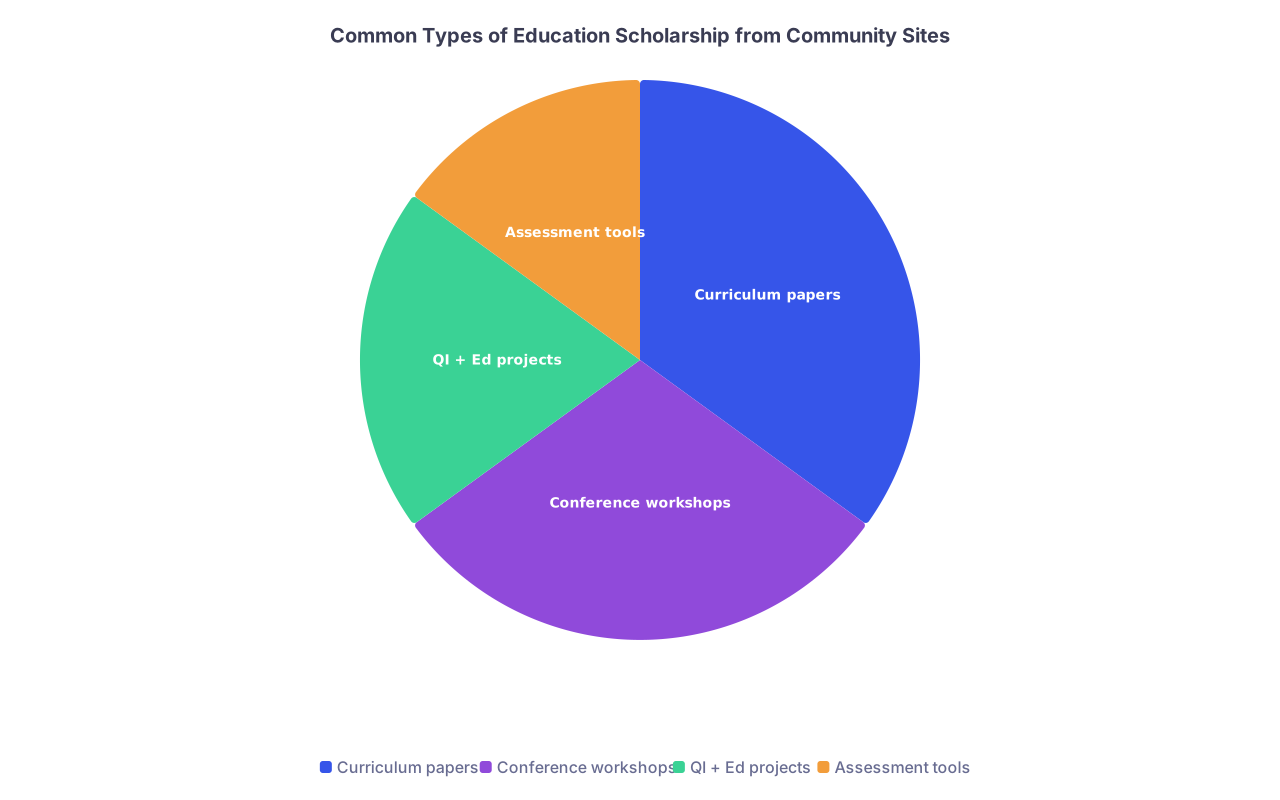
| Category | Value |
|---|---|
| Curriculum papers | 35 |
| Conference workshops | 30 |
| QI + Ed projects | 20 |
| Assessment tools | 15 |
You don’t need an Office of Medical Education to do this. You need:
- A clear educational problem.
- A structured intervention.
- Basic outcomes data.
- A conference or journal that cares (there are many).
If you want help, collaborate with someone at the university side who loves methods and hates doing frontline implementation. You bring the real-world lab; they bring structure and stats.
Negotiating Protected Time and Not Getting Crushed by Clinical Work
Here’s where community life can get ugly: the RVU monster.
If you try to “squeeze” a med ed career into 1.0 FTE of full-tilt clinical work, you’ll burn out and give up. I’ve watched people do it.
You need to start carving out protected time early, even if it’s imperfect. A few practical plays:
Tie your role to accreditation or recruitment.
“For us to remain competitive and meet ACGME requirements in [simulation/assessment/remediation], we need X% FTE for this role.”Make your work visible and measurable.
Track teaching hours, evaluations, committee leadership, resident outcomes, recruitment improvements.Bundle responsibilities into a formal role instead of random tasks:
“Associate Program Director for Curriculum” is easier to justify at 0.2 FTE than ‘the person who randomly runs noon conference and fixes schedules.’Use external recognition as leverage.
Did you present at a national meeting? Win a teaching award? Get something in MedEdPORTAL? Bring that to your chair when asking for time.
Protected time at a community hospital might look like:
- 0.1–0.2 FTE for core faculty with defined responsibilities
- 0.3–0.5 FTE for APD/PD equivalents
- Small stipends tied to clerkship or site leadership
Not perfect, but it’s enough to build and sustain a career.
Growing Regionally and Nationally While Staying Community-Based
You don’t have to leave your hospital to have national impact. You just need to stop thinking of yourself as “just a community doc.”
Some very practical moves:
- Join a national education committee in your specialty society (APDIM, CORD, ACOG, AAIM, etc.).
- Present every year at one regional or national conference. Workshops are especially high yield for educators.
- Volunteer as a reviewer for MedEd journals or abstract committees once you’ve built some experience.
- Collaborate across programs. Run a multi-site curriculum project with 2–3 other community programs. Suddenly you’re doing “multi-center work.”
That portfolio—committee work, regional/national talks, publications—builds your reputation regardless of where you practice clinically.
And if one day you decide to move to a big-name academic center? That CV will go a long way in your favor.
Who Should Not Rely on a Community Base?
Let me be blunt: a community-based med ed career is not ideal if your absolute primary goal is:
- Being a heavily grant-funded education researcher
- Running large, methodologically complex education trials
- Moving into high-level dean’s office roles at top-tier research schools quickly
For that, a traditional academic center with a big med ed research infrastructure will make your life easier.
But if you care about:
- Being a phenomenal teacher
- Leading real-world programs and curricula
- Shaping residents and students directly
- Having real autonomy over your education work
…then a community base is not a consolation prize. It’s home turf.
You just have to be strategic.
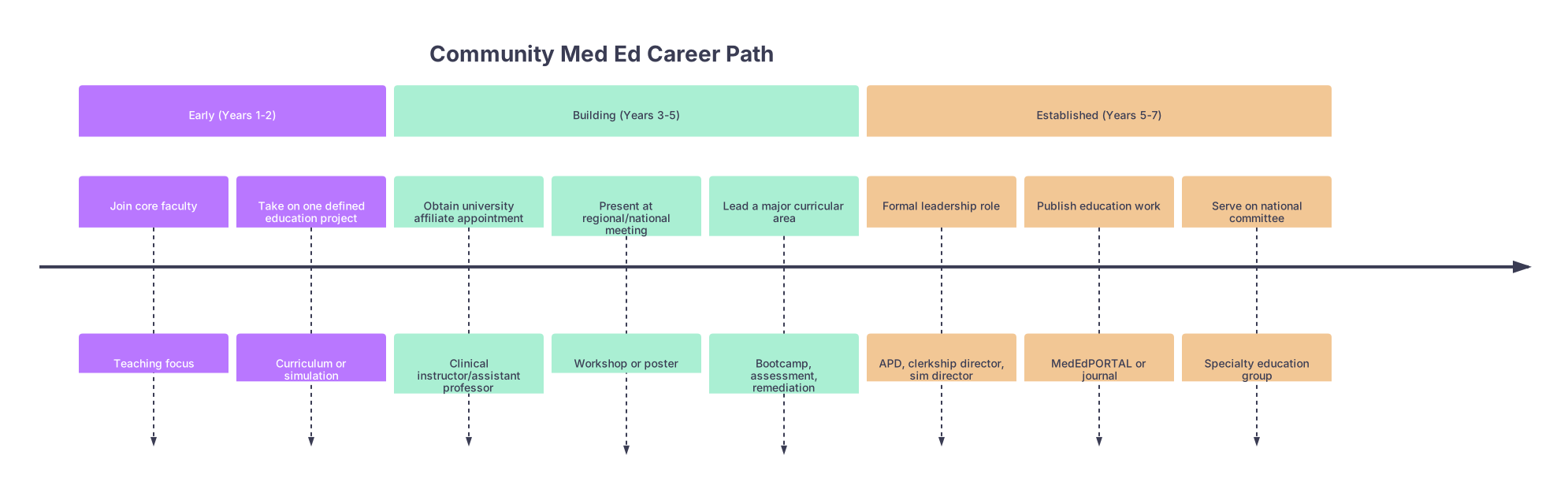
A Simple Roadmap: Years 1–7 at a Community Program
To make this concrete, here’s a rough trajectory that I’ve seen work.
| Period | Event |
|---|---|
| Early (Years 1-2) - Join core faculty | Teaching focus |
| Early (Years 1-2) - Take on one defined education project | Curriculum or simulation |
| Building (Years 3-5) - Obtain university affiliate appointment | Clinical instructor/assistant professor |
| Building (Years 3-5) - Present at regional/national meeting | Workshop or poster |
| Building (Years 3-5) - Lead a major curricular area | Bootcamp, assessment, remediation |
| Established (Years 5-7) - Formal leadership role | APD, clerkship director, sim director |
| Established (Years 5-7) - Publish education work | MedEdPORTAL or journal |
| Established (Years 5-7) - Serve on national committee | Specialty education group |
Obviously, life is messy and doesn’t follow neat timelines. But this is a realistic arc without ever leaving a community setting.
FAQ (Exactly 7 Questions)
1. If I’m at a completely independent community hospital with no med school affiliation, can I still have a med ed career?
Yes, but you’ll need to be even more intentional about external connections. Look for:
- Affiliation agreements you can help develop with nearby med schools (lots of schools need more clinical sites).
- Volunteer or adjunct faculty appointments elsewhere based on your teaching work.
- Regional conferences and national societies as your main academic “home.”
You can still build a strong teaching and leadership portfolio; getting formal academic titles will just take more networking.
2. Do “clinical” or “affiliate” professor titles count as much as regular professor titles?
For internal university promotion politics, they’re different tracks. But for most practical purposes—jobs, credibility, speaking invites, leadership in societies—yes, they count. What people care about is your actual output: what you’ve built, taught, published, and led. A Clinical Associate Professor with a strong education CV often beats a “pure” Assistant Professor with minimal real teaching experience.
3. Can I become a Program Director or Clerkship Director and still be considered an “educator” without much research?
Absolutely. PDs and clerkship directors are core med educators even if they never publish a randomized trial. A solid portfolio of:
- Leadership roles
- Documented teaching
- Innovations (curricula, assessments, remediation frameworks)
- Some dissemination (talks, workshops, a few papers or MedEdPORTAL pieces)
is more than enough to be considered a serious med educator, especially from a community base.
4. How many publications do I “need” to be legit in med ed from a community hospital?
There’s no magic number, but a realistic target over several years:
- 2–4 peer-reviewed education outputs (papers, MedEdPORTAL, major curriculum repositories)
- Several national/regional presentations or workshops
That’s already more than many full-time academic clinicians ever produce. Quality and relevance beat raw count, especially from a community site.
5. What degrees or certifications help if I’m not at a university?
If you’re serious about long-term med ed work, consider:
- A medical education certificate program (often 6–12 months, part-time)
- A Master’s in Health Professions Education, Med Ed, or similar (if you enjoy scholarship)
- Simulation or coaching certifications, depending on your niche
These don’t replace actual work output, but they give you skills, credibility, and connections that don’t depend on working at a university hospital.
6. Will staying at a community program hurt me if I later want to move to a big academic center?
It can, if you spend 10 years just doing service work with no documented education impact. But if you:
- Hold a university affiliate title
- Lead real education programs
- Have a track record of teaching excellence and some scholarship
- Are active in national societies
you’ll be competitive for many academic jobs. I’ve seen PDs and APDs from community programs move into major academic roles with exactly that playbook.
7. How do I avoid being used as “cheap labor” for teaching without recognition or time?
This is the real danger. Protect yourself by:
- Getting roles and responsibilities in writing, with explicit time or stipends.
- Saying yes to a few high-yield education roles, and no to scattered free labor.
- Turning every major “ask” into either a title, protected time, or a pathway to promotion.
- Regularly reviewing your CV and asking: “What from this year actually advanced my med ed career?”
If the answer is “almost nothing,” it’s time to renegotiate—or rethink your environment.
Key takeaways:
You can absolutely build a real medical education career from a community program—if you treat it like a deliberate career, not a hobby. Anchor yourself as indispensable locally, secure a university-affiliated title, and steadily build a portfolio of teaching, leadership, and scholarship that’s visible beyond your hospital’s walls.