Should I Prioritize Curriculum Leadership or Bedside Teaching Roles First?
Are you staring at an email about joining a “Curriculum Redesign Task Force” while your PD is also nudging you to take on more bedside teaching… and wondering which one actually moves your career forward?
Here’s the blunt answer:
If you’re early in your teaching career, prioritize bedside teaching first — and layer in curriculum leadership when:
- you’ve proven you’re a good teacher in real clinical settings, and
- you have a specific problem you want to fix through curriculum work.
Now let’s make that actually usable.
The Core Difference: Visibility vs Leverage
Curriculum leadership and bedside teaching aren’t competing hobbies. They’re different tools.
- Bedside teaching = high visibility, fast feedback, direct impact on learners and patients.
- Curriculum leadership = lower visibility at first, slower burn, but huge leverage once you have influence.
If you try to jump straight to curriculum leadership before you’ve built credibility as a teacher, you look like that person who wants to “optimize the system” but hasn’t actually done the work on the ground.
I’ve seen this play out in real departments:
- Faculty A: Loved committees, edited every learning objective, never on the wards. Residents rolled their eyes. Promotions committee was not impressed.
- Faculty B: Known as “the best attending to learn from,” consistently strong evals, then led a targeted curriculum project that fixed a real pain point. That person gets invited to everything.
You want to be Faculty B.
When Bedside Teaching Should Be Your First Priority
If any of these are true, bedside teaching wins right now:
- You’re a resident, fellow, or junior faculty (0–3 years)
- Your teaching evals are average or unknown
- You don’t have a clear teaching “brand” yet (what people associate you with)
- You don’t understand how your program’s curriculum actually works day-to-day
Your goals in this phase:
Become unambiguously good at teaching in real life.
Not “I think I’m good.” You want:- Strong learner evaluations
- Residents explicitly requesting to work with you
- PD or clerkship director noticing and mentioning your name without you prompting
Learn the pain points from the ground up.
While you’re on the wards, you should be quietly collecting intel:- What topics are always weak? (e.g., discharge planning, E/M coding, pain management)
- Where do students look lost?
- What do residents complain about that’s actually fixable?
This is what powers high-impact curriculum work later.
What prioritizing bedside teaching actually looks like
Concrete moves:
- Say yes to:
- Extra ward months with students
- Being the “teaching attending” on teams that have learners
- Giving core lectures or noon conferences
- Running simulation sessions or small groups
- Say no or “not yet” to:
- Chairing major curriculum committees
- Being “co-director” of something huge with no actual support
- Leading a complete curriculum overhaul while you’re still figuring out your own teaching
You’re building your foundation first.
When Curriculum Leadership Starts To Make Sense
Curriculum leadership is not a badge. It’s a tool you use once you’re dangerous enough to wield it.
You’re ready to prioritize curriculum leadership when:
- You’re consistently rated highly as a teacher
- People ask you to help “fix” certain parts of teaching, not just fill slots
- You can clearly answer: “What educational problem am I trying to solve?”
Good curriculum leaders almost always start from a specific, grounded problem, like:
- “Our interns are unsafe and stressed on night float. We need a focused night curriculum.”
- “Students leave our rotation not knowing how to talk to patients about insulin.”
- “Residents avoid EKGs because they’ve decided they’re ‘bad’ at them by PGY-2.”
If your interest in curriculum work is just “I want leadership,” pause. That’s how you end up spending hundreds of hours rewriting objectives nobody reads.
High-yield first curriculum roles
Instead of saying yes to the biggest, vaguest role offered, start smaller but sharper:
- Lead a single module (e.g., sepsis, chest pain, antimicrobial stewardship)
- Design a short, high-impact series (e.g., 4-session intern bootcamp)
- Own a specific skill domain (e.g., EBM rounds, handoff training, communication with families)
You want a project where:
- The scope is clear
- The learners are defined
- You can see results in 6–12 months
- You can publish or present something from it

A Simple Framework: Which Should You Choose Right Now?
Here’s the decision tree I’d actually use with a junior colleague.

| Step | Description |
|---|---|
| Step 1 | Where are you in your career? |
| Step 2 | Focus on bedside teaching Build evaluations and skills |
| Step 3 | Prioritize bedside teaching Improve feedback and skills |
| Step 4 | Add small teaching roles Wait on big leadership |
| Step 5 | Take targeted curriculum role Keep some bedside teaching |
| Step 6 | Resident or <3 yrs faculty |
| Step 7 | Strong teaching evaluations? |
| Step 8 | Specific curriculum problem to solve? |
If you want an even simpler rule:
- If your teaching evals aren’t clearly strong yet → Bedside teaching first.
- If your teaching evals are strong and you’re frustrated by a recurring educational gap → Start curriculum work (but don’t abandon bedside teaching).
How Promotions Committees Actually View These Roles
Let’s stop pretending all roles are equal on paper. They’re not.
Promotions committees in academic medicine usually look for three education buckets:
- Teaching excellence (bedside, lectures, small groups)
- Curriculum development and leadership
- Scholarship in education (posters, papers, workshops)
Bedside teaching mainly feeds bucket 1.
Curriculum leadership can feed 2 and 3—if you do it right.
Here’s the catch: if you do curriculum work but don’t turn it into something visible (evaluation improvements, publications, regional talks), it just reads as: “served on committee, unclear impact.”
So…
- Early: Max out bucket 1 (be clearly great at teaching).
- Then: Use targeted curriculum work to hit buckets 2 and 3 with:
- A poster at APDIM, ASE, SGIM, STFM, etc.
- A publication in MedEdPORTAL, teaching and learning journals
- A workshop at your regional or national meeting
| Career Stage | Primary Focus | Secondary Focus | What Committees Want to See |
|---|---|---|---|
| Resident/Fellow | Bedside / small group | Occasional curriculum | Strong evals, enthusiasm, reliability |
| 0–3 yrs Faculty | Bedside teaching | Small curriculum projects | Clear teaching strengths, growing niche |
| 4–7 yrs Faculty | Mix of both | Lead core pieces | Impact, leadership, early scholarship |
| >7 yrs Faculty | Curriculum leadership | Select teaching roles | Program-level change, broader impact |
Common Traps (And How to Avoid Them)
Let me be very clear about a few landmines.
Trap 1: The “Big Title, No Power” Curriculum Role
You get offered something like “Associate Vice Chair for Educational Innovation.” Sounds fancy. Comes with:
- No admin support
- No protected time
- Vague scope
- Endless meetings
This will bury you.
Better move:
Take on a smaller, specific role with:
- Clearly defined learners
- Clear deliverables
- Ability to measure impact
Trap 2: Becoming the “Lecture Machine” With No Strategy
You say yes to every noon conference and small group. You’re teaching constantly, but:
- No theme
- No niche
- No scholarly output
You’re exhausted and oddly invisible.
Fix it:
Choose 1–2 signature areas you want to be known for (e.g., diagnostic reasoning, communication, ICU fundamentals) and deepen those. Turn repeated sessions into a study or MedEdPORTAL submission.
Trap 3: Abandoning Clinical Teaching Too Early
I’ve watched people run to curriculum leadership and gradually disappear from the wards. Then they wonder why learners don’t care about their new initiatives.
If you’re an educator, you need to stay at least partially in the clinical trenches. It keeps you:
- Credible
- Realistic
- Connected to what actually works
Ideal balance once you’re established:
Something like 60–70% clinical teaching flavor, 30–40% heavier curriculum/leadership—though the exact numbers depend on your contract.
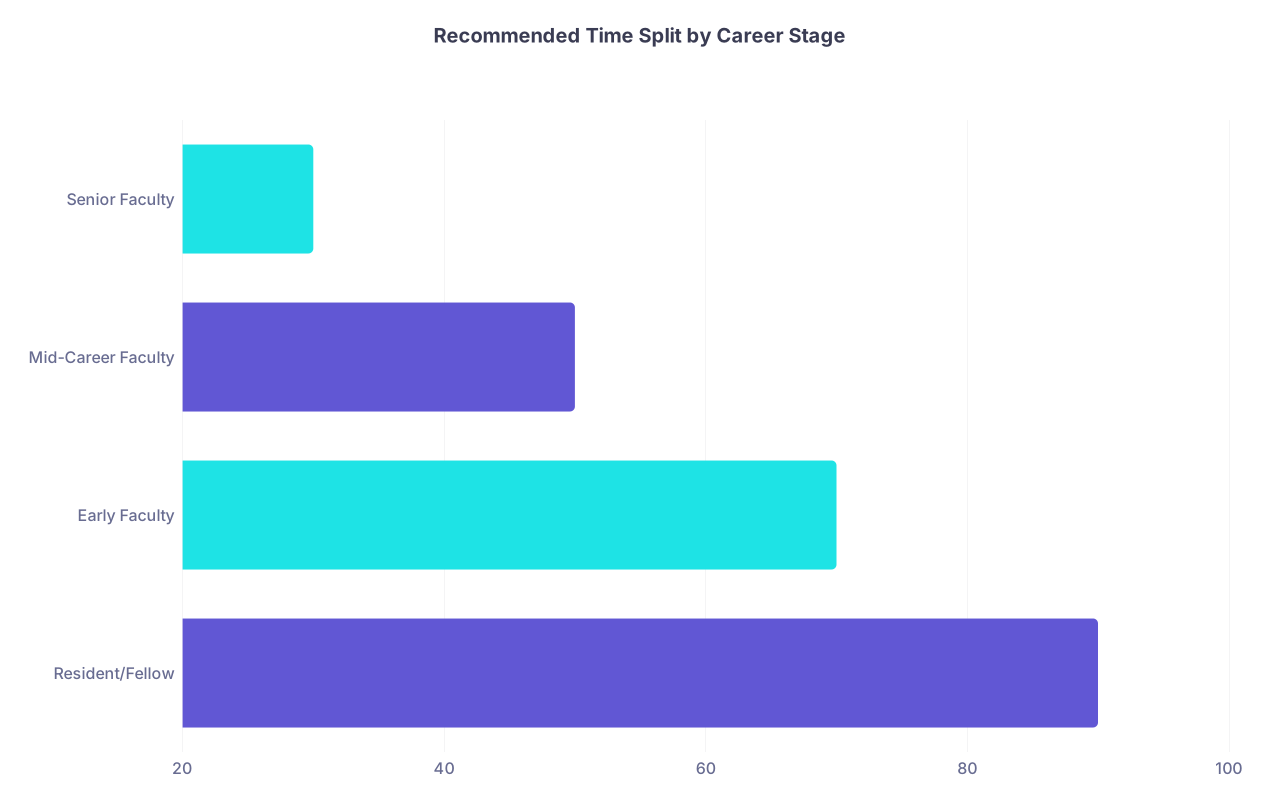
| Category | Value |
|---|---|
| Resident/Fellow | 90 |
| Early Faculty | 70 |
| Mid-Career Faculty | 50 |
| Senior Faculty | 30 |
(Values above are % of time/effort on bedside/face-to-face teaching vs more abstract curriculum leadership. Earlier career = more bedside; later = more leadership.)
How to Sequence Your Next 2–3 Years
Here’s a concrete plan, assuming you’re early or mid-career.
Year 1: Prove You’re a Strong Teacher
- Volunteer for:
- Ward/block teaching
- A consistent lecture or small-group series
- Ask for real feedback:
- Ask your clerkship director or PD, “Can we review my teaching evals together twice a year?”
- Fix one thing each cycle:
- Maybe your explanations are too fast
- Maybe you don’t engage quieter students
- Maybe your sessions run long and feel unfocused
Goal by end of year: Your name is associated with good teaching, not just “covers shifts.”
Year 2: Add a Targeted Curriculum Role
- Pick a pain point you see repeatedly
- Propose or accept a contained project, for example:
- A 4-part intern curriculum on cross-cover calls
- A structured oral case presentation curriculum for third-years
- Build in evaluation from day one:
- Pre/post surveys
- Performance checklists
- Resident or student focus groups
- Submit something:
- Poster
- Workshop
- MedEdPORTAL resource
Year 3 and Beyond: Decide What You Want To Be Known For
By this point you’ve:
- Taught a lot
- Led at least one curriculum project
- Seen what you actually enjoy
Now you decide:
- Do you want to be a master clinician-educator with a bit of curriculum influence?
- Or a program/chief curriculum architect who still teaches, but more selectively?
Neither is “better.” But pretending you can do 100% of both at the same time is fantasy.

The Bottom Line
If you’re trying to decide what to prioritize first:
- Start with bedside teaching unless you are already clearly excellent and recognized for it.
- Use those experiences to identify real educational problems learners face.
- Then pick focused curriculum roles that solve those specific problems and can generate proof of impact.
One feeds the other. But the order matters.
FAQ: Curriculum Leadership vs Bedside Teaching
I’m a PGY-2 and was asked to join a curriculum committee. Should I say yes?
Say yes only if:- It’s a small, time-limited, clearly defined project, and
- It doesn’t crowd out your core responsibilities or teaching opportunities.
If it’s a huge, vague committee with no clear role for you, it’s fine to say: “I’d love to help with specific teaching or small projects first while I’m still building my skills as a teacher on the wards.”
Do I need curriculum leadership to get an academic job after residency or fellowship?
No. For most entry-level academic positions, solid teaching evaluations and good clinical performance matter more. A focused, meaningful teaching or small curriculum project helps, but you don’t need a massive leadership title. Programs care that you can teach, not that you sat on three committees with no tangible output.What if I love content design but don’t love bedside teaching?
You can lean more into curriculum and instructional design roles, especially at larger institutions or simulation centers. But even then, spend at least some time with learners in real or simulated clinical environments. You’ll design better material if you’ve actually watched people struggle through the skills you’re teaching.How much bedside teaching should I keep once I’m in a bigger curriculum role?
Enough that learners still see you as a real clinician and teacher, not just a name on documents. For many mid-career folks, that’s a few weeks of wards/clinic precepting per year plus recurring small groups or simulation. The exact number depends on your contract and goals, but dropping to zero clinical teaching is usually a mistake if you identify as a medical educator.What’s the easiest way to turn a curriculum project into scholarship?
Before you start, decide how you’ll measure impact: pre/post tests, performance metrics, learner confidence, etc. Collect baseline data, implement the change, then collect follow-up data. Write it up for MedEdPORTAL, submit a poster to a national meeting, or run a workshop about how you did it. Don’t bolt on “scholarship” at the end—bake it in from day one.My institution only seems to value big curriculum titles. Should I still focus on bedside teaching first?
Yes. Big titles without demonstrated teaching excellence rarely impress anyone who understands education. Use bedside teaching to build undeniable credibility. Then you’re in a stronger position to ask for curriculum roles that come with actual time, support, and respect. If they only offer titles with zero support, be cautious—that’s how burnout starts.What’s one sign I’ve gone too far into curriculum leadership too early?
Two red flags:- You’re spending hours in meetings about “objectives alignment” but haven’t taught an actual learner in weeks.
- You feel detached from what residents and students actually struggle with day-to-day.
If that’s you, actively schedule more bedside or small-group teaching and re-anchor yourself before taking on anything else.
Open your calendar for the next 3 months right now and block time for concrete bedside teaching—ward weeks, clinics with students, or small groups. Once that’s locked in, then decide if there’s room for a single, sharply defined curriculum project, not three vague committees.