
It’s 6:45 a.m. You’re skimming your inbox before rounds. One email from the clerkship director asking if you’ll take more third-years next block. Another from the residency program: “Can you help with the new intern boot camp?” A CME coordinator wants you for an evening ultrasound course.
You’re already teaching on wards, giving morning report, and precepting clinic. And you’re asking yourself:
“Should I just pick one course and go all in… or keep teaching across multiple rotations?”
Here’s the answer you’re looking for: there isn’t one “right” model. But there is a right model for you, given your goals, personality, and institution. Let’s walk through it like a decision you’d make on rounds.
The Core Question: Depth vs Reach
At the highest level, this is the tradeoff:
- Focusing on one course/rotation = depth, control, and identity
- Teaching across multiple rotations = reach, variety, and visibility
If you’re early in your teaching career, chasing promotion, or trying to avoid burnout, how you balance these matters more than you think.
Here’s the quick contrast.
| Factor | One Course Focus | Multiple Rotations |
|---|---|---|
| Teaching depth | High | Moderate |
| Administrative load | High (if director) | Moderate, more fragmented |
| Learner continuity | Strong | Weak to moderate |
| Institutional visibility | Moderate | High |
| Flexibility / variety | Low | High |
| Burnout risk | Content fatigue | Role overload |
Now let’s break it down in real-world terms.
Option 1: Focusing on One Course or Rotation
This usually looks like: you’re the “medicine clerkship person,” or the “MSK ultrasound course lead,” or the “intern boot camp director.” You put most of your teaching energy into one structured experience.
When this works really well
- You want to build a recognizable teaching niche
If you want to be “the person” nationally or locally for a specific educational area—say inpatient internal medicine teaching, simulation-based resuscitation, or POCUS education—owning one course is powerful.
You can:
- Design the curriculum the way it should be, instead of inheriting a patchwork.
- Collect structured outcomes (exam performance, OSCE scores, learner feedback).
- Publish on curriculum design, implementation, and outcomes.
- Be the go-to name when someone says, “Who runs X here?”
Promotions committees and national organizations love this kind of focused, sustained work.
- You care about longitudinal improvement
When you focus on one course, you actually see year-to-year progression. You fix something in year 1 and see the impact in year 2. You know where students consistently struggle. You can iterate instead of constantly reinventing.
You can also:
- Test-drive new teaching strategies (team-based learning, flipped classroom).
- Integrate simulation, standardized patients, or new assessment tools.
- Align with LCME/ACGME competencies in a systematic way.
- You like control and structure
If you get frustrated when your teaching is constrained by someone else’s clunky schedule, poorly written objectives, or random topic lists, owning one course is satisfying. You control:
- Learning objectives
- Assessments
- Teaching methods
- Faculty development for others teaching in that course
You’re basically running your own small “educational lab.”
Downsides of focusing on one course
Let me be blunt: it’s easy to underestimate the workload.
Common issues:
- Administrative creep: Scheduling, evaluations, grade appeals, committee meetings, dealing with “professionalism concerns.” It adds up.
- Political visibility: If the course is required (like a core clerkship), every unhappy student, dean, and curriculum committee will eventually land on your doorstep.
- Content fatigue: Teaching the same topics 6–10 times a year can get old, unless you’re intentional about variety and evolution.
Another problem: if your course is heavily preclinical or clerkship-focused, residents and fellows may barely know you. If your promotion path depends on reputation across all learners, that’s a gap.
Who should lean toward one-course focus
You should seriously consider focusing if:
- You’re building an educator portfolio for promotion (especially Clinician Educator track).
- You have a clearly defined area of passion (e.g., teaching ECGs, procedural skills, clinical reasoning).
- Your institution supports course leadership with actual time (protected FTE, not “good citizenship points”).
- You enjoy curriculum design and system-building, not just “show up and teach.”
If you don’t get protected time, or leadership is vague about expectations, be cautious. Running a major course “off the side of your desk” is a fast track to resentment.
Option 2: Teaching Across Multiple Rotations
This is more of a “portfolio” approach: you teach on the wards, occasionally in clinic, maybe a lecture in the M3 surgery clerkship, plus some simulation with residents, plus a CME session a couple of times a year.
You’re not the primary owner of any one course. You’re the high-yield guest faculty.
When this works really well
- You want variety and flexibility
If you get bored doing the same thing on repeat, cross-rotation teaching gives you constant novelty.
You can:
- See first-years in skills sessions.
- Work with M3s and M4s on wards.
- Teach residents in morning report or simulation.
- Do a CME workshop for practicing physicians.
Different levels, different needs, different energy. The work feels less monotonous.
- You want broad visibility across the system
If your career goals involve leadership in GME, department education, or hospital roles, being known by students, residents, and faculty across multiple areas helps.
You become:
- The attending residents ask for their clinic block.
- The person students request on evaluations.
- The name program directors drop when talking about “strong teachers.”
When promotion committees ask, “Who knows this person?” the answer is: almost everyone.
- You’re still finding your niche
Early on, teaching widely is useful data collection. You’ll find:
- Which learners energize you vs. drain you.
- Whether you prefer bedside, classroom, sim lab, or small groups.
- What content areas you actually enjoy repeatedly.
I’ve seen many people start as “I’ll teach wherever” and then realize, “I really click with interns in July and August” or “Teaching clinical reasoning to M3s is my thing.” Then they narrow down.
Downsides of teaching across multiple rotations
The main problems:
- Fragmentation: Your prep time is spread across multiple courses, formats, and topics. You’re constantly context-switching.
- Limited influence: You’re a guest in someone else’s house. You can’t fix structural or assessment problems in the course; you just work around them.
- Harder to show “programmatic impact”: For promotion or national recognition, “I give great lectures in five different rotations” is less compelling than “I designed and run X course that improved Y outcome.”
Also, burnout looks different here. Not from excessive repetition, but from feeling pulled 10 different ways by 10 different leaders, each assuming “it’s just one more talk.”
How This Plays Out for Different Career Stages
Let’s be practical and a little prescriptive.
Early career (resident, fellow, first 3–5 years as faculty)
Your best move: start broad, then narrow.
Teach across levels and settings enough to learn:
- Do you like working with students, residents, or practicing clinicians best?
- Do you enjoy longitudinal mentorship or quick-hit teaching?
- Are you more energized by clinical teaching or didactic/simulation work?
But—don’t stay random forever. Within 2–4 years you should be able to say:
“I primarily focus on X area and have Y role there,” even if you still guest-teach elsewhere.
Example:
“I’m primarily involved in the internal medicine clerkship and serve as site director at our VA, and I also help with resident M&M and an annual ECG CME workshop.”
That’s a focused identity, not a scattered set of tasks.
Mid-career (trying to get promoted, considering leadership roles)
Here, pure “teach everywhere” with no clear anchor begins to hurt you.
You’ll want:
- At least one defined home base (course, rotation, or major program).
- Documented outcomes: evals, curriculum changes, learner performance, publications or presentations.
- A coherent narrative: “I’ve spent the last 5–7 years building X, and here’s its impact.”
At this stage, focusing on one course or small set of related experiences (e.g., “transition to residency curriculum,” or “acute care education across UME and GME”) is usually more strategic than spraying effort everywhere.
Late career (experienced educator, senior roles)
Here, you have more freedom to choose what’s interesting.
Some people:
- Stay deeply embedded in one major program.
- Step into broader leadership (DME, GME/DIO, department vice chair for education).
- Curate a mix of high-impact, high-joy teaching across levels and contexts.
The main risk here is inertia: staying chained to a course you no longer love “because you’ve always done it.” At this stage, choosing to shed a course and move to a cross-rotation role—or vice versa—is often smart.
How to Decide: A Simple Framework
If you’re stuck, use this 4-question filter. Answer honestly.
What energizes you more: building systems or direct teaching?
- Systems (curriculum, assessments, structure) → lean toward focusing on one main course/rotation.
- Direct contact, variety, different learners → lean toward multi-rotation teaching.
What does your institution actually reward?
- Promotion criteria and leadership roles often favor visible ownership of something.
- Some places, though, explicitly value “teaching hours,” regardless of where you do them.
Read your promotion guidelines. Ask someone who’s been promoted recently.
How much protected time do you realistically have?
- 0.05–0.10 FTE? A full clerkship directorship will likely eat you alive. Better to be a solid cross-rotation teacher with limited formal admin roles.
- 0.20 FTE or more? Owning a well-defined course makes sense and is sustainable.
What do you want your CV to look like in 5 years?
If you want this line:
“Director, Internal Medicine Clerkship – Led redesign with improved shelf scores and national presentations”
→ focus on one course.If you want:
“Recognized departmental teaching leader across UME, GME, and CME”
→ maintain a strategic cross-rotation presence but still choose 1–2 signature roles.
Blended Strategy: The Model That Usually Wins
Pure extremes (only one course vs teaching absolutely everywhere) are rare and, honestly, not ideal.
The most sustainable pattern I see:
- 1 primary “home base” role (course director, site director, longitudinal curriculum lead)
- 1–3 recurring teaching roles in other rotations (ward teaching, recurring workshop, sim session)
- Occasional one-off or annual events (CME course, boot camp, OSCE examiner)
This gives you:
- A clear educational identity
- Enough variety to avoid stagnation
- A coherent story for promotion and national engagement
- Protection from over-dependence on one program (if it gets restructured, you’re not wiped out)
Think of it as: own one thing, contribute meaningfully to a few others, say no to the rest.
Practical Moves You Can Make This Year
A few concrete steps:
Pick your “home base”
If you already spend most time in a specific area (e.g., M3 medicine clerkship, resident morning report, ultrasound curriculum), lean into it. Ask for a formal title or defined role.Audit your teaching portfolio
Make a simple table: where you teach, how often, what level of responsibility you have, and how much it drains or energizes you.Drop one thing that doesn’t fit your strategy
If something is low-impact, low-joy, and not aligned with your emerging identity, plan an exit in the next cycle.Deepen one thing
Wherever you choose to focus, don’t just “keep doing it.” Improve something: add assessment, create a new module, study outcomes, or present it.Talk to one mentor who actually sits on promotions committees
Ask them bluntly: “Does our system reward deep focus in one course, or broad teaching across rotations? What’s missing in my current mix?”
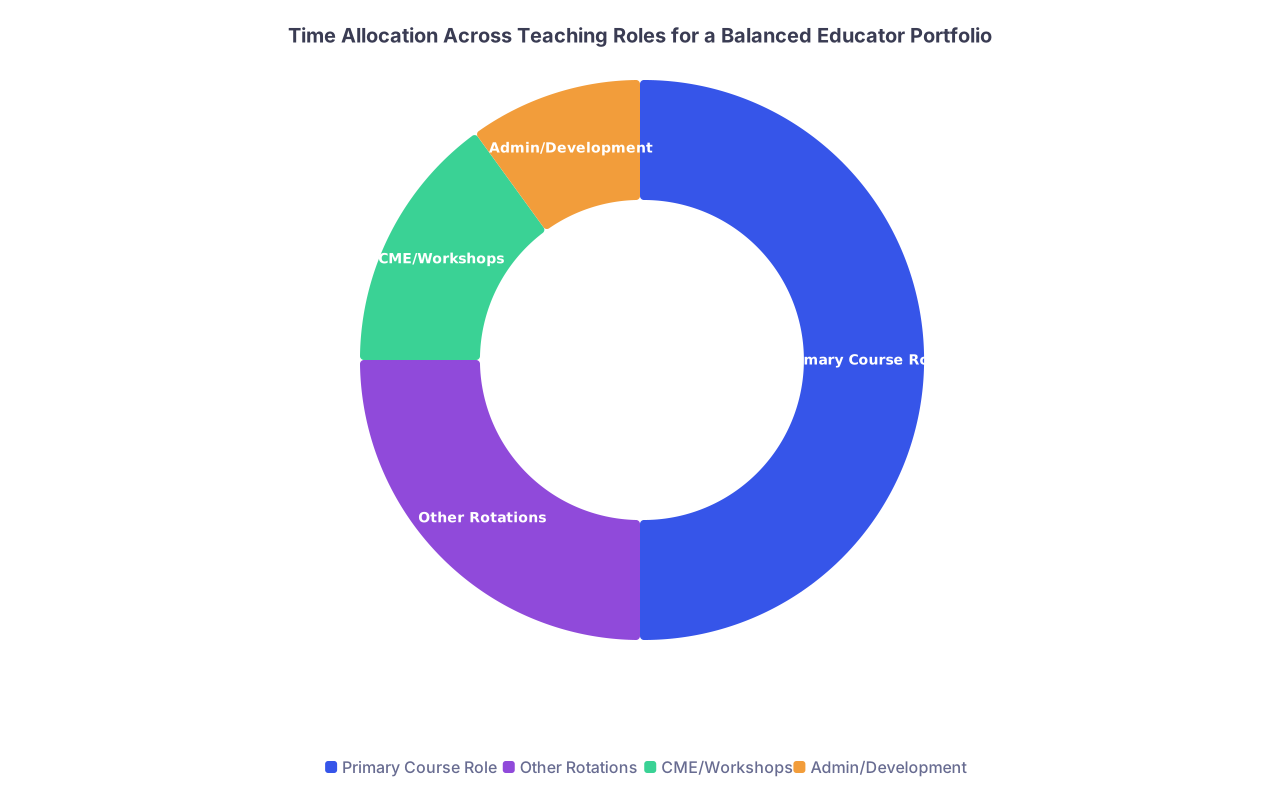
| Category | Value |
|---|---|
| Primary Course Role | 50 |
| Other Rotations | 25 |
| CME/Workshops | 15 |
| Admin/Development | 10 |

| Step | Description |
|---|---|
| Step 1 | Start - Considering Teaching Focus |
| Step 2 | Consider leading one main course |
| Step 3 | Prefer direct teaching variety |
| Step 4 | Take formal leadership in one course |
| Step 5 | Partner role in course plus some guest teaching |
| Step 6 | Choose one home base plus 2-3 recurring roles |
| Step 7 | Teach across rotations while exploring niche |
| Step 8 | Enjoy systems and curriculum? |
| Step 9 | Have protected time 0.2 FTE or more? |
| Step 10 | Need strong promotion case soon? |
FAQ (Exactly 6 Questions)
1. If I want to be a clerkship director someday, should I still teach across multiple rotations now?
Yes, but strategically. You’ll benefit from seeing how different clerkships and rotations structure teaching, feedback, and assessment. Teach broadly early on, then start aligning more of your effort with the clerkship you’d eventually like to help lead. Being known and trusted by the current leadership in that area matters more than being “everywhere.”
2. Does focusing on one course hurt my chances of connecting with residents or fellows?
It can, if you wall yourself off. The workaround is to keep at least one consistent GME teaching role—like a recurring resident report, simulation session, or inpatient teaching month—while your main administrative and design work stays in the course. You don’t need to split 50/50, but you should avoid being invisible to the residency.
3. How do I say no when people keep asking me to teach in new rotations?
Blame your strategy and your time, not your interest. Something like: “I’m putting most of my educational time into the M3 medicine clerkship and a resident sim course right now, and I’m at capacity this year. If something changes or we redesign roles next year, I’d be open to revisiting.” Clear, respectful, and not a permanent burn bridge.
4. Which model is better for promotion on a Clinician Educator track?
Most promotion committees like to see coherent impact, not scattered effort. That usually means some version of: you’ve built, led, or meaningfully improved a course or program, and you can show outcomes or scholarship from it. You can still teach across rotations, but if everything you do is “guest spots,” it’s harder to make a compelling promotion narrative.
5. I’m worried I’ll get bored if I focus on one course. How do I prevent that?
Rotate your challenges inside the course. One year, focus on improving assessment. Next year, add simulation or team-based learning. Mentor new faculty. Engage students in curriculum co-design. Your job as course lead can evolve every 1–2 years, even if the course title doesn’t. Also, keep a small side teaching role outside the course that feels fun and different.
6. Is it realistic to change from multi-rotation teaching to one-course focus mid-career?
Absolutely, and it happens a lot. The typical path: you’ve been a strong, visible teacher across programs; a course or clerkship hits a transition (retirement, restructuring), leadership needs someone credible and energetic; you step in with a negotiated role and clearer protected time. The key is to prune your other commitments when you take that on, or you’ll drown.
Key takeaways:
- There’s no single “best” model—but for career development, having one clear home base plus a few strategic side roles usually beats scattershot teaching.
- Your mix should match your goals, your institution’s reward structure, and your actual protected time, not just whatever lands in your inbox.
- Revisit your teaching portfolio every 1–2 years; adjust before you burn out or get stuck in a role that no longer fits who you’re trying to become as an educator.