
The worst career advice early medical educators get is: “Say yes to everything.”
That’s how smart, motivated clinicians end up exhausted, unfocused, and mysteriously unpromotable.
You should not say yes to most new teaching requests early in your career. You should say yes strategically—enough to build a clear teaching identity and portfolio, but not so much that you become everyone else’s workhorse.
Here’s the answer you actually need.
A Simple Rule of Thumb: Your “Yes” Budget
Use this as a starting point for the first 3–5 years of your career (resident, fellow, or junior faculty):
- Aim to say yes to about 25–40% of new unsolicited teaching requests.
- Say yes to 60–80% of teaching that:
- Comes from your direct program or division leadership, and
- Clearly aligns with your role or career goals.
Put differently:
You’re allowed to say no more often than you think. In fact, you should.
The real question is not “How often do I say yes?”
It’s “What type of things do I say yes to, and in what proportion?”
Let’s make that concrete.

| Category | Value |
|---|---|
| High-value aligned requests | 40 |
| Neutral/unclear value | 35 |
| Low-value misaligned requests | 25 |
Think of your total teaching capacity as a limited budget. You’re going to spend it in three buckets:
- Core responsibilities – teaching that’s truly part of your job description.
- Strategic growth – opportunities that sharpen your niche, relationships, or reputation.
- Noise – random requests that sound flattering but don’t move you forward.
You want most of your “yes” spent on #1 and #2. Almost none on #3.
Step 1: Know Your Real Capacity (Not the Fantasy Version)
This is where people get burned. They overestimate how much teaching they can absorb “just this month” and six months later they’re buried.
Here’s the reality-based way to calculate your monthly teaching capacity.
- List your mandatory teaching:
- Required resident conferences you staff
- Medical student teaching on your regular service
- Program-assigned lectures or small groups
- Convert each into prep + delivery time:
- New 1‑hour lecture: 3–8 hours prep, 1 hour delivery
- Repeat 1‑hour lecture: 1–2 hours touch-up, 1 hour delivery
- Small group: 1–3 hours prep, 1–2 hours delivery
- Set a hard cap:
Outside your mandatory teaching, you get no more than 8–10 extra hours per month early in your career (often less if you’re research-heavy or in a busy procedural specialty).
Put it in a simple table like this and keep it honest:
| Item | Hours/Month |
|---|---|
| Mandatory teaching (assigned) | 10 |
| Course leadership/admin (if any) | 4 |
| New discretionary teaching requests | 6 |
| Total teaching-related time | 20 |
If you’re already at your 20 hours and someone emails:
“Could you just give a quick noon talk on X next week?”
The default answer is no—unless it’s so high-value that you consciously bump something else.
Step 2: Use a 4-Question Filter for Every New Request
You do not need a complex decision algorithm. Use this simple, brutal filter every time someone asks you to take on teaching:
Does this align with where I want my career to go?
- Example: You want to be a medical education leader in ICU.
- Teaching ventilator management to residents? Strong yes candidate.
- Designing an OSCE station in dermatology? Probably no.
- Example: You want to be a medical education leader in ICU.
Will anyone who matters to my promotion or next step notice this?
- Program director you want a letter from
- Section chief
- Education director who controls opportunities/awards
- Course/clerkship director with real institutional visibility
Is this buildable or repeatable?
- One‑off noon talk with no recording or formal evaluation? Low value.
- Lecture that becomes part of a recurring course or curriculum? Higher value.
- Workshop that leads to a teaching file, evaluations, or scholarship? Very high value.
What am I saying no to if I say yes to this?
- Time taken from: research, exam prep, sleep, family, or higher-value teaching.
If you get:
- 3–4 “yes” answers → Strong candidate to say yes.
- 2 “yes” answers → Only yes if you have extra capacity that month.
- 0–1 “yes” → You say no. Without guilt.
Step 3: Protect Yourself from “Good Soldier Syndrome”
Early-career people get targeted for extra teaching because they’re:
- Eager
- Flattered
- Not yet comfortable saying no
I’ve heard this exact line dozens of times:
“You’re so good with the students—could you just take this one more small group?”
“Just this one” is how you end up running three small groups, two lectures, and a workshop you never wanted.
Here’s what to watch for and avoid:
- Pattern of last-minute requests – you’re the backup for poor planning.
- No recognition or formal role – you’re functioning like faculty but listed nowhere.
- Vague promises – “This will be great for your CV” without any structure to actually make it so.
- Repeated asks from the same person where “no” is treated as negotiable.
You counter this with two tools:
- A clear teaching focus (“I’m really concentrating on X this year.”)
- A stock set of professional “no” phrases (more on that below).
What You Should Be Saying Yes To Early On
You want to build a coherent teaching identity, not just a long list of random sessions. Say yes more often to things that check one or more of these boxes:
Anchored roles, not one-offs
- Becoming a small group facilitator for a longitudinal course
- Joining the regular lecture rotation for a required clerkship
- Serving as assistant course director with clearly defined responsibilities
Opportunities that generate documentation
- Formal evaluations from learners
- Named roles in official course documents
- Teaching recorded in your institutional portfolio (e.g., MedHub, New Innovations, Educator’s Portfolio)
Niche-building work
- If you love point-of-care ultrasound: teaching the POCUS elective, building workshops, leading bedside rounds
- If you care about clinical reasoning: CPC conferences, case-based teaching, diagnostic error curriculum
Things that can become scholarship
- New curriculum or workshop with potential for:
- Abstract/poster at a meeting (e.g., SGIM, APDIM, AAMC)
- MedEdPORTAL submission
- Education QI project
- New curriculum or workshop with potential for:
That’s where saying yes strategically pays off.

| Step | Description |
|---|---|
| Step 1 | New teaching request |
| Step 2 | Default No |
| Step 3 | Strong Yes |
| Step 4 | Conditional Yes if capacity |
| Step 5 | Aligns with career focus |
| Step 6 | Visible to key leaders |
| Step 7 | Buildable or repeatable |
What You Should Usually Say No To
You’ll recognize this list from your inbox:
- “Can you give a noon talk on any topic for next week?”
- “We just need someone to fill in as a ward attending because no one else can.” (and it’s framed as teaching-heavy but really service)
- “Could you run a review session for the exam since the students are nervous?”
- “We need an extra facilitator since three people backed out.”
Patterns:
- No connection to your niche
- One-off, low-visibility
- Dumped on you because others declined
Saying yes to these constantly makes you the department’s teaching sponge. You soak up all the random work, but no one remembers the water you carried.
How to Say No Without Burning Bridges
You need ready-made language. Use variations of these.
For misaligned or low-value requests:
“Thanks for thinking of me. I’m actually at capacity with my existing teaching this block and I’m trying to protect time for my primary projects. I’ll have to pass on this one.”
For “almost right” opportunities:
“I’m focusing my teaching on [X area] this year to build depth there. If something comes up in that space, I’d be very interested, but I’ll need to decline this one.”
For requests from senior people where you want to maintain the relationship:
“I really appreciate you reaching out. To do this well would take more time than I can give right now without shortchanging my current commitments. I’d be happy to reconsider for a future cycle if my schedule changes.”
If you want to suggest an alternative:
“I can’t lead this session, but I’d be happy to:
- Share my slides from a similar talk, or
- Help identify someone who might be a good fit.”
Key points:
- You don’t over-explain.
- You do not apologize for having limits.
- You frame your no as protecting quality and existing commitments, not as disinterest.
Track Your Teaching So You Can Say Yes (and No) Smarter
Most early-career educators don’t even know how much they’re doing. That’s dangerous.
Set up a simple one-page tracking system (spreadsheet or note):
Columns:
- Date
- Type (lecture, small group, bedside teaching, mentorship)
- Title/topic
- Audience (students, residents, fellows, interprofessional)
- Duration
- Prep time
- Requester
- Aligned with niche? (Y/N)
- Evidence generated (evals, recording, role title)

Why bother?
- You see your real time burden.
- You find patterns—who always asks last minute, what’s actually aligned, what got you recognition.
- You can show concrete teaching activity during evaluations or promotion discussions.
You’ll also notice something else: half the stuff that feels “huge” in the moment barely registers long-term. That makes saying no next time much easier.
How Your Phase Changes the Yes/No Ratio
Early-career medical teaching isn’t one monolithic period. Where you are matters.
| Stage | Approx. Yes Rate to New Requests | Focus |
|---|---|---|
| Late residency | 15–25% | Exposure, low-prep opportunities |
| Fellowship | 20–35% | Niche-building, visible roles |
| Junior faculty 0–2 | 25–40% | Coherent teaching identity |
| Junior faculty 3–5 | 20–30% | Depth, leadership, scholarship |
Late residency:
- Your main jobs: become a good clinician, pass boards, not burn out.
- Say yes mostly to low-prep teaching that gives you feedback and confidence.
Fellowship:
- Start carving a niche: ICU teaching, ultrasound, ethics, communication skills, etc.
- Say yes when it reinforces that niche and is visible; no to random extras.
Early faculty:
- Be deliberate. Have a teaching brand within 2–3 years:
- “The ECG person”
- “The communication skills person”
- “The M3 inpatient medicine person”
Everything you say yes to should either:
- Strengthen that brand, or
- Build concrete steps toward promotion (roles, leadership, scholarship).
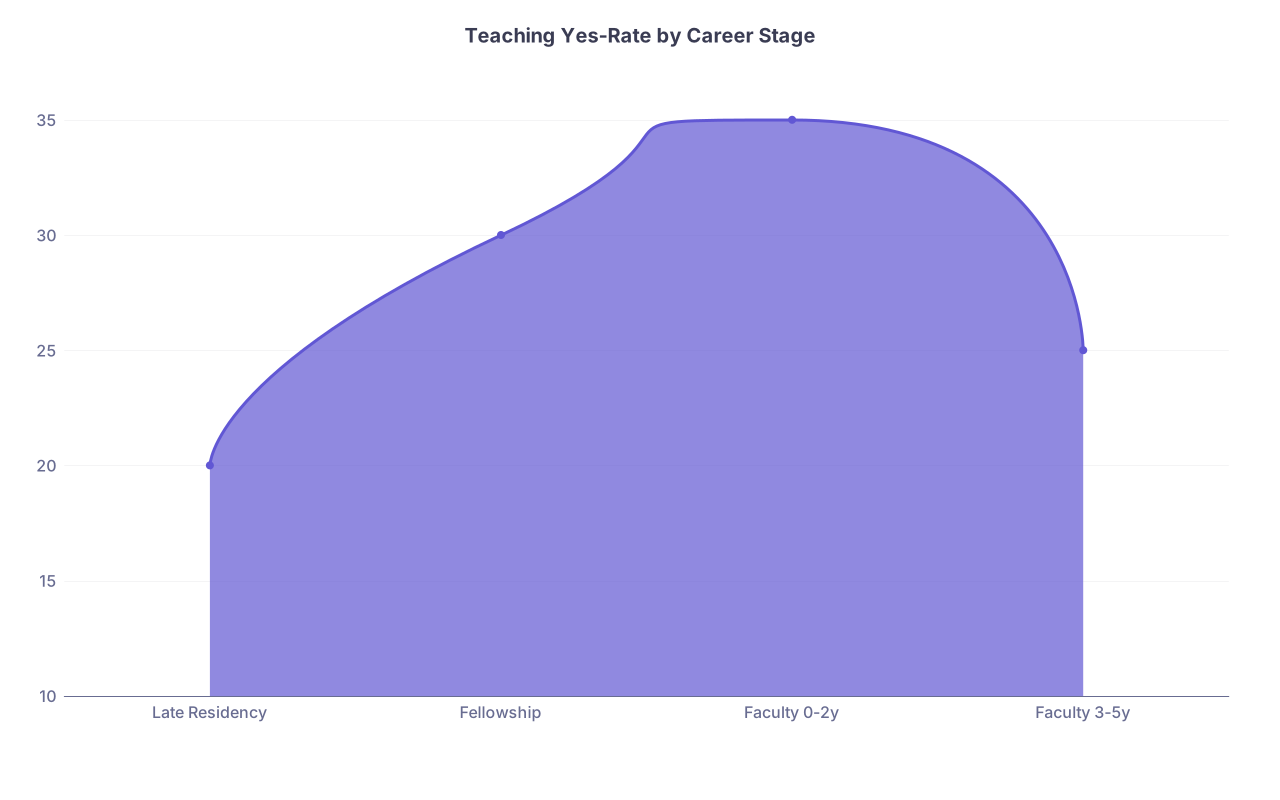
| Category | Value |
|---|---|
| Late Residency | 20 |
| Fellowship | 30 |
| Faculty 0-2y | 35 |
| Faculty 3-5y | 25 |
How to Vet Teaching Requests in 60 Seconds
When the request email hits your inbox, you do this:
Skim for:
- Topic
- Audience
- Time commitment
- One-off vs recurring
- Who’s asking
Ask yourself:
- Does this match my 1–2 sentence teaching focus for this year?
- Will a person who can help my career see or value this?
- Do I have the hours this month to do it well?
Decide on the spot:
- “Yes, this is clearly right for me.”
- “No, this doesn’t fit my focus or capacity.”
- “Maybe, but I need more info.” (then ask exactly what’s expected, how often, and how it’s recognized)
Do not leave maybe’s sitting in your inbox for two weeks while your anxiety builds. That’s how you end up saying yes out of guilt.

What This Looks Like in Real Life
Let me give you three common scenarios and how I’d advise you to respond early in your career.
“Can you give a new 60-minute lecture to the M3 class next month on a topic of your choice?”
- High prep, moderate visibility, potentially buildable if it becomes recurring.
- Say yes if: M3 education is your lane, you could see this becoming “your” session, and you have time.
- Say no if: You’re drowning in board prep, and it doesn’t fit your budding niche.
“We need an extra small group facilitator for the professionalism course this Friday; it’s just once.”
- Low prep, low visibility, pure one-off.
- Probably no. Exception: You’re late-residency, want low-stakes practice, and your schedule is light.
“Would you be willing to join as an associate director for the resident morning report series next year?”
- Significant recurring commitment, higher visibility, leadership and scholarship potential.
- Strong yes candidate if it fits your goals. This is the kind of thing you trade several one-offs for.

FAQ: Saying Yes to Teaching Early in Your Medical Career
1. Will saying no to teaching hurt my reputation early on?
If you say no respectfully and occasionally, no. In fact, people often respect colleagues who have clear priorities and protect their time. What hurts you is saying yes to everything, doing mediocre work, missing deadlines, or burning out. A crisp “I’m at capacity but appreciate you thinking of me” is far better than overcommitting.
2. How much teaching do I need for promotion as junior faculty?
Most institutions care about quality, coherence, and evidence more than raw volume. A small number of well-documented, recurring roles (e.g., small group leader for a required course, recurring lecturer, course co-director) beats a chaotic pile of one-off talks. Check your institution’s educator or clinician-educator track criteria and aim to map your teaching to those categories.
3. Should I ever say yes to a low-value request?
Occasionally, yes—if there’s a very specific reason: it helps a key mentor, it’s a political favor you consciously choose, or you owe someone from a prior assist. But treat that as the exception, not your default. And even then, cap the time you’re willing to spend.
4. How do I pick a “teaching niche” if I like everything?
You do not need a perfect, forever niche. Pick something plausible and practical for the next 2–3 years:
- An organ system (cardio, pulm)
- A skill (clinical reasoning, communication, ultrasound)
- A level of learner (M3 clerkship, interns)
Then bias your yes’s toward that area. You can always pivot later, but scattered early choices are hard to undo.
5. What if my program director is the one asking and I feel I can’t say no?
You can’t say no to everything, but you also shouldn’t automatically say yes. Try:
“I can take on one more teaching commitment this year. Between this and [other thing they’ve suggested], which would you recommend as most important for my development?”
Or: “I’m at the edge of what I can do well. If I add this, I’ll need to step back from something else—could we look at that together?”
6. How do I know if I’m overcommitted with teaching?
Red flags: you’re recycling the same slides without thought, dreading sessions instead of refining them, struggling to meet clinical or research expectations, or getting vague feedback like “seems spread thin.” If prepping for teaching is pushing into late nights or your one real day off, you’re over your reasonable yes-budget. Dial it back for the next 3–6 months.
Open your calendar and email right now. List every teaching commitment on your plate for the next 8 weeks, plus how many hours each will actually take. Then ask yourself: “What’s the next teaching request I need to say no to so I can do the right ones well?”