
The idea that you must have education research publications to advance as an educator is exaggerated—and often flat‑out wrong.
Short answer: No, education research publications are not strictly required. But…
Here’s the real answer you’ll almost never get directly in faculty meetings:
- You can absolutely build a strong educator career with excellent teaching, curriculum work, and leadership, even with zero education research papers.
- At many institutions, especially community and teaching-focused programs, scholarship can be broader than traditional research papers (curriculum development, online resources, simulation programs, assessment tools).
- However, at research-intensive institutions or for promotion to higher ranks (Associate/Full Professor), some documented scholarly activity is effectively expected, and education research publications are often the cleanest way to check that box.
So the real question is not “Are education research publications required?” but:
“Given my institution, my career goals, and my promotion criteria, what level and type of scholarship do I actually need?”
Let’s break that down like someone who has sat on a promotions committee and read too many painfully vague CVs.
1. What advancement actually means for medical educators
Advancement is not one thing. It’s a mix of:
- Academic rank (Instructor → Assistant → Associate → Professor)
- Educational roles (course/rotation director, program director, clerkship director, vice chair for education, DIO, dean roles)
- Recognition (local, regional, national reputation as an educator)
Different levels emphasize different evidence.

Here’s how education scholarship tends to matter at each level:
Early career (Instructor / new Assistant Professor)
Promotion question: “Is this person a good and engaged teacher with potential?”
What matters most:
- Direct teaching effectiveness (student/resident evals, peer reviews)
- Volume and variety of teaching
- Participation in curriculum development, simulation, small groups
- Early involvement in education projects or committees
At this stage:
- Education research publications are not required.
- A single quality QI/education poster or a small local project is usually enough to show “trajectory.”
Mid-career (Assistant → Associate Professor)
Promotion question: “Does this person show sustained excellence and some scholarship in education?”
What starts to matter more:
- Consistent, strong teaching evaluations over years
- Leadership in education (course director, rotation director, APD, etc.)
- Evidence of scholarship of teaching—not just doing things, but disseminating them
Here publications become more relevant:
- Many promotion committees expect some form of scholarship, which may include:
- Peer-reviewed education research papers
- Peer-reviewed curricular innovations (MedEdPORTAL, simulation cases, online modules)
- Invited workshops at regional or national meetings
- Book chapters or sections in education-focused texts
Is education research specifically required? Often no. But some recognized scholarly output about your educational work almost always is.
Senior career (Associate → Full Professor / major leadership roles)
Promotion question: “Is this person a recognized expert and leader in medical education beyond their own institution?”
Now committees look for:
- Visible educational impact at regional/national level
- Leadership roles in societies (APDIM, Clerkship Directors, AAMC groups, specialty-specific education groups)
- A coherent educator brand (e.g., “assessment expert,” “simulation leader,” “remediation specialist”)
At this level:
- Education scholarship is essentially required in some form.
- For many academic centers, peer-reviewed publications are the simplest and strongest currency.
- They do not all have to be hypothesis-driven research; conceptual papers, curricula descriptions, evaluation tools, and invited reviews also count.
2. What different institutions actually expect
This is where people get confused because policies on paper and actual culture often diverge.
| Institution Type | Promotion to Associate | Promotion to Full |
|---|---|---|
| Community teaching hospital | Nice but not required | Strongly preferred |
| Teaching-focused medical school | Expected, but broad forms count | Needed, local/national impact |
| Research-intensive academic center | Clearly required, often multiple | Required with substantial impact |
Typical patterns:
Community hospitals / non-university residencies
- Advancement is more about role, performance, and time-in-service.
- Scholarship expectations are often modest or informal.
- Education research publications are nice-to-have, not required.
Teaching-focused medical schools / regional universities
- Promotion criteria include “scholarly activity,” but allow a broad definition:
- Curriculum design with dissemination
- Published teaching tools
- Workshops with handouts and evaluation data
- Traditional education research is one of several acceptable pathways.
- Promotion criteria include “scholarly activity,” but allow a broad definition:
Research-intensive academic centers
- Promotion guidelines may explicitly mention “peer‑reviewed publications.”
- They still allow “education scholarship,” but:
- CVs with zero traditional publications usually struggle.
- A few strong education research papers can carry a lot of weight.
- For high‑visibility roles (vice dean for education, education institute leadership), having a publication record helps tremendously.
So no—there is not a universal rule. But you should assume: the more research-oriented your institution, the more important true publications become.
3. The three buckets of “education scholarship” that actually count
Too many educators think only randomized controlled trials in JGME or Academic Medicine count as “real scholarship.” That’s wrong and paralyzing.
Most promotion committees accept three main buckets:
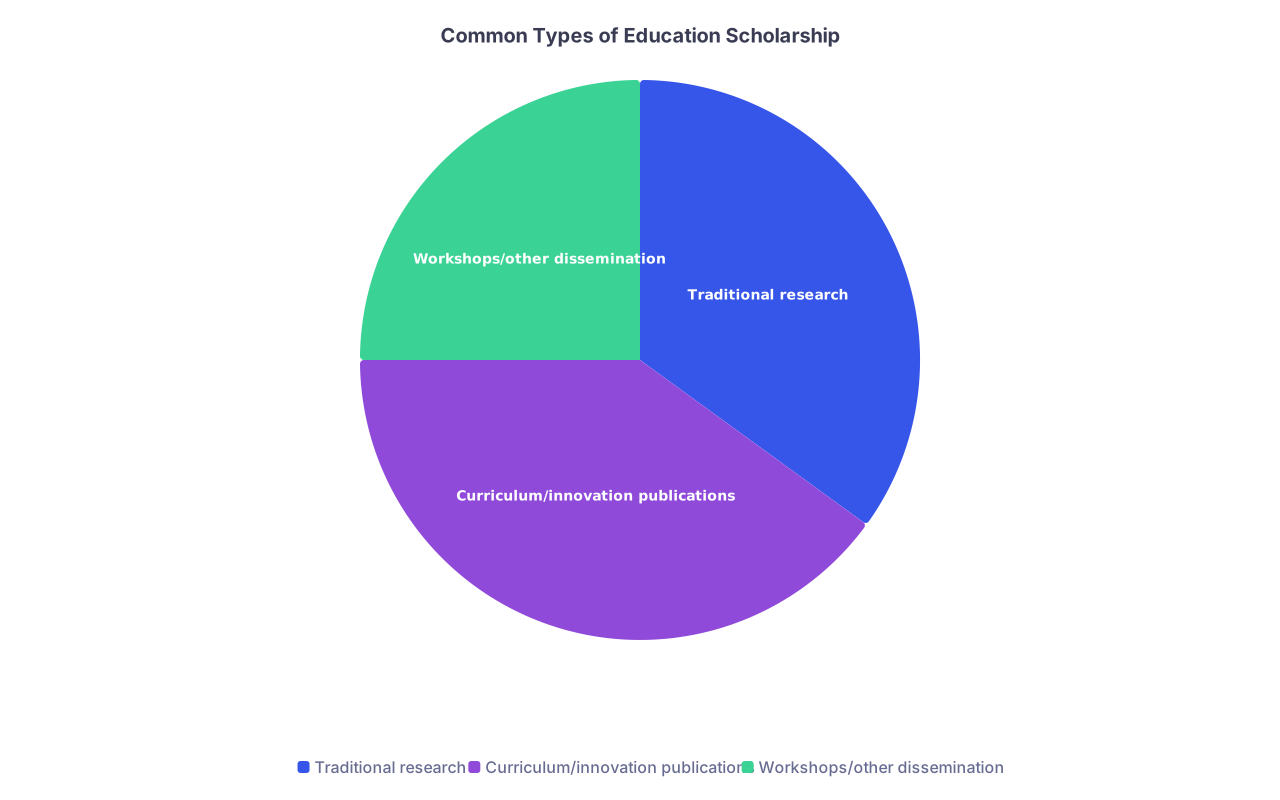
| Category | Value |
|---|---|
| Traditional research | 35 |
| Curriculum/innovation publications | 40 |
| Workshops/other dissemination | 25 |
Bucket 1: Traditional education research
This is what people picture when they hear “education publications”:
- Study of a curriculum or teaching method with pre/post outcomes
- Survey research on learner attitudes or experiences
- Assessment instrument development and validation
- Qualitative work (focus groups, interviews) on training or learning
Pros:
- Strong, widely recognized as scholarship
- Travel well across institutions and specialties
Cons:
- Methodologically demanding
- Requires mentorship, IRB, more time
- Higher risk of projects dying before publication
Bucket 2: Scholarly products from your actual teaching work
These are often easier and more aligned with your daily life:
- Published curricula (MedEdPORTAL, FOAMed resources with peer review)
- Standardized simulation cases and assessment tools
- Implementation and outcomes reports for new rotations, bootcamps, or milestones
- Conceptual articles (“How we built a coaching program for interns,” “A practical model for feedback training”)
Pros:
- Directly tied to your real work
- Still clearly count as peer‑reviewed scholarship when done right
Cons:
- Often under-documented and never written up
- Some committees undervalue them if they don’t know the journal/platform
Bucket 3: Disseminated, evaluated teaching activities
Lower-weight scholarship, but still helpful:
- Invited or peer-reviewed workshops at national meetings
- Educational toolkits with evaluation data shared regionally
- Locally recognized innovations presented at institutional scholarship days
These often need documentation:
- Abstracts
- Handouts
- Evaluations
- Evidence of peer selection or review
One big mistake: doing outstanding work that never leaves your institution. From a promotions perspective, that’s like doing a great study and never submitting the manuscript.
4. How to decide what you actually need
Stop asking the internet and ask your institution. But do it intelligently.

| Step | Description |
|---|---|
| Step 1 | Identify institution type |
| Step 2 | Review promotion guidelines |
| Step 3 | Talk to 2-3 promoted educators |
| Step 4 | Light scholarship OK |
| Step 5 | Plan formal scholarship |
| Step 6 | Education research projects |
| Step 7 | Curriculum and innovation publications |
| Step 8 | Target rank/role? |
| Step 9 | Time/interest for research? |
Step-by-step:
Identify your institution reality
- University-based? Community-based? Formal medical school?
- Is there a clinician-educator track or education pathway?
Pull your official promotion criteria
- Look for words like “scholarship,” “peer-reviewed,” “regional/national reputation.”
- Highlight every place the document mentions:
- Education
- Teaching
- Scholarship
Ask 2–3 people who recently got promoted as educators
- “What actually mattered on your CV?”
- “What did the committee push back on?”
- “Did they ask about publications specifically?”
Clarify your next realistic step
- Are you trying to:
- Get off “Instructor” and onto “Assistant Professor”?
- Move to Associate in the next 3–5 years?
- Position yourself for APD/PD or vice chair for education?
- Are you trying to:
Match your portfolio to the expectations
- If your institution is flexible:
- Focus on high-quality teaching plus a few well-documented scholarly products.
- If your institution is rigid about publications:
- You need a deliberate plan for 2–5 peer‑reviewed education outputs over the next few years.
- If your institution is flexible:
5. Concrete strategies if you have few or no education publications
If your CV feels thin, you do not need a PhD in education to fix it. You need focus and documentation.

Here’s a pragmatic path:
Mine your existing work
- Look at:
- Rotations you’ve redesigned
- Bootcamps, simulation sessions, OSCEs you’ve created
- Feedback/remediation systems you’ve built
- Ask: “What here could become a MedEdPORTAL submission, a short paper, or an abstract?”
- Look at:
Start with one high-yield project
- Examples:
- “Our new intern orientation bootcamp and performance outcomes”
- “A simple feedback framework and its effect on resident eval quality”
- “Remote bedside teaching during call—what learners actually used”
- Pick something you already do, not a fantasy curriculum you do not have time to build.
- Examples:
Find a methodologically competent collaborator
- Local education research group
- Faculty in medical education office or GME office
- Someone who has published 3–5 education papers already
Aim your product appropriately
- Data-heavy? Consider journals like:
- Teaching and Learning in Medicine
- Medical Education, Academic Medicine (more competitive)
- Specialty-specific education journals (e.g., JGME, JGIM Education, EM education journals)
- Curriculum-focused? Consider MedEdPORTAL or specialty portals.
- Data-heavy? Consider journals like:
Document everything
- Save:
- Syllabi
- Assessment tools
- Learner eval summaries
- Slide decks
- These documents help you write, and they also count as evidence of impact in your promotion file.
- Save:
Create a 2–3 year “minimal viable scholarship” plan
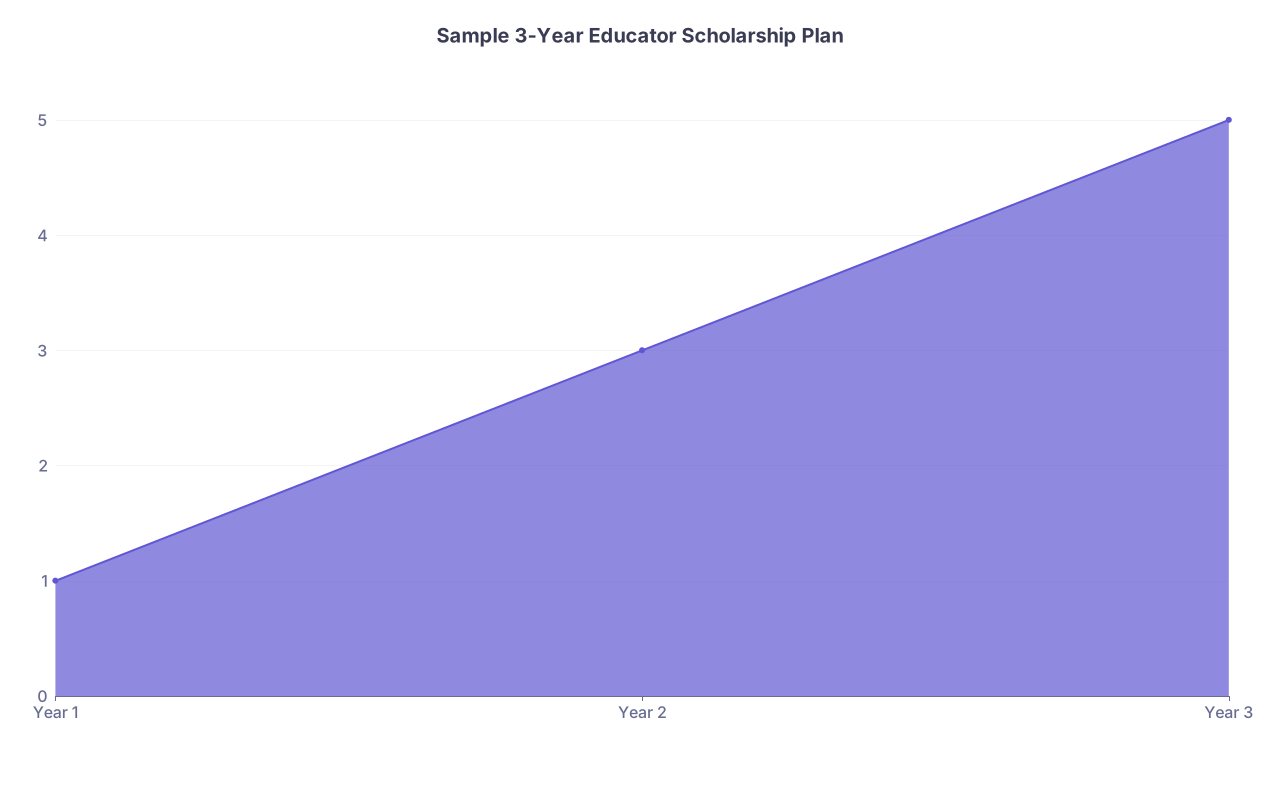
| Category | Value |
|---|---|
| Year 1 | 1 |
| Year 2 | 3 |
| Year 3 | 5 |
Example goal set:
- Year 1:
- 1 MedEdPORTAL or similar curriculum publication
- 1 regional or national meeting workshop or abstract
- Year 2:
- 1 education research paper (small but solid)
- 1 more abstract or workshop
- Year 3:
- 1 additional paper or high-quality curricular publication
- Begin a multi-institution collaboration if possible
That’s enough, at many places, to support promotion to Associate for a strong educator.
6. Common myths you can ignore
Let me be blunt about a few things you might hear in hallways.
Myth 1: “If you don’t have RCT-level education research, it doesn’t count.”
Reality: Completely wrong. Well-done descriptive studies, qualitative work, evaluation reports, and curriculum publications are all legitimate scholarship.
Myth 2: “Teaching excellence alone is enough for advancement.”
Reality: At some community or teaching-heavy institutions, maybe. At most academic centers: no. You need documentation and some kind of dissemination.
Myth 3: “Posters don’t matter.”
Reality: One or two posters alone won’t make your career, but they matter as part of a trajectory, especially when they turn into manuscripts or curricular publications.
Myth 4: “You’re either a researcher or an educator—you can’t do both.”
Reality: Quite a few clinician-educators publish 1–3 education papers a year while leading programs. They do it by aligning scholarship with their real work rather than inventing projects from scratch.
Myth 5: “A master’s in education automatically solves this.”
Reality: An MEd or MHPE can help you design and complete better projects, but the letters alone don’t replace actual scholarly outputs.
7. If you truly hate research—what then?
You can still advance, but you must play the game strategically.

Focus on:
- Curriculum innovation you can publish as a resource, not as a complex study
- Becoming locally and regionally known for a niche (e.g., remediation, coaching, entrustment, clinical reasoning)
- High-quality workshops and invited talks with materials that can be archived or shared in a scholarly format
- Collaborative writing: join a multi-author position paper, review, or best-practices manuscript led by someone who likes the methodology side
You can build a very respectable educator dossier with:
- 2–4 curriculum publications
- 2–4 invited or peer-reviewed workshops
- Consistently excellent teaching evaluations
- Tangible leadership roles in education
No randomized trials required.
FAQ (exactly 7 questions)
1. Are education research publications strictly required to get promoted as a medical educator?
Usually not strictly, but some form of education scholarship almost always is. At research-intensive academic centers, this often means at least a few peer-reviewed papers. At community and teaching-focused institutions, well-documented curricula, MedEdPORTAL publications, and workshops can often meet the scholarship requirement without traditional research articles.
2. Will strong teaching evaluations alone be enough for advancement?
Rarely beyond the earliest levels. Great teaching evaluations are essential, but for promotion to Associate or Full Professor, committees look for impact beyond your own classroom—that’s where scholarship, leadership roles, and dissemination of your work become necessary.
3. What counts as “education scholarship” besides classic research papers?
Examples include peer-reviewed curriculum publications, simulation cases, assessment tools, conceptual or “how we did it” articles, MedEdPORTAL resources, and peer-reviewed workshops with documented materials and evaluations. Many institutions accept these as legitimate scholarship when they’re disseminated beyond your home program.
4. How many education publications do I need for promotion to Associate Professor?
There’s no universal number. At many academic centers, a coherent set of 3–6 substantive education outputs (mix of papers, MedEdPORTAL resources, and national workshops) is often sufficient when combined with strong teaching and educational leadership. At less research-intensive places, even fewer may be enough, if they’re high-quality and well-aligned with your educator role.
5. Do posters and abstracts at conferences really matter for promotion?
They matter as part of a trajectory, especially when they demonstrate that your work has been peer-reviewed and disseminated. A few posters and abstracts by themselves won’t carry a promotion, but they’re valuable stepping stones and can be listed under scholarship in your CV and promotion packet.
6. I have several curricula and teaching innovations but no publications. What should I do first?
Pick your most impactful or mature innovation—say, a bootcamp, rotation redesign, or simulation series—and turn it into a publishable product. Often this means submitting to MedEdPORTAL or writing a focused manuscript describing the curriculum, implementation, and outcomes. It’s far easier to publish something you already do well than to start an entirely new project.
7. What’s one practical way to know what MY institution really expects for promotion?
Talk to two or three colleagues who were recently promoted on an educator track and bluntly ask: “What did they actually care about in your dossier?” Then compare their experience with the written promotion guidelines. Your answer is in the overlap between the policy on paper and what actually got people promoted in the last 3–5 years.
Open your CV today and circle every item that truly counts as disseminated education work—papers, curricula, workshops, or abstracts. If you cannot find at least one or two, pick a single existing teaching innovation and commit to turning it into a publishable product in the next six months.